A few attractions in the greater Taos area should be visited at least once, and here are the ones we experienced during our April journey.
For a breathtaking view of the Rio Grande Gorge, driving 12 miles northwest from Taos to the famous Rio Grande Gorge Bridge is well worth one’s time. Built between July 1963 and September 1965, this steel bridge hovers 650 feet above the river that takes its origins in Colorado’s Rocky Mountains and travels 1,896 miles (3,051 km) before emptying into the Gulf of Mexico. Crossing the bridge on foot comes with a free offering of vertigo while glancing at the chasm below from a walkway that spans its entire 1,280 feet (390 m). Whenever cars drive across the bridge that is part of US Highway 64, vibrations add a slight quiver to the package. Although it’s cool to gaze down at the stream and steep canyon walls from a standing position, my advice is to not do so while walking, unless you have undergone pilot or astronaut training and are immune to motion sickness.
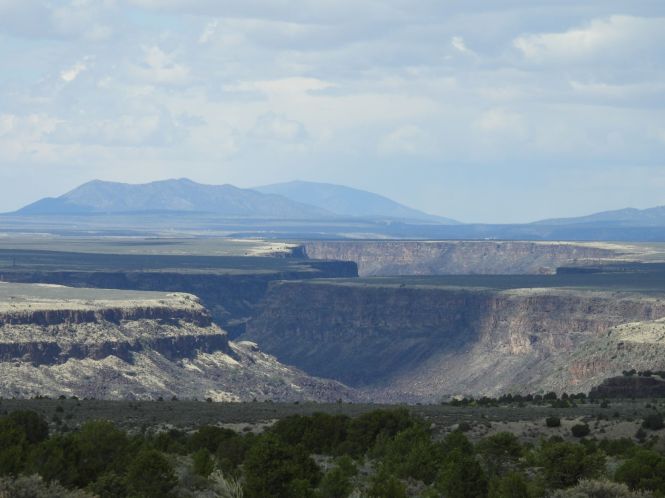
View of the Rio Grande Gorge and the Taos Mountains when approaching Taos from the south along NM Highway 570
To enlarge a photo, click on it. To read its caption, hover cursor over it.


Depending on what route you choose, after a trip of either 28 or 41 miles, you will reach one of New Mexico’s premier hot springs, Ojo Caliente Mineral Resort and Spa (not to be confused with Ojo Santa Fe). If I ever knew that spa stands for the Latin Phrase salus/sanitas per aquam, which means “health through water,” I had forgotten it, but it was good to get a literal and figurative reminder. It’s easy to spend hours, if not days, by soaking in one of a number of hot pools, taking a mud bath and baking in the sun, sitting in the sauna or steam room, getting a massage, taking a yoga class, dining at the local restaurant, or making use of an array of accommodations that range from a camp site or simple cabin to a hotel room or luxurious suite with private fireplace, depending on how deep you want to reach into your pocket. Relaxing in the salubrious, mineral-rich waters of this beautiful place made turning a year older slightly less painful.
Addendum: As fellow blogger Steve Schwartzman points out in the comment section below, attributing the meaning salus/sanitas per aquam to the word spa might have been a marketing ploy by spa owners after the fact. But even so, it’s a brilliant reappropriation of a term I wish I had thought of.


We also used part of one day to revisit Orillo Verde Recreation Area. Located about 25 miles south of Taos within the Rio Grande Del Norte National Monument and along the Rio Grande Wild and Scenic River, it offers short hiking trails and a number of campgrounds, one of which was familiar to us from a previous camping trip. As we had accommodations in Taos this time, we did not get to sleep in a tent, though it would have been perfect spring camping weather. We hope to return there one day to explore more of this lovely stretch of the Rio Grande.


As we made our way back from Orillo Verde, we stopped in Ranchos de Taos, a small town 4 miles south of Taos whose central plaza is home to San Francisco de Asis Church, a National Historic Landmark. Built between 1813 and 1815, it is an outstanding example of adobe mission architecture, continues to be part of the local community, and is an active place of worship. Our visit occurred during the week after Easter Sunday, and the church was still lovingly decorated for that major holy day.


We had only 3 full days in Taos and could easily have filled several more. Reason enough to return there ere long.
 tanja britton
Well, if ever I am in or near Taos, now I know where to go. So beautiful. Thanks for the interesting blog, Tanja
LikeLiked by 1 person
Thank you, Karin. I think you would your visit, including of the area’s many art museums, which, alas, we didn’t have time to explore.
LikeLike
A breathtaking landscape, Tanja.
LikeLiked by 1 person
Thank you, Michael. We think so, too.
LikeLiked by 1 person
This little chrurch is very charming, as for the bridge – maybe I would have crossed it by foot!
LikeLiked by 1 person
Thank you, Christa. I thought the church might be of special interest to you and I have no doubt that you would have crossed the bridge. It’s an experience not to be missed.
LikeLiked by 1 person
Happy retroactive turning-of-your-year day. Northern New Mexico is a fine place to have spent it, able as you were to gorge on sights like the gorge of the Rio Grande. Did you go also round to the back of the Ranchos de Taos church, where “serious” photographers have long taken pictures?
In the history of language, acronyms are a rather modern way to create words. Given that historical reality, any claim that a centuries-old word originated as an acronym is almost certainly false. Such is the case with spa (https://en.wiktionary.org/wiki/spa#Etymology_1). Spa owners may find promotional value in proclaiming the Latin phrase salus/sanitas per aquam, but it’s—to use another Latin phrase—a post hoc rationale.
LikeLiked by 1 person
Since I’m not a “serious” photographer, I neither knew about nor explored the back of the church, was perfectly happy with what I saw and photographed.
Your comments about acronyms made me curious, so I found the following, also on Wikipedia:
“Acronyms were used in Rome before the Christian era. For example, the official name for the Roman Empire, and the Republic before it, was abbreviated as SPQR (Senatus Populusque Romanus). Inscriptions dating from antiquity, both on stone and on coins, use many abbreviations and acronyms to save space and work.”
If you have ever been in Rome, you will have come across SPQR.
It would be an interesting research question to explore the possibility that the Belgian town of Spa was so called because people (fluent in Latin), associated their water with health, But whether “salus per aquam” was a post hoc rationale or not, it was/is a brilliant marketing slogan.
LikeLike
Yes, it’s true that the ancient Romans abbreviated words and phrases in writing to save space, just as we do when we put “St.” for “Street” on a road sign or “oz.” for “ounce” in a recipe. We don’t, however, turn those abbreviations into new words. We don’t, for instance, say we need 6 oz of water (with oz pronounced like the wizard), except maybe humorously. As far as I know, the Romans didn’t turn abbreviations into new, free-standing words, either.
One technicality: abbreviations like ICBM, CNN, ATM, GPS, EU, and FBI, which we pronounce by saying the names of the letters, are called initialisms. If an abbreviation happens to be pronounceable as a word in a language, like NATO and RADAR are in English, then we call them acronyms. I’ll grant you that many people don’t know the term initialism and use acronym for both types.
You’ve gotta hand it to clever marketers for coming up with effective slogans. What’s a little post hoc rationale among marketers, right?
Here’s one of Ansel Adams’s photographs of the Ranchos de Taos church from the rear:
https://www.artsy.net/artwork/ansel-adams-st-francis-church-rancho-de-taos-new-mexico
LikeLike
Clever marketers indeed.
I wish I had been in Taos during the days of Ansel Adams (and Georgia O’Keeffe, and Mabel Dodge Luhan, who will be at the center of a future post, if I ever get around to writing it).
LikeLike
I have the book From Greenwich Village to Taos: Primitivism and Place at Mabel Dodge Luhan’s, by Flannery Burke, which I read the first few pages of the other day. I hope you get around to doing your post about Luhan.
LikeLiked by 1 person
Your book sounds interesting. I am reading a biography about Mabel right now, but it’s slow-going. My problem will be to limit what I want to say about her to a readable amount.
LikeLike
That bridge: Wowsah! After reading what you wrote, I don’t think I would want to walk across it, but the bridge is spectacular. The spa sounds utterly delightful, and I like how there are different accommodations for different budgets. Thanks for taking us along on this beautiful trip.
LikeLiked by 1 person
I think you would be perfectly fine, Laurie, especially if you don’t look down while you walk across the bridge. And Ojo is always a memorable experience. Just thinking about it makes me want to go. 😊
LikeLike
Taos habe ich in absoluter TOP Erinnerung. Ich stand an der Rio Grande Gorge und habe das gute Essen im Ort genossen. Erinnerungen kommen – danke für den Bericht. Ich denke, Du hattest eine tolle Zeit und zeigst schöne Bilder
LG
MAren
LikeLiked by 1 person
Wie schön, daß meine Worte und Bilder deine Erinnerungen aufleben ließen. Das gute Essen habe ich nicht erwähnt, aber wir haben auch einige Male die neumexikanischen Speisen genossen.
Lieben Gruß zurück,
Tanja
LikeLiked by 1 person
TexMex gab es in Texas. War so lecker.
LG MAren
LikeLiked by 1 person
Morning, Tanja. I saw that gorge five years ago, when visiting relatives in NM. It’s staggering, to say the least.
LikeLiked by 1 person
Hi Neil,
I’m glad my post brought back some memories for you. I hope we will all be able to visit NM again one of these days.
LikeLiked by 1 person
Such a beautiful place, Tanja. Those Mesas are stunning as is the architecture.
LikeLiked by 1 person
Thank you, Kerry. I agree with you. And fortunately for the area, no one has yet erected some god-awful structure in an attempt to outdo the natural splendor. The bridge might be construed as such an effort, but I think it blends in very well and helps highlight rather than detract from the Rio Grande Gorge.
LikeLiked by 1 person
Nice photos. The Royal Gorge Bridge, not far from you, can induce similar vertigo if you look between the bridge boards at the river 1000 feet below.
LikeLiked by 1 person
Thank you, Brad.
I once drove across the Royal Gorge Bridge and the clacking of the wooden boards and chasm below left me feeling slightly queasy. 😊
LikeLiked by 1 person
We were near the middle of that bridge when some rowdy tourists decided to see if they could get it swaying side to side. It had just started to move appreciably when a ranger tried to stop them. They ran away to jump into their car and drove away. The bridge settled fairly quickly in the strong winds.
LikeLiked by 1 person
That sounds like a vertigo-inducing incident!
LikeLiked by 1 person
Just focus on the horizon. And just like they say in the movies, “Don’t look down!”
LikeLiked by 1 person
👍
LikeLiked by 1 person
Great post! I’ve driven through that area and well remember the bridge. That kind of height always scares me just a bit. Or, a lot. 🙂 It looks like you had a lovely trip to a beautiful area.
LikeLiked by 1 person
Thank you, Tina. Our visits of the greater Taos area are always memorable, including to the river gorge. I’m not afraid of heights, but I usually have a visceral reaction to them.
LikeLike
Every time I see an image of the Rio Grande gorge, I can’t help but be awed by the spectacular landscape. How lucky you are to see it in real life.
I don’t like the sound of the bridge though. I don’t have a head for heights and would surely be dizzy from the faintest of movement (of that bridge).
(The funny part about this is that before I rehomed my book and DVD collection I must have had a hundred books and DVDs on mountaineering and exploration in the far north and south of the planet. Give me a book on climbing Everest and I would be lost in the pages and photos for hours).
LikeLiked by 1 person
Thank you, Vicki. We do feel lucky about living a day’s drive from Taos and having visited the town and surroundings a few times.
I might have made the bridge experience sound worse than it is, but if one is sensitive to heights and motion, it might not be a pleasant one. While one can hike to and enjoy the views from the rim of the gorge, it doesn’t offer quite the same view of the river from above.
Many of us enjoy being armchair travelers to places we would never be able to visit in person, so it’s perfectly understandable that you got lost in your books and DVDs.
LikeLiked by 1 person
I really enjoyed this series of gorgeous photographs!
New Mexico has so much to offer and we have so little time to explore it all.
Hope your day is a good one.
LikeLiked by 1 person
Thank you, Wally. What you say about N.M. is true about our lives in general: So much to see and do, so little time.
Wishing you and Gini a good end of the week.
LikeLike
Thanks for the tour Tanja, we will be putting these places to visit the next time we are in the area. Is that gorge similar and or the same as what they call the Royal Gorge? We went there when I was a kid and parents took me on a train/tram that took you across it and let me tell you – scared the living crap out of me. They had to forcefully extract me from the foot area of that tramcar when it was over. Ever since that day I’ve been terrified of heights. If this is different, no way I am even going close to that walk ha. Appreciate you taking us along with us on your trip.
LikeLiked by 1 person
The Rio Grande Gorge in New Mexico is not the same as the Royal Gorge in Colorado, which surrounds the Arkansas River. If you scroll up a bit, you will see Brad’s comment about one of his visits to the Royal Gorge.
Sorry to hear about your acrophobia–you are not alone. The good news is that you can take a walk to the edge of the Rio Grande Gorge and glance down at it without having to walk across the bridge, which will also provide an impressive overview of the area.
LikeLike
Ah, thanks for clearing up my confusion!
LikeLiked by 1 person
What an amazing trip! But I would be less than keen to walk across the bridge…I find a small footbridge I sometimes walk across to be as close as I wish to come to motion-sickness. (And I really don’t fancy the free offering of vertigo!)
LikeLiked by 1 person
Thank you, Ann, we are always excited when we get to visit Taos and surroundings. It would be interesting to find our how many visitors to the bridge won’t cross it because of some issues with motion sickness or fear of heights, but I doubt anybody has studied it. Maybe the next time we go, I will do a random sampling of 100 people to try to find out. 😊
LikeLiked by 1 person
Thank you, Tanja, for taking us on a tour of this spectacular landscape. That bridge thoroughly deserves Laurie’s Wowsah! I’m in awe of people who build structures like this…two years of vertigo is two years too much!
LikeLiked by 1 person
Speaking of vertigo: How about those men who built New York’s skyscrapers? Just looking at photos of them balancing across steel beams high up in the sky gives me butterflies in the stomach.
LikeLiked by 1 person
I’m not sure if those guys have no fear, or simply no imagination! And what happens when there’s a sudden gust of wind (not an unusual phenomenon at that height)? Definitely not a career choice I could ever have made.
LikeLiked by 1 person
Nor I.
LikeLiked by 1 person
Wonderful visit, beautiful photos! I adore the church AND knowing it is still being used by the community. 🙂
LikeLiked by 1 person
Thank you, Donna. We had a great visit and can’t wait to go back. 🙂
LikeLiked by 1 person
Long before I had a digital camera, I did wander to the back of the Ranchos de Taos church, and the photo I took there is in my kitchen to this day. When you go back, I think you’d enjoy seeing it.
I’ve meant to tell you about a novel written by a friend of mine, Jack Matthews. He was a professor of history for years here in Texas. Now he’s retired, and divides his time between Texas and Taos. His book has been well received by the Taos community; you can read a bit about it here. I tend not to read novels, but I read Jack’s, and enjoyed it very much. His immersion into the life of the native communities, and his respect for them, make it an especially interesting read.
LikeLiked by 1 person
I’m sure I would. It simply didn’t cross our mind when we were there.
Thank you for the link to your friend’s novel. It sounds intriguing and reminds me of Tony and Anne Hillerman’s novels about the Navajo.
LikeLiked by 1 person
I really enjoyed your three interesting posts on your visit to New Mexico and learning something about its history, architecture and landscapes.
LikeLiked by 1 person
Thank you, Carol, I’m glad
LikeLiked by 1 person
Beautiful photographs and an interesting blog post.. Thank you for sharing.. 🙂
What piqued my attention is the presence of hot springs or onsens in New Mexico, which otherwise didn’t occur to me as a state with volcanoes.. Upon close inspection I realised that the state contains active plates being spread apart by Plate Tectonic forces, hence the presence of volcanic features..
Interesting place.. would like to visit New Mexico too in US.. Thank you once again.. 🙂
LikeLiked by 1 person
Thank you for your interest. I hope you will get to visit New Mexico one of these days, including the hot springs. We highly recommend them. 😊
LikeLiked by 1 person
[…] foot in 10 minutes (see here for my previous post about Taos), and the town’s vicinity (following this link to my post about Taos […]
LikeLike