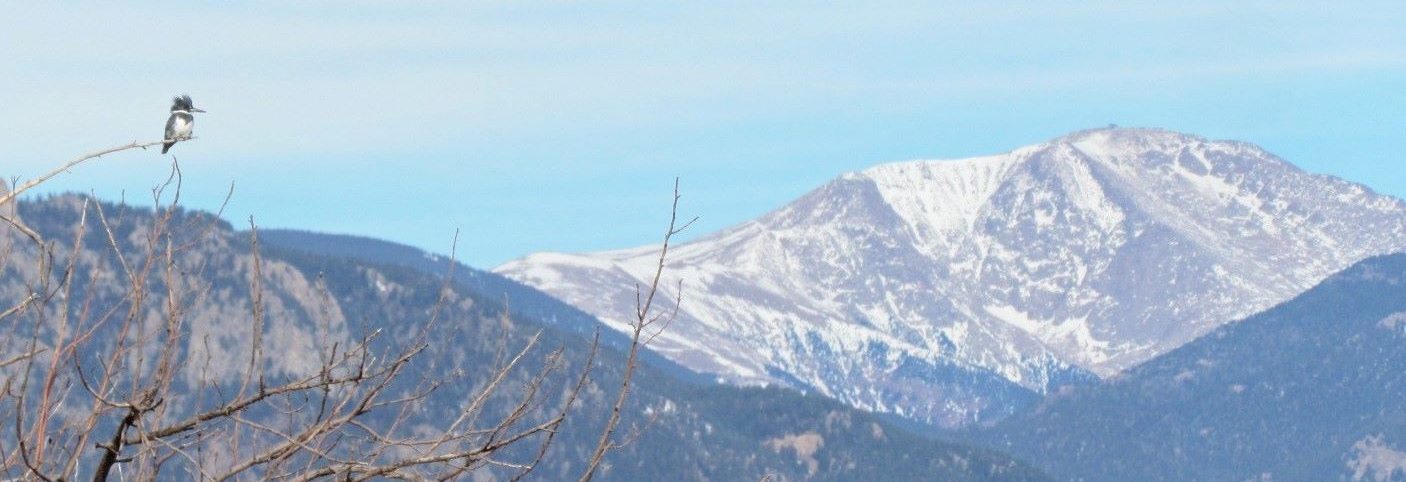

In my last post, If These Walls Could Talk, you might have noticed D.H. Lawrence’s name on the list of luminaries with links to Mabel Dodge Luhan in New Mexico. During the first trip to our neighboring state to the south in the autumn 2009, we happened across a sign alerting us to the presence of the D.H. Lawrence Ranch about 20 miles north of Taos along New Mexico Highway 522. Having never heard of it before, we followed the marker and turned onto a gravel road, which took us to said destination in a little under five miles.
David Herbert Lawrence (1885-1930) was an English writer who penned poems, short stories, novels, essays, and other works of non-fiction. He grew up in Nottinghamshire, the fourth child of a practically illiterate coal miner and a well-educated mother. He won a scholarship to Nottingham High School, but had to quit at 16 in order to earn a living. While working as a clerk in a factory, he developed a bout of pneumonia which might have been the first sign of the tuberculosis that would kill him less than three decades later. He showed literary talent early in life and had some of his writing published in literary magazines before starting to write novels, using many of his personal experiences and encounters to craft his narratives. According to Wikipedia:
His modernist works reflect on modernity, social alienation and industrialization, while championing sexuality, vitality and instinct. Several of his novels, Sons and Lovers, The Rainbow, Women in Love, and Lady Chatterley’s Lover, were the subject of censorship trials for their radical portrayals of sexuality and use of explicit language.
Not only was his writing controversial, so was his personal life. In 1912, he met Frieda Weekley (1879-1956) in Nottingham, a writer herself and married at the time to Ernest Weekley, a philologist and professor of modern languages, and D.H.’s former teacher. Frieda was a Baroness, neé von Richthofen, a noble family from Metz, which was under German control at the time. In case you wonder, as I did, if she was related to the WWI fighter pilot, Manfred von Richthofen, aka The Red Baron, Wikipedia states:
Though their last common ancestor was born in 1661, the Red Baron’s fame nonetheless attached to Frieda’s reputation in war time England.
Frieda and D.H. fell in love and eloped, with Frieda leaving her three children behind with their father. After her divorce in 1914, she lost all maternal rights, a circumstance which was a never-ending source of profound pain for her. Once her divorce was final, Frieda and D.H. married and would stay together through thick and thin until Lawrence’s death, their sometimes troubled and tumultuous relationship notwithstanding. Not only was she her husband’s muse and sounding board, she also edited his writing. From what I read about her online, Frieda was a fascinating woman in her own right and has engendered novels and biographies, which might warrant future exploration.
The pair was living a nomadic lifestyle on account of their financial straits (it seems Frieda’s title did not carry any money), the aforementioned censorship, animosity between Great Britain and Germany, D.H.’s recurring illnesses, as well as a serious case of wanderlust.
In 1922, the couple traveled to Taos at the invitation of arts patron Mabel Dodge Luhan, who had read and liked D.H. Lawrence’s Sea and Sardinia. The Lawrences were so enamored with New Mexico that they returned in 1924. They were accompanied by Lady Dorothy Brett (1883-1977), a painter and the Earl of Esher’s daughter, who was the only one who had responded to D.H.’s scheme to create a utopian society in New Mexico which he intended to call “Rananim.” During this visit, Mabel wanted to gift a 160 acre former homestead, then known as Kiowa Ranch, to the Lawrences. They were troubled by accepting so generous a gift, though Frieda eventually did, giving Mabel the manuscript of Sons and Lovers in return as a type of payment (the novel having been published in 1913). This manuscript had its own interesting afterlife, which you can read about here.
Kiowa Ranch was home to two cabins, and the Lawrences stayed in the larger one called Homesteader’s Cabin; Dorothy Brett occupied the smaller. She painted local landscapes and would eventually make her permanent home in Taos, choosing to become an American citizen. The Lawrences’ five-month sojourn in 1924 was followed by a six-month stint in the following year. D.H., like so many artists before and after him, was inspired by New Mexico and wrote copiously during their time at their retreat, which amounted to 11 months. In his own words:
I think New Mexico was the greatest experience I ever had from the outside world. It certainly changed me forever.
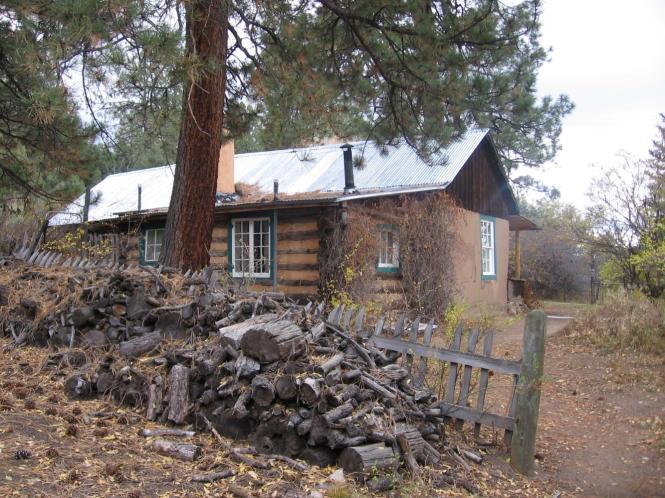
Homesteader’s Cabin, seen from the back
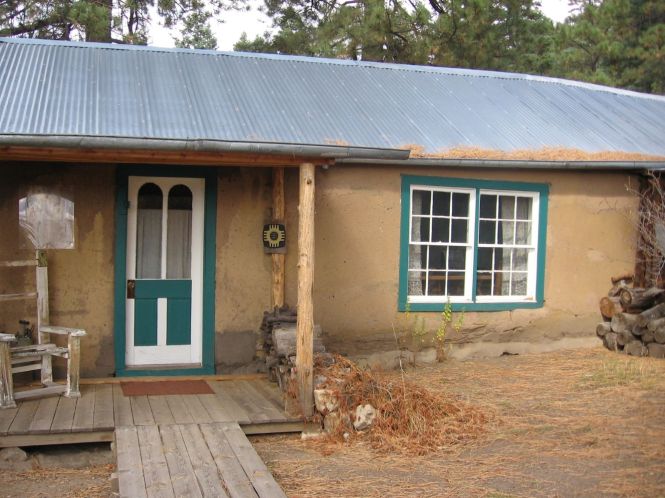
Homesteader’s Cabin, seen from the front
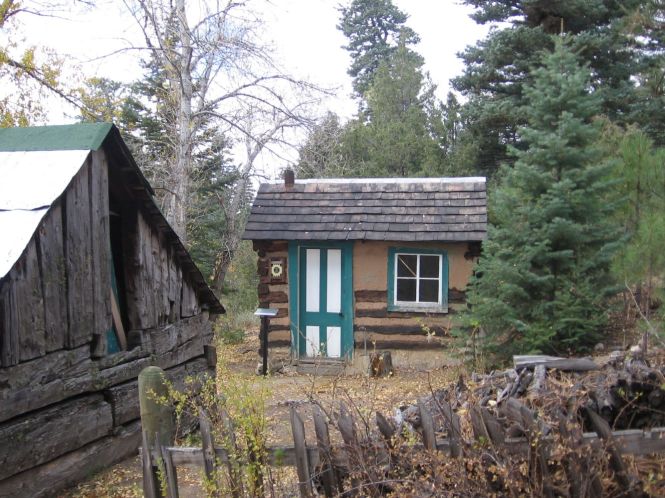
The Dorothy Brett Cabin
More years of peregrinations followed, but were overshadowed by D.H.’s worsening health. After an English physician advised him to seek mountain air to treat his tuberculosis, the Lawrences traveled to a sanatorium in Vence, France, a hilly town near the Riviera in Provence. Alas, his illness was too advanced and D.H. died four weeks into their stay at the age of 44. He was buried in Vence and Frieda returned to New Mexico to live on her ranch. In 1935, she had D.H.’s body exhumed and cremated, intending to bring his ashes to New Mexico. What happened next is a matter of debate. Frieda’s lover and future husband, Angelino Ravagli, with whom she had started an affair while still married (both she and D.H. had multiple extramarital liaisons) was supposed to carry the cremains to New Mexico for burial. Some ashes arrived there and were entombed in a shrine, but several online sources claim that Ravagli dumped the writer’s cremains into the Mediterranean and offered Frieda a substitute. Fact or fiction? I don’t know.
With or without his ashes, a memorial chapel was erected on the ranch with a shrine to D.H. Lawrence, and has become a destination for Lawrence aficionados.
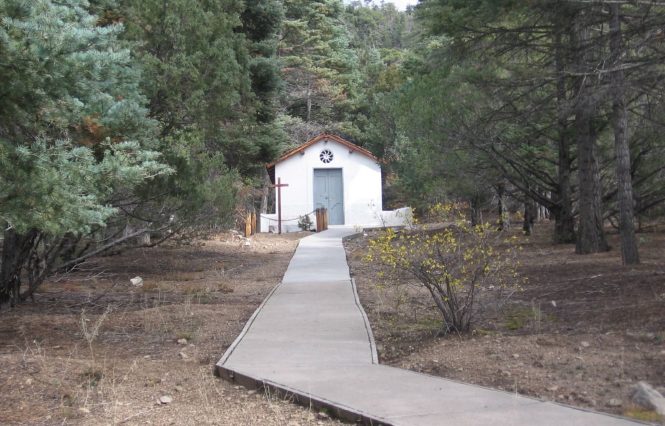
Memorial Chapel
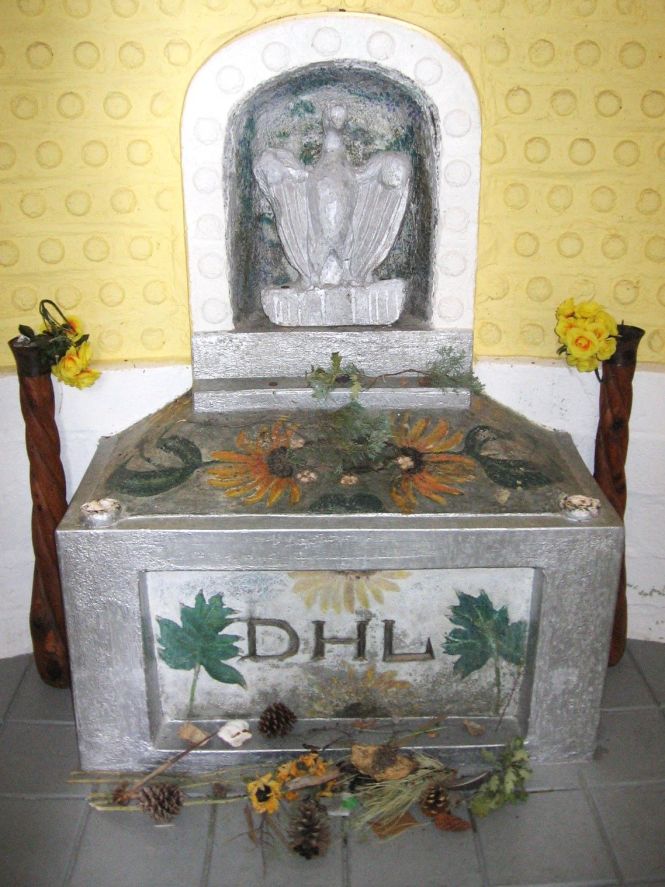
Shrine to David Herbert Lawrence inside the chapel. He identified with the phoenix and also wrote a poem titled Phoenix.
Another star who circled Mabel’s orbit and whose art became synonymous with New Mexico was Georgia O’Keeffe. In 1929, she visited the Kiowa Ranch and Dorothy Brett, who was staying in the Lawrences’ cabin. O’Keeffe spent time stretching out on a carpenter’s bench under a the tall ponderosa pine tree in front of the cabin, where D.H. had done much of his writing. She immortalized a nighttime view with an oil-on-canvas painting titled The Lawrence Tree, a picture of which is displayed under the tree. (To read my previous post about Georgia O’Keeffe, click here.)
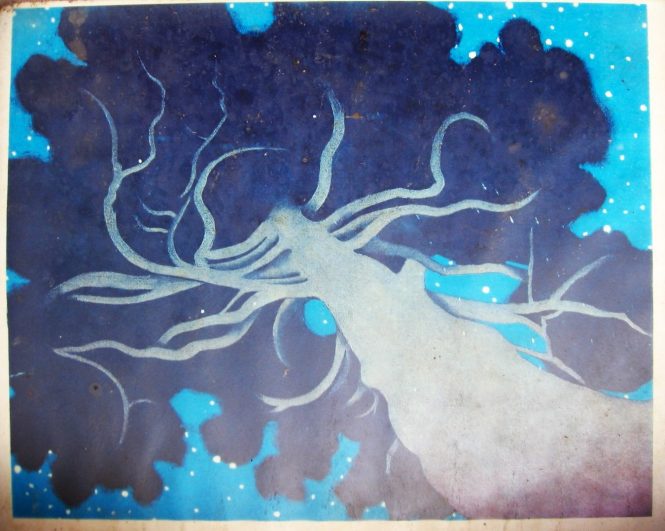
“The Lawrence Tree” by Georgia O’Keeffe
The big pine tree in front of the house, standing still and unconcerned and alive…the overshadowing tree whose green top one never looks at… One goes out of the door and the tree-trunk is there, like a guardian angel. The tree-trunk, the long work table and the fence!—D.H. Lawrence
Frieda died at the ranch in 1956 and is buried in front of the chapel, where her grave is marked with a wooden cross. She deeded her property to the University of New Mexico, who renamed it D.H. Lawrence Ranch. This link will take you to a 14-minute video that describes the history and some of the challenges facing this special site.
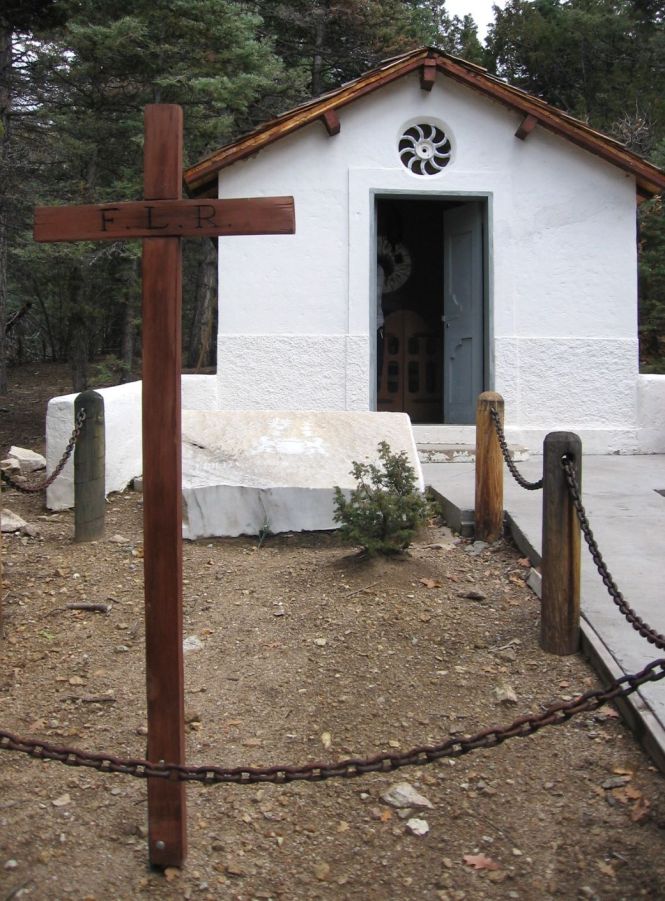
Frieda’s burial place in front of the chapel
 tanja britton
Interesting. Thanks for sharing.
LikeLiked by 3 people
Thank you for stopping by and for commenting. I’m glad you found this interesting.
LikeLiked by 1 person
Fascinating how the area drew so many luminaries of the time, as I expect it still does today.
LikeLiked by 2 people
Thank you, Eliza. I never cease to be amazed by the rich history and people behind so many places.
LikeLiked by 1 person
That is quite a history. Lawrence accomplished quite a bit in his short life, but it is sad that he died so young. Great that he had such a beautiful place to stay.
I really like O’Keefe’s painting. I was unfamiliar with it.
LikeLiked by 2 people
Thank you, Laurie. I’m always amazed to learn about the accomplishments of so many who died young. It makes me feel like a complete slouch. 🙂
I also think O’Keefe’s “The Lawrence Tree” is beautiful. If you ever find yourself near Hartford, Connecticut, you could see the original in the Wadsworth Atheneum:
https://www.thewadsworth.org/
LikeLike
Speaking of DHL: Years ago I read his Sea And Sardinia, and liked it a lot. I re-read Lady Chatterley’s Lover about 15 years ago, and didn’t like it at all. It’s one of the so-called classics, but it seemed overwritten and uninteresting to me. Anyway, have a good day!
LikeLiked by 3 people
Lady Chatterley is famous (notorious?) for its subject matter, unsurprisingly given the prevailing social attitudes when it was written, but I agree that the writing isn’t worth the hype that has attached itself to the book. Lawrence is/was better than Lady Chatterley suggests. For what it’s worth, I’ve always been captivated by his poem “Snake”, but then I’m a bit of an oddball who believes that – ever since Adam and Eve’s days – serpents have always had a rough deal at the hands of mankind!
LikeLiked by 2 people
I’d guess that Sea And Sardinia has held up a lot better than Chatterley.
LikeLiked by 2 people
Thank you for mentioning the poem “Snake.” I read and was touched by it. And I’m glad he missed!
LikeLiked by 1 person
I have never read either, so I can’t really give my opinion. But I have often noticed that writing styles and preferences change so much in the course of just a generation or two, that we have trouble relating. It also depends on the age when we first read a book. I remember how underwhelmed I was when I finally read “The Catcher in the Rye,” wondering what the big deal was.
LikeLiked by 2 people
Interesting. Although I’ve read Lawrence I knew nothing of his New Mexico connections We live on the edge of the Nottinghamshire/Derbyshire coalfield, which was Lawrence’s home patch. The contrast between our local landscape – particularly as it must have looked 100 years ago, scarred by the coal mining industry – and New Mexico, is stark. He must surely have felt like a stranger in a strange land when he first arrived, but he seems to have fallen in love with his life on the other side of the Pond. Who could blame him for that?
LikeLiked by 2 people
Yes, I imagine that Nottinghamshire and New Mexico are quite different. Loving the, at times, otherworldliness of our neighboring state, I have no trouble to see why he and so many other individuals have been charmed by what they saw and experienced. There is a reason New Mexico is known as “Land of Enchantment,” as a fellow blogger reminded me in her comment below.
LikeLiked by 1 person
Despite knowing a good bit about the interwoven histories of these artists, I somehow never had seen the buildings on the Lawrence property; thanks for including those.
This isn’t at all important, but it’s interesting. I remember many accounts of the creation of The Lawrence Tree including the detail that O’Keeffe lay on a picnic table while pondering the tree. You described it as a carpenter’s bench, and Lawrence himself referred to a work table. Resolving the different descriptions isn’t necessary, but I did smile, remembering some favorite lines from William Faulkner’s The Town: ““But then, poets are almost always wrong about facts. That’s because they are not really interested in facts: only in truth: which is why the truth they speak is so true that even those who hate poets by simple natural instinct are exalted and terrified by it.”
LikeLiked by 2 people
I find it so exciting to stumble over something new that turns out to be a missing puzzle piece, which is what often happens when one travels.
I used the term “carpenter bench” because it’s how it was described on a plaque at the D.H. Lawrence Ranch, but your observation is so correct. Ask ten different people to describe an object and you are likely to get ten different descriptions.
LikeLiked by 2 people
Ahhhh, now this looks familiar. We did stop here when we were in Taos, but for some reason I didn’t make the connection to the name when I read your previous post.
LikeLiked by 2 people
I’m glad this brought back some memories, Diana. It often happens to us that we don’t learn about a place, a person, or their connection until after we have returned to a trip, which makes us want to go back. So much to learn and see, so little time! 😦
LikeLiked by 1 person
Holy Taos, Tanja! I had to read this twice to “soak” it all in. And I thought my life had a lot of plot twists and curves. I’ve added this to my list to see. And am saving it as another writer and I have been talking about the interesting people of Taos. I find that many artists, writers, and creators have much adventures! Curiosity, genius, and a forever dreaming state of mind can make one throw “caution to the wind” in living a FULL life. Thank you for sharing. I love learning the history of these creative people. Although young when he died, D.H. Lived a very full life. To be gifted such a home speaks volumes to the connections all of these artists shared.
LikeLiked by 2 people
Thank you for your enthusiastic comment, Karla. I think the artists from previous times we still talk about and admire today had a deep conviction that they had something to share with the world, and they followed their dreams and lived full lives–and long ones, if they were fortunate.
It’s completely fascinating to imagine so many artistic individuals coming together in Taos and benefiting from one another
LikeLiked by 1 person
You’re welcome, Tanja. I love your response–“deep conviction to share with others…” To benefit from one another! Brilliant and bold! I wish we could all be this way!
LikeLiked by 1 person
I share your wish. 😊
LikeLiked by 1 person
💛
LikeLiked by 1 person
In context, DHL obviously stands for David Herbert Lawrence, who was already commonly known as D.H. In today’s world, DHL is probably better known as the initialism of an international delivery company; it stands for Dalsey, Hillblom and Lynn, who were the company’s founders.
It’s a shame D.H. Lawrence died so young. At 44, however, he was an old man compared to Mozart, who died at 35, and Schubert, who lived to be only 31.
My own limited connection to D.H. Lawrence is that when I visited Mexico City several times in the 1960s and ’70s I stayed at the rather run-down Hotel Monte Carlo, where D.H. Lawrence had stayed in the 1920s:
https://www.davidlida.com/blog/619
LikeLiked by 1 person
I’m not familiar with the present-day company behind the letters DHL.
But like you, I have often thought of and bemoaned the many talented lives cut short by disease or other disasters. Mozart is one obvious example; all three Brontë sisters are others.
Thank you for the link to the Monte Carlo Hotel. DHL and his wife got around quite a bit which, no doubt, influenced his writing.
LikeLike
One unusual feature of the Monte Carlo Hotel—at least in the era when I stayed there several times between about 56 and 42 years ago—was that guests who wanted to park their cars at the hotel would drive right through the lobby and pass within a few feet of the reception desk on their way to interior parking. That was quaint, but one annoying feature of the hotel was that it sometimes had mosquitos inside.
LikeLiked by 1 person
Interior parking sounds interesting, but I don’t think the exhaust fumes inside the building would contribute to the hotel’s ambiance. Nor would the mosquitos!
LikeLike
As I recall, not many people parked inside, so fumes weren’t really a problem. The mosquitos, unfortunately, were more frequent.
LikeLiked by 1 person
I didn’t know of D Lawrence’s connection to New Mexico and at first wondered why there would be a museum there. This was interesting. Maggie
LikeLiked by 2 people
Thank you, Maggie. As you know so well, it’s fun to make discoveries like this one during one’s travels. 🙂
LikeLiked by 1 person
Exactly!
LikeLiked by 1 person
Really fascinating article, Tanja. I had no idea of these connections and the history of this ranch.
I love O’Keefe, but didn’t know about ‘The Lawrence Tree’. What a beautiful piece.
LikeLiked by 2 people
Thank you, Tina. We were so excited to happen across this ranch and to learn of its history, especially once we became aware of Mabel Dodge Luhan and her multiple connections.
I also love “The Lawrence Tree.” As I told a fellow blogger above, if you ever want to see the original painting, you can find it at the Wadsworth Atheneum in Hartford, Connecticut:
https://www.thewadsworth.org/
LikeLike
Beautiful post on D.H .Lawrence! Loved to read it thank you .
LikeLiked by 2 people
I’m so glad you enjoyed the post. Thank you for stopping by and for commenting.
Best,
Tanja
LikeLiked by 1 person
Me too. ☺️🙏
LikeLiked by 1 person
Fascinating again!
The first place we lived when we got together was a wonderful top story of an ancient barn. The barn was in the grounds of Garsington Manor in Oxfordshire. Lawrence was a frequent visitor to the Manor as a guest of Lady Otoline Morrell . When war loomed she made the top of the barn a place where Lawrence could live and be considered an agricultural worker on her land and thus avoid conscription and probable death. Unfortunately he used Otollin as a model for a character in his novel and she was so offended that she withdrew the offer of the flat and he never lived there. He might never have seen New Mexico if he had made his character less easily identifiable as his old friend!
LikeLiked by 2 people
Thank you for sharing that fascinating story, Cathy. I think Lawrence offended other people in his life by making them obvious characters in his novels. There is a reason many authors get sued by individuals who think they find themselves the protagonists in what’s supposed to be fiction.
Your first home sound lovely, though!
LikeLiked by 1 person
That was a fascinating read! I read some of Lawrence’s novels at uni but didn’t know much about his connection to New Mexico.
LikeLiked by 2 people
Thank you, Ann. I have read a few of Lawrence’s poems, but none of his fiction. I hope to remedy that hole in my education.
LikeLiked by 1 person
Always so enlivening to catch up on your blog when I’ve been away for a while, Tanja! I knew nothing about the New Mexico connection of Lawrence, and especially enjoyed reading it as I find New Mexico to be “Land of Enchantment” just as the license plates say. Thank you for researching and sharing all this!
Kind Regards,
Julie
LikeLiked by 2 people
Thanks for stopping by and commenting, Julie. I feel the same way about New Mexico as you do and sometimes we talk about moving there. Maybe one of these days!
Warm greetings,
Tanja
LikeLike
Ich habe eine Menge dazu gelernt. LG Maren
LikeLiked by 2 people
Dankeschön, liebe Maren, das freut mich.
LikeLiked by 1 person
Thank you for sharing this very interesting article, from which I learned many details about D H Lawrence’s life that I did not know 🌹
LikeLiked by 2 people
Thank you for taking the time to read and comment on this post, Luisa. I’m so glad you found it interesting!
LikeLiked by 2 people
You’re so welcome 🌹
LikeLiked by 1 person
[…] Lewis also stayed with the Lawrences on their ranch north of Taos during one of those trips (click here for my post D.H. Lawrence in New […]
LikeLike