Last week’s post featured the beautiful Brant and Broadmoor Hotel, and also mentioned the hotel’s founders, Julie and Spencer Penrose. Spencer Penrose (1865-1939), who hailed from a prominent Philadelphia family, had moved to the area in 1892, and partnered with an old school friend, Charles Tutt. Investments in real estate, gold processing, and copper mining made them millionaires. Julie Villiers Lewis Penrose (1870-1956) had arrived in Colorado Springs in 1900 with her first husband, James H. McMillan, and their son and daughter, from their home state of Michigan in search of a cure for her husband’s tuberculosis (please follow this link to my previous article about the importance of this disease for Colorado Springs). Alas, Julie had to watch as her husband succumbed to his disease in May 1902, at the age of 35, only one-and-a-half months after the life of their nine year-old son, Jimmy, had been claimed by appendicitis.
Julie and Spencer married in 1906, combining not only their lives but also their respective fortunes. For the next ten years, the couple lived in Julie’s house on West Dale Street in downtown Colorado Springs, until 1916 ushered in the next chapter of their life. They purchased a new home, “El Pomar” (apple orchard in Spanish and Catalan, so named because it was surrounded by apple trees), in the Broadmoor neighborhood several miles south of Colorado Springs. They also bought nearby land on which the Broadmoor Hotel opened in 1918 to great fanfare.
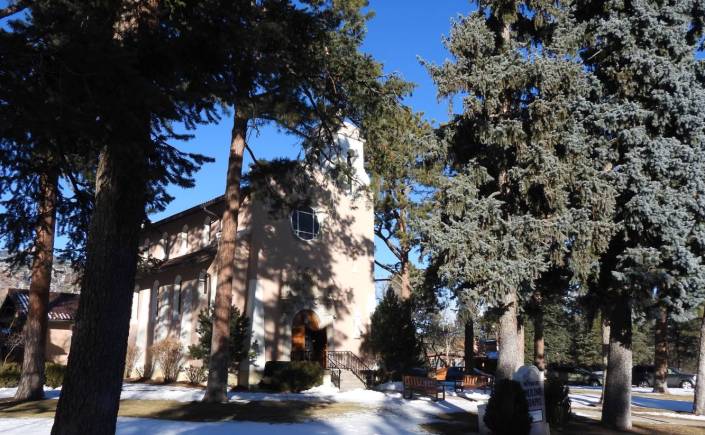
Julie had been brought up Catholic, yet by some accounts had drifted away from that religion. In 1918, while World War I was raging and she was consumed with concerns for her family in German-occupied Belgium (her daughter Gladys had married Belgian aristocrat Count Paul Cornet de Ways-Ruart in 1914), Julie vowed to build a monument to the greater glory of God should her family be spared. Luckily, her loved ones survived and Julie commissioned Pauline Chapel, named after her granddaughter, from the local architectural firm MacLaren and Hetherington. The Spanish Colonial Revival chapel still graces a street corner in close proximity to both the Broadmoor Hotel and the Penrose House (the name El Pomar was replaced with).
When it first opened, Pauline Chapel served as a private retreat for Julie and hotel guests, but it was officially incorporated into the Catholic Church in 1925. After Julie’s death of cancer in 1956 at the age of 85, it was here that her requiem high mass was celebrated, before a procession delivered her bronze casket to the Will Rogers Shrine of the Sun, located above the Cheyenne Mountain Zoo, where Spencer already lay buried.
I had passed and admired Pauline Chapel countless times but, until recently, had done so only from the outside. During one of my Brant visits to the Broadmoor Hotel on a Sunday in late January, I happened to read a sign announcing Sunday Worship at Pauline Chapel starting at 9 AM. It was 8:30. I happily walked the short distance to the chapel and took my place in the balcony for the 30-minute service. After it ended, I had a little time to explore the church interior more closely, admiring its beautiful design and sacred art. You might remember my mention of the priceless art displayed at the Broadmoor Hotel. While most of it stems from Philip Anschutz’s Western art collection, the Penroses were also avid collectors and Julie was responsible for the ornamentation of Pauline Chapel, much of it acquired during trips abroad.
I hope you will enjoy a short tour of this distinctive Colorado Springs landmark and a glimpse at a few of its treasures.

Exterior of Pauline Chapel, built in Spanish Colonial Revival style
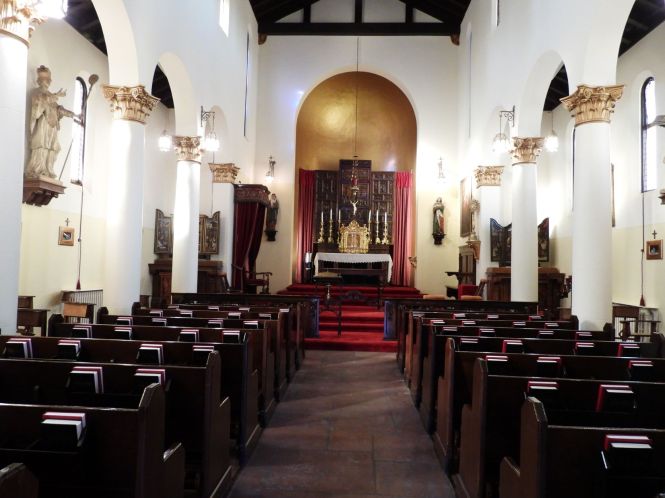
Interior of Pauline Chapel
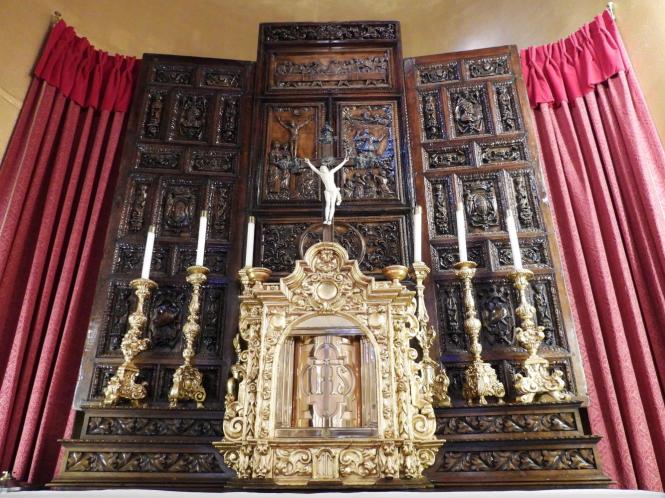
Hand-carved altar and ivory with silver crucifix, both from Spain, with gilded tabernacle from Mexico


16th century Flemish altar pieces flanking the sanctuary

Madonna with child by 16th century Italian/Flemish painter Ambrosius Benson

Loft with rose window and flanked by stone sculptures from Germany
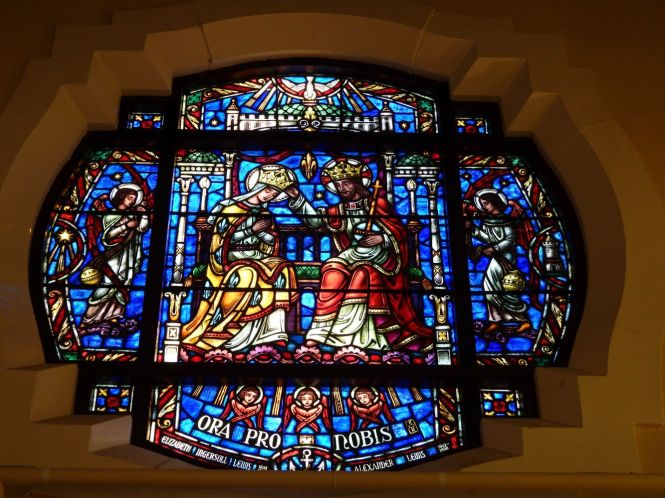
Rose Window, made and installed by a Boston firm
 tanja britton
What a fine looking building, both inside and out. I was interested to read your account of how it came about, and to be reminded how lucky we are, in these modern times, to be largely free from the scourge of tuberculosis. Health services are struggling a bit in the UK right now, but it’s important not to forget the incredible progress that has been made in medical services over the last 100 years.
LikeLiked by 2 people
The chapel definitely has a lot of character and reflects Julie’s sophisticated taste. Sadly, she suffered a number of losses, despite her privileged status. While tuberculosis is anything but gone, it’s not nearly as widespread as it was in the 19th and early 20th centuries. And luckily, most patients with appendicitis nowadays will not die.
LikeLiked by 1 person
I was thinking along the same lines as Platypus Man as I read about the deaths of Julie’s husband and son. And this was a wealthy family that could afford the best care.
What a beautiful chapel! Lovely that you could attend a service.
LikeLiked by 1 person
I had long harbored a wish to see this inside of this lovely chapel and was grateful that everything fell into place that Sunday.
I have often thought of how difficult it must have been for Julie to lose her son and husband so close together. When it comes to the most important things in life, money is useless!
LikeLiked by 1 person
💖💖💖
LikeLiked by 1 person
Thank you, Luisa.
LikeLiked by 1 person
You’re most welcome 🙏🌼
LikeLike
Beautiful church and story. The stained glass is gorgeous! How nice to be there in time for a short service too.
LikeLiked by 1 person
Thank you, Donna. I was very thankful for the opportunity to attend the service and get a look at the inside of the chapel.
LikeLiked by 1 person
Your post is a reminder of how much more common early deaths used to be than they are now. The world has made lots of progress, though that progress has varied significantly by region. You might be interested in this comparison of current life expectancy by country:
https://www.worldometers.info/demographics/life-expectancy/
A couple of take-aways: women live on average about five years longer than men; African countries cluster at the bottom of the list, with the shortest lifespans.
As far as I can tell, pomar isn’t specifically Catalan but rather is common to all three Romance language groups on the Iberian Peninsula (the other two being the Portuguese group and the Spanish group).
LikeLiked by 1 person
Thank you for your comment, Steve. There definitely has been progress in many fields, but I find the discrepancies between different regions in the world depressing. The theoretical knowledge of what ought to be done to ameliorate conditions for all of humanity is there, but we lack the political will translate that knowledge into reality. When I think about all the money spent on weapons in all the wars that humans have waged on one another, and all the good it could have done instead, my misanthropic worldview only deepens.
I also appreciate your thoughts about the etymology of the word “pomar.” I took this information from the official historical sources about the El Pomar home and property without questioning it, even though I should have.
LikeLike
Ah, that feature of human nature again: unfortunately there have always been those who want to steal from and control other people, and sometimes the only choice of the victimized is to fight back physically. When those things happen on a large enough scale we call it war. As you pointed out, in an ideal world the money and labor, if applied constructively rather than destructively, could accomplish so much.
LikeLiked by 1 person
Knowing about human nature, I doubt an ideal world ever existed. I find it hard to reconcile the good individuals are able of and the havoc we have wreaked–and continue to wreak–on one another and the earth.
LikeLike
I really am enjoying these essays of yours. I have missed being in art history class and this helps fill the void so nicely. The rose window is my favorite element of this chapel, with such a strong ultramarine blue coming through.
LikeLiked by 1 person
Thank you, Julie. I have become enthralled by the study of history and find it endlessly fascinating to discover new pieces of the puzzle. My understanding of art history is very general, however, and would benefit from a systematic review!
I also like the blue of the window. I wasn’t inside the chapel when the sun hit the glass but I imagine it would be lovely to see all the colours become more luminescent.
LikeLiked by 1 person
With your writing, the reader feels like she is right there with you. What could be better for getting people interested in art, architecture, and the interesting characters involved. No review needed, as far as I am concerned. 😊
LikeLiked by 1 person
I appreciate your comment very much, Julie. 🙏
LikeLiked by 1 person
Thanks for taking me there to that fine building, Tanja!
LikeLiked by 1 person
Thank you for coming along on the tour, Pit.
LikeLike
Simply beautiful! The outside and inside are lovely. The history was interesting. The outside looks more simple where the inside looks more ornate.
LikeLiked by 1 person
Thank you, Sharon. I think the exterior of the chapel is very attractive but it gives no hint of all the treasures that are hidden inside.
LikeLiked by 1 person
Lovely! What a wide variety of countries are represented by the artwork in the chapel. Beautiful stained glass. ( I always have to stop and photograph stained glass whenever I find it.) 😉
LikeLiked by 1 person
Thank you, Julie. I can relate to the urge to photograph stained glass–it’s lovely, especially when it comes alive with sunlight.
LikeLiked by 1 person
What an interesting history, but so sad to read of the husband and son’s early demise. But if we view the tombstones in old cemeteries, often young children and/or their parents die from medical conditions we can cure today.
Loved the photos too.
Thanks for sharing, Tanja.
LikeLiked by 1 person
Thank you, Vicki. The fact that so many individuals died of now-curable conditions struck a number of our fellow bloggers. Tuberculosis in particular has had a tremendous toll. I, too, have spent a lot of time reading tombstones, and one can’t help but be moved deeply by so many lives cut short.
LikeLike
I love the shadows of the trees on the chapel walls in the first photograph. They give a lovely feel to the image and something of the atmosphere of the building’s surroundings.
LikeLiked by 1 person
Thank you for noticing and commenting on the shadows, Ann. I also love the trees in front of the chapel and wish I could have taken a photo that shows more of the surroundings. Julie picked a beautiful spot for her chapel and even if there are many more structures now than when it was built, it still fits in very well into its environs.
LikeLiked by 1 person
Danke für diesen wunderbaren und interessanten Bericht, liebe Tanja. Ja, Kirchen sind faszinierende Bauwerke, die oft die Geschichte, Kultur und Architektur eines Ortes widerspiegeln. Lese ich deinen Text und schaue mir dazu die Fotos an, so erzählt mir die “Pauline Chapel” ebenfalls eine Menge über die Historie, die Erbauer und den Platz, an dem sie steht.
LikeLiked by 1 person
Danke für Dein Interesse, liebe Rosie, und für den netten Kommentar. Ich finde es auch immer wieder erstaunlich, was frau alles von einem Gebäude und seiner Geschichte lernen kann.
Lieben Gruß,
Tanja
LikeLike
Quite an exquisite church. I was raised Catholic and it reminded me of some of the old chapels we used to attend with my parents/grandparents, especially the stained glass. Much more ornate in this chapel than those, but definitely gives me those old feelings as an altar boy…then I married a Lutheran and well, we’ll leave it there ha.
LikeLiked by 1 person
I quite enjoy visiting churches, especially when I’m back in Europe where they are typically open every day, especially in bigger cities. I find that I take a lot of photos of stained glass windows which often tell interesting stories. Like your wife, I also grew up a Lutheran. I have to say that my preferred place to worship is out in nature, while looking for our feathered friends. 🐦🦉🦅
LikeLiked by 1 person
Your last line sums it up perfectly for me – you have a lot of time to sort things out in the ultra-trail life – I had to laugh as I was watching Lucy’s Dad soon after reading your comment (https://www.youtube.com/watch?v=9tCow8dP3h0) and at 1:54 his son stated the same. ”a greater connection to god through his running than he did sitting in a pew”
LikeLike
Lovely structure and your photos are gorgeous. Life was hard, even for the well-to-do. I guess it still is for so many around the world. I enjoy your posts on these local history stories, Tanja!
LikeLiked by 1 person
I appreciate your interest, Tina, as well as your comment. It’s so true that wealth does not necessarily guarantee a longer or healthier life, as a study of any history book will confirm. In some ways, all of us are the same fragile and vulnerable creatures.
LikeLike
Enjoyed the history and the photographs. The name of the chapel caught my attention because it was my maternal grandmother’s name. Certainly not a common name today, but it brought back memories of my Gram.
LikeLiked by 1 person
Thank you, Brad. I’m glad the post made you think of your Gram. I like the name Pauline but you are right about it being rather rare these days. The following link shows a graph that demonstrates how the name has fallen in popularity:
https://nameberry.com/b/girl-baby-name-pauline
LikeLiked by 1 person
Despite certain differences, the church brought to mind the various Spanish missions and churches here in Texas. Most of ours weren’t as finely appointed, in part because they were built one to two centuries earlier. Still, the interior design is very much the same.
“El Pomar” made me smile; one of the first words I learned when I was taking French was the word for apple: ‘pomme.’ Irrelevant to your post, but interesting to me, is that the Broadmoor opened in 1918: the year of my mother’s birth. When I think of it in that way, the experiences you’ve written about here don’t seem so long ago.
LikeLiked by 1 person
The church’s architecture definitely represents many buildings in the Southwest yet the interior is also very reminiscent of European churches. The artwork definitely contributes to that effect.
I also remember learning “pomme” during French lessons, apart from “porte.” It’s funny how our memory works (or doesn’t).
In some ways, 1918 seems like a long time ago, in others not so much. I don’t think many people born in 1918 are still alive today. Just imagine all the changes they went through.
LikeLiked by 1 person