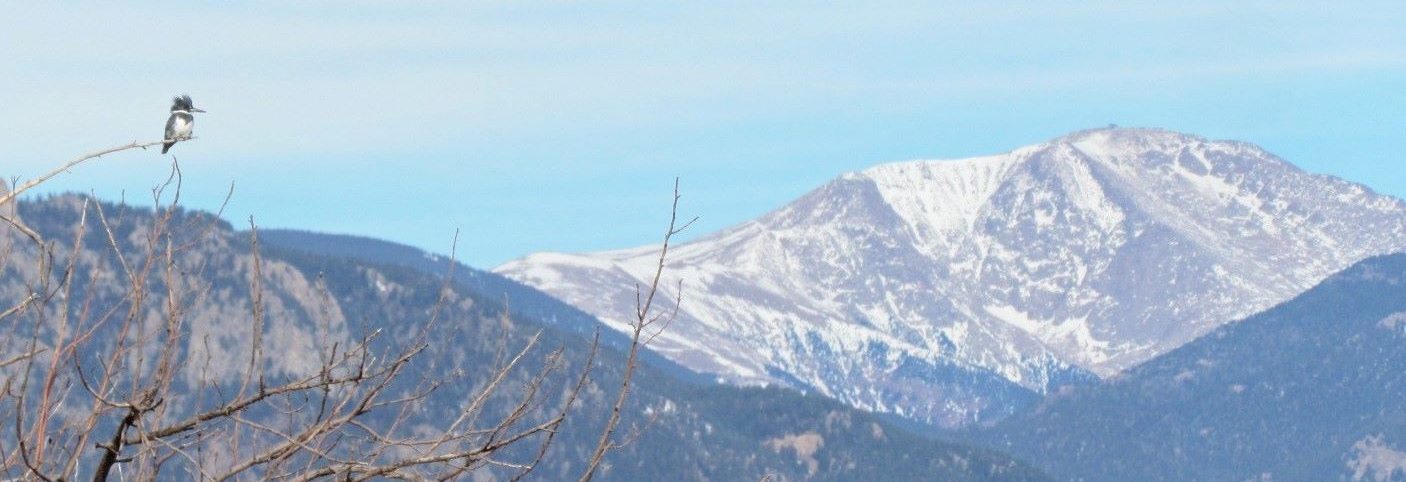
Owls are often considered charismatic. Is it because of their large and specialized eyes, enabling them to see in the dark and conducting a mostly nocturnal lifestyle? Their association with wisdom in our collective consciousness? This association likely originates in Greek mythology, where Athena, goddess of wisdom, warfare, and handicraft, is often depicted with an owl (as was Athena’s syncretic incarnation in Roman mythology, Minerva). This divine owl represents a Little Owl (Athene noctua), a species widespread in Europe, north Africa, and parts of Asia.
The world’s 229 owl species are distributed across 23 genera, and the genus Athene has 9 representatives. While North America is not home to Little Owls, the related Athene cunicularia, graces the western US and parts of Canada during the summer months as well as portions of Florida, the Caribbean, and South America either year-round or during the winter.
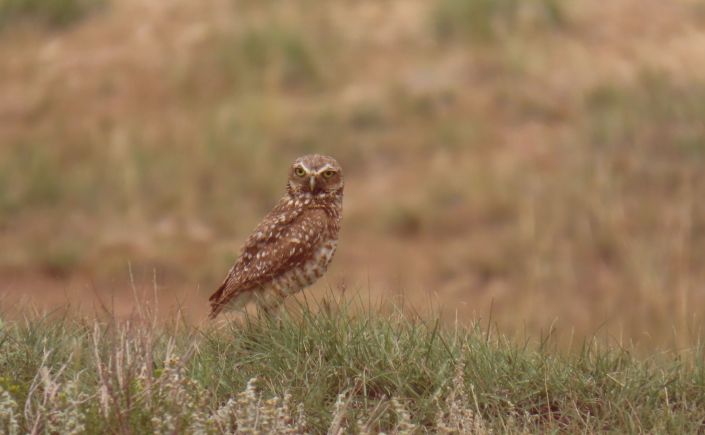
Cunicularius means “miner” or “burrower” and you might have seen that species name in relation to bees or bunnies, with Colletes cunicularius referring to the spring mining bee, and Sylvilagus cunicularius to the Mexican Cottontail. When scientific names make sense and correspond to common names, they are much easier to remember. Such is also the case with the owls featured in this post. By now they are impatiently shaking their heads, telling me to stop setting the stage and raise the curtain instead. So, without further ado, allow me to introduce the charismatic Burrowing Owls (Athene cunicularia) we were fortunate to spot during a trip to Antero Reservoir in Park County, Colorado, in the middle of July (which, incidentally, followed in the wake of the Elevenmile Moose).
As we have learned over the years, when a car is parked by the side of the road with a camera lens (or two) protruding from the window, it’s usually a good idea to stop and find what the other car’s occupants are looking at. Which is exactly what we did. We were not disappointed.
Wait. Didn’t I just say that owls were nocturnal? While that’s true for most, luckily for bird lovers, Burrowing Owls are both nocturnal and diurnal.
So here we are, in the middle of the day, parked along the access road to Antero Reservoir, looking at a colony of ground squirrels and their room mates. True to their name, the owls live in burrows dug either by themselves, prairie dogs, ground squirrels, or turtles. They even adopt human-made substitutes, such as old culverts or buckets or pipes provided for them expressly in areas that no longer have natural dens. “The owls prefer open areas with sparse vegetation and are found in grasslands, deserts, and steppe environments; on golf courses, pastures, agricultural fields, airport medians, and road embankments; in cemeteries and urban vacant lots” (Cornell Lab of Ornithology).
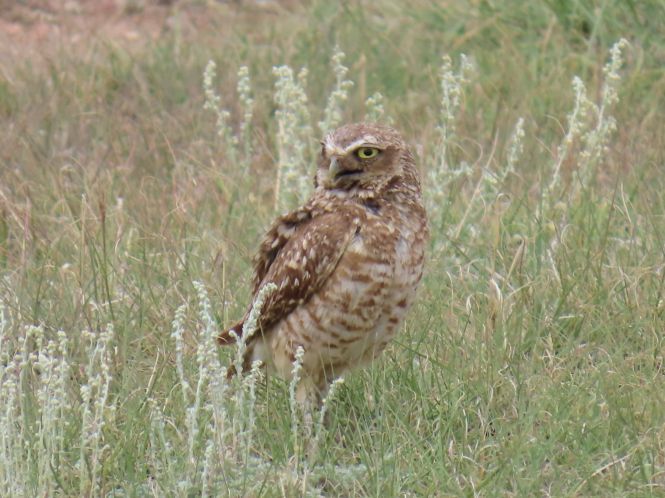
At first we see only this single owl. It is perched on the ground and partially concealed by plants. After scanning the surroundings, it takes off in pursuit of a grasshopper, ubiquitous and numerous this summer. Securing one in its beak, it flies to another spot, lingering just a moment. When this sequence happens repeatedly, we focus our attention on said spot and finally glimpse another owl. It surfaces briefly upon the arrival of Owl 1, then disappears again. Eventually, a round head remains visible aboveground, soon to be joined by another.

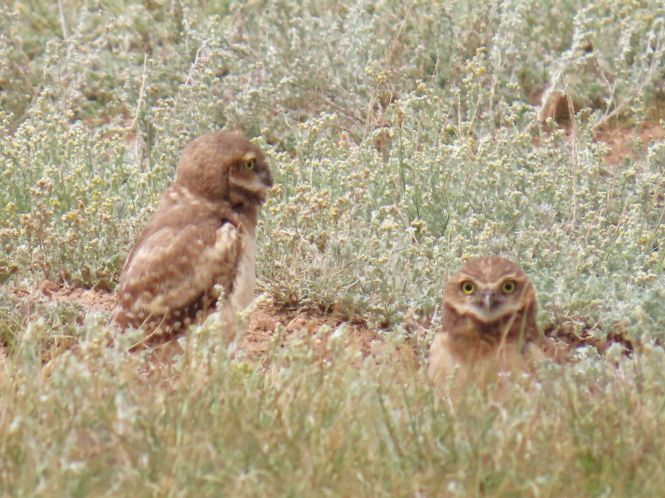
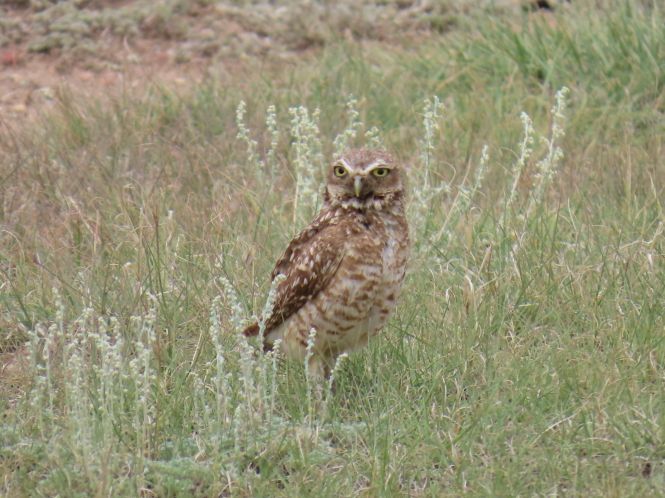
Two juvenile Burrowing Owls getting fed by their parents! By then, we have also seen a second adult. Unlike most other owl species in which the female is larger, both sexes of the Burrowing Owl are roughly the same size. Adult Burrowing Owls measure 9.5 inches between the tip of the beak and the tip of the tail, have a wingspan of 21 inches, and weigh 5 ounces. They are brown with white spots, have big yellow eyes and a yellow beak, and sport long legs that enable them to run through vegetation. Juvenile birds have reddish bellies without markings and their feathers appear overall ruddier and fluffier than the adults’.
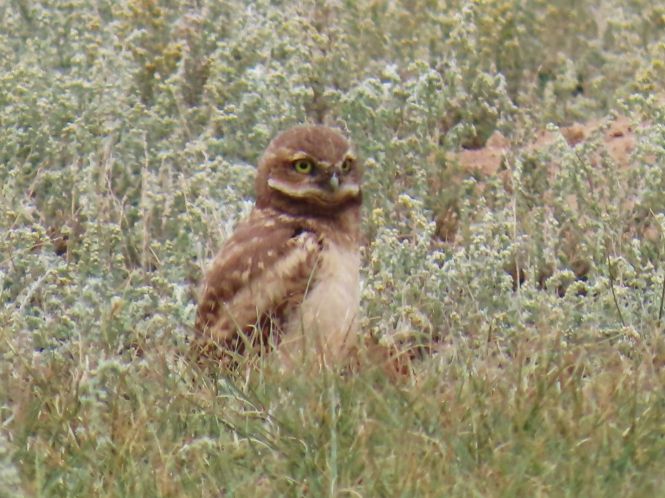
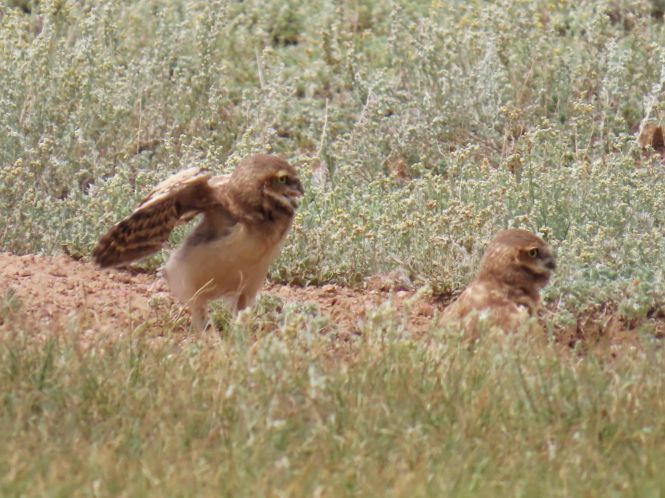
The two juveniles seem to grow bolder in time, no longer bothered by two cars on the road and three camera lenses pointing at them. They remain outside of their burrows and demand food, vociferously calling to their parents and quivering their wings, both common begging behaviors among young birds. The parents try their best to appease their young ones’ growling stomachs. According to Cornell, the clutch size for these owls ranges from 2 to 12. I can’t imagine what it would take to raise a dozen offspring! These owls feed on insects and rodents and are known to stash food underground in preparation of filling all those hungry mouths.
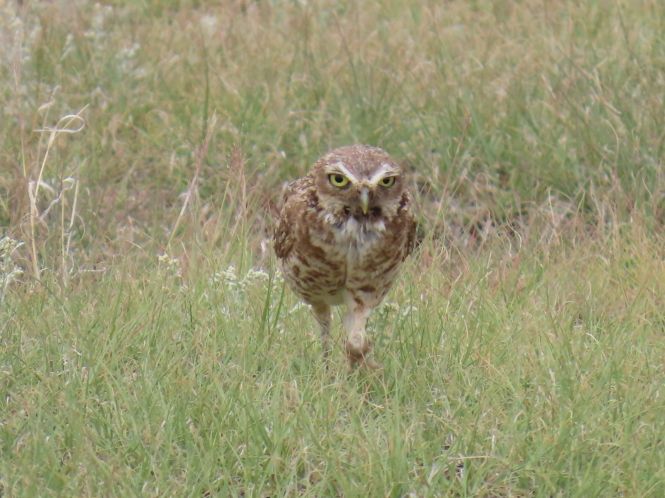
Are Burrowing Owls charismatic? My answer is an unequivocal “yes.” And while my husband concurs, he equally claims that they look curmudgeonly. Perhaps they do but in my mind, it’s a charming kind of curmudgeonliness that does not diminish their charisma.
What do you think?
 tanja britton
I think you had a good lucky time watching those owls! Especially the juveniles. Yes, they are special and so unique in the birds’ world.
LikeLiked by 2 people
Thank you. We did feel very lucky to get to watch (and photograph) this owl family, and we are relishing that memory.
LikeLiked by 1 person
Da hat sich parken und warten aber gelohnt. Diese Eulen sind wirklich Hingucker. Ich habe sie auf Antelope Island gesehen, aber ohne Junge. Deine Fotos sind TOP und Dein Erlebnis unvergesslich.
LG
Maren
LikeLiked by 2 people
Das Parken und Warten haben sich allerdings gelohnt, liebe Maren. Was wieder mal bestätigte, wie wichtig und bereichernd es ist, sich Zeit zum Schauen, Hören und Erleben zu nehmen. Es was ein totaler Gewinn für uns.
Liebe Grüße zurück,
Tanja
LikeLiked by 1 person
Und für uns – die Bilder sind zauberhaft.
LikeLiked by 1 person
I appreciated your link to the article about syncretism, including the folk (or fauxlk, i.e. false) etymology having to do with Crete. Wisdom, warfare, and handicraft: what an incongruous bundle to attribute to a single goddess. And what a surprise for a non-birder to learn that ornithologists created the genus Athene for some owls.
Cunīculus was the Latin name for both ‘rabbit’ and ‘rabbit burrow.’ The word led to Spanish conejo and old-fashioned English coney, both meaning ‘rabbit.’
It’s humorous to think of owls preferring golf courses. We have to wonder how often an owl finds a hole in one.
LikeLiked by 1 person
Having an owl find a hole in one would ennoble any golf course, but I would be worried about the inadvertent golf ball causing pain, injury, or worse.
I was neither aware of the word coney, nor made the connection between cuniculus and conejo. Language is never boring! I do wonder about Coney Island now.
The mention of both wisdom and warfare in the same breath proves to me that the Greeks (and Romans) created gods in their own puny and imperfect image, just as most other religions and belief systems.
LikeLike
You (may have) guessed it: According to Google’s AI (which we always have to corroborate elsewhere): “One theory for how the island got its name is that the Dutch, who settled the area in 1624, called it ‘Konijn Island’ because of the rabbits. ‘Konijn’ is the Dutch word for rabbit, and the English term ‘con[e]y’ was an older term for an adult rabbit. Another theory is that the name comes from the Dutch surname ‘Conyn.’ However, some historians believe that rabbits were only introduced to the island after it was settled.”
LikeLiked by 1 person
Thank you for the information. I did guess it, but we might never know for sure.
LikeLike
This is so cool! I never knew to look toward the ground to spot an owl (or multiple owls). What a wonderful thing to witness!
LikeLiked by 1 person
Thank you, Diana. They are very cool owls. And you should be able to see them in the Denver area. If you ever walk through a prairie dog town, play attention to “flying” dogs.
LikeLiked by 1 person
Oh interesting! I do sometimes walk a trail that goes through one. Next time I’ll take a look!
LikeLiked by 1 person
I hope you’ll see one! Carry your binoculars!
LikeLiked by 1 person
Beautiful and mysterious owls.
LikeLiked by 1 person
Thank you. That’s how I feel about them as well.
LikeLiked by 1 person
Charismatic, definitely! Though…at times, they rock their curmudgeonly side, too. Either way, they’re darling, as are your photos! We have Burrowing owls, too, though north of the Austin area, as far as I know. You got a great set of shots, fun post!
LikeLiked by 1 person
Thank you, Tina, I’m glad you enjoyed the post. I agree–being cute and charismatic does not rule out a curmudgeonly side.
LikeLike
I agree, charismatic. I didn’t know where the wise owl reference came from. You were able to get quite a few amazing pictures of these ones Tanja. Maggie
LikeLiked by 1 person
Thank you, Maggie. We were lucky to get to witness this family feeding time and to have the owls tolerate our presence. A memorable encounter!
LikeLiked by 1 person
How lucky we are that you and your husband had your camera at the ready, on this road trip. I think their slightly grumpy looks just make these owls even more endearing.
LikeLiked by 1 person
Thank you, Julie. This was one of those instances of “right place, right time.”
In combining cuteness and grumpiness, owls are not so different from humans expressing conflicting emotions. 😊
LikeLiked by 1 person
How sad that the eradication of burrowing animals such as prairie dogs and ground squirrels is responsible for their progressive decline. It is well known that golf courses and airports will not do. Furthermore, as burrowing animal populations decrease, burrowing owls become more vulnerable to exposure to predators. Wiki says, “with fewer burrows available, burrowing owl populations will be more concentrated, with more owls occupying fewer burrows. As a result, predators will more easily detect owl populations”. I’ve been reading that the owls have somehow adapted to man-made holes, but it’s not considered a long term solution. The conflict with the prairie dog is as old as that of the wolves/coyotes. The prairie dog is a keystone species. https://www.humanesociety.org/resources/what-do-about-prairie-dogs
LikeLiked by 1 person
Thank you for the link and your concerned comment, Maria. I also worry about the decline of this (and so many other) species. It’s heart-rending to come across human residential areas that used to be inhabited by prairie dogs and burrowing owls. People have mostly put their own needs over those of other creatures and in the context of overpopulation and climate change, it is highly unlikely that our attitudes will improve.
LikeLiked by 2 people
Yes, yes, and yes! Definitely charismatic. How wonderful you came upon this scene and were able to take pictures of owl lunchtime. Smart parents to tuck food away for their hungry youngsters.
LikeLiked by 1 person
Thank you, Laurie. Watching owl lunchtime felt like a great privilege and only served to enhance our appreciation of these charismatic creatures.
LikeLike
Was für ein zauberhaftes Erlebnis, liebe Tanja.
Ich bin hin und weg…
Dankeschön für die wunderschönen Bilder und die ausführliche Info dazu.
Hab noch einen guten Tag.
Liebe Grüße Brigitte
LikeLiked by 1 person
Dankeschön, liebe Brigitte. Es freut mich, daß die Prärieeulen auch Dich bezaubert haben. Was mir bei Deutschlandaufenthalten immer auffällt ist, wie schwierig es ist, überhaupt Eulen zu Gesicht zu bekommen. Ich schätze mich sehr glücklich, Erlebnisse so wie dieses zu haben.
Euch Bees wünsche ich ein angenehmes Wochenende.
Tanja
LikeLiked by 1 person
Thank you for the informative report. And the good pictures (by the way, which lens did you use?). To the fundamental question: charismatic or curmudgeonly: are the muppet-puppets charismatic or curmudgeonly? The answer is: both. So my answer is: they are muppet-like. And this is a compliment to both: the Muppets and the owls.
LikeLiked by 1 person
Thank you, Karsten, I’m glad you enjoyed the post and pictures (I’m using a Canon Powershot SX 70 HS).
And I will never be able to see another burrowing owls without visions of muppets. 😊
LikeLike
Definitely charismatic! How thrilling that you got to see this winsome family. 🙂
LikeLiked by 1 person
Winsome family, indeed, Eliza. I think the “definitely charismatic” vote wins (which, I hope, will also be true in politics!).
LikeLiked by 1 person
Hi. I hadn’t heard of the Burrowing Owl before. I’m not a birder. But I can see why you and so many people are. Birds are fascinating and amazing.
LikeLiked by 1 person
Thank you for going owling with me, Neil, I hope it won’t be the last time. I can attest to the fact that birds and birding are positively addictive, but it’s an addiction I embrace wholeheartedly. 😊
LikeLiked by 1 person
Such beautiful birds, Tanja. I find owls also a little comical, at times with hints of the supernatural – more often heard than seen among the trees around my home, and incredibly silent on the wing for such a big bird.
LikeLiked by 1 person
Thank you, Michael. Their unusual (and sometimes uncanny) behavior has definitely spawned some strange (and sometimes supernatural) myths.
LikeLike
wow, tolle fotos!
LikeLiked by 1 person
Vielen Dank. Es freut mich sehr, daß Dir die Photos gefallen haben. Ich habe mich sehr gefreut, daß die Prärieeulen so wunderbar kooperiert haben.
LikeLiked by 1 person
🙂
LikeLiked by 1 person
Yes, definitely charismatic. Great little birds. Owls’ eyes are totally captivating, aren’t they. We have Little Owls here, but their lifestyle is less interesting than that of your burrowing beauties.
LikeLiked by 1 person
Thank you, Mr. P. Knowing of your predilection for owls, I thought of you when preparing this post. I never see any owl without being awed, they, without a doubt, have a special power.
One of the noticeable differences during visits to Germany is the near-absence of owl sightings or even owl “hearings.” I might not be looking in the right places or at the right times.
LikeLiked by 1 person
I encounter no more than a couple of owls in the UK every year – they are hard work, and luck plays a large part in my successful sightings / “hearings”.
LikeLike
Owls are so unique. It is easy to understand why we like to assign human characteristics to them. The Burrowing Owl is charismatic, curmudgeonly, cute, adorable, fierce – all in one small feathered bundle.
In our area, they are fortunate to have a dedicated group of engineers provide them with ready-made burrows. The Gopher Tortoise (Gopherus polyphemus) conveniently digs nice deep tunnels which the Burrowing Owls readily populate. Once they convince the tortoises to move, that is.
Wonderful post!
LikeLiked by 1 person
Thank you, Wally. I think you are absolutely right about all the character traits you listed for this owl.
It’s nice to know that you have the equivalent engineers to our prairie dogs and ground squirrels. Until I prepared this post, I was not aware of the role turtles played in burrow-building in some parts of the country.
LikeLike
Charismatic!! They look like they are thinking very hard…
LikeLiked by 1 person
Thank you, Kerry. I think so, too, but both attributes aren’t mutually exclusive.
I wonder what they are thinking about. Probably “I can’t wait for junior to grow up so (s)he can catch her/his own food!” 😊
LikeLiked by 1 person
Half of our garden critters are thinking just that!
LikeLiked by 1 person
Hello Tanja,
I feel all adjectives can apply to the physical features of these amazing birds 🙂
I am sorry for my lack of comments – the past few months have been quite hectic.
I hope you know your posts are a delight and I enjoy reading them.
Hope all is well with you and your dear ones.
Warmly,
Takami
LikeLiked by 1 person
Thank you for your comment, dear Takami, and for taking the time to read and like my posts. It’s much appreciated!
Sorry to hear that your life has been hectic. I hope you are coping and that things will slow down for you soon.
All the best,
Tanja
LikeLike
I’m grinning at the serious/thoughtful expression of the owl in the last photo and am utterly charmed, so yes, they certainly are charismatic. We sometimes hear owls in the nearby woods when our windows are open at night – a comforting sound as I drift off to sleep… 🙂
LikeLiked by 1 person
Thank you, Ann. I have the same reaction to them!
And I also love hearing owls hooting when I’m in bed. It’s a reminder that some wilderness still survives.
LikeLiked by 1 person
It feels good that there is some wilderness nearby too.
LikeLiked by 1 person
A splendid post: entertaining as well as being informative. I confess that I wouldn’t call owls charismatic, but that’s only because that’s a quality I associate with human personality. I understand why some would choose to describe these compelling creatures that way. On the other hand, I’ve always enjoyed the curmudgeonly people I’ve known, so that has a more positive vibe for me than it might for others.
If I had to choose only one owl to see, this would be the species. They seem unbelievably clever, and of course they’re cute as can be. I did laugh at your comment about stopping whenever you see someone else stopped with a camera poking out the window. I know someone (not me!) who used to amuse himself when birders were around by staring intently into a bush or tree, sometimes with a raised camera. Inevitably, he’d collect a few others eager to see the ‘whatever’ he was looking at. Now that I think about it, he had a few curmudgeonly tendencies himself.
There’s a great horned owl that nests every year at the Lady Bird Johnson Wildflower Center in Austin. Her name is Athena, and it was just this year that Tina explained to me why that name was chosen!
LikeLiked by 1 person
Thank you, Linda. Curmudgeonly can be clever, compelling, and cute, as this owl proves and your words attest. 😊
I have wondered a few times if I have fallen for people who are trying to have fun by making others believe that they are seeing something unusual. But I don’t mind. I would rather “to be had” than miss a rare sighting.
LikeLiked by 1 person
Wow, this shot was so cool. My daughter these days studying about Nocturnal animals and birds.
LikeLike
Thank you, Anjali, I’m glad you enjoyed the photos of these owls. I hope your daughter enjoys what she learns. I wish I had paid better attention to some things when I was her age!
LikeLiked by 1 person
Great find Tanja! Very observant to be able to spot an owl not much larger than a US sized can of soda (or pop depending on where you live). The little “fuzzy” ones are very cute. And then I remember they have the same skill set as their parents. The very intense stare makes you wonder who is really doing the watching in your last photo.
LikeLiked by 1 person
Thank you, Brad. It helps that the owls have long legs that help make them more visible. Of course, the observers in the other car put us on high alert and helped us to narrow down the search area.
I always feel a thrill when my eyes meet theirs. And I’m glad I’m not on their menu! 😊
LikeLiked by 1 person
Agreed that sometimes the best spotters are other birders. Plus, I’ve heard that owls like options for dinner.
LikeLiked by 1 person
Don’t we all like dinner options?! 😊
LikeLiked by 1 person
Wonderful Owls, but these Burrowing are hard to find even with the added bonus of being able to find them during the day. Way to see the queue and benefit off the other car. When it comes to the Owl family, I do not think there is a species more emotive than these. Ever curious, they’ll angle their head in different postures likely searching for better hearing angles – and those eyes, you’d think the Clash were singing about them in London Calling.
LikeLiked by 1 person
Thank you for your comment, Brian. I had to look up London Calling and the Clash–am not current in musicalese. 😊
In order to find these part-time underground creatures it helps to know the prairie dog towns where they like to hang out (if there are no other birders looking at owls).
And, yes, I also love their faces and expressive eyes.
LikeLike