
If you happen to be a resident in or visitor to Colorado’s Pikes Peak region and have not yet explored the Colorado Springs Pioneers Museum, my sincere wish is that you find some time to do so. As a volunteer docent at this institution since 2015, my opinion might not be entirely unbiased, but I don’t have any compunctions about declaring it the city’s best museum.
Its name traces its origins to the 1896 creation of the El Paso County Pioneers Association and the subsequent 1937 founding of the Pioneers Museum in its first home, the former Knights of Columbus building. Since 1979, the museum has been located in the historic 1903 El Paso County Courthouse (my previous posts about the museum can be found under the heading Colorado Springs Pioneers Museum on top of the homepage).
“Pioneer” carries negative and painful connotations for basically all Indigenous tribes whose ancestral homelands have been located in the Americas for centuries, if not millennia, because they were displaced or killed by so-called pioneers. While a name change for the museum is desirable and has been discussed, it is not imminent.
As we all know, museums have not always been places that tell objective and inclusive stories. But this is exactly what the director, curator, and staff of the Colorado Springs Pioneers Museum aspire to do with each new exhibit, and the newest one is no exception.
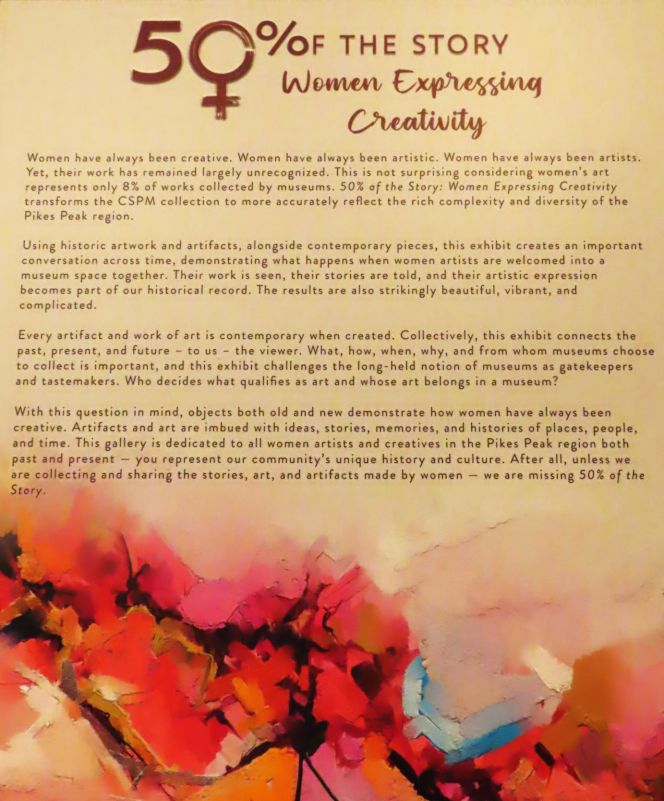
“Women have always been creative. Women have always been artistic. Women have always been artists. Yet their work has remained largely unrecognized.”
50% of the Story: Women Expressing Creativity is the museum’s latest addition after a year-long closure, needed to replace the aged and ailing HVAC system. The museum’s grand reopening in July 2024 was highly anticipated and enthusiastically celebrated. As the introduction to 50% of the Story explains: “Women have always been creative. Women have always been artistic. Women have always been artists. Yet, their work has remained largely unrecognized. This is not surprising considering women’s art represents only 8-10% of works collected by museums.” This new exhibit seeks to remedy this imbalance: ”After all, unless we are collecting and sharing the stories, art, and artifacts made by women—we are missing 50% of the story.”
For the first time ever in the history of our local museum, an exhibit is dedicated exclusively to art created by women with a connection to the Pikes Peak region, either in the past or the present. The designers decided to hang the paintings gallery-style and to blend contemporary and older pieces in an attempt to create a conversation across time. They also chose not to attach a label to each individual piece, not only because gallery space is limited, but also to encourage visitors to look at the art first, rather than at its label. Every wall is equipped with a panel that lists each artwork’s title and each artist’s name as well as a QR code that links to the museum’s website, where additional information can be found, including artists’ statements (if available).

“Still Water” by Vashti Mims
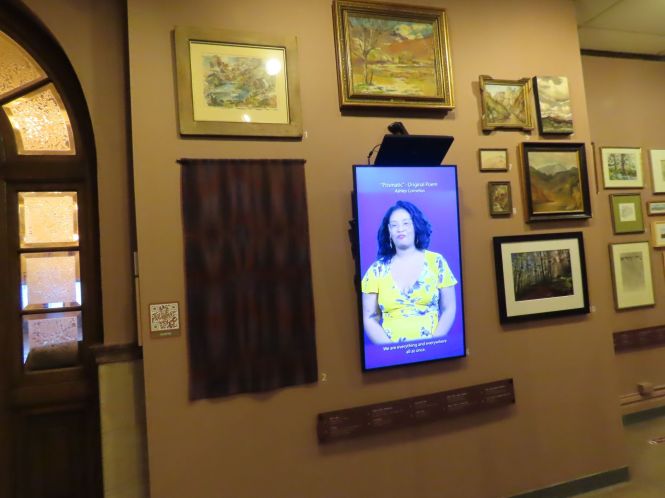
South wall with screen
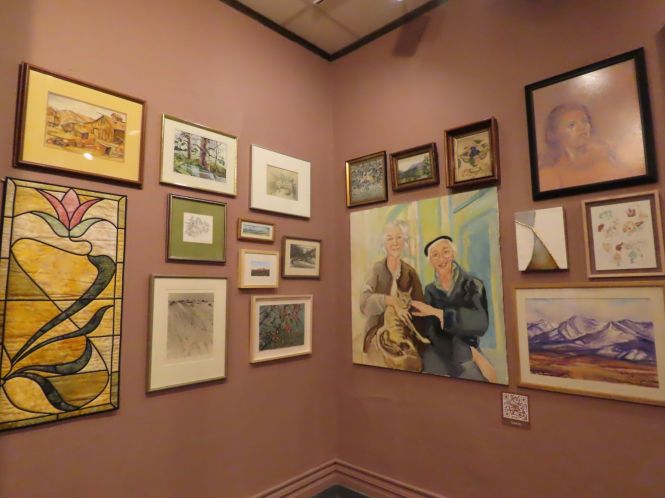
Southwest corner and adjacent walls
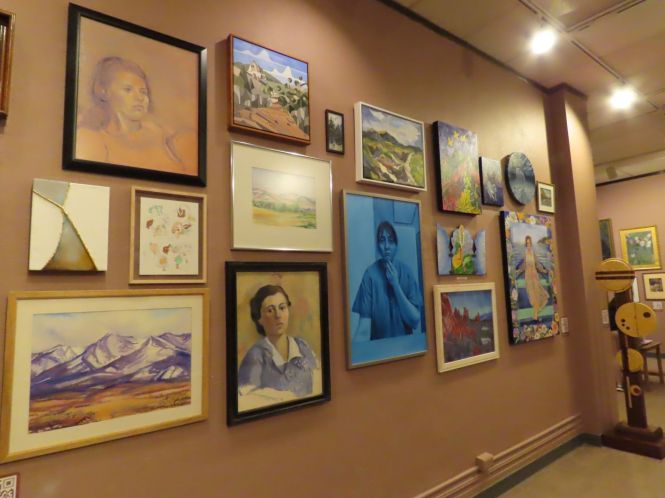
West wall
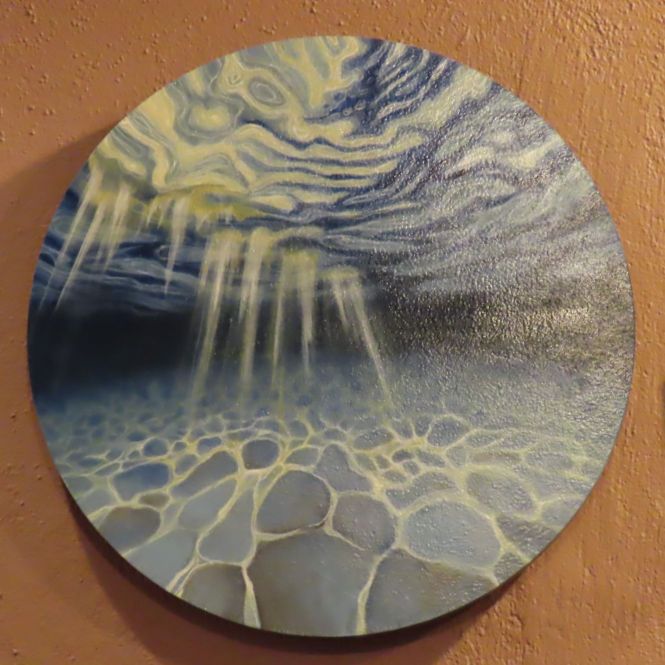
“Glint” by Shannon Dunn
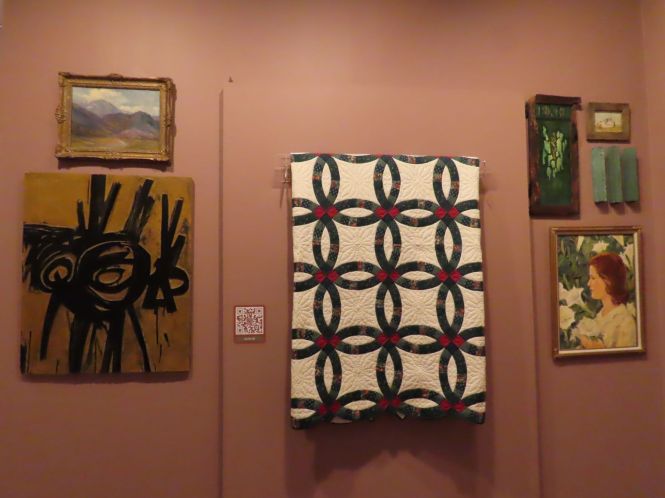
Middle wall with “Double Wedding Ring Quilt” by Mary Ross
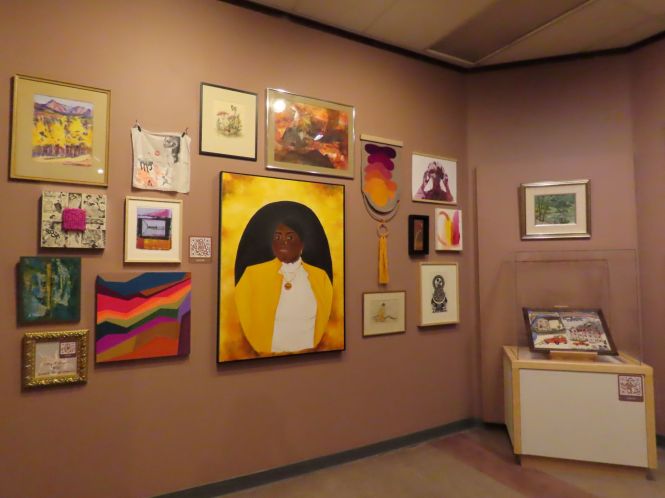
West wall
Apart from paintings, which are in the majority, it also contains other creations, such as a weaving, a beaded deer hide bag by a Ute artist, a wooden totem pole, a shadowbox with a fantastic Victorian era hair wreath, and pottery pieces, to name a few (because of glares in vitrines and other technical issues, I don’t have satisfactory photos of those items).

Northwest corner and northwest wall which includes an embroidery by Claudia Lee (Yates) Bernd (on the right).
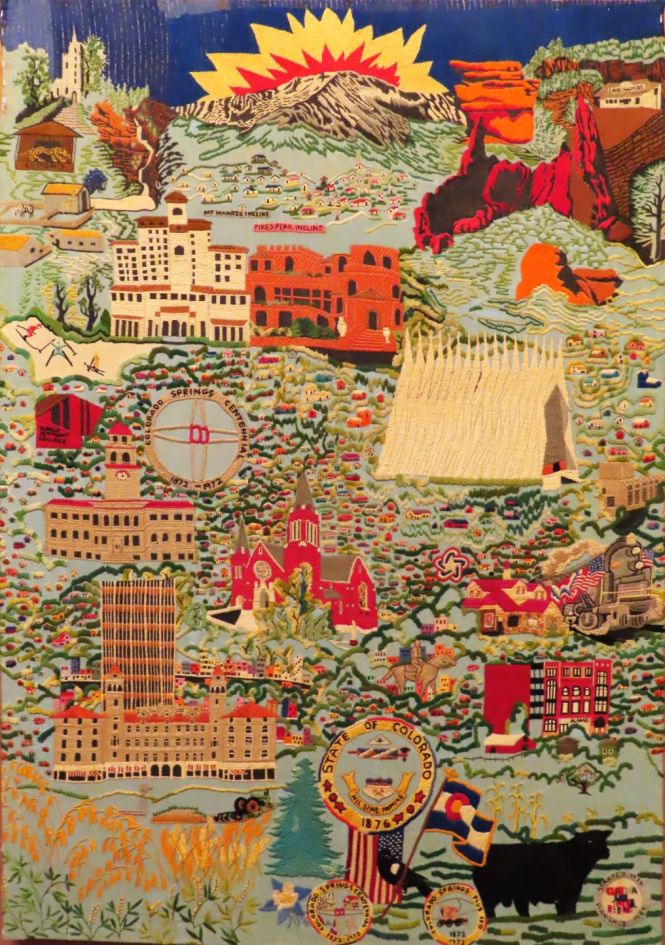
Close-up of the embroidery by Claudia Lee (Yates) Bernd that depicts some of the major attractions of the Pikes Peak region and that took the artist 5 years to complete (in 1981). If you know the area, you can recognize Pikes Peak, Garden of the Gods, the Air Force Academy Chapel, and The Broadmoor Hotel, to name only a few.
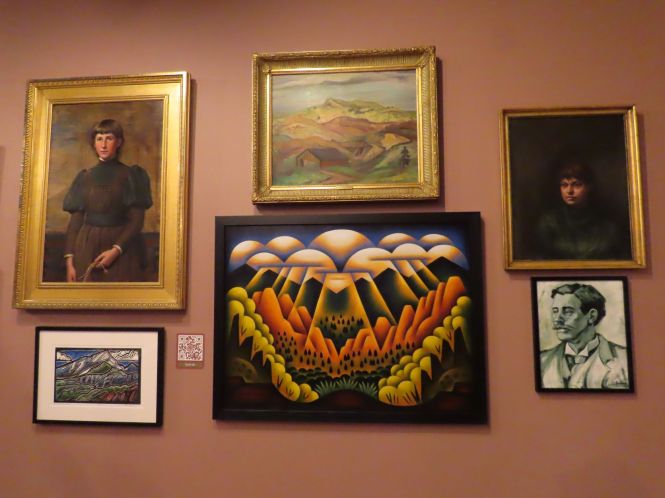
Northeast wall

“Glorious Garden of Light” by Sushe Felix

East wall
For this exhibit, some modern pieces were commissioned and paid for with a special fund. The curators intentionally incorporated different styles and color schemes in an attempt to be as inclusive as possible, and without acting as gatekeepers and tastemakers. Ashley Cornelius, Poet Laureate of the Pikes Peak region since 2021, wrote “Prismatic,” a powerful, empowering poem for the exhibit’s opening which plays on a loop on a digital screen. QR codes also link to recordings of a dance performance, The Mile, by Lilly Parsons, and of a monologue from Every Brilliant Thing by Lynne Hastings.
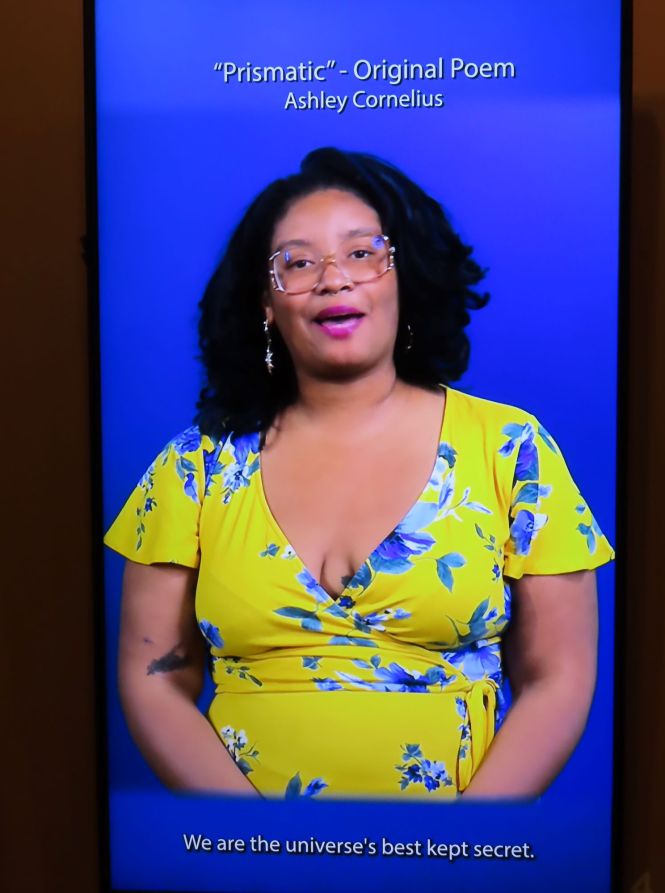
Pikes Peak Poet Laureate, Ashley Cornelius (click HERE to watch and hear her amazing performance of her poem, “Prismatic”).
As you can see from my (unsuccessful) attempt to provide a short summary, it’s very easy to spend hours and hours in this space, trying to take it all in. Thank you for accompanying me on today’s tour through this engaging, educational, and enlightening exhibit at my favorite museum.
 tanja britton
To my morning mind, “Glorious Garden of Light” suggested pieces of watermelon, and the artist’s first name a different food. On the next-to-the-last day of our July trip we made sure to revisit the Georgia O’Keeffe Museum in Santa Fe.
LikeLiked by 1 person
It’s nice to let our imagination run wild when looking at art.
I hope you enjoyed the exhibit in Santa Fe. We have seen her house in Abiquiu and visited Ghost Ranch, but not the museum.
LikeLike
And for us it’s the reverse: several times at the museum but never Abiquiu or Ghost Ranch. The museum is good but always crowded.
LikeLiked by 1 person
We will need to remedy our respective “Bildungslücken” during our next trips to New Mexico! 😊
LikeLike
I didn’t know the word Lücke, which Wiktionary says is related to Loch. That’s a word I knew because my grandmother used to disparage a thing by saying in Yiddish that she needed it like a luch in kop.
LikeLike
This is a very fascinating museum!! Thank you for sharing!!
LikeLiked by 1 person
Thank you, Gavin. We will have to visit the museum the next time you are in town! 😊
LikeLike
This museum is a treasure box! Thank you for presenting it to us!
Kindest regards,
Christa
LikeLiked by 1 person
Thank you, Christa. Treasure box describes the museum perfectly.
Best,
Tanja
LikeLike
Yes, thanks for sharing. What a fantastic exhibit! One to revisit time and time again. To me, Glorious Garden of Light looked as though it featured glowing flying saucers. Fun how different people get different things from the same painting.
LikeLiked by 1 person
Thank you, Laurie. One can visit and revisit the museum countless times and still not look at everything.
It’s indeed fun to learn what different people see in artistic creations. Your interpretation makes me wonder if you are reading or watching any sci-fi stories at present. 😊
LikeLiked by 1 person
Looks like you might be right about it being a great museum… wish I lived closer!
LikeLiked by 1 person
Thank you, Eliza. Put it on your to-do list for your next Colorado trip! 😊
LikeLiked by 1 person
A terrific show.
Did the museum train docents for this exhibit, or did you have to do research on your own?
LikeLiked by 1 person
Thank you, Neil. The museum staff provides us with great training sessions for each new exhibit. It continues to be an amazing experience.
When you are done volunteering in PA, come join us! 😊
LikeLiked by 1 person
I love the embroidery! Thanks for the tour of a museum and exhibit that I’ve not visited. Adding it to the list for next time I’m in the Springs.
LikeLiked by 1 person
Thank you, Diana, I hope you will be able to visit one of these days. You would not regret it!
LikeLiked by 1 person
What an amazing and colourful introduction to the 50% of the story display at the Colorado Springs Pioneers Museum! If I lived a little closer, I would definitely consider visiting the new facilities. Greetings from Canada!
LikeLiked by 1 person
Thank you, Peter. It’s too bad the museum isn’t just around the corner from you. I’m sure you would enjoy a visit there. 😊
LikeLiked by 1 person
Yes, even if it was a two hour drive, I would come and take in the displays.
LikeLiked by 1 person
I’m glad to hear that, Peter.
LikeLike
An excellent exhibition – I’d visit if I lived anywhere near. (And I think it’s a very important subject, underappreciated for too long.)
LikeLiked by 1 person
Thank you, Ann. It’s definitely high time for women to get equal treatment and credit.
LikeLiked by 1 person
Agreed!!
LikeLiked by 1 person
Thank you for sharing this exhibition with us, very interesting!
LikeLiked by 1 person
Thank you, Donna. It’s an amazing exhibit.
LikeLiked by 1 person
Thank you so much, Tanja, for the introduction to this stunning exhibit! I’d say the 50% is %100! There are some truly stunning pieces, here. And good for you that you’re a docent for so many years!
LikeLiked by 1 person
Thank you, Tina. Well said!
Volunteering at the museum has been a profound and enriching experience.
LikeLike
This is a thought-provoking post on an issue that should be of interest to anyone – regardless of gender – who cares about art, culture and history. Enormous credit is due to the Museum staff who came up with the idea of this exhibition. How hard did they have to fight, I wonder, to get their proposal accepted, how much opposition did they face and how many minds did they have to change along the way? And what has been the (private) reaction of Museum professionals in other, similar institutions? We’ll never know, of course, but it’s interesting to speculate.
“As we all know, museums have not always been places that tell objective and inclusive stories.” Absolutely, and the same is true of academic history texts. I am a historian by training, but looking back nearly 50 years to my time as a student at one of the UK’s great universities, women’s role in history (with the exception of a couple of feisty queens!) was never mentioned, and virtually all of the history professors I encountered were male. This would not be the case today, and as your post also demonstrates our society has moved on enormously, though there’s still a way to go.
Thank you again for this post, which has certainly left me with a lot to think about.
LikeLiked by 1 person
Thank you for your thoughtful comment, Mr. P, and for your many interesting questions. I have had similar ones, but don’t know the answers to most.
As docents, sometimes we sense if visitors don’t agree, and occasionally we are told, though most people keep their opinions to themselves. I’m sure the museum officials receive most of the complaints and pushback.
The hope is for all of us who visit museums to get challenged to question some of our preconceived notions, and to examine or reexamine the facts. I think many exhibits at our museum (and surely many others) attempt exactly that.
You are right: Progress has been made, but there’s still a long way to go!
LikeLiked by 1 person
The legacy of the British Empire is a massively controversial subject here, one that museums and galleries can’t avoid (however much they may wish to do so). What you and I would regard as progress is seen as betrayal and “wokery” by others. It’s all very uncomfortable, and I hope those on the side of progress will continue to hold their nerves as the debate rages on.
LikeLiked by 1 person
I share your hope!
LikeLiked by 1 person
I’m so glad the museum is showcasing the works of the women of Pike’s Peak. I wish the museums and galleries of towns and cities worldwide would follow suit. I’m happy to see that the curators were wise enough to include items like quilts, embroideries and a beaded bag because I think these art forms have been devalued in our western society, which has always favored paintings and sculpture. Thanks for amplifying the exhibition with your post, Tanya…wish I could see it in person but this is great.
‘
LikeLiked by 1 person
Thank you, Julie. If you lived here, maybe one of your creations would have been included in the exhibit! 😊
Let’s hope that the trend to be more inclusive will continue at other museums and galleries.
LikeLiked by 1 person
How interesting that the exhibit has various media forms. It reminds me of the time when Mexican artist Frida Kahlo emerged from the unknown precisely because of her prolific multi-media works of art honoring self-expression and indigenous art. She endured a lot of hardship just to emerge as an artist. I think her influence was felt in the USA too. Indigenous women are the protectors and custodians of cultural values, and this Colorado exhibit is honoring and celebrating women’s creativity. Definitely a must-see when traveling to Colorado. Thanks for sharing!
LikeLiked by 1 person
Thank you for your interest and comment, Maria.
I love your mention of Frida Kahlo. She created amazing art, despite her tumultuous life and she is well known in the US. I don’t know if you have read Barbara Kingsolver’s novel “La Lacuna,” but Frida features prominently in the story.
I’m glad the powers that be at our museum decided to create this exhibit. It has garnered a lot of attention and commentary, mostly positive.
LikeLiked by 1 person
I read ‘Frida: A Biography of Frida Kahlo’, a 1983 book by Hayden Herrera. I will check out ‘La Lacuna’ soon at Amazon. It sounds really interesting. Thanks.
LikeLiked by 2 people
I hope you will like it!
LikeLiked by 1 person
Thanks, I will!
LikeLiked by 1 person
Smaller museums and regional museums can be treasures themselves, as well as displaying a variety of artistic and historic treasures. This is a wonderful example. It did cross my mind that, for whatever reason, very small and very local museums, like those in small Texas towns, often provide more varied offerings precisely because they feature the more ‘homely’ creations of pioneer women: quilts, embroidery, and so on. The need for beauty is present in every part of society, and where sculpture and painting aren’t available for viewing, women often did their part to enliven their environments.
Thanks for this wonderful presentation of ‘your’ museum. I’d love to see some of these pieces in person, but your photos do very well.
LikeLiked by 1 person
Thank you, Linda. I also love local and regional museums. Ours has a professional staff, of course, but some smaller ones in the region are run entirely by volunteers completely dedicated to sharing their history.
What I particularly like about this exhibit is that it celebrates so many wonderful creations made by women during countless hours of dedicated work without any thought of ever having them put on public display, or without considering themselves artists. Yet artists they were, and their creations are undoubtedly artistic.
LikeLike
A worthy endeavor. I especially like the lack of labels on the individual pieces. I never look at any backstory or signage when I visit an art exhibit until I have had a chance to take in the piece and form my first impressions – what does it mean to me, what do I think the artist’s message is (if any) and the all important question – do I like it. With that out of the way I an then look for additional background to see if it changes or taints that impression. With that, I can say Linda gets extremely annoyed as it takes me forever to make it through the exhibit…especially if there are birds ha. Thanks for sharing.
LikeLiked by 1 person
Thank you for that comment, Brian. I think you have a very enlightened attitude towards art. Many people seem annoyed if they are not given some information. I also like to form my own opinion first, and if I want/need to know more, can always do so after the fact.
LikeLike