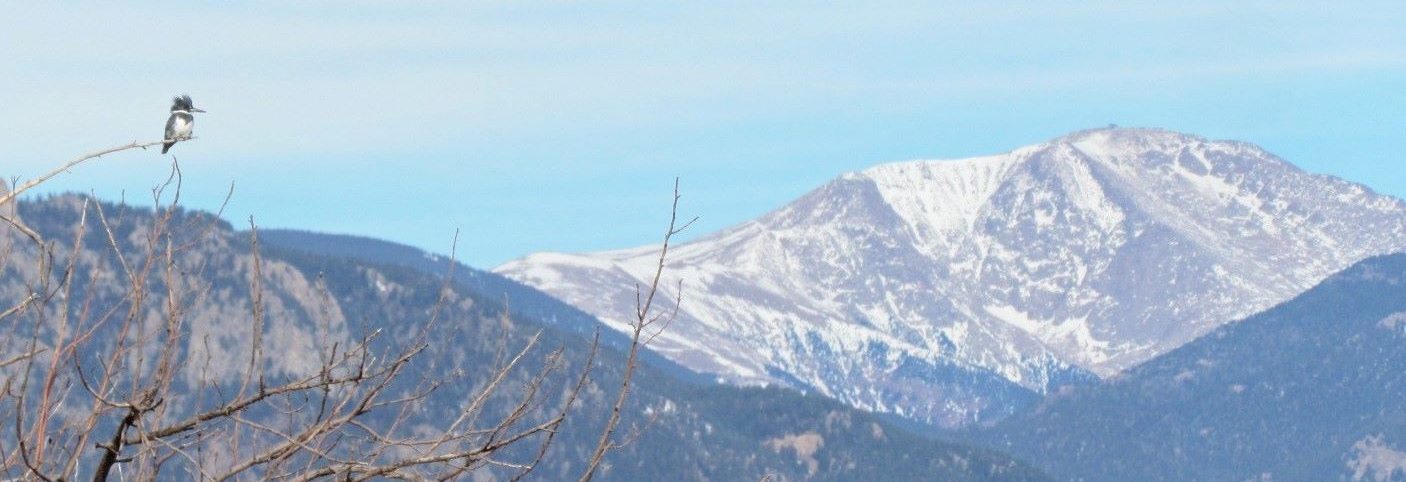

Encounters with wild animals generally fill me with gratitude and happiness, none more than encounters with birds. But whenever I’m out and about with binoculars and camera looking for feathered friends, I also pay close attention to the presence of other creatures. Occasionally, I am lucky and see furry fauna besides our ubiquitous (albeit still-appreciated) squirrels and rabbits and deer. Such was the case on a luminous October day last year that I spent birding along the eastern fringes of Colorado Springs out in the county, where some (too few) residual pockets of prairie have survived the deplorable suburban sprawl and unsustainable development El Paso County is known for.
I will never understand the hate some humans harbor for coyotes. The same humans who love coyotes’ close relatives, dogs (according to a 2024 American Veterinary Medical Association survey, 45.5% of US households own a dog), don’t have any compunctions about trapping, poisoning, or shooting these intelligent, inquisitive, and charismatic canines who fulfill an important role in the ecosystem. I don’t consider a camping trip complete unless our nights in the tent under the stars are made more memorable by the nocturnal utterances of nearby coyotes.
In case you wonder about the title of this post, the scientific name for a coyote is Canis latrans, literally “barking dog.” The unimaginative term “barking” does not do justice to their various and varied vocalizations which include, but are not limited to, yapping and yelping, shrieking and squealing, howling and wailing.
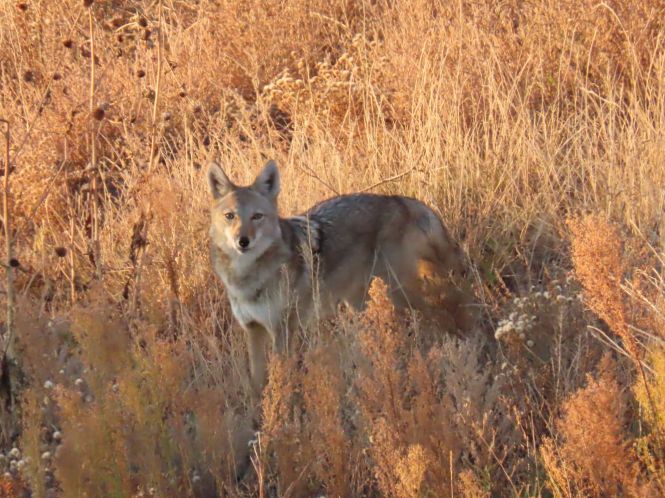
Coyotes occur in all US states other than Hawaii. Having proved extremely adaptable to a wide variety of habitats from grasslands to forests to urban areas, coyotes are supposedly thriving, with the US population estimated at between 2.9 and 4.7 million. That wide range alone gave me pause, as did the fact that most states do not conduct coyote counts but estimate their numbers per square mile, then extrapolate to the entire state (in Alabama, for example, that estimate spans from 1 to 15 animals per square mile!). I can’t help but wonder if their actual numbers might be lower.
The majority of US states allow hunting year-round, with most, though not all, requiring a valid hunting license. Because it is considered a “nuisance” species that occasionally hunts livestock or, rarely, family pets, if a landowner has the impression that a coyote is depredating on his or her land, he or she may kill it without further justification; in some states killing is legal for no other reason than a coyote setting foot on private property, no questions asked!
An estimated 500,000 coyotes are killed each year. To me, that’s a mind-boggling number, especially when one considers that many individuals are likely killed without getting reported. What also boggles my mind: It’s still legal to trap coyotes (and other animals). The fact that it’s acceptable in 2025 to ensnare a sentient being and let it bleed or starve to death, or both, is one more proof that humankind is on the wrong path (as we are daily reminded when one asinine pronouncement after the other assaults us from some centers of power, though that is giving asses a bad name, which is not intended).
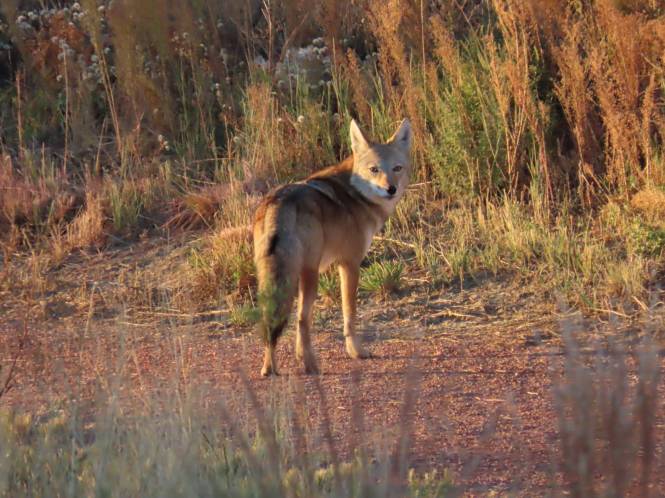
It is not surprising that coyotes are leery of humans because they never know the intentions of the person staring or pointing a shiny object at them—I suspect a camera’s glint is reminiscent of the gleam bouncing off a rifle’s barrel. Most of the time when I’m lucky enough to see coyotes, they are in the process of running away while glancing warily over their shoulders. I try to allay their fears by talking soothingly to them—usually to no avail. But that’s probably for the better. Their justified fear notwithstanding, they occasionally stop long enough to allow me to take a photo or two in which the fleeing derrière is not at the center of the image.
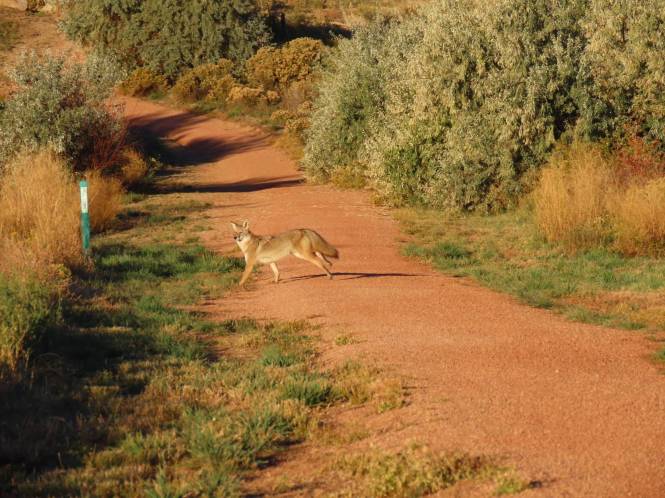
On this particular October morning, my good-looking coyote did not seem unduly alarmed and paused for several instances, granting me a couple of captures with my camera. I admired her (my assumption) graceful gait, attentive attitude, curious countenance, and the way the light of the rising sun suffused her coat with warm tones. After locking eyes for a few brief moments, she wandered off. I wished her good luck, hoping she wouldn’t have to cross busy roads with speeding cars, or meet any trigger-happy gunslingers; wishing her instead to be able to make her way towards a safe den in which to rest for the remainder of the day while dreaming about the next nocturnal foray.
PS: The figures used in this post are based on the website Wildlifeboss. It makes a legitimate impression but if anyone takes issue with these statistics, please let me know.
 tanja britton
Thanks for sharing. Your photos are particularly beautiful in the October light. The critter is good-looking indeed.
LikeLiked by 2 people
Thank you. It was a beautiful time of day for this beautiful encounter.
LikeLiked by 1 person
Hi, Mrs. Tanja-
Thank you for sharing these facts. I also enjoyed the photos you were able to snap!
~Gavin
LikeLiked by 1 person
Thank you, Gavin. As always, I appreciate your visit and comment.
Best,
Tanja
LikeLiked by 1 person
Ja, leider gibt es überall auf der Welt schlechte Menschen. Ich finde, Amerika macht es mit seinen tierfeindlichen und blöden Gesetzen für diese Leute viel zu leicht. Danke für diesen informativen Bericht mit den wunderbaren Bildern vom bellenden Hund.
LikeLiked by 1 person
Danke für den Kommentar, lieber Ernst. Ich finde es sehr deprimierend, daß viele Tiere nicht besser geschützt werden. Und die menschliche Tendenz, sich selbst über andere Lebewesen zu erheben ebenso. Wir haben nichts (oder nicht genug) aus den Fehlern der Vergangenheit gelernt. 😢
LikeLiked by 1 person
Nice pictures of this beautiful animal! I am with you all the way when it comes to hunting coyotes. Such persecution makes me sick to my stomach. Glad to read coyotes are flourishing nonetheless.
LikeLiked by 1 person
Thank you, Laurie. Humans’ ways of “stewarding” the Earth leave very, very much to be desired. If it weren’t for Nature’s resilience, we would be even worse off. 😢
LikeLike
Alas.
LikeLiked by 1 person
The reason you gave, “that [the coyote] occasionally hunts livestock or, rarely, family pets,” does seem to explain many people’s dislike of the animal. In my Austin neighborhood it’s not unusual for people to let their pet cats wander freely outdoors, even though adjacent Great Hills Park is known to harbor coyotes, and every once in a while a pet fails to return.
Coyotes are close enough to dogs that they can interbreed, giving rise to coydogs female dog and male coyote) and dogotes (male dog and female coyote).
The Aztecs, from whom English (via Spanish) got the word coyote, enshrined the animal in their pantheon of gods as Huēheuhcoyōtl (literally old old coyote).
LikeLiked by 2 people
The same behavior is true of cat owners here (and even of some dog owners). I find it deplorable how many irresponsible pet owners there are and that wild animals have to pay for their irresponsible behavior.
Each year, “problem bears” get killed because people can’t be bothered to secure their trash and wait to put it outside until trash day. People leave out dog or cat food and then they complain when wild animals come onto their property to feed.
I have said it before and will continue to say it, “we are a sorry excuse for a species” (though as I have also said before, there are exceptions, but apparently not enough).
In addition to coydogs and dogotes, there are coywolves. All this interbreeding makes one question the notion of species.
LikeLike
Yes, I realized a long time ago how hard it is to find a definition of “species” that fits all cases. The word chosen to represent the concept is Latin, in which language its basic sense was ‘that which is seen in a thing, i. e. the outward appearance, outside, exterior; shape, form, figure, mien, etc.’ (The same Latin root having to do with seeing appears in spectacle and spectator.) And yet two entities that look quite similar sometimes get classified as different species, and two rather different-looking entities may get classified as belonging to the same species. As the Romans used to say: oy vey.
LikeLiked by 1 person
It used to be easier when species were classified by morphology, at least for the casual observer. Genetics have complicated things for laypersons.
LikeLike
I didn’t know much about it. Well shared with beautiful photos 😊
LikeLiked by 1 person
I’m glad you think so. Thank you for stopping by and for commenting.
LikeLiked by 1 person
🙂
LikeLiked by 1 person
Unfortunately, the situation, concerning the hunt is the same here in Canada.
As for coyote sightings – I was blessed to had two encounters in our woods not far away and during one encounter we have both seen each other and looked into each others eyes! This is a moment that will be forever remain engraved in my memory!
Kindest regards, Christa
LikeLiked by 2 people
That’s sad to hear, Christa. I always think of Canada as a better version of the US, and am still convinced that’s true on many, many levels. But apparently not when it comes to the treatment of certain wild animals.
I’m glad you also had the soul-stirring experiences of locking eyes with coyotes and I hope there will be more for you and for me.
Take care,
Tanja
LikeLike
Humans have been on the wrong path for eons. Ours is a highly flawed species.
Anyway, I enjoyed reading your essay. Have a good rest of the week!
LikeLiked by 2 people
Thank you, Neil. I’m afraid your verdict about humans is correct. We know better, but are apparently unable to translate that knowledge into action, at least when it comes to humanity as a whole. There are many individuals who do, but evidently not enough. 😢
LikeLiked by 1 person
Thanks for sharing these coyote facts and photos. We’ve heard them many times while camping, but seen a surprisingly small number of them out and about. I know they’re here, though.
LikeLiked by 1 person
Thank you, Diana. I’m glad coyotes are mostly active at night, and even though they can be hunted then, with a special permit (though I wonder if anybody really checks), otherwise I’m convinced even more would be killed. It’s another sad statement about humankind.
LikeLiked by 1 person
I enjoyed reading your interesting post on the coyotes, Tanja. It is sad that many people have so little respect for wildlife to allow the killing of animals that they deem to be dangerous or being a nuisance. Not only coyotes, but also many other animals, such as wolves, Canada geese, squirrels etc., are being culled.
LikeLiked by 1 person
Thank you for your comment, Peter.
I share in your sadness about the ways people behave on our precious planet. We are the worst bullies ever and don’t deserve to be in control.
LikeLiked by 1 person
Gorgeous photos and great captures of this beautiful animal. Like you, I don’t understand the hatred that some have for these remarkable critters. I don’t see them in my part of Austin, but they’re common in other areas of town.
The last time I heard their calls was in the Davis Mountains (West Texas) about 12 years ago, on a camping trip. I love their vocalizations! Nice post, Tanja!
LikeLiked by 1 person
Thank you for your comment, Tina.
I think nobody who has ever enjoyed those vocalizations during a camping trip will ever be able to forget them. Let’s hope that they will still sound in the future so that more people may be touched by them.
LikeLike
Your photos capture the essence of a magnificent creature that should be left along to live as Nature intended. We encountered coyotes only rarely during our wildlife viewing trips around the US, but each sighting was a thrill. Thanking you for reminding me of those encounters.
LikeLiked by 1 person
Thank you, Mr. P. I hope you had so few encounters because coyotes are mostly nocturnal. As I wrote in another comment above, thank goodness for that fact. There might be even more casualties if they were active during the day. What a sad statement about humankind. 😢
LikeLiked by 1 person
We rarely ventured out after nightfall, and our only coyote sightings were during daylight hours – I wonder what made them come out at a time of day when they should have been resting?
Thinking about it now, we did also spot a few road casualties when out driving during the day – very sad.
LikeLiked by 1 person
It is sad to see so many dead animals by the side of the road.
Your comment made me look up coyotes’ sleep patterns, and I must admit that I was wrong. Apparently, they are not originally nocturnal.
“By nature, coyotes are diurnal, but their sleeping pattern or circadian rhythm depends on their environment and location. Coyotes that live near human settlements are nocturnal. This activity pattern is valuable in avoiding contact with humans during the daytime and hunting for food at night. Nighttime is when people hear them howl, causing the misconception that they are nocturnal animals. But coyotes that live further away from humans in more remote areas tend to be diurnal and hunt during the day.
The number of hours coyotes sleep daily varies from a few minutes up to 12 hours. These animals sleep safely in their dens or sleeping areas away from predators. They have varying sleeping patterns and wake up easily if they are disturbed by movement or noises.”
Here is the website I referenced, in case you are interested:
https://a-z-animals.com/animals/coyote/coyote-facts/are-coyotes-nocturnal-or-diurnal/
LikeLiked by 1 person
Interesting to see how human interaction causes them to modify their behaviour. The places we saw coyote were always remote, so a diurnal lifestyle would have been appropriate. Thank you for the website link – seems like a useful resource.
LikeLike
Stunning photos, Tanja! I wholeheartedly agree with you on the abysmal treatment by humans, of these intelligent, gorgeous creatures. I keep hoping for a day when we realize how lucky we are to share a planet with them. I also hope we finally see that we are living on their turf, not the other way around.
LikeLiked by 2 people
Thank you for your comment, Julie. I keep hoping, too, but I’m afraid that the necessary majority of humans does not share the sense that this is a planet we need to preserve and share with all other living beings. 😢
LikeLiked by 1 person
I fear that you are right, Tanja. 🩵
LikeLike
😦
LikeLiked by 1 person
Great pictures of beautiful animals, Tanja.
LikeLiked by 1 person
Thank you, Pit, I’m glad you think so.
LikeLike
I think coyotes are the only apex predator left in our area (unconfirmed sightings of wolf and puma occasionally pop up). Any predator is routinely hunted here. Coyotes are considered ‘vermin’ and I loathe the practice of putting out a carcass to lure a pack in to be blasted by yahoos. Ugh, it makes me so livid!
LikeLiked by 1 person
What a sad, sad statement about us so-called “pinnacles of creation.”
LikeLike
I have pretty much lost faith in humans, sad to say. 😦
LikeLike
I share that feeling, Eliza, and the sense of sadness that comes with it. 😢
LikeLike
Liebe Tanja,
vielen Dank für Deinen interessanten und informativen Bericht über Koyoten und die feinen, naturbelassenen Fotos dieser hübschen Tiere.
In Deutschland werden Füchse nach wie vor auf grausame Weise und mit qualvollen Fallen “dezimiert” und gejagd. Ich habe schon diverse Petitionen von Tierschutzorganisationen unterschrieben, welche die Fuchsjagd verbieten oder wenigstens einschränken wollen.
Herzlich grüßt Dich
Ulrike
LikeLiked by 1 person
Liebe Ulrike,
vielen Dank für Deinen Kommentar sowie Deinen Einsatz für die Füchse. Ich werde immer zynischer, was die Menscheit angeht. Anscheinend können oder wollen wir nicht dazu beitragen, diesen einzigarten Planeten für uns und unsere Nachkommen sowie für alle anderen Lebewesen zu erhalten.
Das macht mich furchtbar traurig . . . 😢
LikeLiked by 1 person
This hunting also has to do with ‘Wildlife services’, of the U.S. Department of Agriculture. It is reportedly allowed to kill native wild animals at the request of ranchers and livestock owners, including those protected by the Endangered Species Act. The NPR article ‘That’s a bloodbath’: How a federal program kills wildlife for private interests’ explains this very well:
https://www.npr.org/2024/10/10/g-s1-26426/wildlife-services-usda-wild-animals-killed-livestock
LikeLiked by 1 person
Thank you for your comment and link, Maria.
It’s so upsetting that agencies that should protect wildlife are actually destroying it, often without justification. It is very doubtful that in the current political climate anything positive will be accomplished for Earth, Nature, and wildlife. That’s very, very concerning, because we are running out of time . . . 😢
LikeLike
Liebe Tanja, ich liebe die Kojoten in Deinem Land sehr. Habe sie oft gesehen und wenn möglich, diese schönen Erinnerungen auf Fotos festgehalten. In Deutschland macht sich der Goldschakal breit und ich begrüße das sehr. Auch die Wölfe werden hier immer mehr – das Drama ist nun, die Wolfshasser und Fuchsjäger werden immer lauter. Gründe für die Jagd werden immer gefunden. Sei es Tollwut, seien es Nutztierrisse. Petitionen sind nützlich, bewirken aber nichtg sehr viel. Ich kann Deinen Zynismus gut nachvollziehen. Vielleicht kennst du auch das Buch von Shreve Stockton “Der tägliche Kojote” “The Daily Coyote”. Wenn nicht, würde ich es Dir gerne empfehlen. Es ist eins meiner Lieblingsbücher.
LIeben Gruß
MAren
LikeLiked by 1 person
Danke für Deinen Kommentar, liebe Maren.
Menschen beanspruchen für sich das Recht, sich dort auszubreiten, wo sie wollen, und alle anderen Tierarten werden als Feinde angesehen, wenn sie mit uns konkurrieren oder uns sonst irgendwie unangenehm werden können. Leider fehlt oft das Bewußtsein, daß wir Teil der Natur sind, und nicht über ihr stehen, und was diese Einstellung angerichtet hat, erleben wir täglich weltweit.
Das Buch von Shreve Stockton kenne ich nicht, habe es mir aber gerade in der Bibliothek reservieren lassen, danke für den Vorschlag.
Sei herzlich gegrüßt,
Tanja
LikeLiked by 1 person
Das Buch wird Dir gefallen.
LG
Maren
LikeLiked by 1 person
Liebe Maren,
ich wollte Dich wissen lassen, daß ich inzwischen das von Dir empfohlene Buch, “The Daily Coyote” gelesen habe. Und du hattest recht–es hat mir sehr gut gefallen. Allerdings habe ich mich die ganze Zeit über gefragt, wie die Erzählerin eine Beziehung mit einem professionellen Kojote-Killer haben konnte. Ich hätte das nicht gekonnt.
Lieben Gruß,
Tanja
LikeLiked by 1 person
Das habe ich mich auch gefragt, ich hätte das niemals akzeptieren können. Ich hatte auch nicht gewußt, dass es Wettbewerbe in den USA gibt, wer die meisten Kojoten schießt. Ich hoffe, diese sind inzwischen eingestellt, ich habe nichts wieder darüber gelesen.
Liebe Grüße – MAren
LikeLiked by 1 person
Ich habe auch nichts über Wettbewerbe gehört. Aber in vielen Staaten ist es legal, Kojoten zu schießen, wenn sich jemand “bedroht” fühlt. Leider!
LikeLiked by 1 person
Ein weiteres meiner Lieblingsbücher ist von Nate Blakeslee – American Wolf – A true Story. Die Geschichte von 06 – der berühmtesten Wölfin aus dem Yellowstone NP. Grüsslies
LikeLiked by 1 person
Danke für eine weitere Buchempfehlung, liebe Maren!
LikeLiked by 1 person
Fascinating post. I too cannot understand why humans who love dogs should persecute their wild cousins, but then I find many humans increasingly incomprehensible. May you enjoy many more encounters!
LikeLiked by 1 person
Thank you, Cathy. I share your jaded view of humans; we don’t deserve to be in the position of power over all of creation as we have proven to be very inept caretakers. 😢
LikeLike
Interesting, sad information on such a beautiful wild animal. I have only seen one in my life while in Arizona, we were following our GPS not knowing it was all dirt roads and nothing else in sight. We came up on a very thin coyote alongside the road, it didn’t run when we slowed down to see what it was. Not knowing what to do, I tossed our two peanut butter sandwiches out the window and then we left slowly. He watched us and then went to the sandwiches and devoured them. Made me feel better when leaving, but I wasn’t sure if it was something I should have fed it, we had nothing else.
LikeLiked by 1 person
Thank you for your comment, Donna. I wonder if your coyote had mange, which affects the population regularly. It’s very sad to see an animal so afflicted. I don’t blame you for offering it your sandwiches, I would probably have done the same.
LikeLiked by 1 person
Coyotes in the wild are one thing. Coyotes roaming in packs in urban areas, or causing problems on farms and ranches are quite another. In my county, for example, loss of habitat and an abundance of food has led to an overpopulation of coyotes, with all of the problems that can bring (not only for coyotes, but for other species as well, like white-tailed deer).
They are classified as nongame animals, and can be taken when posing a direct threat, or hunted with a license on private land, but I don’t know anyone who dislikes them without reason. Everyone loves to hear their howls at night; not everyone enjoys seeing one snatch a family pet, or appreciates the way they can clean every rabbit and squirrel out of an area. On the other hand, coyotes can take down small or young feral hogs, and nearly everyone in the state wishes them well in that endeavor! They’ve been quite effective at reducing the feral cat population here, as well — and the birds thank them for that!
LikeLike
Thank you for your comment, Linda.
You have a better view of humans than I. Many people don’t like coyotes for no other reason that they have been misunderstood and loathed and shot for “sports” ever since emigrants started encountering them on their overland journey, and many don’t seem willing to stop and question their preconceived notions.
I do understand concerns about livestock predation and overpopulation and, like other species whose numbers are unsustainable, they need to be controlled. Controlled is the keyword, but there does not seem any control, as nobody needs to give any justification to kill a coyote for whatever real or perceived reason. And many states do not require a license to kill.
I also take issue with pet owners who think it’s acceptable for their pets to wander freely. Just think of house cats who are known to kill between 1.3 to 4 billion (with a B) birds a year in the US alone (based on estimates by serious organizations). I would, of course, not want my (or anybody else’s) beloved cat killed by a coyote, but it’s up to me to be a responsible pet owner and not the coyotes’ fault.
LikeLiked by 1 person
As a matter of fact, my city takes the damage caused by roaming cats so seriously that it re-wrote the law. Now, it’s illegal for unleashed dogs or cats to roam freely. Enforcement can be hard, of course, but they try, and apartment complexes like mine make it a part of lease agreements that animals are not to roam the property.
The coyotes help out, in their way. I’ve seen an interesting cycle repeat several times through the years. Roaming cats show up, and before long the coyotes are spotted in the middle of the night, cruising the parking lots. Before long, there aren’t any more cats, and the coyotes disappear!
LikeLiked by 1 person
It’s good to know that your city is addressing this issue. Like with so many other problems, we wouldn’t need legislation if we all did the right thing, but we seem either unwilling or unable to do so.
LikeLiked by 1 person
We are surrounded by Coyotes packs and often serenaded by their haunting howls as they celebrate their successful hunts or simply socializing. They definitely keep our small animal populations thinned – a needed service when it comes to Trash Pandas and Possums, but heartfelt when seen running by with Kits in their mouths. Unfortunately, here in the Midwest they have no natural predators which puts them at the apex until they bring back the Wolf which isn’t going to happen with the farm lobby here. Unfortunately, they have a nasty habit of baiting our local pets by placing one of their pack directly in line of sight to the pet to draw it forward and then pinch it off with multiples hidden back on both sides. Can’t comment on other regions, but rest assured, they are doing just fine. Nice pictures with the golden settings!
LikeLiked by 2 people
Thank you for your comment, Brian. I’m glad you have also been enjoying the coyotes’ amazing vocalizations.
It’s sad, of course, if coyotes attack somebody’s pets, but I think it’s irresponsible to allow our domesticated animals to roam free for many reasons. I don’t have to tell you how many birds are needlessly killed by house cats each year–it boggles the mind. Many loose dogs are aggressive toward humans and both cats and dogs get run over by cars. I think it’s our responsibility to assure that wildlife can continue to thrive.
LikeLiked by 1 person
[…] with the charming coyote in the luminous light of the rising October sun you might remember from my previous post, the morning holds another surprise. After moving on to another favorite birding destination in […]
LikeLike
Nice photos Tanja. As Brian said earlier, we have no shortage of coyotes around Central Illinois. Is it “kai-yoat” or “Kai-yoh-tea” in your neck of the woods, er, mountains? The pronunciation seems generational around here. Kids that grew up on Roadrunner cartoons seem to use the three-syllable version, while the older generation rural residents use the two-syllable pronunciation. My house is similar in surroundings to Intrigued HQ: ravines and trees and rural. Pets being left outside are in danger from coyotes, even larger dog owners need to be mindful to never leave a pet unattended, or tethered, outside. I really liked the “golden hour” treatment of your photos.
LikeLiked by 1 person
Thank you, Brad. The golden hour “treatment” just happened, but I thought it made the coyote even more attractive.
I also pronounce the name with 3 syllables, even though I did not grow up with Roadrunner cartoons. 😊 But I think your sense that older generations pronounce it with only 2 syllables is correct, it’s something I have noticed here as well.
I’m glad to hear that coyotes are doing well in central Illionois.
LikeLiked by 1 person
First, I just wanted to note how refreshing it is to read this comment stream, with its thoughtful and insightful comments/ conversation. This is why I love WordPress, in contrast to surface Facebook or such media comments. Thanks for posting.
Growing up in a rural farming area, when you heard the coyotes (3 syllables 😉 ) very determined and loud night howling, you worried that your neighbor’s lambs or sometimes chickens were in danger. Other than that, they seemed very shy, and you rarely saw them.
And I so agree that keeping pets indoors or on a leash should be standard procedure.
LikeLiked by 1 person
Thank you for your comment, Julie.
I agree that the WP community is typically very caring and insightful and I really appreciate everyone who takes the time to read and comment on issues that range widely.
I’m grateful you are part of that community! 😊
LikeLike
They are very beautiful animals. Your photos are lovely. It must have wonderful to see and make eye-contact with an individual feeling secure enough not to feel the need to take flight.
I also hate the cruel blanket persecution of species – especially when multi-faceted and more humane management strategies can be deployed that are appropriate to local contexts.
LikeLiked by 1 person
Thank you for your comment, Carol. I feel exactly the way you do. It’s sad that we seem unable (or unwilling) to take a nuanced approach to conflicts wildlife.
LikeLiked by 1 person