This is part 2 of a series of posts about our road trip to Texas. If you missed part 1, click here.
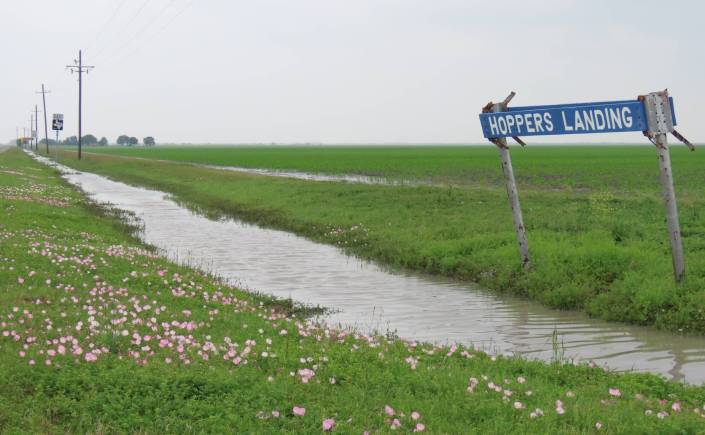
Following our first night at Goose Island State Park, we set out to visit Aransas National Wildlife Refuge 32 miles to the east, where I hoped to see Whooping Cranes (Grus americana). Various birders had told us that the cranes had left for their breeding grounds in Canada already, making my heart sink. On our way to the refuge, the residual flooding alongside the road visible in the featured photo above served as a reminder that a recent weather front had dumped between 10 and 20 inches of rain on some parts of the coast, though the amount along this stretch was a more moderate three to five inches, according to some locals. A significant change in weather can be a signal for birds to commence migration and I couldn’t help but wonder if that had been the case for the cranes.

Once at the refuge, we checked in at the office with my husband’s Senior Lifetime Pass. Formerly known as Golden Eagle Pass and available for the amazing price of $80 to citizens or permanent residents 62 or older, it affords access to all National Parks, Monuments, and Refuges as well as additional federal lands, and it offers a 50% discount on camping fees, where applicable. If you are eligible and have not yet purchased this pass, you are missing out!
When the rangers told us that three Whooping Cranes had been reported by various visitors that very morning, we hopped back in the car and drove to the spot of the last sighting: an Observation Tower at the end of the main park road. Located close to and affording views of San Antonio Bay and Mustang Lake, we ascended the 40-foot steel structure on gently sloping ramps that are also wheelchair accessible. I postponed reading the signs in the parking lot until later, quickly marching up to the platform at the top instead.


I was greeted by a stiff breeze. In the distance I saw three large, white birds, and just as I was taking the cap off my camera lens, they took off, flying even farther away from the tower. I held my breath. When they landed again near the water’s edge, I let out a sigh of relief. Distant as they were, their white color, tall stature, dark caps, and black wing tips gave them away as those hoped-for birds: Whooping Cranes. Apparently most, though not all of them had left. Hallelujah!


A sense of urgency had fueled my desire to find them because these cranes are considered endangered. According to Cornell’s All About Birds,
The Whooping Crane is the tallest bird in North America and one of the most awe-inspiring, with its snowy white plumage, crimson cap, bugling call, and graceful courtship dance. It’s also among our rarest birds and a testament to the tenacity and creativity of conservation biologists. The species declined to around 20 birds in the 1940s but, through captive breeding, wetland management, and an innovative program that teaches young cranes how to migrate, numbers have risen to about 600 today.
A second, possibly more recent entry on the same website states that in 2021, there were 802 individuals, 136 of whom lived in captivity.
600 to 800 Whooping Cranes! While that’s certainly better than 20, it’s not a number that should make us comfortable or complacent. According to the International Crane Foundation, located in Baraboo, Wisconsin, an estimated 1,200 to 1,500 existed in North America in the mid 1800s—apparently they were never abundant. I don’t have to spell out what happened to the cranes—it was similar to what befell the bison and beaver. All of them suffered nearly the same fate as the Passenger Pigeon, extinct since 1914.
Thanks to the 1918 federal Migratory Bird Act and subsequent government-sponsored and private interventions, the survival of Whooping Cranes has—thus far—been assured. How our governments and societies think about and treat this world of ours has profound consequences, and we need to speak out when protective laws that have been put into place by concerned individuals across generations are coming under threat. The current administration has made no secret of the fact that it would like to get rid of the Migratory Bird Act entirely, and many other protections for nature besides.


As a result of decades of dedicated conservation efforts, North America today has two migratory flocks of Whooping Cranes: the group that travels between Texas and Canada, and a second that goes back and forth between Florida and Wisconsin. In addition, both Florida and Louisiana have small resident populations. All of the Whooping Cranes living today are descended from the migratory flock that overwinters at Aransas NWR.
We were fortunate enough to see three individuals from that flock. My photos are distant and grainy, but the second one shows that the middle crane’s head is darker than the other two. This marks the bird as a juvenile. Juvenile cranes start out with reddish-brown feathers that are replaced by white ones as they age. Maybe this teenager wasn’t yet ready to leave and the parents stayed to give her more time? The young crane would have flown to Texas from Canada under her own power last autumn and should be able to manage the return journey.
I don’t know why these three cranes were lingering, but I am grateful for their presence. May tail winds aid their journeys and plenty await them always.
“In the end, we will conserve only what we love; we will love only what we understand, and we will understand only what we are taught.”
Baba Dioum, Senegalese forestry engineer, born 1937
PS: As the map above shows, the Whooping Cranes make a refueling stop in North Platte, Nebraska (alongside Sandhill Cranes) during their migration. We visited there a number of years ago, but not at the right time. Catching only distant glimpses of the trio of cranes at Aransas NWR fanned my desire to return to North Platte to see more. I hope to do so soon.
 tanja britton
Oh wow! I didn’t know the Whooping cranes were endangered! I took them for granted when we lived in Florida. We had several pairs of Sandhill cranes around the various neighborhoods we lived in too. Quite messy birds!
LikeLiked by 1 person
Lucky you. To be able to see both Sandhill and Whooping Cranes year-round is wonderful, but I think Florida and Louisiana might be the only states where that is possible, and I couldn’t live there.
Thank you for your comment.
LikeLiked by 1 person
You’re welcome. And we don’t live there anymore. Moved to New Hampshire a year ago.
LikeLiked by 1 person
Good for you. We visited N.H. once and loved it there.
LikeLiked by 1 person
Yay, I’m glad you saw them, especially knowing that their numbers are so low. Their migratory path is about 4 hours from me, so I think I’ll look into sites in Saskatchewan for viewing them. Maggie
LikeLiked by 1 person
Thank you, Maggie. I was very grateful for this trio.
I hope you will make it to Wood Buffalo NP. If you time it right, you should be able to see baby cranes. How amazing that would be!
LikeLike
So glad you were able to see the cranes! Yay! Yes, South Texas was really dumped on with the rain. That’s kind of how it is here: drought or drown! 🙂
We got two of those Senior Lifetime Passes last summer when we visited Olympic National Park (which I just LOVED, btw). We were 63 then and hopefully will use them for years to come. We’re headed to NM in June and will take a side trip to visit Mesa Verde, so they’ll come in handy there, too. The passes are a great deal.
LikeLiked by 1 person
Thank you, Tina. Seeing the cranes was a dream come true.
Before we left we didn’t know about how extensive the drought was in some parts of Texas. And then to get hit with 20 inches of rain in two days! Too much of a good thing!
The lifetime passes are indeed a great deal and I hope all of us will continue to make good use of them.
LikeLike
Seems strange to have you in Texas. Glad you got to see your long-sought whooping cranes, even if only three from afar. I expect you got closer looks at plenty of other members of the state’s avifauna.
I’ve had a Golden Eagle pass for years and have made good use of it, six times out west last year and most recently in the Everglades.
LikeLiked by 1 person
I was very glad that not all the cranes had left. Better a distant glimpse than none. And you are right about us getting closer looks at many other feathered friends. But then that was the prime reason for the trip.
The lifetime pass makes a lot of sense. One doesn’t even have to travel across the country, it can pay off during repeat visits to local/regional parks. If we never left Colorado again and visited only our national parks here, it would already have paid for itself.
LikeLike
So glad you were rewarded with a sighting, Tanja. Thanks for sharing the moment with us, it’s a thrill to see them. 🙏🏼
LikeLiked by 1 person
Thank you, Eliza. It was very special to see this trio and I hope I will get another opportunity.
LikeLiked by 1 person
This refuge is one of my favorite spots on the coast. I’ve never climbed that observation tower, but I know where it is, and I enjoyed imagining you there. The fact that you were gifted the sight of the cranes makes it doubly wonderful. I never saw cranes there, but I did see my first bullfrog! I have seen Whooping Cranes in flight. Once, a few came over my town (League City) during the fall migration, headed to the coast. There’s absolutely no mistaking them; nothing else that passes over us comes close to being that dramatic.
LikeLiked by 2 people
It must be fun to visit this refuge repeatedly during different times of the year. Maybe you will get to climb the tower during one of your visits in the future, I loved having the bird’s eye perspective.
I have experienced (and enjoyed) a flyover of Sandhill Cranes before and hope to witness one by Whooping Cranes one day. I think it might happen in Nebraska. Lucky you for having had the whoopers fly over your town.
LikeLiked by 1 person
I would love to visit!
LikeLiked by 1 person
Thank you, Cindy. I hope you will one day.
LikeLike
Liebe Tanja, ich denke, die Cranes waren Nachzügler, eine kleine Familie, die sich nicht von Aransas trennen mochte. Wie gut, dass Du sie sehen konntest und danke für Deinen Bericht, Du weißt, meine Erinnerungen werden stark und stärker wenn ich das lesen kann und die Bilder sehe. Wir haben Texas entdeckt und lieben gelernt, weil ich unbedingt diese Kraniche sehen wollte. Im Februar, als wir mit Pit und Freunden dort waren, hatten die Jungvögel noch braungeflecktes Gefieder, ich sehe, der Jungvogel hat nur noch einen braunen Kopf. Ich hoffe, sie brüten erfolgreich in Kanada und immer mehr Wooping Cranes kehren zurück nach Aransas, um zu überwintern. In Florida haben wir keine Kraniche gesehen, ich habe gelesen, es gibt noch Standvögel in Louisianas Sümpfen.
Liebe Grüße
Maren
LikeLiked by 1 person
Liebe Maren,
diese Kraniche zu sehen hat mich sehr beglückt. Es ist beklemmend zu wissen, wie wenige es auf der Welt gibt und welchen Gefahren sie ständig ausgesetzt sind. Das Klima und die Welt ändert sich vor unseren Augen und wir dürfen nichts als garantiert ansehen. Deshalb bin ich für diese Begegnung besonders dankbar.
Wie immer freut es mich, daß Du in Gedanken Deine Reisen nach und in Texas wieder durchlebst.
Dir ein gutes Wochenende,
Tanja
LikeLiked by 1 person
Dir auch ein gutes Wochenende und viel Spaß an den Fotos Deiner Texasreise. Freue mich auf jedes einzelne Foto.
LG
MAren
LikeLiked by 1 person
Dankeschön, liebe Maren!
LikeLike
Even “grainy” images are far better than no images at all. The story helps provide the sharpening for our minds. I’ve also been through Nebraska looking for cranes and haven’t seen very many at all. Thanks for sharing.
LikeLiked by 2 people
Thank you, Brad. Every time I look at these photos, even if they are grainy, they bring back happy memories. And they act as documentation of what I saw.
I hope you and I will have the opportunity to return to Nebraska at the right time of year to see both kinds of cranes!
LikeLiked by 1 person
Mrs. Tanja-
Thank you so much for writing and sharing pictures of these beautiful birds. I am so glad you were able to see them after your long drive!!
~Gavin
LikeLiked by 1 person
Thank you, Gavin. These moments with the cranes were among the highlights of our trip!
LikeLiked by 1 person
Congratulations Tanja!! I am happy to say that the Whooping Crane was my trigger bird to get back into birding after putting the camera down to go off to college and then start the daily grind. We ended up taking a trip down to Aransas and the interest was sparked seeing those incredible birds – the rest is as they say history ha. When you get a chance to get back down in that area in the January timeframe let me know and I’ll get you much, much, closer to these mega birds. So glad those three stayed around for you. I was trying to tell from you pictures if they were banded or not – I always get excited when I see the ones without bands as I know those were probably born in the wild. I assume you found some pie/cake to celebrate your lifer.
LikeLiked by 1 person
Thank you, Brian. It’s easy to see why these cranes would have convinced you to get back to birding, they are so charismatic.
I think chances are higher for me to go to North Platte in Nebraska before returning to the Texas coast. It would be nice to see Whooping Cranes intermingling with Sandhill Cranes.
I was definitely not close enough to see if any of these three cranes had a band.
I had plenty of occasions to celebrate life birds during our trip. I probably gained at least 5 # because of all the pie/cake I ate. 😊
LikeLiked by 1 person
Haha, birding can be hard on your waistline. Definitely not the numbers of North Platte, but there are usually 20 to 30 sandhills mingling with the 15 to 18 Whoopers at this other location…you can really see the height difference there..I thought the sandies were big until a whooper stood up next to it and unfolded those wings.
LikeLiked by 1 person
If I might venture a guess, I suspect you might send me to Lamar Beach Road near Big Tree to see both cranes next to one another.
LikeLiked by 1 person
Yep.
LikeLiked by 1 person
Great post and pix, Tanja! Good to learn thst that the whooping cranes have risen from 20 to 600! 😎❤️🙏
LikeLike
Thank you, Darryl.
You are right, the success in saving the Whooping Cranes proves the importance of conservation and gives hope.
LikeLike
A long journey that payed off in final, you saw the Whooping Cranes…. Braveheart discoverers Tanja and Mike!
Isabelle CoutureXXX
LikeLiked by 1 person
Thank you, Isabelle. But I don’t think we can claim to be brave discoverers. 😊
Someone else had seen them before and, luckily, they were still present by the time we arrived.
LikeLike
[…] For part 2, click here. […]
LikeLike
I am so happy you could see the Whooping Cranes! The information you shared about them is also very thoughtful and thought-provoking.
I have yet to see our native Cranes (in the wild), it is one of my dreams…
LikeLiked by 1 person
Thank you, dear Takami. It was definitely a dream come true.
And I hope you will also be able to fulfill your wild crane dream at some point.
LikeLiked by 1 person
What a great sighting. They are magnificent birds, and it’s good to know their numbers have recovered from that shocking low point. But I hadn’t realised that your Migratory Bird Act is under threat – let’s hope that good judgment and environmental sensibility ultimately prevail, though judging by the news I read every day from the US the omens are not good.
LikeLiked by 1 person
Thank you for your comment, Mr. P. It’s definitely good their numbers have recovered and one hopes their population will continue to sustain itself, but I think it does so only with the added breeding program.
I’m afraid one cannot expect good judgment in any regard from this current administration, as they seem to aim for chaos and destruction in everything they do.
LikeLiked by 1 person
I hesitate to comment on the politics of other countries (it’s bad enough here in the UK), but your analysis seems totally justified. Unbelievable!
LikeLiked by 1 person
Utterly and completely unbelievable and incomprehensible. And reprehensible.
LikeLiked by 1 person
[…] For part 2, click here. […]
LikeLike
How interesting is your experience with the whooping cranes. All the current administration cares about is money and a material world. Neither animals nor the environment figure as important as Bitcoin or winning a trade war! I truly hope these coming years are over soon.
LikeLiked by 1 person
I hope so too!
LikeLike
[…] For part 2, click here. […]
LikeLike
[…] For part 2, click here. […]
LikeLike
[…] For part 2, click here. […]
LikeLike
[…] part 1, click here, for part 2, click here, for part 3, click here, for part 4, click here, for part 5, click here, for part 6, […]
LikeLike
[…] part 1, click here, for part 2, click here, for part 3, click here, for part 4, click here, for part 5, click here, for part 6, […]
LikeLike