
Considering the range map of this iconic bird, it is no surprise that we came across Greater Roadrunners (Geococcyx californianus) during our Texas road trip this spring.

Range map of the Greater Roadrunner (Geococcyx californianus)/Wegekuckuck oder Großer Rennkuckuck. The color purple signifies year-round distribution of this species in its range. Courtesy Cornell Lab of Ornithology.
Possibly known by more people thanks to a cartoon rather than real life, allow me to set the record straight. We did not hear any roadrunners utter the words, “meep, meep,” or witness any instances of rocks being dropped on coyotes. Furthermore, while the roadrunners of the animated film kind are generally smarter and faster than coyotes, in real life they can be outrun by coyotes whose 40 mph speed is twice as fast as their own.
Luckily, we didn’t have to witness any life-or-death drama between the two cartoon antagonists. But we had the pleasure of repeated roadrunner viewings—eBird informs me that 11 of my submitted checklists included them. Interestingly, the first sighting happened at Lake Alan Henry near Lubbock, where we spent our first night in Texas; the last sighting occurred at Palo Duro Canyon, where we spent our last. Both are located in the Texas Panhandle where we entered and left the state, and our roadrunner encounters thus served as bookends to our time in the Lone Star State. All others transpired in the Rio Grande Valley—we did not see them along the coast, the birds’ preferred habitat being arid grasslands and low deserts.

“Good Evening!”
Measuring about 2 feet between the tip of the beak and the tip of the tail with a long neck, legs, and tail, roadrunners are conspicuous, even if their mottled brown, black, and white feathers blend well into the desert landscape. They belong to the Cuckoo family, Cuculidae, but unlike most cuckoos who live in trees, roadrunners spend most of their lives on the ground, a fact reflected in their genus name, Geococcyx, meaning “ground cuckoo,” from the Greek, geo, for “earth,” and kokkyx for “cuckoo.” If coccyx reminds you of the anatomical name for the tailbone, I salute you. Apparently, this curved bony appendage that’s located inferior to the sacrum reminded some early anatomists of a cuckoo’s curved beak.
As their name reflects, these birds are often seen running along the edges of roads in pursuit of sustenance. Their diet consists of anything they can put in their beaks: insects, arachnids, amphibians, reptiles, small mammals, or even other birds. They are famously known to be able to kill rattlesnakes, usually in cahoots with a companion. While one distracts the snake, the other pins its head, then slams the body against a rock until death ensues. The snake is then swallowed successively, with parts protruding from the beak until the bird’s digestive system is able to handle the next segment! And while they prefer meat, they will eat seeds or fruit or other vegetation if need be (they sound like some people I know).
Here are a few more interesting tidbits. As desert dwellers, roadrunners cover most of their water needs from the food they eat. They also conserve water by secreting salt through a gland in front of their eyes, instead of through their urinary tract. Like other birds, they take dust baths to help cool off and rid themselves of skin parasites. The patch of facial skin behind the eye can be white or show red and blue patches, the latter apparently more common during breeding season.

“After this hot day . . .”

” . . . I feel the need to cool down in some dust . . .”

“That was refreshing!”

“Greater Funambulist might be another name for me. I have no trouble balancing on a narrow wall.”
Cornell’s All About Birds shares many more fascinating facts about these charismatic birds, including recordings of their songs, which sound like co-coo-coo-coo-cooo, arranged in a descending pattern. “Meep-meep” is not among the recorded vocalizations but, who knows, we might still come across it if we only listen hard enough.
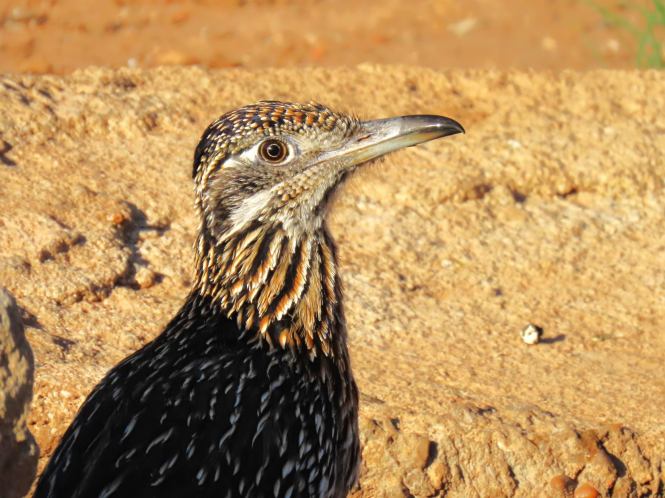
“If I may say so, my eyes are no less attractive than the rest of me. “
If you are interested in my previous posts about our road trip, you can find them under the Texas tab in the menu.
 tanja britton
I recall seeing a roadrunner when we were in the Southwest. But it was particularly fun to learn from you that a coyote can outrun one. For other cartoon fans like me, Fort Robinson, Nebraska’s Trailside Museum shows how they found the skeletons of two bull mammoths who died with their horns locked. Under one was the skull of a coyote who evidently wasn’t wily and got too close. 😁
LikeLiked by 1 person
Glad you had the opportunity to see a roadrunner during your travels.
The scenario you describe sounds like a drama with a bad outcome for everybody involved–no winners there!
LikeLiked by 1 person
Great captures, Tanja. A very cool bird, even if it doesn’t say ‘meep-meep!’ 😉
LikeLiked by 1 person
Thank you, Eliza. Roadrunners are cool birds. Considering their rather fearless behavior, their mellow, dove-like song comes as a bit of a surprise.
LikeLiked by 1 person
That’s a good sized bird! We don’t have them here in the midwest, but I sure would love to see them out there when I travel. Great photos! 😊
LikeLiked by 1 person
Sorry for the belated response, your comment ended up in the spam folder which I hadn’t checked for a while.
I hope you will come across a roadrunner during your travels. Seeing one is a memorable experience (even it doesn’t quite act like its TV relative 😊).
LikeLiked by 1 person
No worries on the delay! It’s summer and we both should be outside more. Remember when our mom used to call us in for dinner? Those were the days! 🌟
LikeLiked by 1 person
Wise words! Enjoy your summer!
LikeLiked by 1 person
Im Palo Duro Canyon habe ich ihn auch gesehen – er hatte sogar eine Eidechse im Schnabel, wahrscheinlich für seine Jungen. Den Roadrunner zu sehen, das war mein großer Wunsch auf den Texasreisen. Auch bei unseren Freunden in der Nähe von Dallas haben wir ihn gesehen. Nur in New Mexico nicht, dabei ist er dort der Staatsvogel 😉 Deine Bilder sind fantastisch, danke fürs Mitnehmen.
Viele Grüße
Maren
LikeLiked by 1 person
Vielen Dank, liebe Maren.
Wie schön, daß Dein Wunsch, Roadrunners zu sehen, in Erfüllung gegangen ist. Ich finde es nett, daß Neu Mexico den Roadrunner als Staatsvogel gewählt hat. Wir haben ihn dort schon gesehen, ebenso wie weiter südlich in Colorado. Manchmal verirrt sich einer sogar in unser County, doch leider nicht allzu oft.
Liebe Grüße zurück,
Tanja
LikeLiked by 1 person
That’s a good closeup you show at the end. Based on the distribution map, you won’t be surprised that we see a roadrunner every now and then in the Austin area.
LikeLiked by 1 person
Thank you, Steve. The individuals we met weren’t too shy and we were able to get some close views.
Glad you are able to see roadrunners from time to time near Austin.
LikeLike
They team up to kill and devour rattlesnakes? Amazing!!
LikeLiked by 1 person
That was exactly my reaction when I learned about this behavior!
LikeLiked by 1 person
Even cuter than the cartoon version. 😊
LikeLiked by 1 person
Thank you, Pepper.
They are very handsome!
LikeLiked by 1 person
Tanja, it was a delightful surprise to see pictures of real roadrunners on your blog post this morning. I remember the Saturday mornings in the 70’s when our boys were watching the roadrunner cartoon. I always thought that this figure was just a cartoon character with no connection to the real world.
LikeLiked by 1 person
Thank you, Peter. While based on real-life roadrunners, some liberties were taken with the cartoon character. I think entire generations of Americans (and Canadians,it sounds like) grew up with Looney Tunes.
LikeLiked by 1 person
Darling birds! I don’t see them often, though I did see one in a native plants garden in Albuquerque, NM, on our trip. It was wary of us, but let me gawk at it for a bit. I’m on the Birds of Texas FB group, and often folks from North Texas will post photos of them. I’ve see pics of the male standing at a window or glass door, lizard in beak, bringing a gift to the photographer. These birds are flirts!
I’d have to move out west, which isn’t out of the question…:)
LikeLiked by 1 person
Thank you, Tina. It would be quite a surprise to have a roadrunner show up to your glass door with a lizard as a present. Maybe that’s still in the offing for you!
LikeLike
Out west or to New Mexico (which is something we have discussed before). 🙂
LikeLike
Very glad you were able to see such varied behaviors and capture those events in photos to share. Yes, the “kokkyx” did remind me of the word for tailbone, loosely translating to “ground tailbone” because those are the two parts that usually connected when riding horses with my cousins when we were little. Even though there weren’t any “meep meep” sounds, did you see any little clouds of dust as they took off running?
LikeLiked by 1 person
Thank you, Brad.
Ground tailbone doesn’t sound like any fun at all, even though the riding no doubt was.
Sadly, no “meep, meep” sounds, and no dust clouds. But seeing the roadrunners still was fun. 😊
LikeLiked by 1 person
How nice! All are new to me…
LikeLiked by 1 person
Thank you. They were new to me too when I moved to the US. They don’t occur in Europe.
LikeLiked by 1 person
Great shots and writing, Tanja.
LikeLiked by 1 person
Thank you, Michael, much appreciated! 🙏
LikeLiked by 1 person
You’re most welcome, Tanja.
LikeLiked by 1 person
Thank you so much for sharing, Mrs. Tanja!!
I loved learning about this bird through the information you presented. I have actually never seen one of these birds before! They are quite fascinating! I cannot believe that they would eat snakes and even other birds! That seems so strange to me for a bird.
Funny enough, this small creature reminded me of a mini ostrich as I examined the photos.
I hope that you are doing well! My family and I are on a road trip right now, similar to the one we took last year where we were able to visit you and Mr. Mike (just in a different part of the United States), so I have had you both on my mind recently! 🙂
Blessings,
Gavin
LikeLiked by 1 person
Thank you, Gavin. I’m glad you enjoyed getting to learn a few facts about these interesting birds. They are definitely very tough to survive in desert-like landscapes.
It always makes me a little sad to know that some birds eat other birds, but it happens not infrequently.
Glad to hear that all of you are on a road trip. We hope you are enjoying your time together and are seeing many interesting and beautiful sights. Tell everybody hi from us!
Best,
Tanja
LikeLiked by 1 person
It definitely is a sad thing.
I will send my family your salutations! 🙂
LikeLiked by 1 person
I never see roadrunners in my area, of course, but when I spend time in the Kerrville/Uvalde/Llano area, I do see them from time to time. The first time I saw one, it was perched on the railing of a bar in Camp Wood — what a treat!
I have a friend outside Kerrville who used to have one as a sort-of-pet. At the time, there was little around her place but brush, cedar, and gravel roads. When the bird showed up one afternoon, she threw it a bit of chicken trimmings. That was the beginning of a long and beautiful relationship, although her kids used to complain it wasn’t fair that she gave the roadrunner bits of raw steak, while they had to eat hamburger.
LikeLiked by 1 person
I have heard of other instances of people developing almost pet-like relationships with roadrunners. I do feel a little conflicted about it, but I’m sure I would enjoy getting to know and observe one closely over the course of many years.
I too have seen a roadrunner perched on a railing, and that one was singing, an enchanting moment.
LikeLiked by 1 person
Thank you for setting the record straight dear Tanja!
Admittedly my first introduction to the road runner was indeed “meep meep” during my university years in the US☺️ (As a non-birder at the time, I didn’t even know that real road runners do exist!)
What an interesting and in my subjective opinion pretty bird! I am glad you could see them in person!
LikeLiked by 1 person
Thank you, dear Takami. I think you are not alone in meeting your first roadrunner on TV.
I agree with your subjective assessment of these birds, they always make me stop in my tracks.
LikeLiked by 1 person
Being in the UK, I had only the cartoon version of the roadrunner in my head – always a favourite character in my childhood. So this was very interesting and lovely to see this attractive bird…but I am perhaps, a little disappointed that there’s no ‘meep meep’! 🙂
LikeLiked by 1 person
Sorry to take away from your childhood memories, Ann. I will let you know if I ever come across a roadrunner who knows what’s expected of him. 😊
LikeLiked by 1 person
Hehe!
LikeLiked by 1 person
Such charismatic birds; I’m glad you had repeated encounters and good views. Some lovely photos.
LikeLiked by 1 person
Thank you, Mr. P. They are definitely birds with character and I’m always glad when I happen across them.
LikeLiked by 1 person
In Germany we had a common documentary series called “Tiere vor der Kamera” of Ernst Arendt and Hans Schweiger. They filmed the Roadrunner as you can see here: Der schnellste Vogel im Wilden Westen | Tiere vor der Kamera (1986) | Folge 19/54. They described the bird as charismatic. By the way: the documentary of them which I like the most is about the Keas in New Zealand.
LikeLiked by 1 person
Vielen Dank für den Kommentar und den Link zum Film. Ich bin ja auch in Deutschland aufgewachsen, kann mich aber leider nicht an diese Serie erinnern. Eine Bildungslücke, und mein Verlust!
Die Folge über die Keas habe ich auch schon gefunden und merke sie mir mal vor.
LikeLike
I was astonished when I first found out that roadrunners were part of the cuckoo family, Tanja. My husband had one follow him on a walk, the roadrunner was showing him his stick. Nature is wonderful!
LikeLiked by 1 person
I was also surprised to learn that fact, Kerry. They are unusual birds in more ways than one!
LikeLiked by 1 person
Ah, the patron animal of the running community. They are definitely abundant in the south Texas region (especially at Benson-Rio and Falcon state parks. It also happens to be one of Linda’s favorite birds – not so much for its beautiful coloring and exquisite shape, rather for their absolute savaging of snakes – enemy of my enemy …. The dirt bath shots were awesome!
LikeLiked by 1 person
Thank you, Brian. It was fun to watch this roadrunner take a dust bath–at Benson-Rio, by the way! 😊
I have seen roadrunners with frogs before, but not with snakes, I imagine it would be wild (and hair-raising) to watch a duo take down a rattlesnake.
LikeLiked by 1 person