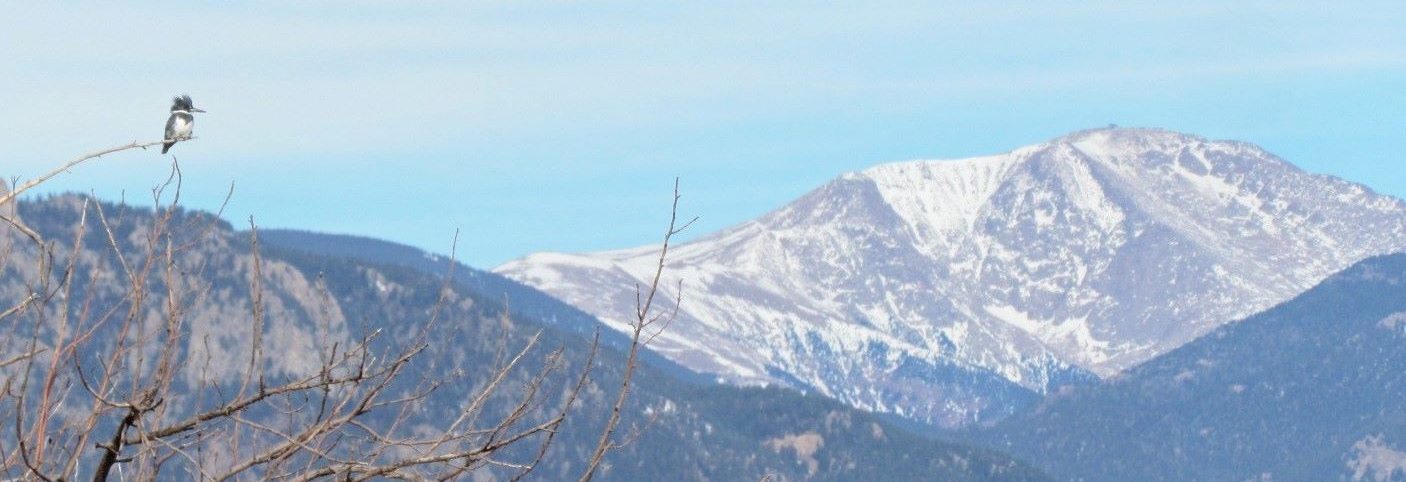

I had seen exactly one Scissor-tailed Flycatcher (Tyrannus forficatus) in my life prior to our trip to Texas this spring, in May 2021, when a lone representative was observed 15 miles south of Colorado Springs at Clear Spring Ranch, a birding hotspot. This triggered an odyssey of local bird lovers to the site, as this region is not part of the bird’s usual range.
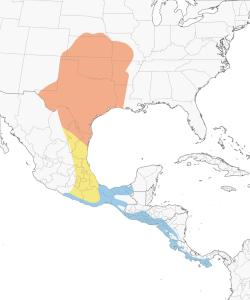
Range map of the Scissor-tailed Flycatcher (Tyrannus forficatus)/Scherenschwanz-Königstyrann. Red, breeding range. Blue, non-breeding range. Yellow, migration. Courtesy of Cornell Lab of Ornithology.
The more fortunate south-central US, on the other hand, is blessed with the presence of this stunning species each summer, where it migrates from Central America to meet its mate and makes babies. Its appearance in Colorado is not as far-fetched as it might appear at first glance, and a review of the Colorado Bird Records Committee shows several dozen documented sightings in the last 25 years in the state. This is due to what the Cornell Lab of Ornithology describes as follows:
Scissor-tailed Flycatchers tend to wander widely on their way to and from the wintering grounds, a habit they share with Fork-tailed Flycatchers and Tropical Kingbirds. During spring and fall they may show up almost anywhere in North America, as far north as British Columbia and Nova Scotia.
Cornell also mentions that “the Scissor-tailed Flycatcher forms large premigratory roosts in late summer, with up to 1,000 birds in one flock. They often roost near towns, perhaps taking advantage of the large trees as roosting sites.”
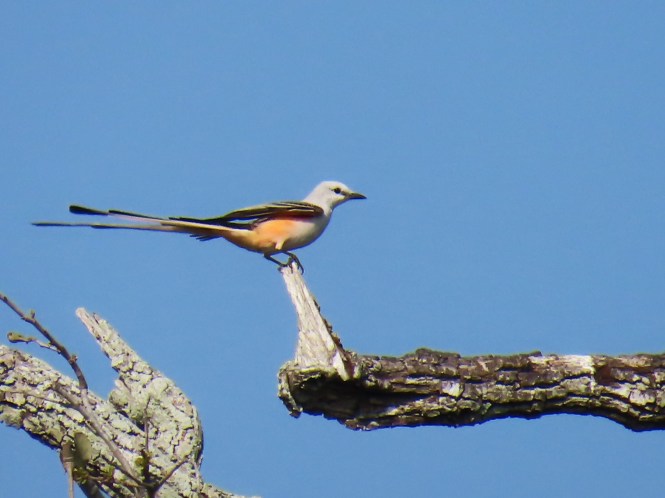
While I can only dream of finding myself in the presence of a flock with hundreds, much less a thousand, of these arresting avians, I was elated to see a total of 21 on 12 different occasions during the two-and-a-half weeks we spent in Texas. This is not due to any merit of my own, but rather to the fact that they love to perch on fences or power lines in open country. As well as to their most conspicuous body part—a tail whose length exceeds that of their body and whose forked appearance is immortalized in the bird’s name.
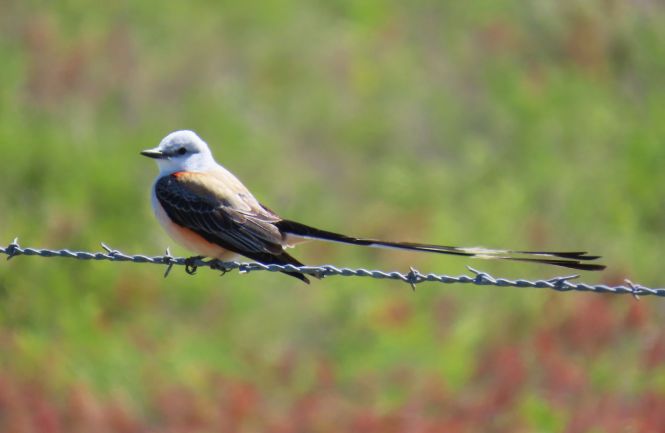
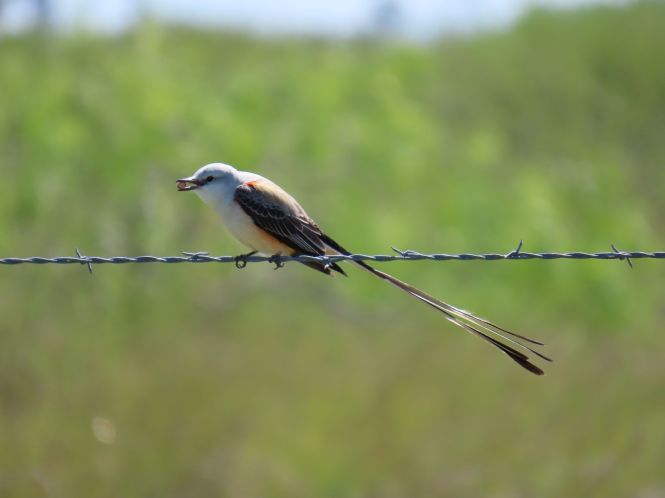
The genus name, Tyrannus, tells us that the Scissortail is a kingbird and belongs to the family Tyrannidae, aka tyrant flycatchers. It also suggests that representatives of this family don’t tend to be shrinking violets but, instead, are full of self-confidence, to put it mildly. According to merriam-webster.com, the species name forficatus is derived from the Latin forfic-, forfex, which means “scissors, shears” and perhaps results from an alteration of forcip-, forceps. While the birds’ long tails might seem like an encumbrance, they actually help them perform quick aerial maneuvers in pursuit of insects, their preferred food, even though they will occasionally supplement their diet with berries.
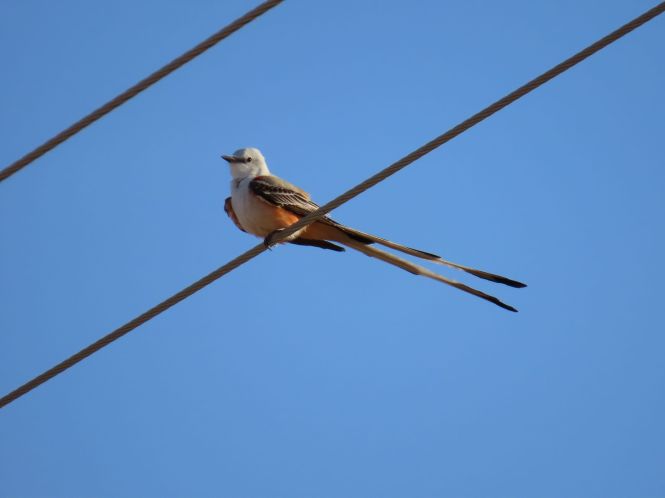
As all my photos show, there is no overlooking that splendid tail. Another favorite feature of mine: the salmon-colored feathers on the belly and flanks as well as under the wings. Alas, I was not granted a photo of these colorful underwing coverts. Here is a link to an eye-catching photo in Cornell’s Macaulay Library that shows half a dozen scissortails suspended in mid-air with extended wings and spread tails. Not surprisingly, this was taken in late September 2018 in Texas, very likely during the aforementioned premigratory gathering that exemplifies the old adage, “birds of a feather flock together.”

If you are interested in my previous posts about our road trip, you can find them under the Texas tab in the menu.
 tanja britton
What an awesome birding moment! Scissortails are such showstoppers—those tails are unreal. 😍 Love how many you spotted on your trip!
LikeLiked by 1 person
Well said–showstopper is the perfect word to describe them. Thank you for your coomment.
LikeLiked by 1 person
You’re so welcome! 😊 I’m still amazed by how gracefully they move, like little sky dancers. Hope you spot even more on your next outing!
LikeLiked by 1 person
What a striking bird! I can see how easily they can steal the show☺️ I am happy you had many opportunities to view them during your trip.
LikeLiked by 1 person
Thank you, Takami. Scanning the power and fence lines was very rewarding time and again and the tail often gave away the bird, making me very happy.
LikeLiked by 1 person
What a handsome bird. It’s good to know that their magnificent tails are a help rather than a hindrance, though I guess evolution would have taken the bird’s morphology in a different direction if that were not the case.
LikeLiked by 1 person
Thank you, Mr. P. Long tails in birds often make me wonder about the practicality of having to carry and care for them. But you are right and they must have proven to be helpful and advantageous in the course of time.
LikeLiked by 1 person
What a unique tail! A pretty bird indeed.
LikeLiked by 1 person
Thank you!
Thanks to that tail, it’s nearly impossible to miss this bird when it perches on a wire next to the road.
LikeLiked by 1 person
You have really captured the elegance of this bird in these photos. We had flycatchers who nested right over the window of a cottage, we spent many summers at, in Ontario. I don’t know if they were scissor tailed but they had the same coloring as these ones. 🤔
LikeLiked by 1 person
Thank you, Julie. How nice that you remember nesting flycatchers from your childhood.
Given the distribution of the Scissortails, I don’t think they were the ones you saw in Ontario. There is an entire range of flycatchers that nest in North America, it could have been any number of them.
LikeLiked by 1 person
Elated is a good word for your reaction to finding yourself in a place where this species is common. The Latin original meant ‘carried away’ or ‘carried out from,’ as coincidentally the flycatcher has sometimes been from its normal range.
LikeLiked by 1 person
Getting carried away by birds is one of my favorite escapes.
I could pretend to have known the etymology of the word, but that would be a lie.
LikeLike
Learning that origin may be belated / But the new word knowledge leaves you elated.
LikeLiked by 1 person
Wow, what luck on your part to capture so many flycatchers, Tanja! Their long tail is truly remarkable.
LikeLiked by 1 person
Thank you, Peter. I was very gratified to see these striking flycatchers on a number of occasions. It probably won’t happen again for quite some time.
LikeLike
Great set of photos, Tanja! Along with that great tail and the salmony tummy, I love their sweet little faces–such pretty birds! Glad you saw some! They’re not around my neighborhood in north/central Austin, but whenever I venture southward, especially towards the Lady Bird Johnson Wildflower Center, I always see at least one and it’s a treat!
LikeLiked by 1 person
Thank you, Tina. This is a bird that will always wow the observer. I agree that they have very pretty faces, their tyrant reputations notwithstanding.
It’s nice that you know about a place to find at least one of them, in case you need your Scissortail fix. 😊
LikeLike
That is some tail. As I was reading your piece, I was wondering if it might have a use other than being ornamental. Yes, it does. What a treat to come across so many of them. Imagine seeing thousands. Wowsah!
LikeLiked by 1 person
Thank you, Laurie. I will always remember them fondly as part of this trip. It would be astounding to see hundreds, if not a thousand, of them at once!
LikeLiked by 1 person
You bet!
LikeLiked by 1 person
What a beautiful and unusual bird! It must be quite dramatic in flight.
LikeLiked by 1 person
Thank you, Eliza. They are quite dramatic to behold. It’s a dream to see a flock of them in flight.
LikeLiked by 1 person
This bird’s one of my favorites. They’re one of those signs of a changing season here; when they show up, summer’s on the way. I usually see them on Galveston Island, perching on wires or fencing, just as you described. It does make them easy to spot. They’re so fast and agile, they’re great fun to watch as they pursue insects. I’m glad you were able to see them.
There’s a bit of an update about flamingos in Texas. Check out my comment on Sam’s blog, and her response. I think you might have seen quite a different bird from the one I already knew about. Now, I’m going to have to watch for them around Galveston Bay and Bolivar.
LikeLiked by 1 person
I always claim not to have favorite birds, but while that’s mostly true, it’s also true that encountering some birds comes with an extra frisson of happiness, which is absolutely true for the Scissortails. Lucky you for being able to go to the Island to see them if you want to (during the right time of the year).
Thank you also for the link about rarities seen at Galveston Island and more information about American Flamingos. It will be interesting to see if more show up in unusual places in the future.
LikeLiked by 1 person
We use to see these when we lived in NW Arkansas. They are very impressive.
LikeLiked by 1 person
Good for you. I would love to be able to see them regularly. I never tire of looking at them.
Thank you for your comment.
LikeLiked by 1 person
I love this species . Great shots, Tanja.
LikeLiked by 1 person
Thank you, Michael, I do too. Seeing so many was very memorable.
LikeLiked by 1 person
Beautiful experience.
LikeLiked by 1 person
Indeed, it was. 🙂
LikeLiked by 1 person
Hi, Mrs. Tanja-
What a fascinating bird!! I have never seen one of these before. I think that their split tail provides so much character to where one could never mistake it for a different kind of bird! Often times, when birds perch on the feeders in our backyard, I struggle trying to tell them apart since they all look so similar! I feel that if one of these showed up in my yard, I would not be able to mistake it! I really appreciate that about this bird! Despite this fact, though, all birds (and all of the Lord’s creation for that matter) are beautiful!!
Thank you, once more, for adding us with another peak into your Texas trip!
Blessings to you,
~Gavin
LikeLiked by 1 person
Thank you for your comment, Gavin. I suspect that you would be able to see these striking flycatchers if you were to spend some time driving more rural roads and scanning the power lines and fence posts. This might be a fun project before the summer is over and they will leave again to head south! Just in case you need something else to do before it’s time to go back to school. 😊
Best,
Tanja
LikeLiked by 1 person
That sounds like a very fun activity!! Thank you for the suggestion! 🙂
LikeLiked by 1 person
I think you would really enjoy seeing one of these long-tailed beauties. And who knows, there might be a roadrunner also! 😊
LikeLiked by 1 person
I saw my first scissortail flycatcher a few months ago, a mile or so from our house. What pretty birds they are! We have a killdeer and her two babies in our garden. The babies look like tiny pompoms on legs. K x
LikeLiked by 1 person
I’m excited for you about your scissortail life bird! I hope you will see some more before they head south again.
I would love to have killdeer babies in our garden. Pompoms on legs is a perfect way to describe the little ones. 😊
LikeLiked by 1 person
We are very lucky to have our pom-poms!
LikeLiked by 1 person
Was für wunderschöne Aufnahmen von diesen so besonderen Vögeln, die wir in Europa gar nicht haben. Ich habe nur einmal einen gesehen, die Fotos sind schlecht aus dem Auto heraus. Ich genieße Deine Bilder und ich bemerke, wie die Zeit vergeht, es ist schon so lange her, dass wir in Texas herumreisten.
LG
Maren
LikeLiked by 1 person
Dankeschön, liebe Maren. Wir hatten Glück, daß wir diese Schönheiten mehrere Male beobachten konnten und es hat großen Spaß gemacht.
Die Zeit vergeht allerdings wie im Fluge, und nicht nur für Vögel.
LikeLiked by 1 person
One of my favorite birds! You are absolutely correct, those tails are the true eyecatcher, but those breast highlights seal the deal for me. So far a miss in my check list for this year, but hopefully when we get back to Texas I’ll get some chances to meet them again. As a note, since you are familiar with the locations now, they can usually be found in abundance behind the South Padre Island convention center when in season. Oh, and I smiled when I saw the shots of them on the barbed wire – that is so typical of all the shots I’ve taken on them.
LikeLiked by 1 person
Thank you, Brian. They are stunners! I also adore that salmon color. I would love to capture a photo of them in flight with that same hue showing on their underwings, but my flight photos suck, so I will need to wait for another opportunity.
And yes, I did see a pair behind the Convention Center on SPI. Let’s hope they have added to their number by now.
LikeLiked by 1 person
What wonderful photographs of one of our all-time favorite birds.
We lived in San Angelo, Texas for a few years and became totally spoiled with their abundance. Here in central Florida, we have found a spot where migrating Scissor-tails roost along with Western Kingbirds in the winter. At least we get a glimpse of these beauties a few times a year. We’ll take it.
LikeLiked by 2 people
It’s so nice to have you back, Wally, I have missed you! Thank you for your comment.
How lucky to have lived in an area where Scissortails are seen regularly. And to now live near a spot where they can be encountered during migration. It’s wonderful that you can get your yearly Scissortail fix. 😊
LikeLiked by 1 person