Spring and summer in the northern hemisphere bring not only beautiful blossoms, bees, and butterflies, but also baby birds observable by all of us if we pay a little added attention to our surroundings. Some species are exceedingly furtive and keep their nests well concealed, but others have been habituated to humans and even make use of our built structures, such as robins and swallows who often nest under the eaves of roofs.
I never grow tired of finding nests or young birds and hope you, too, will enjoy some of my sightings from this year. In reading up on egg development, I gained a renewed appreciation for the process and was reminded that the incubation period for different birds ranges from 9 to 80 days: The smaller a species, the shorter the incubation; the larger, the longer. 9 days is all the eggs of a white-eye need to develop. White-eyes are small songbirds that occur in Africa, southern Asia, Australia, and New Zealand and comprise about 100 different species. Compare this to the opposite end of the spectrum, the Royal Albatross, whose eggs take 80 (!) days to hatch.
Never having seen an albatross myself, in another instance of falling down the internet rabbit hole, I came across a reference to Samuel Taylor Coleridge’s famous ballad first published in 1798, The Rime of the Ancient Mariner. I had heard of, but never read it, but I finally remedied my ignorance by listening to a compelling recital by Ian McKellen and am now ready to ask the right question if I ever make it to Jeopardy (if you want to spend 30 minutes of your time, here is a link). The poem has at its heart the killing of an albatross who had helped save the crew of a ship, which leads to perdition for all, save the lone surviving titular mariner, who learns the following lesson:
He prayeth best, who loveth best
All things both great and small;
For the dear God who loveth us,
He made and loveth all.
The expression “to wear a dead albatross around one’s neck,” which connotes that someone carries a heavy burden, originated from Coleridge’s story, as the mariner who shot the albatross, was forced to carry the carcass of his avian victim around his neck in penance.
Back here in the landlocked state of Colorado, I haven’t come across albatrosses real or mythical (even though we have had some rather out-of-the-way, unexpected winged vagrants of whom more in the future). Instead, here are some of this year’s enchanting new baby birds. (FYI: I use baby bird and juvenile bird interchangeably. A juvenile bird by definition wears juvenile plumage, i.e. its first coat of feathers in which it typically—though not always—fledges from the nest.)
In April, when my friend Andrea (who blogs at Between Urban and Wild) invited me to visit her favorite organic plant nursery in Cañon City, Desert Canyon Farm, whose owners, Chris and Tammi Hartung, love not only plants but birds also, we spent some time exploring the local avifauna and were fortunate to see the resident Curve-billed Thrasher family who make their home in a prickly cholla cactus. On the day of our visit, the adults were busy ferrying food back and forth to their nestling. I was glad to learn from the owners that it fledged a short while later and was busy exploring its new world. By happenstance, I had come across another thrasher nest a few weeks earlier and was able to snap a photo of 3 greenish eggs.
Clutch size: 3-5 eggs. Incubation period: 13-15 days. Nestling period: 11-16 days.
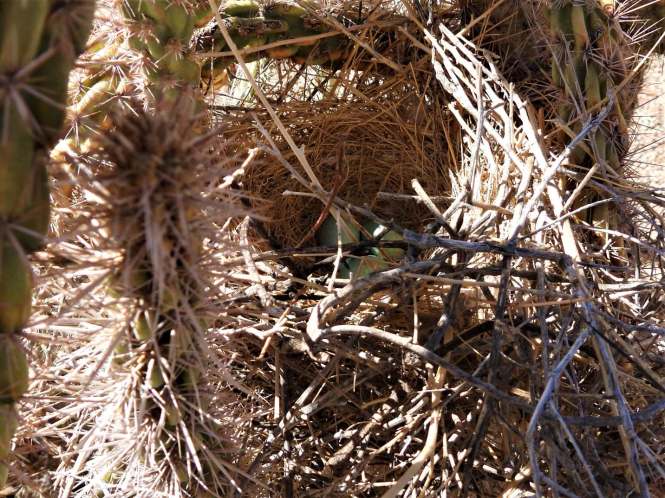
Curve-billed Thrasher nest with 3 greenish eggs April 17, 2023
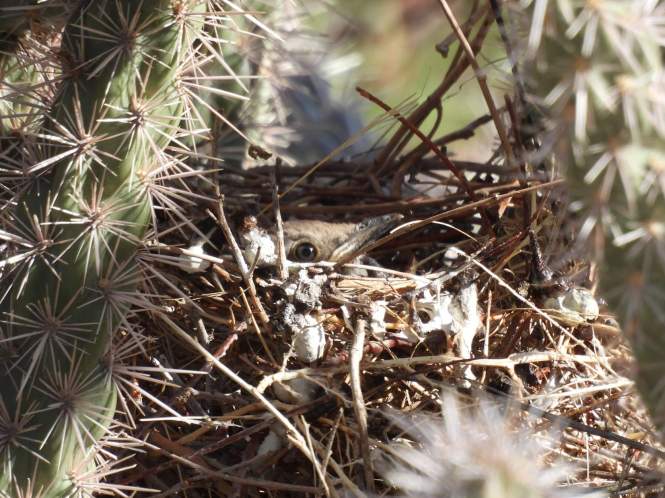
Curve-billed Thrasher/Krummschnabel-Spottdrossel April 27, 2023 (adult thrashers have orange eyes)
During a trip to Pueblo in June, seeing four fledgling Green Heron juveniles at City Park in a conifer made my day—check out those hairdos! I never saw their nest, but it might have been in that very tree. According to Cornell’s All About Birds, “Green Herons use many plant species as nest sites: pines, oaks, willows, box elder, cedar, honey locust, hickory, sassafras, and mangroves. The nest is usually on or over the water, but may be up to a half-mile away. It may be anywhere from ground level to 30 feet off the ground (occasionally higher).”
Clutch size: 3-5 eggs. Incubation period: 19-21 days. Nestling period: 16-17 days.
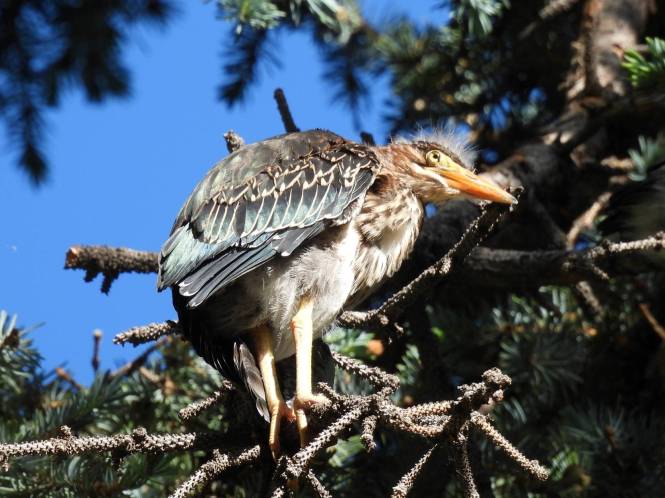
Green Heron/Grünreiher June 19, 2023
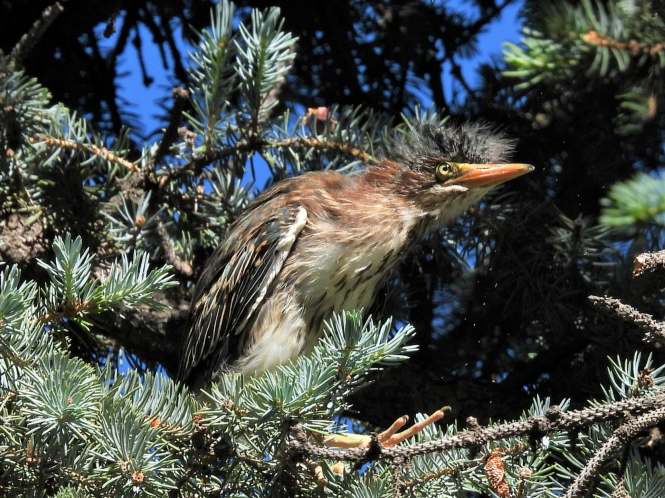
Green Heron June 19, 2023
On that same June day in Pueblo, I came across this Osprey nest with one juvenile at Valco Ponds. It was hot, 88⁰ F (31⁰ C), and I felt sorry for them in their utter exposure on their platform. The young one seemed to be engaged in gular fluttering, the avian version of panting, in which birds open their beaks and flutter the upper throat muscles in order to regulate their internal temperature. Rain or shine, cold or heat, there is no getting away from the elements.
Clutch size: 1-4 eggs. Incubation period: 36-42 days. Nestling period: 50-55 days.
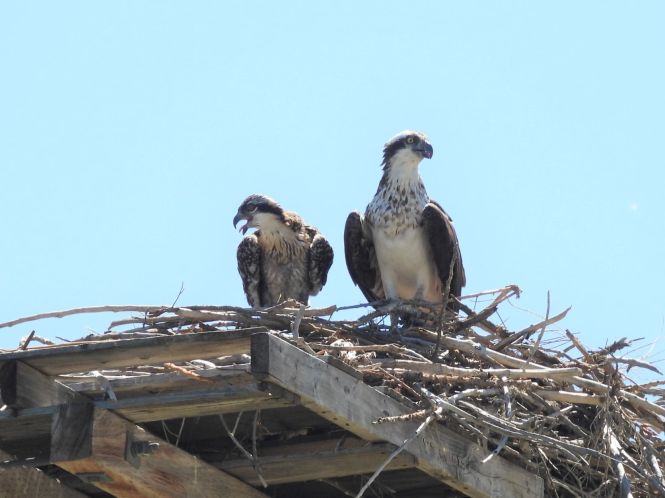
Osprey/Fischadler June 19, 2023
Later in June in Colorado Springs, I returned to the site where I had discovered the nest of a pair of Eastern Phoebes under the roof of a gazebo, with two tails protruding from the rim of their nursery. Technically, this species is not supposed to breed in El Paso County, but they have expanded their range from the eastern states in the last several years. On the day of my return visit, the nest was empty, but I saw both adults carrying insects, a sure sign of hungry mouths nearby.
The parents kept flying to one particular shrub and I parked myself on the ground in the vicinity to watch. Imagine my delight when I espied not two fledglings, but four! The dappled light and vegetation complicated picture taking, and I didn’t get a satisfactory image with all four of them, but loved the way this threesome cuddled next to one another while waiting for more insects to be served by their tireless caretakers.
Clutch size: 2-6 eggs. Incubation period: 15-16 days. Nestling period: 16-20 days.
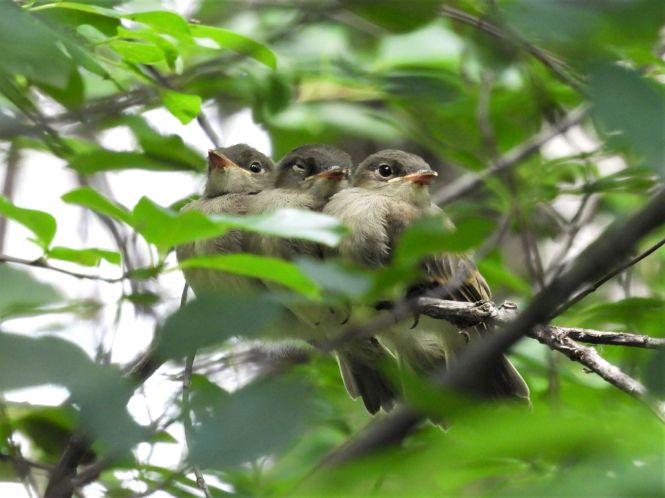
Eastern Phoebes/Weißbauch-Phoebetyrann June 22, 2023
Lark Sparrows, on the other hand, are common in our prairie habitat, and while it was no great surprise to come across a juvenile, the encounter was no less joyful. This young sparrow, whose plumage differs from an adult’s, also shows another feature that indicates it was born only this year: the light, fleshy flange of the gape at the back of the beak where the two mandibles meet (the upper mandible is also known as the maxilla). This gape flange is no longer visible in adults.
Clutch size: 3-6 eggs. Incubation period: 11-12 days. Nestling period: 11-12 days.
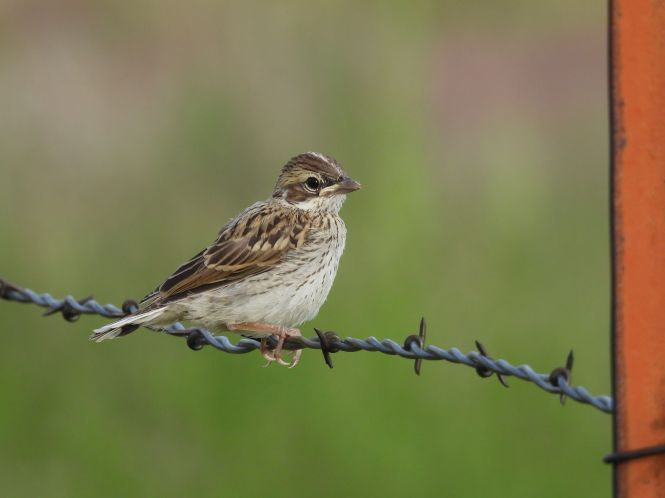
Lark Sparrow/Rainammer June 30, 2023
A light gape flange is also visible on this recently fledged House Wren I ran into at Chico Basin Ranch on the last day of June. These little birds are bundles of energy and compensate for their short stature with an oversize voice that travels far and wide. One can’t help but feel uplifted by their winning personalities.
Clutch size: 3-10 eggs. Incubation period: 9-16 days. Nestling period: 15-17 days.
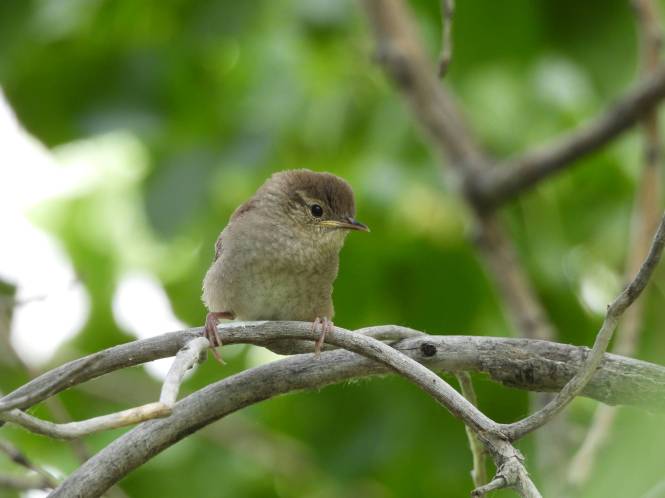
House Wren/Hauszaunkönig June 30, 2023
July also began with a nest sighting. These three Cassin’s Kingbird nestlings kindly demonstrate the fact that the gape, i.e. the interior of the opened mouth, of juvenile birds is brightly colored, which serves as a signal to the adults to:” PLEEEASE, deposit food here.”
Clutch size: 3-10 eggs. Incubation period: 9-16 days. Nestling period: 15-17 days.
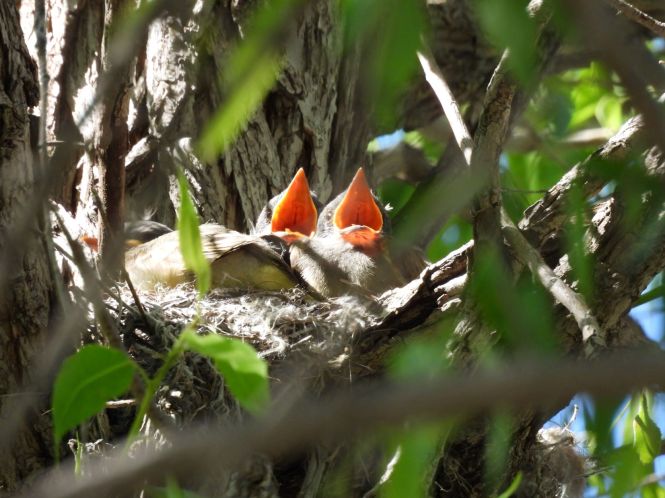
Cassin’s Kingbirds/Cassinskönigtyrann July 3, 2023
Summer isn’t over, and I look forward to more baby birds. And wherever you are, I hope you will enjoy the nests, eggs, nestlings, and fledglings of birds who share your home environment with you.
🦉🦉🦉🦉🦉🦉🦉🦉🦉🦉
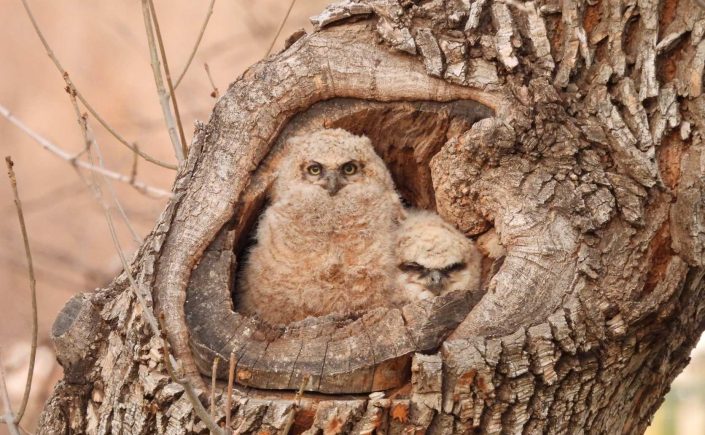
PS: Last but not least, the featured photo above shows two Great Horned Owls/Virginiauhu at the entrance of their nest in a tree cavity on May 3, 2023.
Clutch size: 1-4 eggs. Incubation period: 30-37 days. Nestling period: 42 days.


Great Photographs!
LikeLiked by 1 person
Thank you, I’m glad you think so.
LikeLike
Sehr schöne Bilder. Besonders die Fotos vom Nachwuchs. Sehr süß.
LG Jürgen
LikeLiked by 1 person
Dankeschön, lieber Jürgen. Sie sind alle sehr fotogen.
LikeLike
Fantastic. I loved this post! 👍
LikeLiked by 1 person
I’m glad, thank you very much.
LikeLiked by 1 person
You are so sharp eyed to see the nests of little birds! I can identify a stork nest only. Lovely post!
LikeLiked by 1 person
Thank you, Cathy. It’s so much fun discovering the nests and little ones.
LikeLike
What a great post!
LikeLiked by 1 person
Thank you, I’m thrilled you enjoyed the post.
LikeLike
Fun to see so many babies and what they grown into. I really like the phoebe triplet photo, it reminds me of a Pixar short movie.
LikeLiked by 1 person
Thank you, Brad. I have to say that the phoebes stole my heart, because it took me a while to find them, and they aren’t supposed to be breeding in the county. And because they are sooo cute. 🙂
LikeLiked by 1 person
There were a pair at Intrigued HQ early summer. Four hatchlings in the first brood, can’t remember how many in the second.
LikeLiked by 1 person
I read that they can have up to 3 broods a year. Just imagine all the work involved for the parents!
LikeLiked by 1 person
Wonderful post! What a great way to start the day. My favorite is the picture of the owls. Amazing how little time it takes for some bird species to hatch. Lots of fledglings around our home on the edge of the woods, and I always love seeing them. Oh, this fledgling time of year.
LikeLiked by 1 person
Thank you, Laurie. Owls are always special, and the two owlets were as interested in me as I in them. I also find it remarkable how quickly some birds develop.
It’s nice to know that you get to enjoy baby birds right beside your residence.
LikeLiked by 1 person
So wonderful to live on the edge of the woods. Lots of birds.
LikeLiked by 1 person
Who doesn’t love baby pictures!?!
The information in your post is fascinating. Your photographs are a testament to your talented observation skills. Birds are very good at not revealing their nesting sites.
Excellent way to start my day, Tanja! Thank you.
LikeLiked by 1 person
Thank you, Wally. I don’t have to tell you how thrilling it is to happen upon nests and their delightful denizens. Watching the eggs turn into these delightful creatures always takes my breath away.
LikeLike
Cute, cute, cute! Inevitably I love the owls, but also gaping Kingbirds (“Feed me! NOW!!!) 🙂
LikeLiked by 1 person
Thank you, thank you, thank you!
Feed me NOW might need to be the theme of a future post showing only open gapes. 😊
LikeLiked by 1 person
Sounds good to me 🙂🙂🙂
LikeLiked by 1 person
It’s so nice to see these photos. We are sometimes lucky enough to see robins or cardinals nests up close but all the other birds seem really good at hiding them.
LikeLiked by 1 person
Thank you, Julie. It’s always a highlight of my outings when I come across a nest or some recently fledged young birds, so I pay extra attention if I hear or see anything out of the ordinary.
How nice for you to have robins and cardinals nest near where you live.
LikeLiked by 1 person
Die sehr schönen Aufnahmen passen wunderbar zu den tollen Informationen, liebe , Tanja. Ein Gruss aus dem Aargau. Ernst
LikeLiked by 1 person
Dankeschön, lieber Ernst. Es freut mich immer, wenn die Bilder und zugehörigen Worte gefallen.
Alles Gute,
Tanja
LikeLiked by 1 person
That’s a great opening picture. At first I didn’t even see the smaller owl. My mind apparently took it to be part of the encircling tree bole.
LikeLiked by 1 person
Thank you, Steve. Blending into their surroundings is something all nestlings and fledglings do very well.
LikeLike
I don’t know where you get the energy to do all this beautiful work. I really enjoyed this one.
Sent from my iPhone
LikeLiked by 1 person
Thank you, Gary. I’m so glad you enjoyed this post about our feathered friends and offspring.
LikeLike
Wonderful photographs! I especially love the young owls – owls are something of a favourite for me. Their faces look so expressive, although I guess that is a certain amount of projection on my part. (That second owl looks as if it may be feeling a bit grumpy, hehe!)
LikeLiked by 1 person
Thank you, Ann. I also have a weakness for owls–they are so charismatic. I had the same thought about one of the owlets possibly appearing curmudgeonly. 🙂
LikeLiked by 1 person
Thanks, Tanja, for this informative post and the lovely pictures.
LikeLiked by 1 person
Thank you, Pit, I’m so glad you enjoyed the portraits of these birds.
LikeLike
Loved the owl photo, exquisite! Lots of babies around my yard, too. Bluebirds, catbirds, robins and wrens are on their second broods. The warblers are about finished as I don’t hear them as much any more. I love the dawn chorus and it lasts too short a time for me!
LikeLiked by 1 person
Thank you, Eliza.
I’m in awe at the variety of birds who nest in your yard, that’s absolutely wonderful.
I also regret when the dawn chorus diminishes, so we have to enjoy it while it lasts.
LikeLiked by 1 person
The trio of Eastern Phoebes is my favorite photo, although of course I enjoyed seeing all the babies. I’ve seen various egrets and herons in the nest, but most of the time I never see the young ones until they’ve fledged and are following their parents around. My great relief this year was finally seeing young cardinals at my feeders. I’ve known the nest was around, and I feared it might have been low enough in the shrubbery for a critter — probably a cat — to get to it. But all seems well. Now, I have a pair of cardinals who might be the parents feeding one another again, so we might have a second brood for me to worry about!
LikeLiked by 1 person
Thank you, Linda. The phoebes are extremely endearing. I loved watching them in the shrub, snuggling next to one another while waiting for more food to arrive.
How special for you to know that your local cardinals have raised a family. If the female lays more eggs, I hope they, too, will fledge. It is nerve-wracking to worry about their well-being.
LikeLiked by 1 person
These images of these baby birds and photos are great. Anita
LikeLiked by 1 person
Thank you, I’m glad you enjoyed them.
Best wishes,
Tanja
LikeLiked by 1 person
Bezaubernd Tanja.
Vögel sind einfach großartig.
Liebe Grüße Brigitte
LikeLiked by 1 person
Dankeschön, liebe Brigitte, das sind sie ohne Zweifel.
Ich wünsche dir eine gute neue und hoffentlich nicht zu heiße Woche.
Tanja
LikeLiked by 1 person
How do you manage to get all these photos? They are an amazing collection! The Great Horned Owl on the left actually looks like a human face with a Santa Claus beard over it! 😉 I didn’t know anything about the albatross; thanks for posting that. I took a quick listen to the first part of Ian’s recitation. what a perfect voice for that poem.
LikeLiked by 1 person
Thank you, Julie, it was fun seeing and photographing these birds in various locations and at various times.
It’s fun to read about others’ impressions when looking at some of these photos and I’m glad the owl gave you visions of Santa.
I also thought Ian McKellan’s voice was great for the poem.
LikeLiked by 1 person
Great pics. Glad you listened to Coleridge’s poem. One of the great ones.
LikeLiked by 1 person
Thank you, I’m glad you enjoyed the bird photos. And I was glad to finally learn what Coleridge’s poem was all about.
LikeLike
The Eastern Phoebes are absolutely adorable! You have a very nice collection of baby bird photos.
LikeLiked by 1 person
Thank you, Rebecca. It’s so much fun finding nests with baby birds. And the phoebes stole my heart as well.
LikeLiked by 1 person
Oh….diese beiden puscheligen Waldkauz-Babys sind einfach zu niedlich! Ich bin immer wieder begeistert und verzaubert von dem innigen, liebevollen Familienleben dieser kleinen Käuze. In jedem Frühling schaue ich mir die Live-webcams von “Beleef de Lente” an, die dieses traute Familienglück vom zu bebrütenden Ei bis zum Hinausfliegen in die weite Welt zeigen.
So, so schön!
Liebe Grüße für dich, liebe Tanja,
von Rosie 🥰🌹
LikeLiked by 1 person
Herzlichen Dank für den netten Kommentar, liebe Rosie.
Auch ich finde Eulen sehr charismatisch und der Frühling ist ohne sie nicht komplett, Hoffen wir, daß es diesen beiden bisher gut erging.
Dir noch einen guten und hoffentlich nicht zu heißen Sommer.
Tanja
LikeLike
☀️🐞🌸
LikeLiked by 1 person
🦉🙏🦉
LikeLike
What a fantastic array of feathered babies! I remember seeing a juvenile green heron and thinking ‘not the prettiest but very cute!” The owls are so precious and perfectly camouflaged.
LikeLiked by 1 person
Thank you, Kerry. Finding bird nests and babies is always a highlight of the year
And while the juvenile Green Herons might not win a beauty contest, they are nonetheless very endearing.
LikeLiked by 1 person
His mother loves him…💚💚💚 We have a new baby in our neighbors pine tree – a screeching red tail hawk. Mother uses our yard as a supermarket!
LikeLiked by 1 person
Luckily, most mothers love their young ones!
Having a predator in the neighborhood is one of my least favorite realities of nature… 😦
LikeLiked by 1 person
Chicks and Juvis are so cute – I enjoy watching them fledge when we have the opportunity around here. Every hear an Eastern Phoebe couple nest under our porch, actually a balcony as it wraps around to a walk out basement on the back side. I think they count on the safety they get there every year and consistently hatch and fledge 4 new ones every year. This year was a big surprise as the femal had two broods giving us 8 new residents – moths don’t have a chance in our yard ha. I have never seen a chick or a juvi Green Heron, so thanks for providing that first. Mom picked a perfectly camouflaged site for her nest, perfect hue match. Great post.
LikeLiked by 1 person
Thank you, Brian. How exciting to have your own phoebe nest under your porch. I’m always touched when birds seek the proximity to humans, which seems to be true for both Eastern and Say’s Phoebes.
The juvenile Green Herons were a first for me as well this year and, speaking of camouflage, I would have completely missed them if another birder hadn’t pointed them out to me. Definitely a case of hiding in plain sight.
LikeLike
I especially like the great horned owl babies. They are fun to watch from a distance. They are the bullies of the owl world.
LikeLiked by 1 person
Seeing owl babies is always special. When seeing their cute faces, one could easily forget that they are carnivores. 🦉
LikeLike
so precious. And I really admire the awesome camouflage of owls!
LikeLiked by 1 person
Thank you, Karin. Seeing young birds in or near the nest is always something to celebrate. And I also marvel at the owls’ camouflage. Most of the time I only see their silhouette because they are exposed on a branch, otherwise they blend into the background perfectly.
LikeLike
Superb photos, Tanya.
LikeLike
Thank you, Michael. Sorry for the late response, but for some reason, your comment ended up in my spam folder, and I only discovered it today.
LikeLiked by 1 person
You’re welcome, Tanja. No worry 🙂
LikeLiked by 1 person