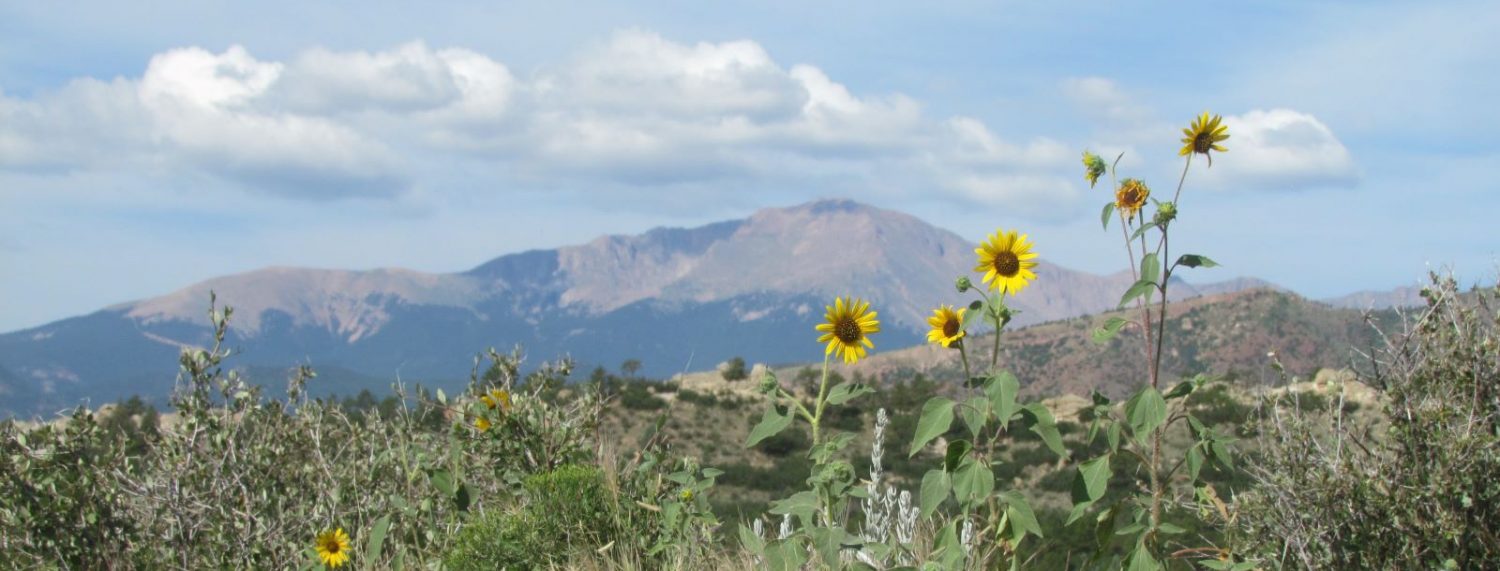
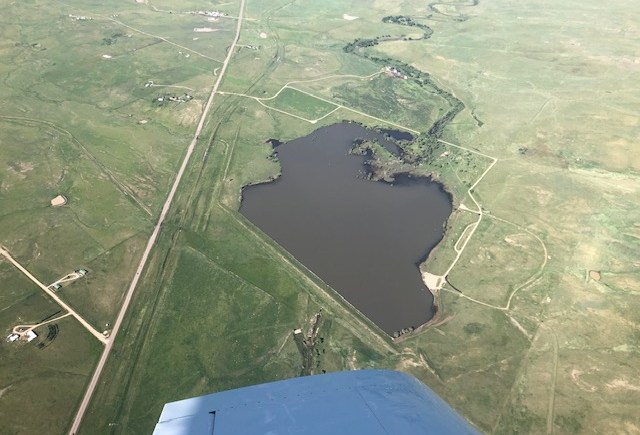
The last time I checked, Colorado was not considered a tropical wetland, even if the entire state has officially been drought-free for a few weeks and it has been hot. But for a bird in flight, off its regular course and looking for water, Ramah Reservoir, located some 40 miles (about 70 kilometers) east of Colorado Springs and featured in the photo above, might be an attractive proposition. After May and June rains not only filled the reservoir, which had been empty for several consecutive years, but caused it to overflow its borders, wetlands were created where none had existed, and an avian visitor who had never before been reported in Colorado, found itself drawn to this body of water.
On June 23, a human visitor to the Ramah State Wildlife Area, curious to see how much water was present, encountered a creek overflowing its banks (the one creating the green ribbon on top of the image), an overly full reservoir, and washed-out roads. She also espied a long-legged brown bird on the flooded road. Not a birder, she took a photo with her smart phone, looked up the name of the bird, then reported it on eBird. A birder saw her photo and the news of her sensational sighting spread to all those who pay attention to avian happenings. The app on my phone dedicated to reports of rare or unusual bird appearances lit up repeatedly that day, as the winged creature in question had been identified as a Limpkin (Aramus guarauna).

The range map from the Cornell Lab of Ornithology shows that this bird was definitely far off course, as a limpkin is not expected in the American West. According to Birds of the World, “ [it] is a locally distributed resident in freshwater marsh and riparian habitats from Florida south through the Caribbean islands and Central and South America as far as Argentina, Peru, and Bolivia.”

Range Map for Limpkins, courtesy Cornell Lab of Ornithology
Vagrancy in biology describes the appearance of a species outside its usual range. The term is most commonly applied to animals, and to birds in particular, but can also pertain to plants. Wikipedia states, “There are a number of poorly understood factors which might cause an animal to become a vagrant, including internal causes such as navigatory errors (endogenous vagrancy) and external causes such as severe weather (exogenous vagrancy).”
While vagrant birds are often exciting occurrences for birders, because we are able to see species we would not otherwise come face to face with, finding oneself blown off course is often a fraught, if not terminal, event in a bird’s life. (S)he might be exhausted from the journey, not find suitable food, be unable to fly way back to the breeding or wintering grounds, or encounter dangers from animal or even human predators.
I wish I could tell you that this story has a happy ending, but I don’t know. This lovely Limpkin was sighted at Ramah Reservoir daily between June 23 and July 4 by birders who often traveled for hours to see it, but hasn’t been found since. It stayed along the course of the creek that drains into the reservoir and was often observed preening in shrubs, or foraging for food in the water. I saw it beat its wings a few times while hopping from one place to another, but as far as I know, it never flew any significant distance while there.
Did it take off when the water receded and sufficient wetlands were no longer present? Was its navigational system intact and enabled it to fly to Florida to join its relatives? I hope so, but this is wishful thinking. It might have met a less desirable fate, and we will probably never know.

Cornell: “The Limpkin is the only member of its taxonomic family, Aramidae. Although it resembles herons and ibises in general form, the Limpkin is generally considered to be more closely related to rails and cranes.” This kinship is reflected in the German name for the bird, “Rallenkranich” (which literally means rail crane).

Cornell: “The name Limpkin purportedly comes from the bird’s gait, which appeared to early European settlers as a limp, perhaps when pursued by hunters with dogs. At such times, the usually stolid bird gallops away at unexpectedly high speeds.”

Cornell: “The Limpkin’s bill is uniquely adapted to foraging on apple snails. The closed bill has a gap just before the tip that makes the bill act like tweezers. The tip itself is often curved slightly to the right so it can be slipped into the right-handed curve of the snail’s shell.” There are no apple snails in Colorado and this limpkin seemed to gorge on various worms.
I never heard it vocalize, but according to Cornell “This bird’s haunting cries, heard mostly at night, are otherworldly and unforgettable.” Click here for a link to listen to recordings of its voice.
I’m so grateful for my first-ever sighting of this charismatic bird, so far away from where it should be, and I can only hope that (s)he is still alive and well somewhere.
PS: With many thanks to my friend Andy B. for providing me with the aerial photograph of Ramah Reservoir, taken from his airplane. He shared it with me because he was impressed with the amount of water in the reservoir, but didn’t know how well it would complement this post.
 tanja britton
Vagrant birds often leave me shaking my head as to how they arrived and as you say for some that’s where their journey will end.
This must have been a great thrill Tanja, one I’ve shared many times in the past. It’s good you have a phone app to keep up to date, I gave up my pager a few years back and as a result yesterday, only 10 miles from home, I missed out seeing a fantastic bird of prey only seen once in the whole Country before!
LikeLiked by 1 person
It was a great thrill, Brian, to see this bird for the first time in my life. The phone app has enabled me to see some birds I wouldn’t have without it, but I don’t “chase” every reported rarity. Some birders travel long distances for sightings, but I usually have a limit.
I’m sorry you missed the bird of prey. Did you give up your pager because it was getting too disruptive?
LikeLiked by 1 person
It was getting too expensive and I was not really able to chase rare birds like I used too so it had to go.
LikeLiked by 1 person
Glad you were able to see the limpkin but you write movingly about how being so far off course is not so good for the bird.
LikeLiked by 1 person
Thank you, Laurie. Any rare sighting would be more joyful if we knew that the bird would rejoin its kind afterward.
LikeLiked by 1 person
What an amazing sighting! I hope it finds its way safely south again.
LikeLiked by 1 person
Thank you, Eliza. Let’s hope it will.
LikeLike
A person seeing your phrase “rails and cranes” out of context might well imagine something industrial, like a port or factory or mine. Similarly, “exogenous vagrancy” and “endogenous vagrancy” might be assumed to come from sociology and to refer to people.
I followed your link to hear a limpkin’s call, and the mention there of “oddly shaped outermost primaries” sent me scurrying for a definition: “Primaries are the outer wing feathers, attached to the bird’s small, fused ‘hand’ bones. Most groups of birds have 10 primaries. Primaries usually have pointed, as opposed to rounded or square, tips.”
LikeLiked by 1 person
Words carry so many different meanings, depending on the context, it’s really quite fascinating. As are birds’ feathers. Entire books have been written about the subject including molt, which could keep you busy for hours–just in case you are bored. 😊
LikeLike
Fascinating essay. I was unfamiliar with this subject. I guess there’s a chance that the bird got back on course. Let’s hope so.
LikeLiked by 1 person
Thank you, Neil. I, too, was unfamiliar with the subject until a few weeks ago. It would be thrilling to know that the bird made it back to where it was meant to be.
LikeLiked by 1 person
Let‘s hope that this beautiful bird has found its way back where it belongs!
LikeLiked by 1 person
Thank you, Christa. I also hope so.
LikeLiked by 1 person
That is a long way off course! Lucky for you to see it but I hope he got back to his friends. 😊 Maggie
LikeLiked by 1 person
Thank you, Maggie. The limpkin made a lot of birders very happy and I hope she returned to his friends to tell them about his wild adventure. 😊
LikeLiked by 1 person
Such a handsome bird, definitely one you’ll remember (aided, of course, by your excellent photos!).
LikeLiked by 1 person
Thank you, Mr. P. The bird is beautiful and I was particularly struck by her friendly facial expression and her absolute nonchalance vis-à-vis dozens of birders at a time, watching and photographing her, for so many days in a row.
LikeLiked by 1 person
A very nice +1 Tanja. Let’s hope it found its way home, or at least closer to home, under cover of darkness one evening or early morning. Seeing one “vagrant” makes me wonder what other kinds of “vagrants” might be around these often dry reservoirs.
LikeLiked by 1 person
Thank you, Brad, I like to imagine a happy ending to this bird’s odyssey.
I also often wonder how many birds are far off course and we never know, because nobody happens to see and report them. Let’s keep looking!
LikeLiked by 1 person
Agreed. Though as a relatively new birder I do not expect to be the one to see the rare out of place bird. Statistically, the experts who are out there much more than I will see them. Perhaps you will be one of them Tanja!
LikeLike
I am shocked you saw a limpkin! It is definitely a bird found in the marsh here in Florida. You can hear the sound on All About Birds (https://www.allaboutbirds.org/guide/Limpkin/overview). The first time I heard it I really wondered what it could be!
LikeLiked by 1 person
We were all shocked, too, Pam. I hope to see some of this bird’s relatives in one of Florida’s marshes one of these days. And to hear their vocalizations!
LikeLike
Funnily enough, I only became aware of Limpkins with this blog post from a Texas blogger: https://rappentest.wordpress.com/2023/05/06/dim-damp-and-delightful/ (he covers a number of birds on this particular visit; scroll down for the limpkin).
It is fascinating and concerning when a bird is so far off its normal course. A few years back there was a Blue-footed Booby in the Austin area; birders went nuts!
Like you, I hope Mr/Ms L is in a safe place.
LikeLiked by 1 person
Thank you, Tina. I wasn’t really aware of limpkins before this sighting, as I have never visited any of the places where they are supposed to occur (though I hope to remedy that one of these days).
I can imagine what the presence of the Blue-footed Booby did to Texas birders, as that is what happened in this case, too.
Let’s hope our limpkin is safe.
LikeLike
How wonderful to get to see one!
LikeLiked by 1 person
It really was, Valerie. Thank you for your visit and comment.
LikeLiked by 1 person
I hope it was able to make his way back to its regular habitat.
LikeLiked by 1 person
So do I, Pit.
LikeLike
Really interesting info, and lucky you, to add that to your “bird list”! don’t know if it’s just my imagination, but there seems to be something especially sweet about this bird.
LikeLiked by 1 person
Thank you for commenting, especially on the bird’s sweetness. I had the same impression when I watched her and think the sweet aura is due to her beautiful, serene eyes.
LikeLiked by 1 person
I scrolled down through the comments, and I don’t think you saw my post about our most famous vagrant bird: a flamingo that escaped from a Wichita, Kansas Zoo, came to Texas, and has been hanging out on the coast ever since. The last sighting I’ve heard about was in spring of this year, which means it’s been nearly five years that the bird has survived, and apparently thrived.
Limpkins are such fascinating birds. I’ve never seen one, but the Floridians I follow — as well as occasional Texans — do. I’m glad you had the opportunity; it surely was a rare one. It’s always interesting to come across birds that don’t do what we think they’re ‘supposed’ to do. I see it especially with migrations. When the flocks of Coots head to the north, for example, there always are one or two who stay in our marinas, apparently without any urge to follow the flock. They seem perfectly healthy; they’re just ‘odd ducks.’
LikeLiked by 1 person
Thank you for the link, Linda, I replied separately to that post.
Since having published my post, the plot has thickened. Someone saw a Limpkin in Boulder (even farther north) yesterday and again today, but people think it might be a different individual, based on photographic comparisons. How wild is that? It will be fascinating to see if more Limpkins will check out Colorado in the future.
LikeLiked by 2 people
A lovely bird to see – I do hope its adventure ended well and that it found itself in a suitable habitat.
LikeLiked by 1 person
Thank you, Ann. That’s what everybody has been hoping for.
LikeLiked by 1 person
Congratulations on your Limpkin!
She was probably sent on a scouting mission by our local Limpkin social club to check out the potential for a place to escape Florida’s humidity. Once they receive her trip report which says “no snails here”, they’ll calm down and welcome her back home.
Have a great new week!
LikeLiked by 1 person
Thank you, Wally. It might well be that there is second scout in Colorado. A few days ago, a Limpkin was sighted in Boulder, and people thought it was a different one, based on photographs. It will be interesting to learn what the Colorado bird records committee decides.
Who knows. Maybe more Limpkins will decide they prefer Colorado to Florida.
I hope you can stay comfortable in the heat and humidity.
LikeLike
Hello dear Tanja,
I had not heard of this beautiful bird prior to reading your beautiful post, so thank you for sharing.
How thoughtful and smart of the human visitor to snap a photo of the Limpkin and post it on eBird. I am glad you had a chance to view this bird with your own eyes and will keep stubborn hope that this lovely Limpkin had a happy ending.
It’s been a bit of a challenging year and I’ve been missing my favorite blogs, but it’s great to be back. I hope you and your husband have a safe and wonderful summer.
Best wishes,
Takami
LikeLiked by 1 person
Thank you so much for stopping by and commenting, dear Takami, both on this post and many previous ones. I have visited your blog a couple of times to check on you and was hoping you were only taking a break.
I’m sorry to hear that your year has been challenging. I think that’s true for most of us because of the world situation, and if personal problems are added, it’s easy to get completely overwhelmed.
I appreciate the good wishes and return them for you and your loved ones.
Take care,
Tanja
LikeLiked by 1 person
Reminds me of that large eagle from Europe/ Asia that was sighted in many places in the northeastern US last year. Felt bad for it here by itself. I wonder if it ever found its way back.
LikeLiked by 1 person
I always worry about these vagrants so far afield, Sharon. I think most of the time we lose track of them and I suspect that most won’t make it. But maybe, hopefully, I’m wrong.
LikeLiked by 1 person
Felt bad it kept flying place to place like it was searching for a mate or something familiar.
LikeLiked by 1 person
Congrats on the lifer Tanja. We actually saw this sighting come through our rare bird alerts. Limpkins have been showing up at a lot of odd places this year, not sure the reason, possibly an eruption that is pushing them further out of their range or just some bad directions from the GPS, who knows. I can say they are very hardy birds and based on personally witnessing their ability to successfully protect several chicks (7) in the middle of a gator infested swamp at Payne’s Prairie in Gainesville, FL – my money is on this one just moved on in search of a mate or different food. Oh, and once heard, never forgotten ha.
LikeLiked by 1 person
Thank you, Brian. A (the same?) Limpkin also showed up in Boulder about a week after the last sighting of this one, and the experts are still trying to decide if they are one or two different birds.
It will be interesting to see if this species will keep exploring different destinations. I have yet to hear one, but look forward to that experience as well.
LikeLike
What a beautiful visitor! I haven’t seen one – we don’t live far enough south. I would love to hear the haunting vocalization.
LikeLiked by 1 person
(S)he was (and hopefully still is) beautiful, and I also hope to be able to hear that voice one of these days.
LikeLiked by 1 person