An article in The Gazette, our local newspaper, in early September that announced the restoration of a piece of public art in Colorado Springs piqued my interest. After attending a guided tour of Monument Valley Park on October 30, I remembered to walk the short distance to the Fine Arts Center at Colorado College and take a look at the now-completed project.
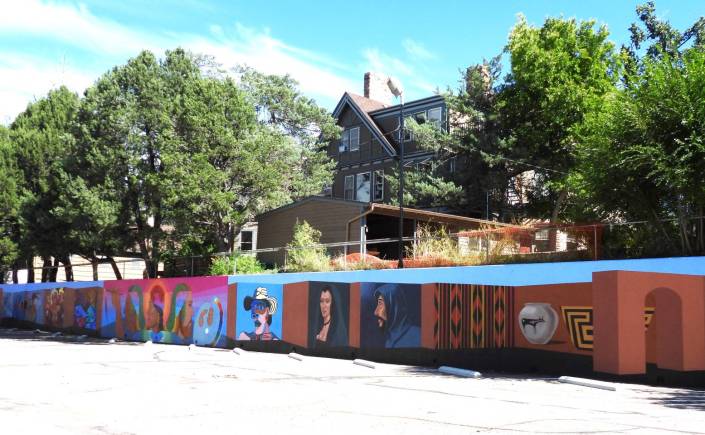
Instead of entering the imposing front gates of the Arts Center, I strolled to the parking lot across from its entrance, where the entire east wall is covered with a mural. Having visited the art museum, but without making use of its parking lot, I had been unaware of the existence of this wall painting, which has adorned the otherwise gray and drab space since 1986.
Arte Mestiza is the creation of Denver-born artist, Emanuel Martinez. When he fashioned it in the 80s, he had a budget of $300, which led to his choosing cheaper paint and even diluting it in places. The intervening decades with repeated cycles of sun, heat, water, wind, and snow had worked their detrimental ways on the mural and after repeated entreaties by Martinez to address the bleaching and damage to his artistic work, a $50,000 grant was obtained from the National Endowment for the Arts in June of this year.
Since then, the wall has been power washed, cracks have been filled in, and the murals have been resurrected with fresh paint as well as a preservative to better protect them from the elements. The artist retained the original design with one exception. On the advice of his daughter, an archeologist, Martinez changed the jewelry worn by the depicted Mayan from gold to jade, after learning that jade was the Mayan’s precious stone.
Martinez, who is well known nationally and internationally and whose work has been exhibited at the Smithsonian’s National Museum of Art, was quoted by The Gazette: “One of my missions was to help (Hispanic people) instill pride in ourselves, in our identity and to bring that to life through muralism.”
I haven’t found a detailed description of the various panels of the mural, so you and I can come up with our own ideas. Without further ado, here are images showing Mr. Martinez’s stark and vibrant masterpiece, Arte Mestiza (mestiza is here used as an adjective, denoting that the art represents mixed European and Indigenous American ancestry).
To enlarge a photo, click on it.


For more information about the artist, Emanuel Martinez, and to see more of his murals, as well as drawings, paintings, and sculptures, follow this link to his website: https://emanuelmartinez.com
 tanja britton
danke für deinen interessanten überblick. den künstler werde ich später mal erkunden, der name sagt mir im moment überhaupt nichts.
interessant sind die anlehnungen an bekannte kunstwerke. die bilder wecken gleich assoziationen. das bild mit der “picasso-anmutung” gefällt mir besonders. ich finds gut, dass die wand restauriert wurde, wenngleich sie etwas “statisch” auf mich wirkt, also die mauer selbst. wenn es quasi eine umrundung bzw. umrandung einer kunstschule ist, wäre etwas moderneres auch eine gute idee gewesen. es ist wie es ist – die bemalungen jedenfalls sind sehr kreativ und schön.
LikeLiked by 1 person
Herzlichen Dank für den Kommentar und Deine Eindrücke. An Picasso mußte ich bei dem einem Bild auch denken und der Künstler wurde sicherlich auch noch von anderen Malern beeinflußt.
Ich habe es generell mit moderner Kunst weniger und finde es schön, daß der Maler der diese Gemälde 1986 erschuf, sie jetzt auch wieder restaurierte, Es stand, glaube ich, nie zur Frage, etwas Neues zu schaffen, da die alten Gemälde hätten entfernt bzw. übermalt werden müssen.
LikeLiked by 1 person
I love these! What good news to read that they’ve been restored and preserved for future generations to enjoy.
Emanual Martinez has also taught me a new word: “muralism”! 😊
LikeLiked by 1 person
I was also thrilled to see the result of the restoration. I think it was Diego Riviera who was among the first Mexican artists to popularize muralism.
LikeLiked by 1 person
So it isn’t just a view of the nearby Rocky Mountain peaks that piques your interest.
The right-hand panel in your third photograph is a copy of Davis Alfaro Siqueiros’s 1934 mural “Democracy Breaking Her Chains.”
https://www.wikiart.org/en/david-alfaro-siqueiros/view-of-a-mural-depicting-democracy-breaking-her-chains-detail-of-the-series-new-democracy-1934-1934
The Spanish adjective mestizo traces back to Latin mixtus, from which English got the word mixed (and from which in turn English speakers created the verb mix).
LikeLiked by 1 person
You are right, Steve: many things pique my interest. I think we have that in common.
Thank you for the information about one of the panels. When I saw it, I thought it might represent Indigenous cultures trying to break the chains of colonialism.
And as we discussed before, the more languages one knows, the easier it is to derive the meaning of many words.
LikeLike
It’s excellent that a grant was secured to repair and restore this mural. I doubt if that happens very often with murals or with any other kinds of public art.
LikeLiked by 1 person
A truly excellent outcome for this mural, Neil.
Your comment made me curious and I looked up the website of the National Endowment for the Arts. Here is a list of the projects it helps support:
https://www.arts.gov/grants/grants-for-arts-projects/artistic-disciplines
LikeLiked by 1 person
The bright colors really caught my eye. I’m glad to hear these have been preserved!
LikeLiked by 1 person
Thank you, Diana, the colors are very eye-catching. It’s a wonderful outcome for this mural.
LikeLiked by 1 person
Thank you for this beautiful introduction to artist Emanuel Martinez and his vibrant pieces!
LikeLiked by 1 person
Thank you for your interest and comment. I was also happy to learn about the artist and his beautiful art.
LikeLiked by 1 person
Wowsah! Vibrant and powerful. So glad he got the grant to restore this treasure of a mural.
LikeLiked by 1 person
Thank you, Laurie. It’s definitely a mural to make one stop in one’s tracks. It was great to first read about it and to then see it with my own eyes.
LikeLiked by 1 person
That is a particularly fine set of murals. Delighted to hear that they received a grant for restoration.
LikeLiked by 1 person
Thank you, Kerry. I second everything you said! 😊
LikeLiked by 1 person
Beautiful murals, so good to hear they’ve been restored. And do I understand the original artist restored them? Maggie
LikeLiked by 1 person
Thank you, Maggie, it’s a beautiful collection of wall paintings. And yes, the same artist who painted the originals in 1986 did the restoration in 2023. Remarkable, isn’t it?!
LikeLiked by 1 person
Beautiful public art! So glad that this has been restored, the work is stunning, the colors so vibrant. Thank you for sharing this!
LikeLiked by 1 person
Thank you, Tina. It took a long time for the Fine Arts Center to come around to the artist’s entreaties to help these murals survive, but I think everybody is happy now. I’m so glad to have learned about their existence.
LikeLike
Kudos for whoever put the work in to get that grant to save that wonderful mural. Definitely need more of that throughout the country.
LikeLiked by 1 person
Kudos indeed. As you know, I’m a great fan of murals and think they have the power to transform neighborhoods and cities, and mostly in a good way.
LikeLiked by 1 person
I was not familiar with Martinez-thanks for the introduction! My favorite is of the painter who is painting the Janus-like heads. Perfect balance and color with a timeless sense about it, I think. Such a mixture of Christian and Indigenous symbolism throughout the murals, and I love the way both male and female or portrayed in active roles.
The artist’s web page is amazing, as well.
Hope you are enjoying your October, Tanja!
Best,
Julie
LikeLiked by 1 person
Thank you, Julie, I’m glad you enjoyed the post and Mr. Martinez’s creations. I only learned about him when I read the article in the newspaper not long ago and am glad I had the opportunity to see his impressive mural.
It’s starting to feel like October here and I’m enjoying the changing of the seasons. I hope you are, too.
Warm wishes,
Tanja
LikeLike
I’m glad that the artist himself was allowed to do the restoration work. It no doubt was satisfying for him, and helped to maintain the integrity of the work. I enjoyed the paintbrush and palette combination, and the tribute to Picasso, but my favorite was the skeletonized horse and rider. I know I’ve seen that theme from the early 1900s, in a Galveston newspaper writing about the cholera outbreak, and there’s a famous skeletonized camel and rider from the days of the Texas Camel Corps during the Civil War. It’s fun to see it still a part of our culture.
LikeLiked by 1 person
I agree that the story had a happy ending, with the creating artist being the one to restore the mural as well.
It’s interesting to see some of the recurring motifs in different contexts, but skeletal figures usually don’t usually augur well.
LikeLiked by 1 person
These are beautiful murals with a cultural richness and significance that adds to their importance. It’s great to hear that the were restored! 🙂
LikeLiked by 1 person
Thank you, Ann. I also find the cultural context and expression stimulating.
LikeLiked by 1 person