
If you know me or my blog at all, you will easily see why this cover appeals to me. The photo of a prairie sky in tumultuous flux, coupled with a title containing the word “owl,” guarantee that I will pick up this book from the shelf.
I don’t typically buy books because of their cover (just as I try not to judge them by them), since an image might raise expectations which are often disappointed upon reading the tome. But when an attractive cover image genuinely represents what’s hidden on the pages within, it’s a perfect marriage, and this book manages exactly that.
An Owl on Every Post is a memoir written by Sanora Babb, an author unknown to me until I purchased this volume. After having read it, I think she and her writing deserve to be better known and, happily, she is experiencing somewhat of a renaissance. Without the misfortune of having written a novel titled Whose Names are Unknown, with a similar theme as John Steinbeck’s The Grapes of Wrath, she might have become recognized earlier as a great writer, and a voice for those displaced by the Dust Bowl.
But let me start with a short summary of the author’s life. Sanora Babb (1907-2005) died not so long ago at the age of 98. She grew up in Oklahoma Territory, where she lived near and befriended members of the Otoe tribe, which would instill in her a lifelong admiration for Indigenous ways of life. In 1913, when six years young, her parents moved with Sanora and her four-year-old sister to Baca County, in southeastern Colorado. They shared a one-room dugout with her paternal grandfather, who was homesteading a parcel of land. The closest water source was 2 miles away and the family eked out a living by growing and selling broomcorn, a type of sorghum used for the production of brooms.
Their lives and livelihoods were dependent on the vagaries of the climate and they frequently ran out of cash and, consequently, of food, and often went to bed hungry, especially in the winter. A diet rich in hardtack and beans but poor in fresh fruits and vegetables predisposed them to scurvy and one year they were near starvation, surviving without food for 7 days.
Not being able to make a living from the land, they moved to Kansas when Sanora was 11, where she attended school for the first time, and later settled in the Oklahoma Panhandle, where she finished high school. Her grandfather taught her how to read and write with the help of the only book available in his dugout, Kit Carson’s Autobiography. The pages of the Denver Post that papered the dirt walls also became sources of grammar, spelling, and sundry information not always suited to a child’s eyes. Despite, or possibly because of, her unconventional education, Sanora graduated from high school as valedictorian. By then, her father worked as a professional gambler, an occupation deemed disreputable by her teachers, and Sanora was barred from giving her commencement address.
Maybe thanks to those wallpaper copies of the Denver Post, Sanora became a journalist, and later an editor, poet, and novelist. She moved to Los Angeles, where she experienced first-hand the trials and tribulations of the refugees from America’s Dust Bowl during the Great Depression in the 1930s. It was here that she worked for the Farm Security Administration and where she kept detailed notes on the plights of the migrants who had come to California in hopes of better lives. According to several online sources, her supervisor, Tom Collins, shared those notes with John Steinbeck which might have found their way into his famous novel, Grapes of Wrath. He credited Tom Collins, but not Sanora Babb. Online one can find discussions about whether Steinbeck knew that some of the information Tom Collins shared with him came from Sanora, or whether Tom Collins told Sanora that he passed on her notes.
Steinbeck’s novel was published in 1939 to great acclaim, while Sanora was finishing her manuscript, for which she had secured a publisher, Random House. After the immediate and stellar success of Steinbeck’s novel, her publisher, convinced there was no appetite for similar fare and fearing the appearance of imitation, put her novel on a shelf. There it moldered until 2004, when Whose Names are Unknown was published by the Oklahoma University Press. By this time, Sanora was 97 years old. The novel was a finalist for the 2004 Spur Award, the ForeWord Reviews 2004 Book of the Year, and the Pen USA 2005 Literary Award.
I have yet to read either Sanora’s or Steinbeck’s novel (a gap I in my reading list I hope to fill, and soon), but here are some reviews of Sanora Babb’s Whose Names are Unknown:
…those who have read both books say Babb’s novel is a better read for today’s market than The Grapes of Wrath—leaner, faster paced and full of details that give a more insightful look at a tragic time in American history.—Mike Conklin, Chicago Tribune
One of the best novels I have ever read about the Oklahoma Panhandle farmers during the 1930s….quite possibly as good as, perhaps better than, The Grapes of Wrath.—Tulsa World
With characters less contrived than Steinbeck’s, Babb has given us a sad and rugged novel about a sad and rugged people, the Okies. Each writer, Steinbeck and Babb, deserves to be read. The Publication of Whose Names are Unknown, rights a decades old literary wrong.—Salt Lake Tribune
As a result of reading Sanora Babb’s memoir, we checked out a 2012 documentary from the library, The Dust Bowl, by the incomparable Ken Burns (if you are not familiar with his films about the Civil War, National Parks, Mark Twain, Roosevelts, to name only a few, I think you are missing out). As serendipity (or synchronicity) would have it, Sanora and her overlooked novel are mentioned in it.
To come back to An Owl on Every Post, which was first published in 1970 and reprinted in 1994, with an afterword by the author, let me just say that I loved every word of this memoir. As nothing I can write will come close to Sanora’s lyrical voice, allow me to quote several passages (which I also copied into a notebook, representing “words I wish I had written,” as fellow blogger douginnc once called them).
The first passage describes her first morning impressions outside the dugout, where the family had been dropped off by a car in the middle of the night:
We were up at dawn, a cool, frosty dawn….We watched the big sky turn pink and orange, then blue. The air was of such purity that we stood breathing deeply for the simple pleasure of breathing. Its fragrance was unlike the softer, leafy air we had known. Strong plants that lived in the land of little rain gave into the winds their pungent smells, sagebrush more powerful than all others. We turned around to see the full circle of horizon, the perfect meeting of earth and sky….We were at once in a grand and endless space, and enclosed; locked in. (p. 15).
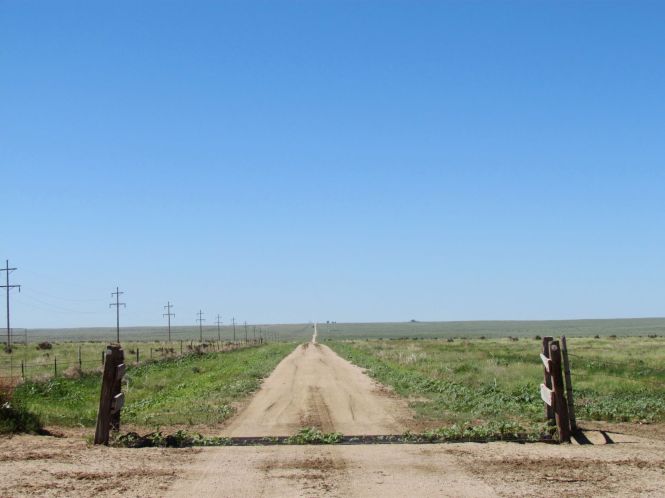
Colorado’s plain in one of my photos, taken in June 2017
She shares more impressions of their new home:
Now while the days were crisp and the sun kinder than in summer, we had to prepare, for winter lasted long, and we were soon to learn how ferocious its storms, how bitter its cold, how inhumanly isolated our lives. (p. 15)
I had begun to like this land and its ways. I felt close to its animals and birds and sparse growing things, its silence, event its loneliness. Its loneliness stretched my soul beyond my years to a mysterious sense of time when I should reach that far land’s end and lift up the sky to enter the lives and worlds I had no need to know until then. (p. 18)
About her first trip through the night on a horse-drawn wagon, she says this:
We drove home in the dark, such a dark as we had never seen, a black primeval dark, the darkness beyond the sun….The stars were withdrawn, small, giving no light, unlike other nights when they seemed to hang large from the sky ready to be reached for and taken into our hands. We were silent within a great silence. The air was sharp, cool, No insects sang. We met no one. Our small company of five persons, two horses, and a dog traveled thought the black night as in the infinite black of space. (p. 33)
Here is her poetic description of the moonrise:
A huge moon slid up from the eastern rim of earth slowly at first, then swiftly into the sky. We saw the plain, vaster than by day, lost in the mystery of the night, reaching, far, far, the furry back of an old earth in an ancient time, frightening and beautiful under the sheen of the moon. The sense of an aboriginal time was strong in the nights of the plain. The moon was not the one I knew, not an ornament of summer evenings, or the reassuring lamp of winter dark, It was a world of liquid light, magnetic, overpowering, arousing in a child’s mind a furtive knowledge not yet lost. (p. 33)
It was during that same memorable night ride under the moon that she beheld the titular owls:
The road ran for a ways along a fenced field; here also were thin, barked telephone poles with a single wire. An owl sat on every post. Their great immobile eyes stared, their heads swiveled. They were watching for prey, the little field mice, no doubt, but to me they were curious, even ominous, an owl on every slender post like a night-blooming flower. (pp. 33-34)

Burrowing Owl. The text doesn’t explicitly state if this is the species of owl Sanora saw, but I assume so, since this is the predominant owl that resides on the prairie.
Her first experience of snow on the plains is described as follows:
During our evening visit to the cane patch before going to bed, a soft snow was falling. The northern sky was heavy with winter storm. A cold wind rose, shaking the dry cane stalks, and the feathery snow tuned to icy barbs and whirled up from the ground and away on the wind. (p. 55)
They were snowed in for a couple of days before the men were able to open the door to the dugout and shovel several feet of snow to create a corridor between their dwelling and the horse barn, which allowed everybody to come outside:
Walking in the white corridor was a new delight. In order to see our winter world, we must find the woodpile and climb to its top. There we turned slowly around looking over the great circle of snow that for us began with our farm at the center and reached to the horizon. How tell its beauty?
It lay white and silent, sparkling in the sun. We stood in awe of the purity laid upon the world giving respite from all that was not in harmony with the deepest yearnings of our souls. Over the earth lay this purest of days, its gentle beauty speaking to a part of us unspoken to, ignored by the hard land beneath. (p. 60)
In contrast to the serenity of this snowy post-storm scene stands a scary one when they were caught in a thunderstorm:
Weeds beside the road trembled in a small wind then the air was still again, too still. We had reached the open plain when the first large drops of rain fell and suddenly stopped. A sharp clap of thunder filled the sky and dark clouds traveling fast covered the sun. In this stormy shade a brilliant clarity spread over the plain; everything near and far could be seen in precise detail….Forked lightning cracked the sky and heavy thunder followed….The turmoil of the clouds frightened us. They appeared to boil and grew blacker every moment. We could feel the terrible wind held back, ready to break upon us. Suddenly the lightning flashed in great bolts all around us; jagged blades split the black sky and lighted the plain more brightly than the sun. Thunder roared and clapped and shook the air. Far ahead we saw the electricity ran along our fence. Then a great flash blinded us. The lightning speared the ground and stood rooted for an instant. The bolt and the thunder deafened us. The air smelled of burning. We were paralyzed by the shock. (p. 113)
The scary storm abated almost as quickly as it had materialized:
The storm had stopped. The wind had died down and clouds were racing away from the sun. The sky was clear and blue, and only at the horizon, far off, sheet lightning twinkled. (p. 115).
If you have spent any time on North America’s Great Plains, you will know how genuine are her experiences, how apt her descriptions. In a 1994 afterword to her memoir, Sanora Babb summed up the influence the Great Plains had on her life:
Years have passed since my life on the plains, but living in a true wilderness as a child had a profound influence on me. Regardless of what unusual or unexpected professional or personal path I was on, throughout my life I always felt grounded in the plains. The impact of those years is still potent.
I can relate to this book on many levels. I don’t claim to know what it must have been like to live in that harsh setting, and I arrived one hundred years too late to know the true wilderness the plains once represented, when Great Plains Wolves still coexisted with coyotes. Imagine! But, like Sanora Babb, I appreciate the vast expanse of land and sky with its stark and sere beauty, its solitude, its intricate ecosystem, and all the tenacious denizens who make their home there.
+++++++++++++
PS: I’m curious to learn how many of you know about this author, her works, or the possibility that Steinbeck might have plagiarized her writing.
 tanja britton
Great review and beautiful photos!
LikeLiked by 1 person
Thank you, Luisa. I’m glad you think so.
LikeLiked by 1 person
As ever, you are most welcome, dear Tanja!
LikeLiked by 1 person
Thank you for introducing us to this writer, Tanja. I have been on the lookout for Steinbeck’s Grapes of Wrath, but shall also look this one up. Those excerpts were beautifully written.
LikeLiked by 1 person
Thank you, Michael, I’m glad this piqued your interest. Just when we think that we are whittling down on our reading list, it grows longer again. 🙂
LikeLiked by 1 person
Hallo Tanja,
da hat mein Vorsatz, mir keine neuen Titel ganz dringlich vorzumerken, ja nicht sehr lange funktioniert. 😅
LG
Anna
LikeLiked by 1 person
Dann ist ja gut, daß Du mir die Schuld dafür geben kannst, Dich nicht an Deinen Vorsatz halten zu können, liebe Anna. 😊
LikeLiked by 1 person
Thank you for this post, for introducing this author and bit of background to Steinbeck’s work and the poignant reminder that life is not fair. I hope she was well enough at 97 to enjoy her belated recognition.
LikeLiked by 1 person
I had never heard of her. What beautiful writing! Believe it or not, it is available through our interlibrary loan system, and I have just requested it. I hope Steinbeck did not plagiarize her. He is one of our greats with many other fine novels to his name. But you never know. If you find anything else out, let us know.
LikeLike
I’m glad I came across this book and learned about its remarkable author, and I share your hope that Sanora Babb was able to enjoy the belated publication of this novel in the last year of her life.
LikeLiked by 1 person
Nice summary biography of the memoir. Someday I hope to capture an owl, on any post.
LikeLike
Thank you, Brad.
If you spend time in Colorado’s prairie in the summer, chances are pretty good of seeing (and photographing) a Burrowing Owl on a post! Something to look forward to!
LikeLiked by 1 person
That’s our long term plan. And where we can see the Front Range from our windows.
LikeLiked by 1 person
👍
LikeLike
Thanks for bringing this memoir, and its author, to my attention. I’d never heard of Babb before. I likely will read this book.
LikeLiked by 1 person
My pleasure, Neil. Thanks for your interest. If you get around to reading this memoir, I hope you will enjoy it.
LikeLiked by 1 person
I’d never heard of Sanora Babb, but can remember being greatly impressed and moved when I read The Grapes of Wrath. From what you’ve written Mr. Steinbeck would have had some questions to answer had he still been alive when An Owl on Every Post was published! Babb was clearly a gifted writer, and her life story is fascinating. She deserves to be better known, and more widely celebrated.
I’ve also never seen Ken Burns’ documentary on the Dust Bowl, but if it’s anything like his series on the Civil War it must be fascinating and insightful.
LikeLiked by 1 person
It’s nice to know that Sanora Babb is finally receiving more attention and recognition for her writing and I look forward to delving into more of her works.
I think all the documentaries Ken Burns has produced are fascinating and insightful and I always learn so much from them. I re-ordered The Dust Bowl from the library and hope to view it again soon. There is always too much information to absorb in one viewing.
LikeLiked by 1 person
While I was at university I spent a few months studying US history. I wish the Ken Burns documentaries had been available at that time (the early 70s), to bring the subject to life and counterbalance the dry-as-dust academic tomes I was obliged to read!
LikeLiked by 1 person
It is very refreshing to learn what history meant for individuals and how it impacted their lives, and Ken Burns is great at showing us exactly that. I also prefer his approach to history compared to the older ones.
LikeLiked by 1 person
This post reminds me of the discussion we had years ago about the 1884 novel Ramona, by Helen Hunt Jackson. What a contrast between that book, which became wildly popular, and Sanora Babb’s, which lingered for six decades before finally getting published.
One of the sentences you quoted from Sanora Babb, “I felt close to its animals and birds…,” exemplifies something I’ve noticed elsewhere: some people don’t include birds among animals. I’ve similarly noticed that some people don’t mean to include insects when they speak of animals, just as most probably don’t mean to include humans when they mention animals. I imagine linguists who specialize in semantics have studied the different ways in which speakers of a language draw the boundaries around categories.
LikeLiked by 1 person
It’s interesting that you bring up Helen Hunt Jackson. You are right that she had Ramona published right away upon completion, but interestingly, both she and Sanora Babb died the year following the publication of their respective novels (luckily, Sanora wrote a few others that were published more expediently than “Whose Names are Unknown”).
I have also noticed that some writers view birds or insects as different from other animals, and for most of history, humans have had a tendency to lay claim to superiority from other animals and to set ourselves apart. It might be done subconsciously, but I suspect it often reflects how people rate the intelligence of certain groups of animals in relation to our own.
LikeLike
I did not know of this author! I’m curious and what to read! I was just talking about the Dust Bowl documentary the other day. I love book covers, too (I TRY not to judge, but…). What a fascinating review and photos! 💛
LikeLiked by 1 person
Thank you, Karla, I’m glad this piqued your interest. It’s a fascinating story and I’m glad I stumbled across it.
We plan to watch the Dust Bowl documentary again because it was so interesting and full of information. And because it can teach us so much about how better to honor and treat the earth and thereby avoid similar mistakes that led to the environmental calamity that was the Dust Bowl.
LikeLiked by 1 person
So beautifully said! Yes!!
LikeLiked by 1 person
I loved this piece. You are extremely talented! I share your love for the Great Plains and the undisturbed nature it provides. I want to read an Owl on Every Post. I just started Travels with Charlie on Audible. It’s great.
Gary
>
LikeLiked by 1 person
Thank you for your kind comment, Gary, it’s much appreciated. I’m glad to have piqued your interest and I hope you will enjoy this memoir.
Your mention of Travels with Charlie reminds me that it’s been too long since I read the book. I also loved it and hope to pick it up again sometime soon.
Happy reading and listening!
And happy new year!
LikeLike
I certainly see why you were compelled to pick up this book.
The rest of us are very happy you did.
I’ll be checking in to her work as I was looking for something to read. Your selection seems perfect. Thank you!
LikeLiked by 1 person
Thank you, Wally, I’m glad my review appealed to you. If you end up reading some of Sanora Babb’s books, I hope you will enjoy them.
LikeLike
I’ve never heard of her, but having grown up on the prairies myself it’s piqued my interest. Thanks for the introduction. Maggie
LikeLiked by 1 person
Thanks for your interest, Maggie. You would probably be able to relate to the author’s experiences even better as someone who grew up on the plains. I only wish I could have experienced them in their original state.
LikeLiked by 1 person
Vielen Dank für die Vorstellung dieses Buches, Tanja und viele Grüße
Brigitte
LikeLiked by 1 person
Danke für Dein Interesse und Deinen Kommentar, liebe Brigitte.
Liebe Grüße zurück,
Tanja
LikeLiked by 1 person
Tanja – I loved reading this post and your wonderful photos. I too love a turbulent prairie sky photo. I decided to look for this book after reading your post. It sounds fascinating. -Jill
LikeLiked by 1 person
Thank you, Jill, I’m so glad you found this interesting. I would love to hear your opinion about the book!
LikeLiked by 1 person
Tanja – I tend to order books and have them on hand for whatever my mood and when I have time. So it may be awhile… but will definitely share my thoughts. -Jill
LikeLiked by 1 person
Thank you, Jill, I understand. I have a long list of books I want to read and it keeps growing, instead of shrinking. 🙂
LikeLiked by 1 person
Compelling post, Tanja. So much so that I ordered both books from our library!
LikeLiked by 1 person
Thank you, Eliza. I think it’s great that you ordered the books from your library and I hope you will enjoy them.
LikeLiked by 1 person
Fascinating and wonderful! Thank you so much for sharing this important and inspiring person and her work and story.
LikeLiked by 1 person
Thank you! I was deeply touched when I learned about Sanora’s long wait to have before her first novel was published. I’m glad she is receiving more attention and accolades these days.
LikeLiked by 1 person
Thank you for sharing about her!
LikeLiked by 1 person
Ich habe früher die Früchte des Zorns, die Strasse der Ölsardinen usw. gelesen. Ich mag Steinbeck sehr. Leider kenne ich natürlich diese Autorin nicht. Danke für die achtsame Lebensgeschichte dieser Autorin. Liebe Grüsse. Ernst
LikeLiked by 1 person
Danke für den Kommentar, lieber Ernst. Du hast mehr von Steinbeck gelesen als ich, doch das will ich ändern. Aber erst habe ich vor, den Roman von Sanora Babb über den Dust Bowl zu lesen. So viele Bücher, so wenig Zeit. 😊
LikeLiked by 1 person
Du sagst es!
LikeLiked by 1 person
Ich habe Deinen Bericht sehr gerne gelesen. Burrowing Owls habe ich auf Antelope Island gesehen und lieben gelernt. Ich habe Michener gelesen, Colorado Saga – ich bin darin versunken, die Plains vor 100 Jahren und mehr mit all ihren Büffeln und der Natur – ich schweife ab.
Liebe Grüße
MAren
LikeLiked by 1 person
Es freut mich, daß mein Bericht bei Dir schöne Erinnerungen hervorgerufen hat, liebe Maren. Burrowing Owls zu sehen ruft immer ein Glücksgefühl hervor, nicht wahr?
Ich wünsche Dir ein gutes Wochenende,
Tanja
LikeLike
Thank you, Tanja, for the introduction and review. Beautiful, descriptive excerpts. I wish I could write so wonderfully!
LikeLiked by 2 people
Thank you, Donna. I also wish I could write like this. The words melt on one’s tongue.
LikeLiked by 2 people
Wonderful post, incredible photos, and an intriguing read for us! Your words flow beautifully and inspire me to hopefully find an owl later this month, if even just perched on the arm of a birder. Keep warm and keep blogging!
LikeLiked by 1 person
Your comment warmed my heart, which is doubly appreciated on so cold a winter’s day. Thank you so much. 😊
LikeLiked by 1 person
Sanora’s writing is beautiful – evocative and soulful. I recognise feelings and responses that I’ve had to wide open Scottish landscapes, so her words resonate. I looked for her book on UK Amazon: £44 for a paperback…so I reckon not many UK folk will have read her books. We’re missing out!
LikeLiked by 1 person
I’m surprised at that unreasonable price, Ann. that makes no sense.
But I’m glad that some of the passages from her book brought back good memories and feelings of Scotland. It’s wonderful how landscapes can become part of our psyches.
LikeLiked by 1 person
I’ve since found that there are more normally priced copies around too… 🙂
LikeLiked by 1 person
That makes more sense.
LikeLiked by 1 person
What a surprise! When I read your title, I assumed we’d be treated to some of your photos. Instead, I was introduced to an author I’ve never heard of, and a book I intend to read; I’m sure I can get it through inter-library loan. I may even purchase a copy for a 96-year-old friend who’s a voracious reader, and who lived in Oklahoma as a child; her parents settled there when it still was Indian territory.
Another coincidence: a couple of my close family members developed their reading skills thanks to the newspapers they used to help insulate their beds and chink the walls of the house during the coldest part of the winter. There are stories galore; I’m glad that both Steinbeck and Sanora Babb told some of them.
LikeLiked by 1 person
I’m so pleased I could surprise you, Linda. I imagine your 96-year-old friend will be able to relate to Sanora Babb’s experiences and I hope she (and you) will enjoy the book.
I have also marveled at the newspaper-wallpapers in old cabins we have visited. How intriguing to imagine how many individuals received information and/or education from the print on their walls. Not only did the papers provide warmth for the bodies, they also nourished the mind.
LikeLiked by 1 person
[…] last week’s post about Sanora Babb’s remarkable memoir, An Owl on Every Post, the Great Plains play a central role. Today I want to talk more about Chico Basin Ranch, my very […]
LikeLike
I’m going to check out that book. I’m from the Plains, after all, and you’ve captured my attention about it.
LikeLiked by 1 person
I’m so glad the book appealed to you, Lisa. I have no doubt that it will speak to you, too.
LikeLiked by 1 person
Thx! I just bought the audiobook version, so I can listen while I do winter pruning. And I told my mother about it too.
LikeLiked by 1 person
That’s great. I think the author deserves to be better known.
LikeLiked by 1 person
I have to admit, I am not familiar with this particular author – I do very much like her prose – has a nice lilt to it. Not a particular fan of Steinbeck, but that may be less to do with his works vs the stigma of being forced to read it during my school years. Something always leaves a bitter taste when you know there will be some form of comprehension evaluation afterward. Only exception was Fyodor Dostoevsky who I did become quite fond of. Needless to say, I would have been immediately drawn to that title as well!
LikeLiked by 1 person
I’m not surprised that the title would have jumped out at you, Brian, and I’m glad you enjoyed Sanora Babb’s prose.
Steinbeck wasn’t on my syllabus, but I also have bad memories about required high school reading, I think that’s a universal experience. Telling a teenager what to do or what to read has probably never been a good idea.
LikeLike