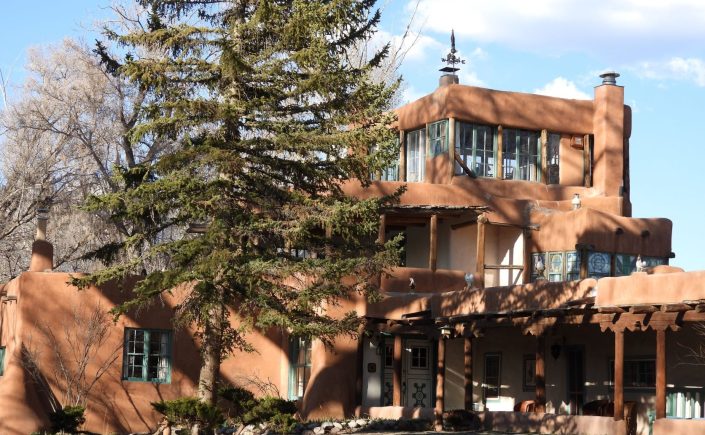
If these walls could talk, they might tell of:
…four rooms fashioned from adobe some 200-odd years ago in Taos, New Mexico
…the momentous decision by Mabel Dodge Luhan (1879-1962) to move to Taos in 1917, and to purchase 12 acres of land in 1918 on which these four rooms stood
…the renovation of these original structures and addition of a multi-level adobe house by Antonio Luhan (or Lujan), a member of the Tiwa tribe at home at Taos Pueblo, whose land abuts the property
…the years in which the house became the home of Mabel and Tony after they married in 1923, and where they lived until Mabel’s death in 1962
…the fertile decades under Mabel’s aegis during which America’s artists and thinkers flocked to Taos in search of inspiration and stimulation
…the period in the 1970s when the house was owned by actor and film maker Dennis Hopper, who shared it with his hippie-era friends
…the time in which it served as the base for Las Palomas, an educational foundation
…the (so-far) final chapter of the house, which started in 1996, when the Attiyeh Foundation transformed it into a Historic Inn and Conference Center
To enlarge a photo, click on it. To read its caption, hover cursor over it.


If these walls could talk, they might tell of the complex and complicated life of Mabel Ganson Evans Dodge Sterne Luhan (what’s in a name?!):
…who, in the words of her biographer, Lois Palken Rudnick, “tried to enact the fate of humanity through her personal existence”
…who was born into the wealthy industrial Buffalo, New York, Ganson family in 1879 whose Victorian mores, confines, and capitalist goals she tried to escape from for her entire life
…who was groomed to become a society hostess and find fulfillment in marriage, which led to her complicated relationships with men, and the belief that “women were dependent on men to realize their destinies,” a conviction she wrestled with all her life
…who married Karl Evans at 21 and had her first and only child, John, at 23
…who lost her first husband in a shooting accident in 1903 when she was 24
…who married architect Edwin Doge in 1904 and moved to Florence, Italy, where she reconstructed the Renaissance in a Florentine villa and presided over a salon for artists
…who fled this Florentine dream world as well as her second marriage for Greenwich Village in New York City in 1912, where she established a salon for America’s intellectual elite, described by her biographer, as
…perhaps the most famous salon in American history. Her apartment at 23 Fifth Avenue became internationally known as a gathering spot where “movers and shakers” of the pre-World War I era engaged in a free exchange of avant-garde ideas in art, politics, and society.
Mabel immersed herself in the spirit of her times, supporting, writing, and speaking about the various causes that promised to liberate her and her fellow men and women from the spiritual and psychological shackles of the past.
…who divorced her second husband and entered into her third marriage in 1916, with artist Maurice Sterne (her biographer claims “She married him to have greater control over the direction of his art.”)
…who once again became disillusioned with her life and escaped to New Mexico in 1917 to join Maurice, who had traveled there to find inspiration
…who experienced a kind of rebirth in New Mexico. As she later wrote:
There was no disturbance in the scene, nothing to complicate the forms, no trees or houses, or any detail to confuse one. It was like a simple phrase in music or a single line of poetry, essential and reduced to barest meaning.
According to Rudnick:
…[she] began to imagine that new world as a center for the rebirth of American civilization.
Among the Pueblo Indians of Taos,…Mabel discovered a culture that seemed to offer everything she had lacked in childhood, failed to re-create in Florence, and could not find in Greenwich Village. The Pueblos offered a model of permanence and stability, a 600-year-old community where individual, social, artistic, and religious values were fully integrated.
Taos was the last place Mabel tried to build what she called a “cosmos.” Here she became the leading proponent of the primitivist doctrines that attracted many alienated white intellectuals in the 1920s.
Among the Anglo expatriates who moved to Santa Fe and Taos after World War I, Mabel took the lead in promoting the utopian myth of the Southwest as a garden of Eden, where the climate, terrain, and indigenous peoples offered a neurotic, mechanized, and deracinated Anglo civilization a model for its aesthetic and spiritual renewal. She did this not only through her extensive correspondence and published articles and essays, but also by attracting to Taos an extraordinary array of painters, writers, musicologists, ethnologists, and reformers to help her celebrate and preserve the lands and culture of what her friend John Collier called “The Red Atlantis.”
…who met and fell in love with Antonio Luhan, who would become her fourth and final husband in 1923, following her last divorce
Mabel believed that she and Tony would serve as a “bridge between cultures.” She dreamed of establishing Taos as the birthplace for a new American civilization, one not based on getting and spending, or on the redistribution of wealth. The Pueblos’ lack of interest in material wealth, their devotion to communal values, their healthy respect for human limitation and for the natural environment seemed a sane counterpoint to the frenetic white civilization she saw as heading to self-annihilation.
…who, like many of us was, a bundle of contradictions. According to her biographer, despite her idealized depiction of her union with Tony,
She drove Tony Luhan away at various times by her jealousy and interest in other men…
Furthermore,
Although she was capable of extraordinary generosity, she had a great deal of difficulty maintaining the disinterested benevolence she admired so much in Pueblo character.


If these walls could talk, they might tell of the pantheon of talented individuals who visited Mabel and Tony in their beautiful home and for whom many of the guest rooms are nowadays named (this list is not complete):
…Painters Georgia O’Keeffe, John Marin, Andrew Dasburg, Dorothy Brett, Nicolai Fechin, Rebecca James
…Writers Mary Austin, Willa Cather, Spud Johnson, Frank Waters, Robinson Jeffers, D.H. Lawrence, Gertrude Stein, John Reed, Aldous Huxley
…Musicologist and conductor Leopold Stokowski
…Anthropologist Elsie Parson
…Sociologist John Collier
…Photographers Ansel Adams, Alfred Stieglitz
Just imagine for a moment the creative forces collected under the roof of this house!
And last, if these walls could talk:
… they might whisper of an ephemeral visit by me and my husband to the Mabel Dodge Luhan Historic Inn and Conference Center in April 2023, the realization of a long-held dream which was supposed to materialize in April 2020, only to be postponed when The Pandemic waylaid plans for many of us.


For three nights we stayed in the Juniper House, a later addition to the property to accommodate more visitors. We slept in the Rebecca James room for the first night, and in the Frank Waters room the last two for sentimental reasons, as author Frank Waters was born and spent his childhood in our home town, Colorado Springs. We loved getting to know the beautiful setting and buildings of this retreat and its late-winter landscape, asleep with the dream of a burgeoning spring. Of course, it was fascinating to learn about Mabel and Tony and their sometimes troubles in paradise.
We also enjoyed exploring downtown Taos which can be reached on foot in 10 minutes (see here for my previous post about Taos), and the town’s vicinity (following this link to my post about Taos Surroundings).
And if you would like more information about the Mabel Dodge Luhan House, here is a link to its website.

Mabel Dodge Luhan’s burial place in Taos, not far from Kit Carson’s gravesite. Tony, who died one year after Mabel, is buried at the Taos Pueblo Cemetery.
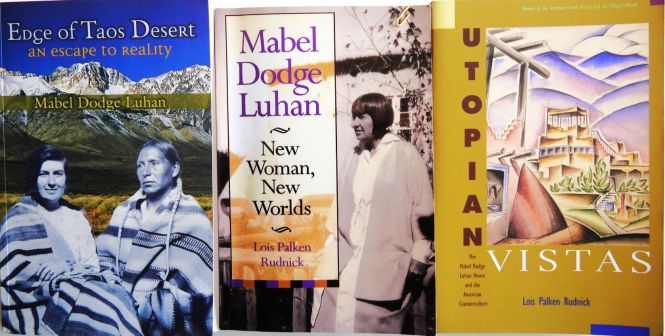
Thank you for sticking with me until the (almost) end of this long post. If your interest has been piqued and you would like to further delve into this intriguing history, Mabel Dodge Luhan authored an autobiography in four parts. I have only read part four, pertaining to her life in Taos, titled Edge of Taos Desert: An Escape to Reality. Writer and teacher Lois Palken Rudnick, who passed away in 2021 at the age of 76, is THE authority on Mabel. Her books Mabel Dodge Luhan: New Woman, New Worlds, and Utopian Vistas: The Mabel Dodge Luhan House and the American Counterculture will give an exhaustive idea of the woman, her era, and her legacy.
 tanja britton
This is amazing information. Thank you.
LikeLiked by 1 person
Thank you, Cindy, I’m glad you found this interesting.
LikeLike
Adobe is such a unique style. Thanks for sharing.
LikeLiked by 1 person
Thank you for your interest. I also love buildings made of adobe and wish we lived in one.
LikeLiked by 1 person
enchanting !!!…really like wild wild west…is there still a sheriff buried somewhere? …best regards, dear Tanja!
LikeLiked by 1 person
Thank you for your comment. It really was an enchanting experience and learning about the history of the place and people has been fascinating.
LikeLiked by 1 person
Not a woman I knew about. Thank you for enlightening me! Did Huxley visit her? I am thinking of the possible links with Brave New World.
LikeLiked by 1 person
Thank you for your comment, Cathy. I don’t know about Huxley, but D. H. Lawrence did, which I will talk about in next week’s post.
LikeLike
Fascinating -as Lawrence and Huxley knew each other and Huxley used the Mew Mexico location so centrally in Brave New World it seems likely!
LikeLike
Thank you for following up on this, Cathy. I searched the internet some more and found an article (https://bookriot.com/literary-tourism-taos-new-mexico/) that showed a photo with Lawrence and Huxley together in Taos, so your instinct was absolutely right. I had not come across Huxley’s name, somehow.
LikeLike
Mabel had what you might call a ‘colourful life’ and her home is fascinating too. It must have been marvellous to stay in the Juniper House – glad you were able to realise that dream!
LikeLiked by 1 person
Colourful, indeed, Ann! The place and its history are very intriguing and I don’t think this was the last time we visited there. 🙂
LikeLiked by 1 person
So interesting and fascinating, Tanja. As always thank you for the research and putting it all together for us.
LikeLiked by 1 person
Thank you, Dwight, I’m glad you found the post interesting. It has been a lot of fun to learn about the place and its people.
LikeLiked by 1 person
I had never heard of Mabel, but her restlessness, combined with her wealth, is a familiar American story. However, it wouldn’t surprise me to learn that other cultures have Mabels, too. A fascinating if sad story of a women searching for creativity and meaning. Do you think she found it?
LikeLiked by 1 person
Thank you for your comment, Laurie. It has been interesting to learn about Mabel’s privileges on the one hand, and her profound struggles on the other. From what I have learned it seems that she found a new sense of being and fulfillment once she moved to Taos and especially once she met Tony, but I think that she couldn’t completely leave the old Mabel behind, which is also perfectly understandable. Many of us continue to carry our background and belief systems with us, even if we embrace new ideas and new ways of being.
LikeLiked by 1 person
There’s a saying: You can take the boy/girl out of the country but you can’t take the country out of the boy/girl.
LikeLiked by 1 person
The improvised adornments on Mabel Dodge Luhan’s grave seem appropriate to her personality and doings.
Given that your visit took place nine months ago, what prompted you to put out this post now? Will you do other posts about Luhan?
A year or two ago I read From Greenwich Village to Taos: Primitivism and Place at Mabel Dodge Luhan’s, by Flannery Burke. The Amazon description of the book includes this paragraph:
“In this first book to consider Dodge and her visitors from a New Mexican perspective, Flannery Burke shows how these cultural mavens drew on modernist concepts of primitivism to construct their personal visions and cultural agendas. In each chapter she presents a place as it took shape for a different individual within Dodge’s orbit. From this kaleidoscope of places emerges a vision of what place meant to modernist artists—as well as a narrative of what happened in the real place of New Mexico when visitors decided it was where they belonged. Expanding the picture of early American modernism beyond New York’s dominance, she shows that these newcomers believed Taos was the place they had set out to find—and that when Taos failed to meet their expectations, they changed Taos.”
LikeLiked by 1 person
This post has been on my mind since our visit and I planned to get it completed while working on my previous posts about Taos. However, the mind does not always proceed in a linear fashion. And while the photos had been uploaded and saved in a draft post, it took me a while to figure out how to present so much information.
At this point, I don’t plan any more posts about Mabel.
Thank you for sharing the quote. While many of the “mavens” were drawn to Taos because they believed it offered an alternative to the places and lives they were leaving behind, they inevitably altered the very essence of the place. It’s not unlike Californians escaping California for Colorado and Californicating Colorado in the process.
LikeLike
You may be interested in the etymology of the non-Cali part of Californicate:
https://www.etymonline.com/word/fornicate
LikeLiked by 1 person
It is a well known word, but I don’t think that’s the meaning in the word Californicate.
LikeLike
I’ve always taken it to be that word. Here’s more:
https://en.wikipedia.org/wiki/Californication_(word)
LikeLiked by 1 person
Thank you.
LikeLike
I am always curious about big old houses. Interesting to read their back story.
LikeLiked by 1 person
Thank you for your comment, V.J. I feel exactly the same way about big (or small) old houses. It’s fascinating to learn what went on behind their walls.
LikeLiked by 1 person
…a million stories to be told….
LikeLiked by 1 person
…at least! 🙂
LikeLiked by 1 person
I’d never even heard of Mabel. From your essay I understand her to be somewhat flawed but also visionary and brilliant. I’d love to have met her, though I suspect she’d not feel the same about me (a little too conventional and far too cautious for her free spirit to tolerate!). And the Jupiter House looks great, simply oozing with character.
LikeLiked by 1 person
Thank you, Mr. P. It has been fascinating to learn about Mabel and her entourage. Many individuals benefitted from her patronage and largesse, but despite her idealistic notions, she continued to be a flawed human being, just like the rest of us.
LikeLiked by 1 person
Great history lesson, thank you! We didn’t see any of this when we went to Taos.
LikeLiked by 1 person
Thank you, Diana. This is another good reason to return to Taos! 😊
LikeLiked by 1 person
This is fascinating! I love Taos! One of my favorite places to go. I would love to stay in the Juniper house; I’m so happy you finally were able to visit. My life parallels Mable’s life in many ways. I understand her. “If these walls could talk…”I’m saving this to read again. This is on my bucket list. I also appreciate all the hard work and excellent review in creating these pieces for us. Thank you so much!
LikeLiked by 1 person
Thank you for your enthusiastic comment, I’m so glad you enjoyed this post. 🙂
We also love Taos and hope to return, as there is much more to discover and explore. I hope you will be able to check out Mabel’s former home!
LikeLiked by 1 person
It’s my pleasure, Tanja! I keep dreaming—and this is a spot to hit for sure. Happy Friday! 😃
LikeLiked by 1 person
So interesting. What a brave woman she must have been. 😊
LikeLiked by 1 person
Thank you for your comment. I think Mabel was a very complex human being and bravery was one of her many sides. I’m still learning about this and others.
LikeLiked by 1 person
I’d never heard of her before. Sounds as though she put Taos on the map.
LikeLiked by 1 person
Thank you for your comment, Neil. Mabel definitely helped to make Taos famous, and some of the artists who came on her behest, never left again and made New Mexico their new home.
LikeLiked by 1 person
I first became aware of Luhan through my interest in Georgia O’Keeffe. She and D.H. Lawrence both landed at Luhan’s place; Lawrence ended up buying a nearby ranch. Even though he and O’Keeffe never met, her painting of a tree on his property — “The Lawrence Tree” — is one of my favorites. As for Luhan, her salons in New York and Taos brought together some of the most influential artists of the time. She certainly was a complex character. You might find this New Yorker article of interest; it helps to untangle some of the overlapping relationships of the time.
LikeLiked by 1 person
Thank you for your comment, Linda. It anticipated next week’s post about D. H. Lawrence, which will also mention Georgia O’Keeffe and the painting you mentioned, so maybe you will no longer have to read it. 🙂
Thank you also for the link. I will read the article when it’s not past my usual bedtime.
LikeLiked by 1 person
Tanja, I think you did hear the walls talk, even if just a little bit, and interpreted what they were saying for us. Thank you.
LikeLiked by 1 person
Thank you, Brad, for letting me know that you were able to hear the walls talk. That makes me happy. 🙂
LikeLiked by 1 person
I’ve seen few of these interesting houses in Taos, but have never heard of Mabel or her house. Interesting to learn about her. Maggie
LikeLiked by 1 person
Thank you, Maggie. Adobe-style houses are the norm in Taos and there are many beautiful buildings one could look at for hours on end. I’m always a little disappointed when I realize that I should have visited a place in a town AFTER I have already left.
LikeLiked by 1 person
me too 😊
LikeLiked by 1 person
Sounds like a ‘larger than life’ character. Great post, Tanja!
LikeLiked by 1 person
Thank you, Eliza, I’m glad you enjoyed this post. And “larger than life” is a good way to summarize Mabel’s long and colorful life.
LikeLiked by 1 person
Faszinierend Tanja und ich freue mich, dass ihr eure Pläne doch noch nach der Pandemie wahrmachen konntet !
Liebe Grüße Brigitte
LikeLiked by 1 person
Danke, liebe Brigitte, es freut mich, daß Dir dieser Beitrag gefallen hat. Wir waren wirklich froh, daß diese Reise doch noch zustande kam, und “nur” mit 2 Jahren Verspätung. 😊
LikeLiked by 1 person
Fascinating post, Tanja. What a life Mabel lived! The home and compound are beautiful, glad it’s still in use for many to enjoy and appreciate.
LikeLiked by 1 person
Thank you, Tina. It has definitely been a fascinating journey, both to Mabel’s home and into her rich inner life.
LikeLike
You know me, I am always up for anything intriguing! Thanks for the dive into the history behind this location – those walls have an incredible story buried in them. I sure hope my walls never speak to anyone – they’d probably go on and on about me whining about my elbow hehehe,
LikeLiked by 1 person
Thank you for being interested, Brian. You make a good point about walls talking. I would only want our walls to tell the good stories, not the bad, but I guess we wouldn’t get a say, so it might be better if those walls stay quiet. 😊
LikeLiked by 1 person
What a fascinating account, Tanja! Thank you for sharing so many historical and personal details about this woman and her story – what a lot of research you’ve done about her life and the stories this house could tell.
LikeLiked by 1 person
Thank you for your comment. It has been fun and stimulating to learn about Mabel’s life and to visit her former home, and I imagine that we will return there to learn more.
LikeLiked by 1 person
[…] escritortanjabrittontanjabrittonwriter.com·Hace 1d […]
LikeLiked by 1 person
Thank you for reposting this blog post.
LikeLike
As soon as I looked at your photos of this house, I immediately thought of Georgia O’Keeffe. How lucky you are, to have stayed at this fascinating place. Thanks for sharing!
LikeLiked by 1 person
Thank you for your comment. Julie. I understand why you thought of Georgia O’ Keeffe, another fascinating woman. She will also feature in next week’s post.
LikeLiked by 1 person
Looking forward to it!
LikeLiked by 1 person
Thank you!
LikeLiked by 1 person
What an extraordinarily beautiful building, and also beautiful art. I had never heard of the Luhan family.
LikeLiked by 1 person
Thank you, Karin. Mabel looms large in Taos even today, and she had an outsized influence on many of America’s leading intellectuals and artists. Comparing her to Gertrude Stein (with whom she had a complicated relationship) would not be wrong.
LikeLike
👏👏👏
LikeLiked by 1 person
Thank you, I’m glad you enjoyed the post.
LikeLike
❤❤❤
LikeLiked by 1 person
Ich danke Dir für diesen Bericht, planen einen 3. Besuch in Taos in diesem Jahr. Es ist ein magischer Ort.
LG
MAren
LikeLiked by 1 person
Ich kann gut verstehen warum. Auch wir wollen wieder nach Taos zurück!
Genießt Euren Besuch!
Liebe Grüße,
Tanja
LikeLiked by 1 person
Danke, Ende April wohl, kann auch Anfang Mai werden.
LikeLiked by 1 person
👍
LikeLike
Fascinating slice of history.
Nicely done.
LikeLiked by 1 person
Thank you, Wally, I’m glad you found this interesting.
LikeLike
[…] my last post, If These Walls Could Talk, you might have noticed D.H. Lawrence’s name on the list of luminaries with links to Mabel Dodge […]
LikeLike
Quite interesting post and read, Tanja!
LikeLiked by 1 person
Thank you, Donna. I’m glad you found it interesting. Thank you for stopping by and for commenting.
LikeLiked by 1 person
[…] of literary luminaries who enjoyed Mabel Dodge Luhan’s hospitality and patronage from my post If These Walls Could Talk, Willa Cather’s name was among […]
LikeLike