
Recent repeated excursions to New Mexico (if only in my mind and photo archives) resurrected thoughts of another essay long wanting to be written. If you remember the listing of literary luminaries who enjoyed Mabel Dodge Luhan’s hospitality and patronage from my post If These Walls Could Talk, Willa Cather’s name was among them.
Willa Cather (1873-1947) was one of America’s best-known and most widely read writers in the first half of the 20th century and joined the pantheon of Pulitzer prize-winning authors in 1923 for her WWI novel, One of Ours. My husband and I set out on a literary pilgrimage to Willa Cather’s childhood home in Red Cloud, Nebraska, in the autumn of 2015, and I summarized my impressions in a previous post, A Visit to Catherland.
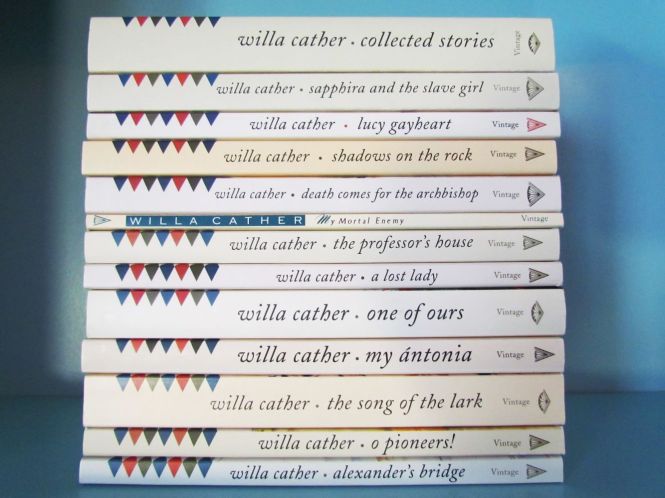
During that trip I became the proud owner of Willa Cather’s fictional creations and subsequently read one volume after the other. Apart from One of Ours, My Ántonia, one of her so-called prairie novels, might be most familiar as it has been required reading for generations of America’s students. She will be forever connected in the public’s mind with Nebraska’s Great Plains, but several stories play in different settings—New Mexico among them, which she explored multiple times and whose natural and cultural landscapes intrigued her.
In Willa Cather Living: A Personal Record, by Edith Lewis, Willa’s companion of over 40 years, Edith relays an episode that says much about both Mabel Dodge Luhan and Willa Cather (to whom she always refers formally):
On one of Willa Cather’s returns to Santa Fé from her journeys about the country, Mabel Luhan called on her and asked her to visit her at her hacienda in Taos. With one or two exceptions, Willa Cather never visited anyone; and at this time especially she wanted to be absolutely free to follow her own devices. But Mabel Luhan was very persistent, in a quiet persuasive way. She offered Willa Cather one of her guest houses to stay in…and promised that she should never be bothered by anyone….Willa Cather finally agreed to come for two or three days….Although Willa Cather had intended to make a very brief visit, we stayed for more than two weeks.
Her two visits to Mabel Luhan—for she stayed with her a second time the following summer—were very rewarding to Willa Cather. Mabel Luhan—essentially an artist herself—knew the conditions that contribute to an artist’s work, and was able to create them. She had, too, a large, ungrudging generosity toward people she admired; one felt that she enjoyed helping them toward their aim and seeing them realize their desires.
Tony Luhan, Mabel’s husband, captivated many visitors who stayed with the couple and Willa Cather was no exception. Edith describes his influence as follows:
Willa Cather was very much impressed with Tony Luhan, and felt an instant liking and admiration for him. He was a splendid figure, over six feet tall, with a noble head and dignified carriage; there was a great simplicity and kindness in his voice and manner….from Tony, Willa Cather learned many things about the country and the people that she could not have learned otherwise. He talked very little, but what he said was always illuminating and curiously poetic. Although Eusabio in “Death Comes for the Archbishop” is a Navajo…, I think his character was essentially drawn from Tony Luhan.
Incidentally, Willa Cather and Edith Lewis also stayed with the Lawrences on their ranch north of Taos during one of those trips (click here for my post D.H. Lawrence in New Mexico).
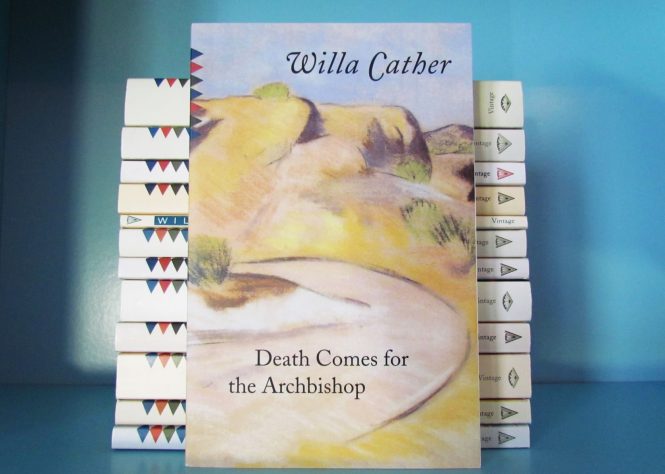
During her repeated sojourns in New Mexico, Willa Cather absorbed everything she could about the land and its people and turned it into grist for her creative mill. When I first saw the book title of Death Comes to the Archbishop, thoughts of a murder-mystery came unbidden, even though I should have known better, based on what I had already learned about the author. And while the titular archbishop does not suffer murder, the narrative delves into the mysterious world of faith and religion by following the peregrinations of a Catholic priest in New Mexico in the 19th century.
The lives of numerous Native tribes at home in the Americas were upended with the arrival of the Spanish, who occupied vast expanses of land and claimed it for the Spanish Crown after the 1521 conquest of the Aztec Empire, thereby establishing New Spain. New Mexico was one of New Spain’s kingdoms and when Mexico became independent from Spain in 1821, New Mexico lay in the territory of that new nation. After the 1846-1848 Mexican-American War, it was ceded to the United States. 1850 saw the creation of the US Territory of New Mexico, and on January 6, 1912, New Mexico became the 47th US state.
With the Spanish Conquistadors came Catholicism and about 34% of New Mexico’s adult population still identifies as Catholic today. Willa Cather, who grew up Baptist and later became Episcopalian, was fascinated by Catholicism and its influence in New Mexico. In Death Comes to the Archbishop, she fictionalizes the life of Jean-Baptiste Lamy (1814-1888), a French-born Roman Catholic priest and eventual Archbishop of Santa Fe, who becomes Jean Marie Latour in her novel.
After the 1927 publication of Death Comes for the Archbishop, the author explained her motivations for writing it to her admiring audience:
I had all my life wanted to do something in the style of legend, which is absolutely the reverse of dramatic treatment. Since I first saw the Puvis de Chavannes frescoes of the life of St Genevieve in my student days, I have wished that I could try something like that in prose; something without accent, with none of the artificial elements of composition. In The Golden Legend [a medieval collection of hagiographies] the martyrdoms of the saints are no more dwelt on than are the trivial incidents of their lives; it is as though all human experiences, measured against one supreme spiritual experience, were of about the same importance. The essence of such writing is not to hold the note—not to use an incident for all there is in it—but to touch and pass on.
It is in this spirit of slight detachment that in Death Comes to the Archbishop, New Mexico’s geography, flora, fauna, and humanity are presented through the eyes of a Catholic priest who comes here from a different world. And even though his responsibility is to convert nonbelievers, and to bring religion and ritual back to those Catholics who lived without the ministrations of priests for decades, if not centuries on account of their geographical isolation, the fictional Latour does not belong to the group of “fire and brimstone” clerics and is depicted as a rather sympathetic figure who is interested as much in nature, culture, and human accomplishments as in religion. While some Catholic priests are portrayed as selfish and exploitative of their flock, one looks in vain for criticism of the Church as a whole, or its role in the often forced conversion of America’s Indigenous groups who had practiced their own beliefs and traditions for centuries, if not millennia.
In order to illustrate this book’s (beautiful-to-my-ears) style, and to cover a range of topics, I chose several rather longish quotes:
The traveler dismounted, drew from his pocket a much worn book, and baring his head, knelt at the foot of the cruciform tree. …A young priest, at his devotions; and a priest in a thousand, one knew at a glance. His bowed head was not that of an ordinary man, —it was built for the seat of a fine intelligence. His brow was open, generous, reflective, his features handsome and somewhat severe. There was a singular elegance about the hands….Everything showed him to be a man of gentle birth—brave, sensitive, courteous. His manners, even when he was alone in the desert, were distinguished. He had a kind of courtesy toward himself, toward his beasts, toward the juniper tree before which he knelt, and the God whom he was addressing.
In all his travels the Bishop had seen no country like this. From the flat red sea of sand rose great rock mesas, generally Gothic in outline, resembling vast cathedrals. They were not crowded together in disorder, but placed in wide spaces, long vistas between….The sandy soil of the plain had a light sprinkling of junipers, and was splotched with masses of blooming rabbit brush, —that olive-coloured plant that grows in high waves like a tossing sea, at this season covered with a thatch of bloom, yellow as gorse, or orange like marigolds.
The two priests rode side by side into Los Ranchos de Taos….The inhabitants were all gathered in the square before the church. When the Bishop dismounted to enter church, the women threw their shawls on the dusty pathway for him to walk upon and as he passed through the kneeling congregation, men and women snatched for his hand to kiss the Episcopal ring. In his own country all this would have been highly distasteful for Jean Marie Latour. Here, these demonstrations seemed a part of the high colour that was in landscape and gardens, in the flaming cactus and the gaudily decorated altars, —in the agonized Christs and dolorous Virgins and the very human figures of the saints. He had already learned that with this people religion was necessarily theatrical.
In the working of silver or drilling of turquoise the Indians had exhaustless patience; upon their blankets and belts and ceremonial robes they lavished their skills and pains. But their conception of decoration did not extend to the landscape. They seemed to have none of the European’s desire to “master” nature, to arrange and re-create. They spent their ingenuity in the other direction; in accommodating themselves to the scene in which they found themselves. This was not so much from indolence, the Bishop thought, as from an inherited caution and respect….The land and all that it bore they treated with consideration; not attempting to improve it, they never desecrated it.
Bishop Latour had one very keen worldly ambition; to build in Santa Fé a cathedral which would be worthy of a setting naturally beautiful. As he cherished this wish and meditated upon it, he came to feel that such a building might be a continuation of himself and his purpose, a physical body full of his aspirations after he had passed from the scene.
The narrative ends with the death of the aged Archbishop Latour of natural causes, after the completion of his dream church in the center of Santa Fe (minus the steeples on the two towers, which have remained unfinished). This corresponds to the real life of Archbishop Lamy, who was responsible for the construction of the Cathedral Basilica of St. Francis of Assisi in Santa Fe, starting in 1869, and where he was buried in 1888 following his death of pneumonia at the age of 73.
Built in a Romanesque Revival style by French architects and Italian stonemasons, the edifice is strikingly different from New Mexico’s predominantly adobe-style churches. The cathedral was built at the site of a previous church with roots dating back as far as 1610. The original structure was replaced in 1630, but was destroyed during the Pueblo Revolt in 1680. In 1714, a new church was erected only to be replaced by Lamy’s cathedral, with the exception of a small preserved chapel. This is dedicated to La Conquistadora (Our Lady of Peace), a sculpture brought to this continent from Spain in 1625 and thought to be the oldest representation of the Virgin Mary in the United States.
Willa Cather’s visit to this Cathedral served as one of her inspirations to write Death Comes to the Archbishop. Having read her “legend” inspired us to visit what has become one of Santa Fe’s best-known landmarks.
To enlarge a photo, click on it. To read its caption, hover cursor over it.


 tanja britton
I read this beautiful book many years ago. It made quite an impression on me and its lyrical beauty has stayed with me all these years.
LikeLiked by 1 person
“Lyrical beauty” describes this work’s style very well, Laurie, and it has had the same lasting impression on me.
LikeLiked by 1 person
I imagine that her works, at least some of them, continue to find plenty of readers. Is she your favorite author?
LikeLiked by 1 person
You are right, Neil, Willa Cather still has many fans. The Willa Cather Foundation is partly responsible for that, but the quality of her writing speaks for itself.
I don’t know if she she is my favorite author (I don’t think I could choose), but she is one of them.
LikeLiked by 1 person
I have not heard of this author. You have peaked my interest, Tanja.
LikeLiked by 1 person
I’m glad I peaked your interest, V.J. One of Willa Cather’s novels, “Shadows on the Rock” is actually set in Canada, in Quebec. It also reflects the author’s fascination with Catholicism and talks about the French settlers who made Quebec their home.
LikeLiked by 1 person
Oh, I would be interested in that. I have one of her books on hold at the library.
LikeLiked by 1 person
Great, I hope you will like it.
LikeLiked by 1 person
These latest essays of yours are so informative Tanja, also quite enjoyable to read. These generous encouragers of artists, like Mabel Luhan are so rare and precious. I think they deserve as much praise as the artists themselves.
LikeLike
Thank you, Julie, I’m glad you have found the last several posts interesting. They have been fun to write, as I had thought of them for a number of years.
I also thank you for visiting and liking the older post about Georgia O’Keefe. I understand why so many artists flocked to New Mexico, but Mabel Luhan definitely aided that movement.
LikeLiked by 1 person
And thank you for sharing your love of place and history with us. I can’t get the image of “The Lawrence Tree” out of my head, such a unique perspective G. O. had and my new favourite painting of hers now.
LikeLiked by 1 person
I’m so glad my poor photo of this wonderful painting appealed to you, Julie. It would be fun to see the original and to experiment with how to hang it. This is how it’s oriented at the Wadsworth Atheneum:
https://5058.sydneyplus.com/argus/final/Portal/Public.aspx?lang=en-US
LikeLiked by 1 person
Thanks for the info Tanja. ❤️
LikeLiked by 1 person
My pleasure, Julie. Thank you for your interest!
LikeLiked by 1 person
Have definitely not come across Willa Cather before. She was clearly very accomplished, but I wonder how well her work resonates with readers from outside the US? I shall watch out for her.
LikeLiked by 1 person
I imagine her work resonates with someone with an interest in the history of the Great Plains, New Mexico, Quebec, and WWI. Otherwise her narratives might seem to come from far away and long ago. But if a reader loves lyrical prose, he or she will not be disappointed.
LikeLiked by 1 person
I’ve never heard of Willa Cather. Thanks for the introduction. Maggie
LikeLiked by 1 person
That’s interesting, Maggie. I didn’t know that she was so little known in Canada. As I told another fellow blogger from Canada, her novel Shadows on the Rock is about the settlement of Quebec, and I thought it was very well written and engaging.
LikeLiked by 1 person
Oh, I’ll look for it, thanks
LikeLiked by 1 person
A most interesting post which has made me curious about Willa Cather. Hopefully I’ll have the chance to read some of her books in the near future…
LikeLiked by 1 person
Thank you, Ann, I’m glad to have piqued your interest. As one of the quotes in my older post about Willa Cather shows, the author was into botany, which you and she have in common: “There is one book I would rather have produced than all of my novels. That is Clements Botany dealing with the wild flowers of the west.”
LikeLiked by 1 person
I’ve read only a handful of W.Cather’s books… I didn’t realize how prolific she was!
LikeLiked by 1 person
She was definitely prolific. I’m always amazed at how many formerly famous authors or creations have been forgotten or eclipsed. Our memories are short.
LikeLike
I went to my library to find books popular when my mother was young, like Daphne du Maurier, and they had got rid of them all. Such good books, all but forgotten.
LikeLiked by 1 person
One of the challenges is the sheer number of new publications and the limitation of space. A library that holds all the volumes ever written only exists in fiction. 🙂
LikeLiked by 1 person
True!
LikeLiked by 1 person
Thank you, Tania. Another fascinating author for me to look out for. 🙂
LikeLiked by 1 person
I’m glad to have piqued your interest, Michael. I can only repeat: So many books, so little time. 📚📚📚
LikeLiked by 1 person
I’ve enjoyed these profiles of writers and artists, it’s always fascinating to learn about what influences their creations. New Mexico seems such a rich place, in both natural landscape and human activity and events. It’s no wonder that so many have gravitated toward that ‘land of enchantment’. Very nice post, Tanja!
LikeLiked by 1 person
I appreciate your feedback, Tina. Learning about all the people who gravitated to New Mexico’s stark beauty has been fascinating and, like you, I can relate to why they were inspired to paint or write or sing about their experiences.
LikeLike
When I looked at that stack of Cather books, I realized that I knew only three of them, and had read only one. I did have her firmly connected to the prairie in my mind, like Laura Ingalls Wilder. Perhaps that’s because our teachers chose books for us Iowa students to read that were most obviously connected to the land that we knew. I really enjoyed reading more about her: especially her connection to New Mexico.
LikeLiked by 1 person
Thank you, Linda. I think the canon of literature is too vast and deep for most of us to develop a comprehensive understanding. I constantly come across names and titles I have never heard of, even though the authors and their works were once considered essential.
That being said, it’s very satisfying to make connections between different people and places we know of, such as between Mabel, DHL, Georgia O’Keefe, and Willa Cather.
LikeLiked by 1 person
One of the passages you quoted referred to blooming rabbit brush. In October 2022 we saw some in New Mexico’s Pecos National Historic Park, which in part memorializes the Pueblo Revolt you mentioned. We’d seen some of those flowers in the even more majestic setting of Zion National Park in 2016.
LikeLiked by 1 person
Since you single out rabbit brush, does that mean the plant does not grow in Texas? I have come to like rabbit brush, so much so that we planted four in our yard. Pollinators love it, too, and it blooms late into autumn. Furthermore, it’s drought-resistant.
LikeLike
I just checked and found that rabbitbrush makes it into two parts of Texas: the western panhandle, and two counties south of New Mexico. Both of those places are over 400 miles from Austin, so the only chance I get to see rabbitbrush is when I travel a good distance.
I’m happy to hear you’ve planted some in your yard and have been getting to enjoy it by just walking outside.
LikeLiked by 1 person
That’s interesting. Somehow I expected them to be more widespread in Texas.
LikeLike
As I also just noted when I revisited your post about the flora you encountered at Pecos NHP, we had a discussion about the scientific name of rabbit brush then!
LikeLike
Thank you very much for talking about this book and its author, who I didn’t know yet🌹🌹🌹
LikeLiked by 1 person
Thank you for your interest, Luisa. There are so many authors and so many books. It’s impossible to keep track of all of them!
LikeLiked by 1 person
Indeed my dear Tanja.
Thank you for your thoughts.🙏🤗😘💖
LikeLiked by 1 person
As a native Nebraskan who now lives in New Mexico, I particularly enjoyed this piece. You captured both Cather and New Mexico well. Both are amazing!
LikeLiked by 1 person
I appreciate your visit and your comment very much, thank you. I have found much inspiration during our visits in both Nebraska and New Mexico, not unlike the artists I have written about on my blog.
LikeLike
Quite the immersion Tanja! Unfortunately, Linda and I have a bad impression of NM at the moment thanks to two bad experiences staying at Las Cruces (coming and going on our Arizona trip). I’ll try not to let that set a tone for all of NM ha. Thanks for introducing me to this new author – admittedly, a different genre than my usual reads (currently in the middle of Do Hard Things by Steve Magness), but always good to stretch one’s boundaries.
LikeLiked by 1 person
Thanks for your comment, Brian. I hope you will give N.M. another chance because it has so much to offer. And you are right about the advisability of stretching one’s boundary–we all benefit from that from time to time. I had to look up the book you are reading right now and the summary sounds intriguing.
LikeLike