For bird lovers in El Paso County, Colorado, the new year brought a new bird species that had never before been reported here. Birders who keep track of unusual sightings were in a tizzy when the rare bird alert listed the presence of a Brant (Barna bernicla) at Prospect Lake in Colorado Springs on January 14. Many of us flocked there in the ensuing days, hoping to catch a glimpse of said goose, but none was granted and we assumed that it had left the county.
Luckily, we were proven wrong when the Brant was observed again one week later, on January 21. Not surprisingly, it was re-found by the one person who has seen 400+ of the 419 species ever recorded in El Paso County. He must have scanned each flock of waterfowl each day after that initial report, and the rest of us benefitted from his diligence and expertise. Thank you, Mark!
That second sighting was nowhere near the first, but happened on the grounds of the distinguished Broadmoor Hotel five-plus miles away, where the Brant was grazing on the award-winning golf course with its well-kept green. It was associated with thousands of Canada and Cackling Geese who were all nibbling on blades of grass, leaving fertilizer behind in return.
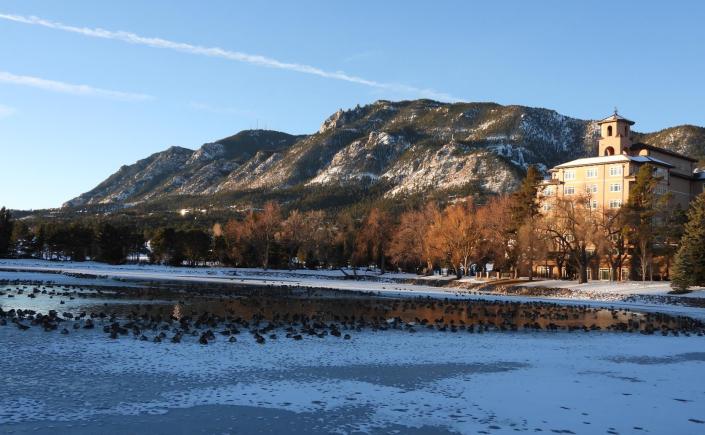
When a text message alerted me to Mark’s find on January 21, I happened to be nearby. Just as I pulled up next to the fence enclosing the golf course, a huge flock of geese was taking off in response to a dog off leash whose owners were walking on the golf course. The geese flew southward toward the hotel and, as I and a number of fellow present birders suspected, to Cheyenne Lake, located between the two main hotel buildings, Broadmoor East and Broadmoor West. We hopped back into our cars and drove to a public parking lot west of the hotel, then hurried to the partly frozen lake. There, in a gaggle of myriad garrulous geese was the hoped-for rarity.
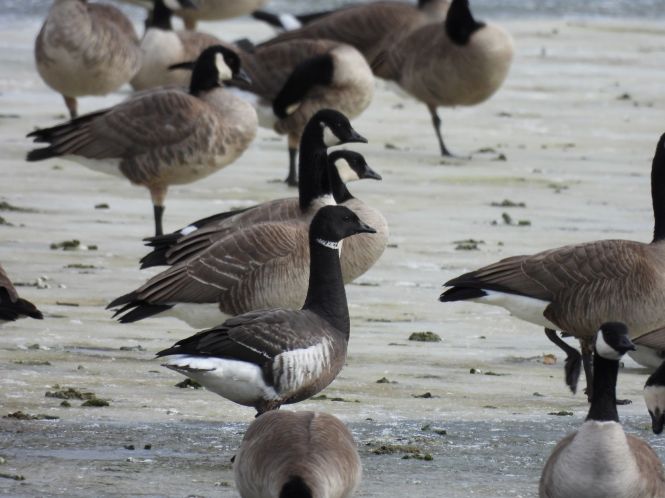
Black Brant (Branta bernicla bernicla) in the center
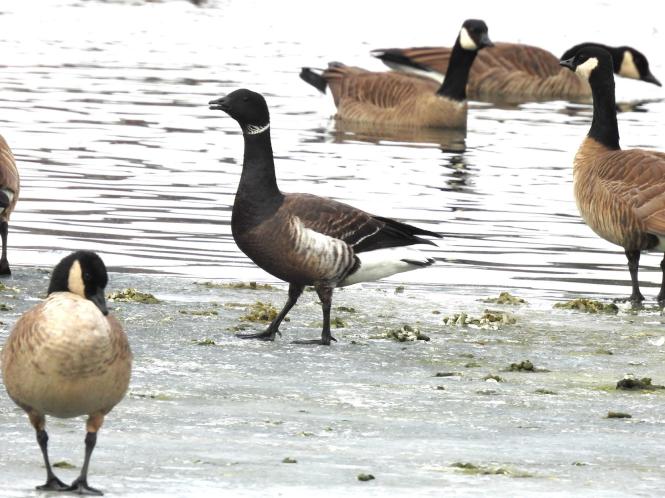
Black Brant (Branta bernicla bernicla) surrounded by Cackling Geese
Smaller than a Canada Goose (Branta canadensis) and approximately of equal size as a Cackling Goose (Branta hutchinsii), the bird in question looked slightly darker and lacked the white cheek patch of its Branta relatives, sporting a chic white necklace instead. Brants breed in the Arctic and winter along costal waters. A few venture inland and, according to eBird, Colorado has had 986 reported sightings. A couple of years ago I drove to Denver to meet my first-ever Brant, and the species has also occurred in other counties in the state. This year, it was finally El Paso County’s time and, happily, all those desiring to see a Brant were granted their wish, as the bird continued to favor the forage available on the Broadmoor golf course and the waters of Cheyenne Lake for at least a number of weeks. The last documented report is dated February 6, but the bird might still be around.
I made a few trips to The Broadmoor to gaze at this handsome goose. Our visitor represents a Black Brant (Branta bernicla bernicla), one of 3 subspecies (a fourth is under consideration). Its breast and belly are black, as opposed to pale or gray in the other subspecies. Black Brants nest in the western Arctic, winter on the Pacific Coast, and are the most expected vagrants inland. According to Cornell’s online Birds of the World:
Wintering locations are usually characterized by an abundance of native intertidal plants used as forage, particularly the seagrass, Zostera; no other species of goose relies so heavily on a single plant species during the nonbreeding season. In contrast to European populations, Brant wintering in North American have, for the most part, not switched to agricultural habitats.
Which likely explains why inland sightings of this goose are relatively rare. Our Brant most definitely did not come here to feast on seagrass, but it must have been able to derive enough sustenance from the local grasses.
It was great to start the birding year with this avian gift dropping out of the sky—literally.
🎁🎁🎁🎁🎁🎁🎁🎁🎁🎁🎁🎁🎁
During my forays to The Broadmoor, which I hadn’t visited for a number of years, I treated myself not to blades of grass but to hot chai from one of the cafés, in addition to a self-guided tour of the hotel.
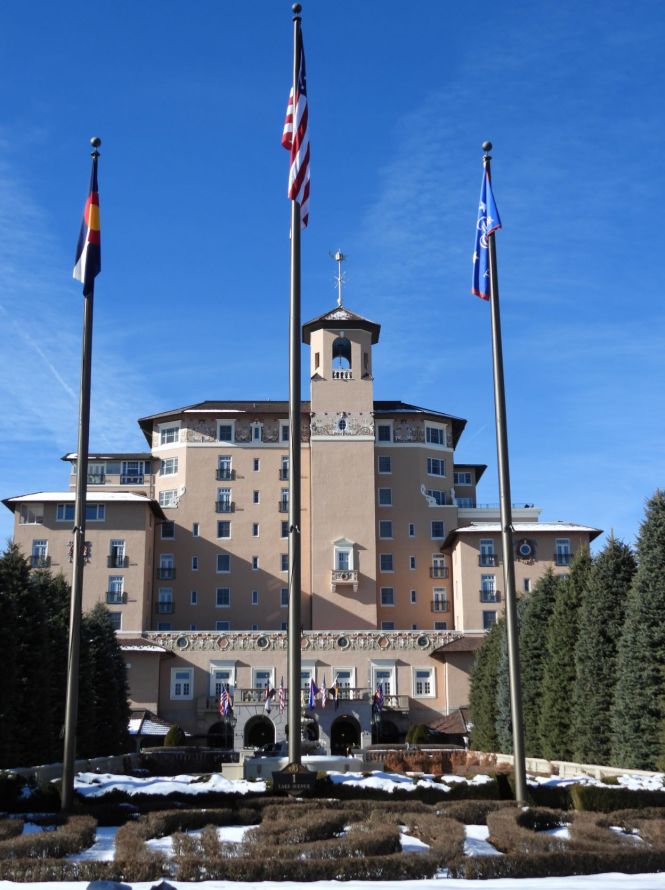
Original Broadmoor Hotel (Broadmoor East)
The Broadmoor Hotel first opened its doors in 1918. The brainchild of Julie and Spencer Penrose, whose legacy also includes the charitable El Pomar Foundation, the couple imagined that a European-style hotel in Colorado’s beautiful setting would attract visitors from near and far. Their vision came true and the internationally acclaimed hotel has accommodated prominent politicians, entrepreneurs, entertainers, athletes, and artists as well as regular folks for more than a century. It is one of only three Colorado hotels honored with five stars from Forbes Travel Guide in 2024 (the other two being the Little Nell in Aspen and the Madeline Hotel and Residences in Telluride), and has done so for 64 consecutive years, the longest streak for any hotel globally.

Hotel lobby at Broadmoor East with central fountain flanked by Maxfield Parrish paintings

One of the galleries at Broadmoor East

Ceiling detail at Broadmoor East
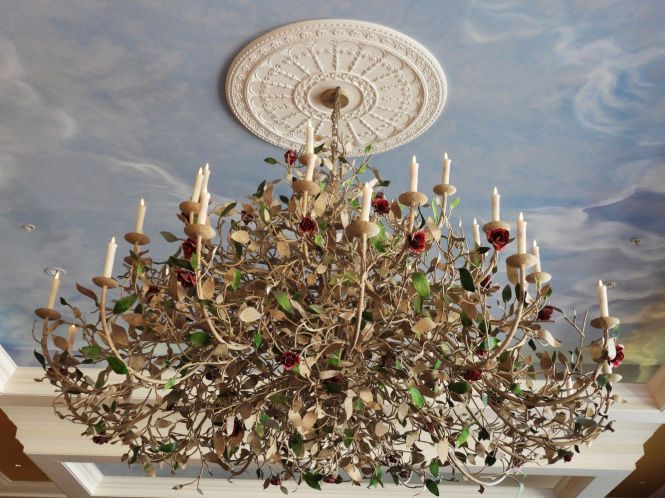
Chandelier at Broadmoor East
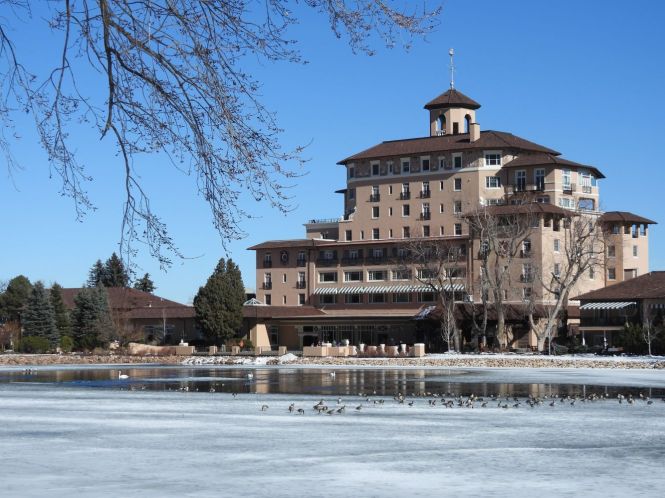
Broadmoor East with Cheyenne Lake in foreground

Hotel lobby at Broadmoor West with a fabulous arrangement of red roses

Broadmoor West with Cheyenne Lake in the foreground and the Front Range in the background
Since the Penroses’ passing (Spencer died in 1939; Julie in 1956), ownership of The Broadmoor has changed a number of times. In 2011, it was purchased by the Denver-based Anschutz Corporation. Philip F. Anschutz is a collector of Western art and the hotel corridors play host to priceless paintings and sculptures by well-known artists, including Maxfield Parrish, Thomas Moran, Albert Bierstadt, and Frederic Remington. (The Anschutz Collection also makes up the American Museum of Western Art in Denver, which has long been on my must-visit list.)
Thanks to the hotel’s spectacular setting at the foot of Cheyenne Mountain, its attractive architecture, delectable décor, and artistic arrays, the visitor is transported into a space of splendor where it is easy to while away hours while pondering the appeal and power of beauty.
 tanja britton
Thanks for sharing. Both the Brant and the grand Hotel. 😊
LikeLiked by 1 person
You are right–the hotel is grand, indeed. The Brant and other geese showed great taste in their choice. 😊
LikeLiked by 1 person
The joys of twitching, a successful sighting. Luckily that lake was nearby!
As you know we get a lot of Brents over-winter in Europe. I used to see a Black Brant or two nearly every year but not for some while. They are quite distinctive when seen in good light.
Nice hotel, bit posh for me.
LikeLiked by 1 person
It’s definitely joyful to see and observe rare or new birds, but I have to say that I don’t consider myself a twitcher (I guess one could argue the exact meaning of the word). While I do a little happy dance for a life bird, it’s more important to me to get to know birds better and to try to do my part to help them survive in an increasingly hostile world.
I can also relate to your comment about the hotel. have never stayed at The Broadmoor and might never, but it’s a beautiful place to visit.
LikeLiked by 1 person
As we would say in Maine, that was some day. What a thrill that must have been for you. I bet that Chai tasted really good. And what a setting!
LikeLiked by 1 person
It was some day, indeed, Laurie! As I told a fellow blogger, the geese were exceedingly discerning in choosing where to hang out for at least a number of weeks. 😊
LikeLiked by 1 person
ich habe gerade leider nicht die muse und ruhe um deinen text zu lesen, möchte aber einen lieben gruß da lassen. besonders gut gefällt mir das foto mit den black brant in the center. und auch die fotos, auf denen das gebäude mitsamt umgebung zu sehen ist, gefallen mir sehr. liebe grüße, viel freude und zuversicht aus berlin, m.
LikeLiked by 1 person
Es freut mich, daß Du Dir trotz fehlender Ruhe und Muse trotzdem die Zeit genommen hast, die Bilder anzuschauen und mir einen Kommentar zu hinterlassen. Vielen Dank dafür sowie für die lieben Grüße, die ich hiermit erwidere. 🌷
LikeLike
Your birding year is off to a good start. May it continue!
LikeLiked by 1 person
Thank you for the comment and good wish, Neil. I’m also hoping for more happy bird encounters this year.
LikeLiked by 1 person
It’s good that nature deigned to grant
Your ardent wish to see a brant.
And speaking of ardent, the unfamiliar (to me) word brant reminded me of the German preterite stem brannt-, and I wondered if the two might be related. The American Heritage Dictionary gives as the etymology of brant “Variant of brent(-goose), possibly from Middle English brende brindled.” Having heard of brindled but not sure of its meaning, I looked it up in turn and found it means ‘tawny or grayish with streaks or spots of a darker color.’ The etymology for the adjective is “Alteration of Middle English brended, probably from brende, past participle of brennen, to burn, from Old Norse brenna. So my speculation hadn’t been a wild goose chase after all.
LikeLiked by 1 person
I’m not the only one engaged in wild goose chases. How gratifying that our respective chases were not in vain. I’m glad you etymological chase came full circle and I thank you for sharing your interesting and new-to-me-too findings.
LikeLike
Congrats on the Brant, wootwoot! So happy you got to see it! I have been ‘chasing’ a Barnacle Goose seen near my daughter’s home in Delaware (1.5 hrs). I’ve been three times and still haven’t seen it. It kinda fell off the radar for a week and then yesterday got reseen! I’m under the weather right now, or I’d have already been on the road this morning to chase again! hehe
LikeLiked by 1 person
Thank you, Donna, local birders have been spoiled lately.
I hope you will get to find the Barnacle Goose, which would be a life bird for me. They occur in great numbers in Northern Germany, but I have not had the chance to see them there.
I also hope you will be feeling better soon!
LikeLiked by 1 person
Thank you for well wishes, feeling good! Going to try to locate Barnacle Goose tomorrow while visiting grandboys. Fingers crossed!
LikeLiked by 1 person
I look forward to seeing your photos! 🙂
LikeLiked by 1 person
Does your “Front Range in the background” imply that somewhere there’s a Back Range in a foreground?
Your mention of hot chai reminded me that European languages ended up with two versions of the word for ‘tea,’ depending on which variety of Chinese the form traces back to. Portuguese and Russian have chá and chai, respectively, while English, German, and French have tea, Tee, and thé.
LikeLiked by 1 person
I have often wondered about (and in one previous blog post questioned) the potentially confusing use of the word Front Range. It’s definitely not the Front Range for a Coloradan living on the Western Slope!
It’s interesting why we ended up with two different version for “tea.” In case you want to read an interesting (and very disturbing) book about tea, I recommend “For all the Tea in China” by Sarah Rose. ☕
LikeLike
The answer to your question seems to be, as given in Wikipedia, that the Front Range “is the first mountain range encountered as one goes westbound along the 40th parallel north across the Great Plains of North America.” The settlement pattern of the United States was strongly from the east, where the British initially established themselves, toward the west.
Thanks for recommending the book about tea.
LikeLiked by 1 person
Congrats on your sighting. Wonder what made the goose stray so far from the Pacific. Maggie
LikeLiked by 1 person
Thank you, Maggie, it was fun to get to see the Brant a few times. I always wonder about birds so far off course, and always worry about their survival and future. The Brant, it will likely migrate north when the time is right and do ok, but smaller birds, like warblers, who get blown off course, might not survive the winter in areas with harsher conditions than where they were supposed to end up. 😦
LikeLiked by 1 person
I think bird watchers must be the most observant people on the planet. This Brant goose could so easily have gone unnoticed by the rest of us. I’m glad to see it here in your photos Tanja.
LikeLiked by 1 person
I have learned a lot from and am grateful to those birders who pay very close attention to details. There is so much to learn! But it’s so much fun, and birds are such beautiful beings. 😊🦉🐦🦅
LikeLiked by 1 person
They truly are beautiful! 🤩🦢
LikeLiked by 1 person
Wow, swish hotel! Impressive that they have museum-quality art right there in the lobby. I’d love to see an original Bierstadt in person.
Congrats on your latest lifer. 🙂
LikeLiked by 1 person
Thank you, Eliza. I think you would love the hotel. The paintings are distributed along many walls and it’s easy to spend hours there.
LikeLiked by 1 person
I hear that the western art exhibits in the Denver area are superb. One day I’ll visit and check out the Botanical Garden, too.
LikeLiked by 1 person
I hope you will. I have only visited the Botanical Garden in Chatfield, but not the main one in downtown Denver, but it has been on my radar for a long time!
LikeLiked by 1 person
Bravo on the Brant sighting! In Colorado, no less.
That is a fabulous hotel. Thanks for the tour.
LikeLiked by 1 person
It was fun to see the Brant so close to home (you can tell that I do some “chasing.”). And the hotel is definitely a local treasure.
LikeLike
Oh wie schön.
Es ist meine Lieblingsgans und auch hier ist sie sehr selten.
Die dunkelbäuchige Ringelgans (Branta bernicla bernicla) überwintert hier in großer Anzahl.
Die schwarzbäuchige Pazifische Ringelgans (Branta bernicla nigricans)
hab ich im letzten November zum ersten Mal gesehen
und die Grönländische Ringelgans (Branta bernicla hrota) noch nie.
Ich freue mich für dich !
Liebe Grüße
Brigitte
LikeLiked by 1 person
Danke, liebe Brigitte. Es freut mich, daß Du Dich für mich freust. 😊
Das ist wirklich eine sehr hübsche Gans und ich hoffe für uns beide, daß wir irgendwann mal die anderen Unterarten zu sehen bekommen. Ich bin eigentlich davon ausgegangen, daß Ringelgänse regelmäßig in Norddeutschland zu sehen sind, habe mich aber anscheinend getäuscht.
Happy birding to us!
Tanja
LikeLiked by 1 person
Es gibt sogar Ringelgans Tage an der Nordsee.
Musst du mal googeln 😊
Liebe Grüße Brigitte
LikeLiked by 1 person
Danke für den Hinweis, liebe Brigitte. Ich habe es gegoogelt und die Ringelganstage finden dieses Jahr am 12. April eröffnet. Ich würde gerne mit dabei sein! Vielleicht hast Du ja vor, daran teilzunehmen!
LikeLiked by 1 person
Ich würde natürlich gerne, aber mit Buddylein geht das nicht 😉
LikeLiked by 1 person
Irgendwann schaffen wir es beide vielleicht einmal dorthin.
LikeLiked by 1 person
Vielleicht 😊
LikeLiked by 1 person
Thanks for sharing that rare goose sighting. It must have been a real thrill to see a bird so rare.
The hotel interior is amazing. 🙂
LikeLiked by 1 person
Thank you, Vicky. The goose sighting made a lot of birders very happy. And I appreciated the opportunity to spend a little time again at the hotel as it is filled with much beauty.
LikeLike
Great find! Cross one of your birding list.
LikeLiked by 1 person
Thank you, Sharon, I’m very happy that the Brant graced us with its presence.
LikeLike
Well done Tanja – what a cool looking goose and I can easily see how it could get lost in all the Canada/Cacklings about. That is a new one on me, but now know what to look for now. Also a lovely hotel, thanks for introducing me to that as well.
LikeLiked by 1 person
It was helpful to have many eyes search for the Brant among all the Canadas and Cacklers. As you know, it’s such a happy feeling when one realizes what one is looking at.
I’m glad you enjoyed my short summary about the hotel. It’s definitely a local landmark.
LikeLike
We have a saying here – perhaps you have it too – about the challenges of finding a needle in a haystack. Successfully spotting that Brant amongst all those other geese must have been equally challenging, but definitely worth it. Good looking hotel, too!
LikeLiked by 1 person
Thank goodness geese are a little bigger than needles. It’s very rewarding to scan a large flock of seemingly identical birds and to detect one that looks slightly different. I’m convinced that realization releases a burst of endorphins.
The beautiful setting and the opportunity to re-visit the hotel only added to the happy feeling. 😊
LikeLiked by 1 person
Neat! I don’t think I’ve ever seen a Brant before.
LikeLiked by 1 person
You are more likely to see a Brant in the Denver area than anywhere else in Colorado, I think most sightings have been in the greater metro area, so keep your eyes open when you come across a flock of your favorite Canada Geese.
(Sorry for being facetious–I remember your opinion about them from a discussion we had here a few years back. 😊)
LikeLiked by 1 person
Given that I’m surrounded by flocks of geese, I shall be sure to keep an eye out every time I leave the house!
LikeLiked by 1 person
👍 Good luck!
LikeLike
Auch ich lasse hier liebe Grüsse zurück. Bin im Moment etwas indisponiert. Danke für die fabelhaften Bilder. Ein lieber Gruss. Ernst
LikeLiked by 1 person
Ich danke Dir, lieber Ernst. Es tut mir leid, daß Du etwas indisponiert bist und ich hoffe, daß sich alles wieder einfügt.
Liebe Grüße zurück und gute Wünsche für ein angenehmes Wochenende.
Tanja
LikeLike
Hallo Tanja, ein wunderbarer Bericht, die Gänse sind natürlich das Highlight für mich. Aber der Bericht über das Hotel ist sehr spannend, Danke für die Info. Ringelgänse überwintern bei uns im Teufelsmoor in großer Zahl, auch die Kanadagans ist gut vertreten hier. Meine Freunde in Texas haben Schneegänse gesehen an einem See, die fehlen hier und ich habe sie auch noch nie gesehen auf meinen Reisen.
Freue mich immer über Vögel, mit meiner Merlin App stehe ich morgens früh vor der Tür und lausche dem beginnenden Frühlingsgesang, die Merlin App ist so klasse, um Vögel zu finden.
LG
Maren
LikeLiked by 1 person
Vielen Dank, liebe Maren, es freut mich, daß die Gänse und das Hotel Dich angesprochen haben. Ich habe erst zwei Ringelgänse in meinem Leben gesehen, würde mich aber gerne mal in einer ganzen Schar verlieren. Kanada- und Zwergkanadagänse kommen hier zu Tausenden vor, und deshalb ist es immer super, wenn sich mal eine andere Art dazwischen versteckt. Eine Schneegans habe ich dieses Jahr auch noch nicht gesehen, ich glaube, unser Winter hier war dafür etwas zu mild.
Schön, daß Du Deinen Tag mit Vogelmusik beginnst. Und Du hast recht–die Merlin App ist sehr hilfreich.
Sei herzlich gegrüßt,
Tanja
LikeLiked by 1 person
As Brian at Wildlife Intrigued always tells me, “Look for the loners”. Beautiful hotel as well. Thankfully its splendor hasn’t changed since I saw it when I was a kid.
LikeLiked by 1 person
Yes, trying find the loners is a good exercise and when we do, it’s often exhilarating. How fun that you got to stay at the Broadmoor as a kid and that you have good memories of the place.
LikeLiked by 1 person
[…] Last week’s post featured the beautiful Brant and the Broadmoor Hotel, and also mentioned the hotel’s founders, Julie and Spencer Penrose. Spencer Penrose (1865-1939), who hailed from a prominent Philadelphia family, had moved to the area in 1892, and partnered with an old school friend, Charles Tutt. Investments in real estate, gold processing, and copper mining made them millionaires. Julie Villiers Lewis Penrose (1870-1956) had arrived in Colorado Springs in 1900 with her first husband, James H. McMillan, and their son and daughter, from their home state of Michigan in search of a cure for her husband’s tuberculosis (please follow this link to my previous article about the importance of this disease for Colorado Springs). Alas, Julie had to watch as her husband succumbed to his disease in May 1902, at the age of 35, only one-and-a-half months after the life of their nine year-old son, Jimmy, had been claimed by appendicitis. […]
LikeLike
What a gorgeous location and grand hotel
LikeLiked by 1 person
Thank you, Pit, it really is. Keep it in mind for the next time you will be in the area. 😊
LikeLike
Wow, was für ein Hotel! Ich wünsche dir ein schönes Wochenende
LG Andrea
LikeLiked by 1 person
Ja, das Hotel ist wirklich etwas Besonderes. Danke fürs Vorbeischauen, liebe Andrea, und auch Dir noch ein nettes Wochenende.
Herzliche Grüße,
Tanja
LikeLiked by 1 person