
After bidding adieu to the Sandhill Cranes and the San Luis Valley, I return to Colorado Springs via Salida and Cañon City along US Highway 50 . This segment of highway parallels the Arkansas River which originates in the mountains near Leadville and streams toward its destiny with the Mississippi.
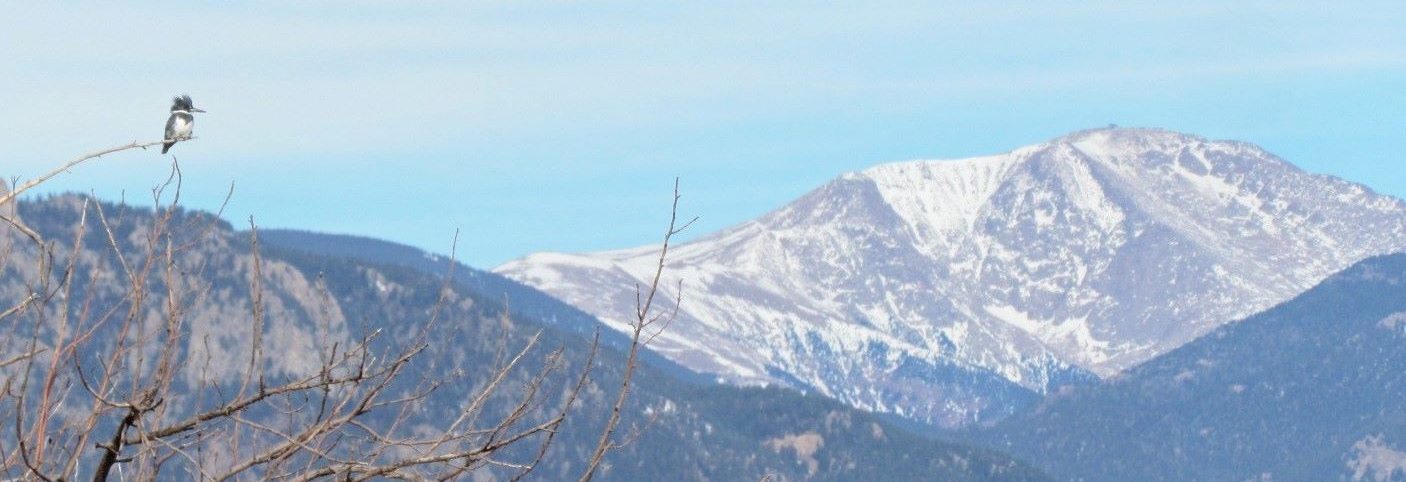
For the first 50 miles after Salida, the road hugs the river tightly until the 1,200-foot-deep Royal Gorge forces it to veer away (the bottom of the gorge is home to a railroad, but not an automobile road). The wildly scenic highway is endowed with a series of recreation sites with access to the river for fishing, rafting, or picnicking. Hurrying past these picturesque places is a shame and I always try to visit at least a few (one of them is shown in the featured photo above). During a previous return trip from the Valley in 2021, I enjoyed a special avian encounter at one of the sites, which prompts me to stop there once more this March 20.
Could it be, I wonder, that the same species will once again be present?
I pull off the highway, park the car, and walk the short distance to the river. Within minutes, I see the hoped-for bird fly past me just above the level of the water and land under a nearby bridge: an American Dipper (Cinclus mexicanus). The somewhat lackadaisical appearance is more than compensated for by the bird’s unusual attributes: It sings a song as crystalline as the water of the fast-flowing mountain streams where it makes its home, and walks or swims underwater with open eyes to look for aquatic larvae, its preferred food, or for other invertebrate or piscine snacks.
With a smile on my lips and a bounce in my steps I follow it to the bridge, where I rejoice to detect the bird sitting in the creek with nesting material in its beak.

Could it be, I wonder, that the nest is right there?
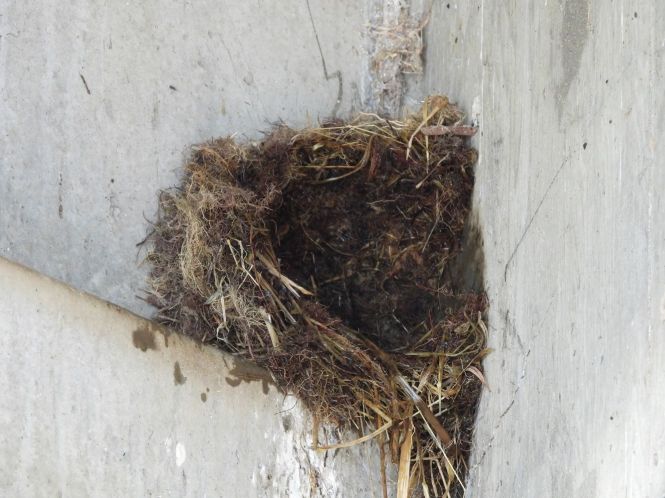
“American Dippers nest in inaccessible, nearly vertical surfaces, often over rushing water. They typically place nests on large boulders, cliff ledges, on fallen logs, under an overhanging dirt bank, or underneath a bridge or culvert.” (Cornell)
I’m thrilled to find that it is, and even more to watch her carry the contents of her bill to the nest and commence to weave it into the existing structure, employing her feet, beak, and body to wriggle the plant fibers into place just so. I can’t be sure, but suspect that it is a she, as it’s the female dippers who choose the nest site. Both sexes supposedly build the nest, but when a second dipper appears, it (he?) seems to be there mainly for moral support and to cheer her on in a dipper kind of way.
I also have no way of knowing if these two dippers are the same birds I saw in this location three years earlier, but it’s a lovely thought. To survive for so long is unlikely for a wild bird whose life expectancy is distressingly low, but I take comfort in the fact that it might be possible. According to Cornell, “the oldest American Dipper was over 8 years old, when it was recaptured and released during a banding operation in South Dakota.”

“Dippers have a thin white line of feathers on each eyelid that create a white flash as the bird blinks.” (Cornell)

The American Dipper’s nest is a two-part domed or ball-like structure with an entrance that always faces the water. The outer shell is primarily made of streamside mosses, though it may also contain leaves and bark from streamside trees. The inner portion of the nest is a pad of dry grasses and leaves. ” (Cornell)
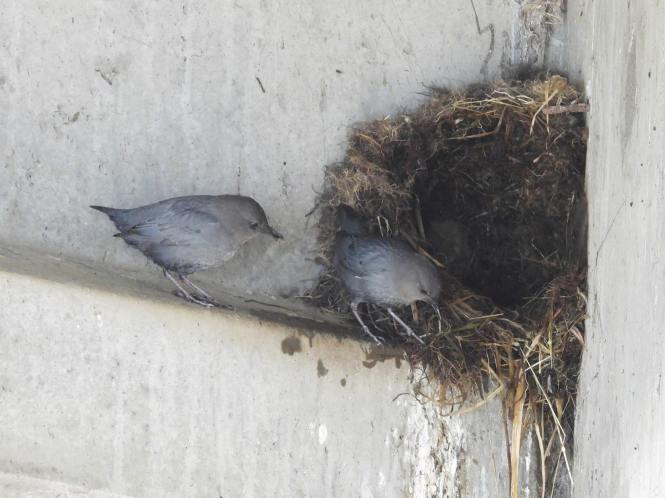
Diligent dippers determined to finish the domicile for their descendants
Happy to witness several sorties and returns, I finally take my leave from these two busy and single-minded parents-to-be. Their nesting site is not just around the corner from Colorado Springs, but some 80 miles away, and it’s questionable if I will make it back there this year to monitor the pair’s progress. But in my mind I will revisit them time and again, conveying my fervent wishes for a successful breeding season so the world will welcome and be enriched by more charismatic dippers, “North America’s only truly aquatic songbird.” (Cornell)

 tanja britton
What a lucky moment! It’s great when nature reveals such cute surprises.
LikeLiked by 1 person
I felt so lucky and thankful for this encounter. Thank you for your comment.
LikeLiked by 1 person
How lovely to see and you got some great images.
LikeLiked by 1 person
Thank you, Brian, it was wonderful to witness the pair at work and I hope as is well with them.
LikeLiked by 1 person
beautiful
LikeLiked by 1 person
Much appreciated, thank you!
LikeLike
Wonderful!
LikeLiked by 1 person
Thank you, Luisa, I’m glad you think so.
LikeLiked by 1 person
Truly my pleasure, dear Tanja. ❤️🙏❤️
LikeLiked by 1 person
Wie schön. Ich denke schon, dass es die selben Vögel sind, denn Vögel sind ja unglaublich standorttreu.
Ich freue mich sehr für dich.
Liebe Grüße Brigitte
LikeLiked by 1 person
Ich danke Dir, liebe Brigitte, diese Begegnung hat mich zutiefst beglückt. Ich stimme Dir zu, daß es sich entweder um die selben zwei Individuen handelt wir vor 3 Jahren oder um deren Nachwuchs. Ich hoffe sehr, daß das Paar erfolgreich seine Jungen großziehen kann.
Liebe Grüße zurück,
Tanja
LikeLiked by 1 person
Holy cats, what a view! Magnificent. And what a treat to see the dippers.
LikeLiked by 1 person
Thank you, Laurie. It’s a beautiful drive by itself and the dippers were an absolute bonus which made me so happy.
LikeLiked by 1 person
I can picture your route in my head. Nice photos and story. Another place to add to my list for CO next time.
LikeLiked by 1 person
Thank you, Brad, I’m glad you have a mental image of my itinerary. I don’t know about you, but my wish list for places to visit in Colorado alone grows longer instead of shorter–now idea how that happens. 🙂
LikeLiked by 1 person
That’s good! An 89-year old friend of mine has the theory that he can’t pass on until he runs out of hobbies. He’s still collecting new ones. Hope it works.
LikeLiked by 1 person
That’s a good philosophy to live by.
LikeLiked by 1 person
Do you happen to know what makes “songbird” and “truly aquatic” almost disjoint categories in North America? Are truly aquatic songbirds more common on other continents?
LikeLiked by 2 people
That’s a great question, Steve. All I know is that there are 5 species of dippers globally, and as far as I know, dippers are the only songbirds that live aquatic lives. Here is a summary I found on “Birds of the World”:
“Dippers are the only truly aquatic songbirds, spending their entire lives along fast-flowing streams. Unique among songbirds, dippers dive underwater and walk along the submerged streambed with long, strong legs and feet in search of aquatic invertebrates that cling to rocks. They have several adaptations for this challenging life, including thick, uniform feathering, with no naked skin between feather tracts as in other passerines, a large oil gland for waterproofing, and flaps over their nostrils. Dippers never wander far from streams, shifting downstream to still-open waters if winter conditions are especially harsh, but as soon as the ice is gone they wander back up the streams, heralding a new breeding season with their wren-like songs cascading off the rocks.”
LikeLike
These are great photos.
LikeLiked by 1 person
Thank you, VJ. I felt so privileged to be able to take them.
LikeLiked by 1 person
That’s how I feel too, Tanja, when I’m able to get up close and personal.
LikeLiked by 1 person
To build a nest on a small ledge of a huge rock wall is quite a feat for the dippers. This is an impressive photo essay, Tanja.
LikeLiked by 1 person
Thank you, Peter. I have always admired dippers, even before I knew about their elaborate nests, and my admiration for them has only increased since then. What amazing creatures.
LikeLiked by 1 person
It isn’t every day that a person gets to see birds building a nest. I think those birds were glad to have you observing them!
LikeLiked by 1 person
Thank you, Neil, I was beyond happy to witness their nest-building. I don’t know if they were glad about my presence, but they tolerated me. On the other hand, maybe they liked the idea of becoming famous, which is what I told them as I was taking my photos. 🙂
LikeLiked by 1 person
Fantastic experience, Tanja. And rare photos you got of the dipper’s domicile.
I haven’t found any dippers this winter, but I’ve read that the bird is picky about water quality.
The stream, as they usually reside, unfortunately looks very polluted, and has done so for a few years. Very sad!
LikeLiked by 1 person
Thank you, Hanna, this was my first experience of seeing dippers build a nest and I’m still smiling about it.
Sorry to hear about your polluted stream. It’s so depressing to know how our destructive lifestyles affect other creatures. 😦
I hope the stream will be restored again to its cleaner self!
LikeLiked by 1 person
Thank you, Tanja. The dipper is a little delight 😊
LikeLiked by 1 person
Wow–what a wonderful thing to witness and marvelous story you shared with us! I’ve heard of American Dippers, but didn’t know much about them. Thank you for this post and I do hope you can make it back–this year or next!
LikeLiked by 1 person
Thank you, Tina, I’m glad I could share some fascinating facts and fotos about this charismatic bird. I hope you will get to see dippers one of these days, they are so much fun to watch.
LikeLike
Wonderful encounter and photos, Tanja. Such a adorable little bird! I esp. love the silver and blue background in the water shots.
LikeLiked by 1 person
Thank you, Eliza, I do adore these birds. Thank you also for noticing the color of the water, I had the same reaction as you.
LikeLike
Great little birds, so resourceful. Always a pleasure to see them, and to marvel at their precarious nest-sites!
LikeLiked by 1 person
Thank you, Mr. P. I always claim that all birds are special, and while that’s true, there is no denying that some seem extra special, dippers being among that group. 🙂
LikeLiked by 1 person
Das ist so nett.
Frühling läßt sein blaues Band jetzt auch über Colorado winken.
LG
MAren
LikeLiked by 1 person
Danke, liebe Maren. Du hast recht–so langsam sehen wir die Zeichen des Frühlings. Diese Wasseramseln hatten ganz bestimmt Frühlingsgefühle. 😊
LikeLiked by 1 person
You had me at “wildly scenic highway”.
That opening photograph is spectacular. After I took such an image, I might have been tempted to just go home.
I am so glad you did not do such a thing. Your encounter with the Dipper was incredible. I’ve never seen one. The nest-building series is truly special.
Danke, Tanja.
LikeLiked by 1 person
Ich danke Dir, lieber Wally!
We do get spoiled with spectacular mountain views here but no matter how often I see them, I never grow tired of them.
Just as I never grow tired of watching dippers go about their business, alone or in pairs. Watching this pair build a nest was a first for me, and I still treasure the memory. I also visualize them taking turns sitting on eggs inside their completed nest. Fingers crossed!
LikeLike
What an absolute thrill, Tanja!! So happy you stopped, I love when I get that ‘need to stop and check’ feeling. Feels like Someone above is assisting in our little birding sightings and adventures, which we are so thankful!! 🙂
LikeLiked by 1 person
Thank you, Donna, I still think of those two busy nest builders and hope their nesting season will be successful. I’m always grateful when the hunch to “stop and check” is rewarded with a beautiful sighting.
LikeLiked by 1 person
Lucky you! What a treat! We don’t have that bird around here, so I loved reading about it. Walking underwater with eyes open? Sounds like a game I played in the lake as a kid. 😉 I looked up their song, and it is as you described. And lots of calls–seems like they have a lot to say.
Cheerio,
Julie
LikeLiked by 1 person
Thank you, Julie. I’m always cheered when I see or hear a dipper. They are very active and very vocal yet are still great company (which cannot be said of many humans with those characteristics 😊).
If you ever decide to come out West, I hope you will see one.
Best,
Tanj
LikeLike
I hope they continue with high sides. It looks like eggs or young bird could fall out of that.
LikeLiked by 1 person
I think the nest was not completed when I took my photos. If you read one of the captions under the photo, it mentions that the nest is a domed or ball-like structure with an opening.
LikeLiked by 1 person
What a great experience. I have only seen a Dipper once in my birding adventures and that was a pretty short one at that. Thanks for showing us their nests and I can say for the record I did not know they could swim – how cool is that! Now I am pumped to hunt for another one!
LikeLiked by 1 person
Thank you, Brian. They are cool birds, indeed, and I have no doubt you will enjoy seeing them should you ever come to Colorado and visit a mountain stream.
LikeLike
They are so cute great captured 😍
LikeLiked by 1 person
They are cute, and seeing them made me very happy.
Thank you for your stopping by. I apologize for the late response, somehow your comment ended up in the spam folder.
LikeLike
Fascinating feathered friends! Such hard workers that they make the most of their lives! 💕
LikeLiked by 1 person
Fascinating indeed. And cheering and inspiring as well. I still think of them and hope they are doing well.
LikeLiked by 1 person
[…] from the Sandhill Cranes in the San Luis Valley follows US 50. After the happy encounter with a pair of nest-building American Dippers along the Arkansas, the highway ascends away from the river to a plateau that abuts the […]
LikeLike
The very phrase “aquatic songbird” fascinated me. I’d never considered that such a thing could be possible. It’s wonderful that you found this species in the same place, and even better that you were able to record the nest-building process.
The creativity and adaptability of birds seems endless. Our swallows commonly build under bridges or other shelters, but some have taken up residence in our marinas. Many marinas have floating docks, which means the underside always is the same distance from the surface of the water. The first time I saw swallows skimming the water at full speed and disappearing under the dock, I thought it had made a serious miscalculation. Not so. They build nests and raise young in that nice, dry spot, secure from almost every predator. I hope your Dippers find their chosen spot just as safe and secure!
LikeLiked by 1 person
Thank you, Linda, I share your good wishes for the dippers’ success. They are quite remarkable and their water-based life are fascinating.
I don’t know if birds’ creativity and adaptability is endless, but it’s amazing and wonderful, thank goodness, as we have made it difficult for so many to continue to lead their lives the way they used to for eons.
Thank you for sharing your experience with the swallows. I have nothing but admiration for the ways in which these wonderful creatures try to make do with what they find.
LikeLiked by 1 person
Lovely photographs of this delightful encounter. I hope that nest will soon be full of babies who will go on to have their own offspring in due course. 🙂
LikeLiked by 1 person
Thank you, Ann, I hope for the same.
LikeLiked by 1 person
So good that you stopped. We should all try to do that more often. You were well rewarded. What remarkable little birds with an amazing lifestyle – especially gathering food underwater. I have just listened to a recording of their crystal clear song. Gorgeous.
LikeLiked by 1 person
Thank you, Carol, for taking the time to read, comment, and listen to the dippers’ wonderful vocalizations. I was so happy about that encounter and still think of it often, imagining the parents sitting on the eggs, or the eggs having hatched already. 🙂
LikeLiked by 1 person