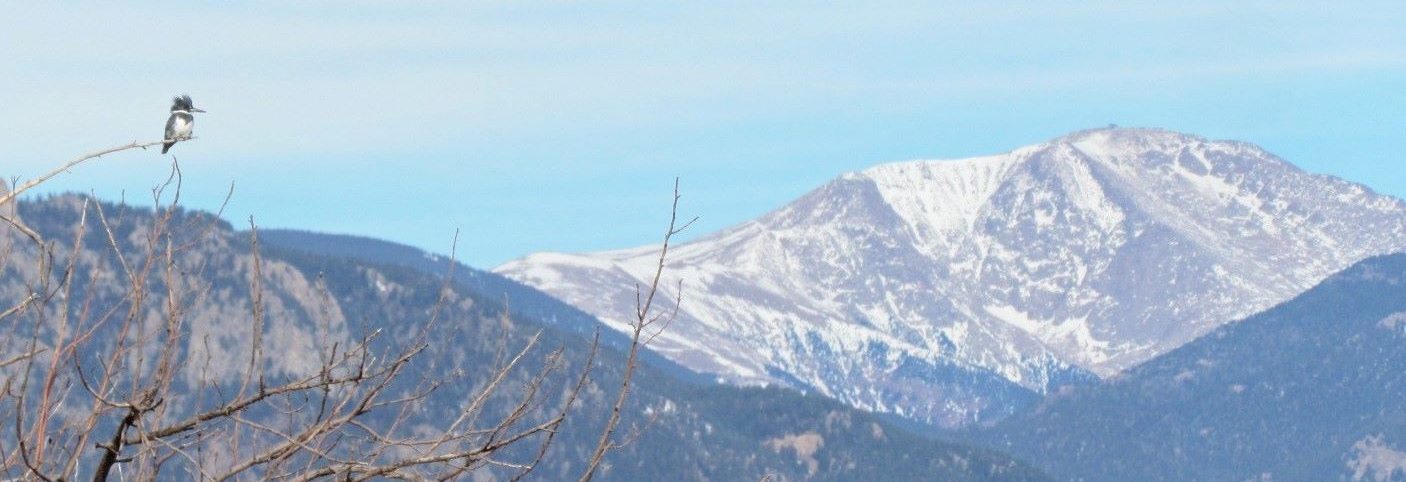

With the creation of Kane Ranch Open Space in March 2022, El Paso County added an opportunity for outdoor enthusiasts to explore prairie habitat in the eastern half of the county—only a limited number of area parks offer a similar experience. Kane Ranch Open Space is located around 15 miles southeast of Colorado Springs and 4 miles east of Fountain along Squirrel Creek Road. A parking lot and portable outhouse welcome visitors on foot, bike, or horseback (open spaces allow only “passive recreation,” as opposed to regional parks which also provide playgrounds and sports facilities).
A lollipop trail, aka balloon trail or, more apropos to this setting, lariat trail (more about Kane Ranch in a future post), traverses the 440-acre area. The string (or handle) portion of the trail leading to the 0.7 mile loop measures about 1.4 miles one-way, so that an out-and-back trip covers approximately 3.5 miles. Near the parking lot, a row of cottonwood trees along the typically dry bed of Williams Creek equals cover and food for a host of creatures. Beyond, the rolling terrain is composed mostly of shortgrass prairie and affords wide-open vistas of the Front Range of the Rocky Mountains along the western horizon, with 14,115-foot Pikes Peak towering above all other heights. The Sangre de Cristos in the southwestern and Spanish Peaks in the southern sky form a rocky rim in the distance while prairie extends nearby in all directions and continues southeast, east, northeast, and north into Oklahoma, Kansas, Nebraska, and Wyoming hundreds of miles off (which are “seen” only in the mind’s eye, however).
Two signs, one at the parking lot and another along the first part of the footpath, alert the visitor to rattlesnakes and advise her to stay on the trails—an advice ignored at one’s own peril, though I haven’t (yet) encountered one here. Lizards sun themselves along the trail or scurry off when the wanderer approaches too close for comfort. The open space is home to a number of prairie dog towns and their vehement and vociferous vocalizations provide a constant and welcome background chatter.
To enlarge a photo, click on it. To read its caption, hover cursor over it.


Pronghorn often graze on the shortgrass prairie, though they are few and far between. Whenever I’m lucky enough to find myself in their presence, some written words of William Jackson Palmer, Civil War General and founder of Colorado Springs, come to me unbidden and leave me feeling melancholy. In 1896, on the occasion of the quarto-centennial of the founding of the city in 1871, he reminisced about his days as a surveyor for the Kansas Pacific Railroad in the late 1860s, when he crossed the prairie between Kansas and Colorado’s Front Range (like many people then and now, he refers to pronghorn as “antelope,” which they are not):
In September, with the engineers . . . , I rode from Sheridan [Kansas] across the plains, directly to this spot, Colorado Springs. . . . We were some ten days on this reconnaissance, during which we met considerable buffalo, three bands of wild horses, and antelope in such numbers that we were scarcely out of sight of them in the daytime from the Kansas border to the present townsite of Colorado Springs (my emphasis).


The photos embedded in this post reflect June visits during last year and this year. Do you notice a difference between the side-by-side views?
In 2023, all of our usual average annual rainfall fell during May and June, creating a verdant and lush prairie with an abundance of wildflowers as well as flowing water in the otherwise dry creek bed, the first and only time we have seen this. Spring of 2024, by contrast, brought below-average precipitation, which is immediately obvious when you compare the juxtaposed images above. In comparison to numerous flowers that enlivened various shades of green last June, the only conspicuous blossoms this June belonged to evening primrose.


Besides appreciating the remarkably tenacious flora that all-too-frequently has to brave heat, dryness and wind, I am in awe of similarly hardy birds who either lay their eggs in subterranean burrows (the aptly named Burrowing Owl), on the barren ground, or amid prickly plants that don’t appear warm and welcoming to tiny and naked and blind creatures. Who, despite their unprepossessing beginning, will eventually take to the sky and sow sounds of beauty into the prairiescape like sunflowers sow seeds into the wind.
Fortunate are those who are blessed with the songs of meadowlarks and mockingbirds, of Lark Sparrows and Lark Buntings. I’m happiest if the prairie is alive with birdsong and if I get to witness “skylarking,” an aerial display some birds engage in, Lark Buntings, Colorado’s State Birds, among them. They fly up into the sky and, while spiraling back down to earth, sing their little hearts out, similar to the fabled Eurasian Skylarks, and in so doing, make my own heart sing.


I can’t talk of my love for the prairie without concluding with a sobering statistic. In 2019, a comprehensive longitudinal study published by the journal Science concluded that the bird population of the United States and Canada has suffered a dreadful 29% decline since 1970, resulting in the heart-rending loss of nearly 3 billion birds. Some sub-populations are even more severely affected. Grassland birds for example, like the ones at Kane Ranch Open Space, have experienced a jaw-dropping 53% decline.
The various reasons are mostly human-caused: destruction of habitat, toxic chemicals, climate change, house and feral cats. To try to prevent a future without our feathered friends, birding organizations have come up with Seven Simple Actions to Help Birds: Make windows safer, Keep cats indoors, Grow native plants, Avoid pesticides, Drink coffee that’s good for birds, Protect our planet from plastic, Watch birds and share what you see.
Let us all attempt to live in such a way that will help all denizens of Mother Earth.
 tanja britton
Amazing Photos დ
LikeLiked by 1 person
Much appreciated, Cindy, thank you! 🙏
LikeLike
An interesting habitat to visit. Thanks for sharing. I loved to see the critters and the flowers too.
LikeLiked by 1 person
Thank you for coming along on a visit. I’m glad you enjoyed getting a glimpse of our habitat which is so different from yours.
LikeLiked by 1 person
The decrease in bird populations is distressing. Humankind has messed up Planet Earth real good.
LikeLiked by 1 person
We truly have messed things up, haven’t we? I often wonder why we don’t seem capable to turn things around, despite knowing what ought to be done.
LikeLiked by 1 person
Was für herrliche Aufnahmen, ich liebe besonders die Fotos der Vogelarten. Ist irgendwie ein bisschen zu meiner Lieblingsbeschäftigung geworden: Birding.
LG
Maren
LikeLiked by 1 person
Dankeschön, liebe Maren. Welcome to birding. Mein Mann sagt immer, ich könnte schlimmere Süchte haben! 😊
Genieß Dein Wochenende,
Tanja
LikeLiked by 1 person
Ich liebe es, Vögel zu erwischen, schon immer, aber die neue Kamera macht alles noch ein bisschen leichter mit dem 600 mm Objektiv. Geduld braucht es aber dennoch.
LG
MAren
LikeLiked by 1 person
The lizard is called a Speckled Earless Lizard (Holbrookia maculata approximans)
“Males often have a yellow tint on the lower sides, blue outlines around the side bars, copious light speckling, and less distinct dorsal blotches. Gravid females often have a pink or peach tint and an orange throat patch. As its common name implies, this lizard lacks external ear openings.”
(https://www.herpedia.com/lizards/phrynosomatidae/speckled-earless-lizard.html)
What an educational post. I love the image of the black-tailed prairie dogs. They look like they have an important meeting and their presence is required!
LikeLiked by 1 person
I appreciate the feedback, Maria, thank you for letting me know about the lizard. I looked at a list of Colorado lizards but couldn’t make up my mind. “My” lizard has a white throat and the photos I found of earless lizards online didn’t show that variation. I don’t have enough experience to know about normal variations.
Watching and listening to prairie dogs are a few of the reasons I love walking through that habitat. They always put me in a good mood.
LikeLike
You’re welcome. I was surprised to learn that your image is actually that of a female in breeding coloration. I would have thought it was a male, as they usually have the vibrant colors, but not in this case.
LikeLiked by 1 person
http://www.naherp.com/viewrecord.php?r_id=39396
LikeLiked by 1 person
Thank you! She is beautiful.
LikeLiked by 1 person
She sure is!
LikeLiked by 1 person
Hormones can cause amazing bodily changes! 🙂
LikeLiked by 1 person
I like your photo essay about the recently created Kane Ranch Open Space park. It has a strong message about the lack of progress in the area of environmental protection, Tanja.
LikeLiked by 1 person
Thank you, Peter. I love reporting about the Open Space but hate all the sobering and saddening statistics about loss of habitat and loss of life.
LikeLiked by 1 person
Beautiful pictures, but very sobering stats. I grew up on the Canadian Prairies and have seen them change a lot over time. Hopefully we can make enough changes to reverse this loss. Maggie
LikeLiked by 1 person
Thank you, Maggie. I didn’t grow up here but even I have noticed loss of habitat and loss of life in the last ten years, since I started to pay closer attention. It’s very disheartening. I hope there is still time to make a positive difference.
LikeLiked by 1 person
This is a beautiful description of the prairie Tanja. I feel for the spunky birds and flowers that make a go of it in such a difficult place. I hope enough people can fall in love with the prairie and its dwellers to spur a big change in human behavior.
LikeLiked by 1 person
Thank you for your sharing your kind words and wishes, Julie, which are my wishes exactly. It’s challenging to remain optimistic in humankind’s ability (or willingness) to change the world for the better.
LikeLiked by 1 person
The contrast between the photos from the two years is stark, and very revealing. Grim statistics on the collapse in bird populations. Sadly, but unsurprisingly, its a similar story here.
LikeLiked by 1 person
The year-to-year fluctuations are to be expected. A loss of so many bird species over the course of a few decades is not, and should neither be expected nor tolerated.
I think one of the problems results from feeling helpless (and hopeless?) in the face of calamitous news. I don’t know if the saying “Never doubt that a small group of thoughtful committed citizens can change the world; indeed, it’s the only thing that ever has” attributed to Margaret Mead has ever been true, but if we stop believing it, how can we go on living?
LikeLiked by 1 person
That’s a sobering thought. I hope Margaret is right, but I admit there are times when despair at what we – as a species – are doing to this planet and its wildlife overwhelms me.
LikeLiked by 1 person
I’m often overcome by that same overwhelming sense of doom.
LikeLiked by 1 person
Thanks for giving us even more places to visit next time we are in Colorado, Tanja. I think my adult daughter would squeal with delight to see that many prairie dogs in one place. I might even let out sounds of jubilation to find burrowing owls. All while, hopefully, listening to the sweet sounds of a meadowlark or three.
LikeLiked by 1 person
I can relate to your daughter: I also squeal in delight when I get to spend time surrounded by prairie dogs. 😊 And when I get serenaded by meadowlarks and horned larks, and lark buntings, and . . .
LikeLiked by 1 person
It looks like a wonderful place to be–love the prairie dog photo, they’re so cute! I do all of the pro-bird things and certainly have a nice neighbor hood population and decent migratory population to observe and learn about.
LikeLiked by 1 person
It is a wonderful place to be, Tina.
The birds (and countless other creatures) thank you for doing your share in trying to make this world a better place for all denizens. 🙏
LikeLike
I want to say collared lizard? But it doesn’t look quite right, so I’m not sure. The colors are pretty, though!
LikeLiked by 1 person
Thank you for sharing your thoughts, Diana, which were similar to mine.
Fellow blogger Maria from Botanical Journal from the Caribbean (https://tropicalfloweringzone.wordpress.com/) identified this lizard as a Speckled Earless Lizard (https://www.herpedia.com/lizards/phrynosomatidae/speckled-earless-lizard.html).
LikeLiked by 1 person
You certainly found a wonderful place to explore, discover and relax – all in one trip.
I vividly remember my first Skylark in Germany. He soared high and kept singing and flapping and eventually fell to earth, exhausted. After a minute, he took off again to repeat the performance.
Those vistas are incredible. I would be visiting often if at all possible.
Thank you for all the really lovely photographs!
LikeLiked by 1 person
Thank you, Wally, I’m glad you enjoyed the Colorado vistas and creatures.
Seeing and hearing Eurasian Skylarks in Germany is always a highlight of my visits and you describe their wonderful display beautifully. I have never seen an American bird skylark as high or as long. Sadly, their numbers have also dropped and it takes some effort to experience their uplifting performance.
LikeLike
I love to see all the different animals and birds from a different ecological landscape. I can’t remember the last time I heard a meadow lark – they were abundant in Scotland. K x
LikeLiked by 1 person
I also love encountering so many different animals on my forays, Kerry. We are lucky to still have destinations where that is guaranteed.
You should be able to see (and hear) Western Meadowlarks in Texas: https://www.allaboutbirds.org/guide/Western_Meadowlark/
LikeLiked by 1 person
Thank you so much, Tanja. That’s a future road trip to hear larks!
LikeLiked by 1 person
“A road trip to hear larks” sounds like music to a birder. 😊
LikeLiked by 1 person
🐦🐦🐦
LikeLiked by 1 person
The primroses are looking lovely. I like how prairie and desert scapes make you look harder and deeper for the wonderful variety hidden in what looks like unchanging flatlands.
LikeLiked by 1 person
Thank you for your perceptive and insightful comment. We used to drive across the Great Plains thinking they were monotonous, but when I started to bird and learned about the prairie’s rich ecosystem, it became one of my favorites.
LikeLiked by 1 person
What a fine set of photos, Tanja. I’m especially fond of prairie dogs, but I’m a windmill enthusiast as well. For me, seeing a windmill and stock tank in the middle of the proverbial ‘nowhere’ is wonderful. There’s one that marks the so-called Three Corners area where Colorado, Kansas, and Oklahoma together. The actual marker is a few feet away, but no matter.
The road that leads to that marker runs along the Oklahoma/Kansas state line. One of these days I may show it. The land on either side of the road looks exactly the same. There’s a bit of a lesson there, I’d say. I’d love to go back to the area. With luck, I’ll be financially able to do that before my physical abilities give way. I spent two weeks in Kansas, exploring the prairies and grasslands, and following the Santa Fe trail. People who say there’s nothing ‘out there’ haven’t looked closely enough.
LikeLiked by 1 person
Thank you, Linda. I wholeheartedly agree that many claims about the prairie are absolutely false. It’s an intriguing ecosystem with very hardy and beautiful denizens.
I hope you will be able to make it back to the Three Corners area for more prairie dogs, windmill, and whatever else your heart desires. And I hope we will make it there one of these days, which would be our first visit.
LikeLiked by 1 person
One thing I learned early in my involvement with native plants in Texas is that of all habitat types, prairies are the most endangered because almost all of them have been farmed and ranched for a long time.
LikeLiked by 1 person
That’s a very good point, Steve–there are few prairies that haven’t been altered. It’s to be hoped that those original prairies still extant will be protected, and that others can be restored. I find them and their life forms endlessly fascinating and they serve such important functions (which was one of the hard-learned lessons of the Dust Bowl).
LikeLike
Looks similar to our local prairies…until you look at the mountains in the background ha. I need to get myself a Lark Bunting one of these days – our plans have change a bit due to an unexpected request for Linda’s photography work, but still planning to get out to CO in Sept. Can you make sure one or two of those Buntings hang around until we make it there ha.
LikeLiked by 1 person
I often pinch myself when I see those mountains. Never grow tired of them.
I will try my best to keep some buntings around for you! 😊
LikeLike
There’s so much natural beauty here at home! I think we take it for granted. Everyone must compile some local travel destinations for their short bucket list. Including me! Thank you for getting my list off to a good start! 🚙⛰️🇺🇸
LikeLiked by 1 person
Thank you! I completely agree that one does not have to travel far to make exciting new discoveries.
LikeLiked by 1 person
[…] I knew about Kane Ranch Open Space was that the land was donated by Andy Kane, who also has a nearby road named for him, the road that […]
LikeLike