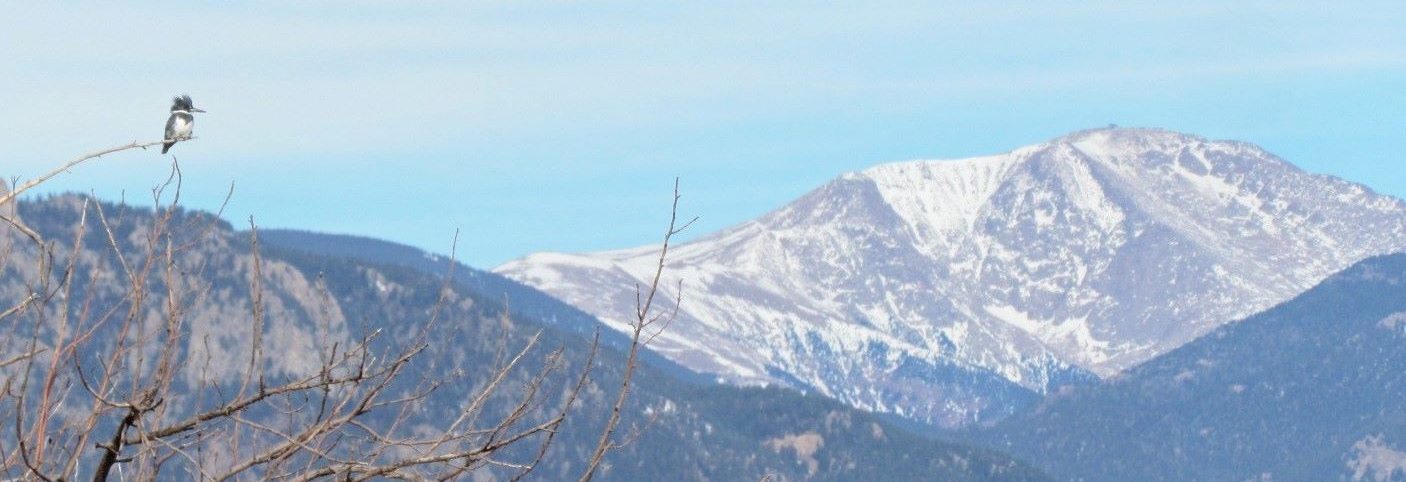

“Home” for the birds I’m about to introduce to you does not technically include Colorado, based on the range map from the Cornell Lab of Ornithology. But range maps only show the typical distribution of a species and every rule has its exceptions. I don’t know about you, but the saying “exceptions confirm/prove the rule” has never made sense to me, neither in the German version, “Ausnahmen bestätigen die Regel,” nor in English. If you are curious about an explanation, please read the comment below by fellow blogger Steve Schwartzman whose blog you can find at https://portraitsofwildflowers.wordpress.com

Range map from Cornell Lab All About Birds
Cornell also has a “sightings” map which shows that the birds in question have made appearances in Colorado, something I know from personal experience. I first encountered one representative in January 2016 at a private property in Colorado Springs and again twice that summer at Pueblo Mountain Park in neighboring Pueblo County to the south. My fourth encounter occurred in their “normal” range in New Mexico in April 2019, but I had not had the pleasure of seeing its kind for more than 5 years.
Until the middle of June 2024 that is, when a sighting reported on eBird created palpable excitement in the local birding community. The person who discovered it did so while marking damaged or weakened trees for removal at a local park for the purposes of fire mitigation. This removal was at first planned for July, but when it became clear that a bonded and probably breeding pair was using one of the designated trees for a possible nest, the officials graciously agreed to postpone tree removal until later in August. Which will, we all hope, give the pair enough time to incubate their eggs, care for their nestlings, and allow them to fledge, based on a typical incubation period of 11 days and a nestling period of 30-32 days.
Without further ado, meet the striking Mrs. and Mr. Acorn Woodpecker. While the common name refers to their dietary predilection for acorns, the scientific name, Melanerpes formicivorus, tells us that they eat ants as well, from “formica” for ant, and “vorare” for eat/devour. (They also like other insects and arthropods.) Acorns and other nuts are stashed in individually drilled holes in trees known as granaries which can hold upwards of 50,000 nuts, according to Cornell Lab of Ornithology.
Both sexes look the same at first glance and their facial markings are often described as clownish. But at second glance, the male has an all-red cap that borders his cream-colored forehead while a black cap separates the female’s red occipital patch from her light forehead.
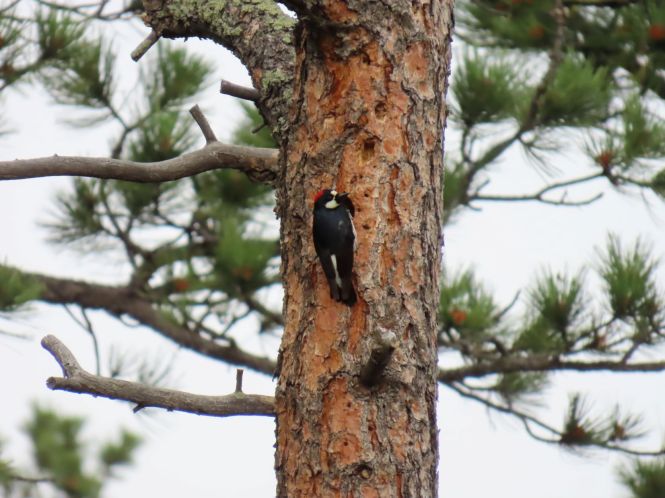
Female Acorn Woodpecker at the entrance to tree cavity with a likely nest

Female Acorn Woodpecker at the entrance to the tree cavity

Male Acorn Woodpecker peeking out of the tree cavity

“I wonder what’s going on out there.”
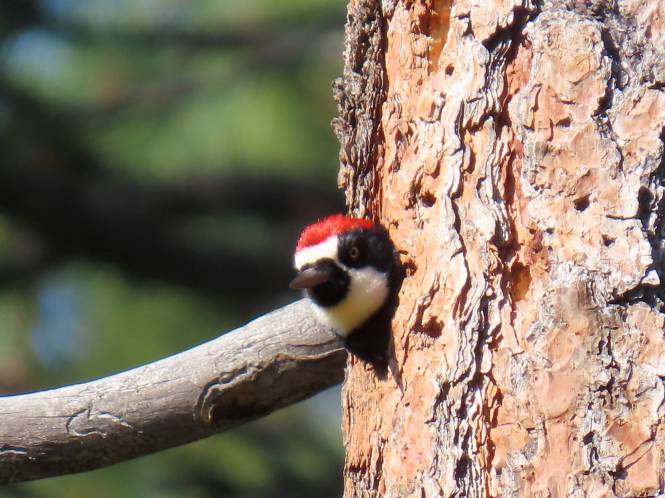
“Are you looking at me?”

“Bye now. It’s time for me to withdraw back into the tree cavity to tend to our eggs.”
Cornell also provides the following fascinating information:
Acorn Woodpeckers are such unusual birds with such complicated social behavior that they have given rise to one of the longest-running behavioral studies of birds. They live in family groups of up to a dozen or more individuals, and they cooperate in raising young and in gathering, storing, and guarding food. Even their approach to cooperative breeding is unusually complex. Some groups have multiple breeding males and females, and all of a group’s breeding females lay their eggs in a single nest. Each female destroys any eggs that are present before she begins laying, resulting in the demise of more than one-third of the total eggs laid in joint nests. Once all the females have started laying their own eggs, their destructive behavior stops and they remove the debris to a nearby tree. There each egg is gradually eaten by several individuals—often including the female who laid it. Throughout the year, Acorn Woodpeckers collect acorns and wedge them tightly into holes they’ve made in tree bark. Acorn Woodpeckers fiercely defend these acorn granaries against other groups and any other species that might rob the stores. They also defend 15-acre territories around the granary. They occasionally wander outside the territory in pursuit of acorns and water. Birds that help at nests but don’t get to breed often go out looking for breeding vacancies in other groups, up to about 10 miles away.
I’m kind of glad that there are no other woodpeckers around to devour some of the eggs and I hope this couple will be successful in raising a brood. I also hope the powers that be will consider leaving the tree with their nest cavity standing at the end of the season (and maybe a few more if they are used as granaries) if it can be at all justified from a fire mitigation point of view. While the tree looks lifeless, this story proves the importance of allowing dead wood to decay naturally and, in so doing, enable it to give wings to new life.

Female Acorn Woodpecker picking an acorn from the forest floor

Female Acorn Woodpecker with an acorn in a tree

Female Acorn Woodpecker taking off in a blur
PS: Stratton Open Space, where these woodpeckers were detected, is adjacent to the neighborhood where I first saw this species in 2016 and where it had occurred for a number of years before. To my knowledge, no sightings were reported at that site during recent years. It is intriguing to imagine that the same pair (or their offspring) has been breeding in the park all this time.
 tanja britton
Lovely. We do not have this Woodpecker here in Finland. Thanks for sharing.
LikeLiked by 1 person
Thank you for your comment. They are very attractive, aren’t they? I always find it interesting to see the difference between European and North American birds, and also to learn about the species that are present on both continents.
LikeLiked by 1 person
That’s what I like as well. 😊
LikeLiked by 1 person
Die sind inzwischen bestimmt alle ausgeflogen 😉
Zuckersüsse Bilder.
Liebe Grüße aus dem Teufelsmoor
Maren
LikeLiked by 1 person
Danke, liebe Maren. Ich weiß nicht, ob die Jungvögel schon ausgeflogen sind, das hängt natürlich davon ab, ob die Eier erst im Juni gelegt wurden. Ich habe vor, in den nächsten Tagen nochmals den Baum aufzusuchen und bin gespannt . . .
LikeLiked by 1 person
Übrigens, ich leibe meine Merlin App und die eBird Seite im Internet. Besser geht´s nicht.
LG Maren
LikeLiked by 1 person
Das kann ich gut nachvollziehen, Maren. eBird benutze ich jeden Tag, und Merlin auch des öfteren. Bei meinem letzten Deutschlandbesuch hat Merlin mir unglaublich viel geholfen, einige Vögel an ihren Stimmen zu erkennen, was sonst wahrscheinlich unmöglich gewesen wäre.
LikeLiked by 1 person
Faszinierend Tanja.
Natürlich kannte ich diesen Vogel bisher nicht und freue mich über deinen Bericht und deine Bilder.
Ich würde mir auch wünschen, dass nicht immer alles auf-und weggeräumt wird.
Vögel brauchen diese Nistplätze und andere Tiere das Unterholz und so weiter und so fort.
Liebe Grüße und weiterhin viel Erfolg beim birding 🐣🐤🐥
Brigitte
LikeLiked by 1 person
Danke, liebe Brigitte. Es ist so interessant, die unterschiedlichen Vogelarten in Nordamerika und Deutschland kennenzulernen und zu vergleichen.
Das mit dem Totholz sollte eigentlich so leicht sein, doch müssen wir da unsere Mentalität noch ändern.
Auch Dir weiterhin viel Erfüllung beim Birding. 🐦
LikeLiked by 1 person
They are an interesting and attractive woodpecker. I remember observing them in CA. They are quite chatty! Do you know if they reuse the same tree or dig a new hole every year? I can’t imagine that leaving one tree up would pose a huge problem.
LikeLiked by 1 person
I have a friend who grew up with them in California and also remembers their vocalness/vocality. This pair was quiet on both occasions I saw them but I imagine that they will be more chatty if/when they have offspring to talk to. I need to go back there to try to find out!
LikeLike
I forgot to answer your question! I think they often reuse the same cavity. The following is from Cornell:
“Acorn Woodpeckers excavate multiple cavities, any one of which may be used for nesting (the rest are used for nocturnal roosting). They dig cavities in dead or living limbs, large or small, either in the granary (storage) tree or any other large tree. The woodpeckers reuse nest holes for many years.”
LikeLike
Any way to email the parties in charge of the cutting? Cornell’s info might sway them to keep the tree. 🤞🏼
LikeLiked by 1 person
They have heard from many parties and I’m sure they are aware of what’s at stake. Whether or not they will take that into consideration is another question.
LikeLiked by 1 person
What a fascinating bird! Unlike the woodpeckers we have around here. I wonder if ther range is expanding nothward. In Maine, we have birds that I never saw when I was young, including cardinals and red-bellied woodpeckers.
LikeLiked by 1 person
I think time will tell about their possible spread northward, but you are absolutely right about many species expanding their range.
I envy you your cardinals and red-bellied woodpeckers. 😊
LikeLiked by 1 person
You took some terrific photos. Excellent work.
LikeLiked by 1 person
I’m glad you think so, Neil. Thank you! 🙏
LikeLiked by 1 person
Nice photos Tanja. I can now tell the male from the female. The few we saw in Yosemite were too far away to take good photos, but we did see the “granary” tree. Thanks for the tip on a new birding spot in CO for future trips.
LikeLiked by 1 person
Thank you, Brad. I didn’t realize they were sexually dimorphic until I saw a checklist that mentioned the sighting of a male. Only when I looked at my guide book again did I realize what I had missed before.
LikeLiked by 1 person
This was a fascinating read, Tanja. I’m so glad birders were able to get the fire mitigation crew to hold off on removing this much needed tree. The fact that these birds actually create granaries to store acorns was new to me. How smart and resourceful they are. 🤔
LikeLiked by 1 person
Thank you, Julie. I agree–not only are these birds incredibly attractive, they are smart and resourceful–and plan ahead!
I hope that the tree crew will be able to preserve some of the trees this pair has been using possibly not only during this year, but in years past.
LikeLiked by 1 person
Oh wow, that’s exciting. They are very pretty too, but what an usual family structure they have, sharing a nest, kicking out the eggs. Interesting, thanks for sharing Tanja. Maggie
LikeLiked by 1 person
Thank you, Maggie. I think they are gorgeous to look at and also found it fascinating to learn about some of their unusual behaviors.
LikeLike
Vielen Dank für die tollen Bilder und die tollen Informationen über den Eichelspecht. Dir eine gute Zeit. Ernst
LikeLiked by 1 person
Dankeschön, lieber Ernst, es freut mich, daß Dir diese attraktiven Eichelspechte gefallen haben.
Liebe Grüße,
Tanja
LikeLiked by 1 person
Wonderful post, Tanja! They’re such pretty birds and so cool that you found them in their nesting place. I saw my first and (so far) only Acorn Woodpecker in Costa Rica last fall. It’s a tricky decision, isn’t it? But you’re so right that leaving dead wood/trees is such an important step for nesting critters of all sorts.
LikeLiked by 1 person
I’m glad you enjoyed the post, Tina, thank you. It must have been a memorable experience to see your life bird Acorn Woodpecker during your Costa Rica trip. I hope you will encounter one in the US as well.
I wish more people would allow their trees to remain standing even after they die.
LikeLike
This was terrific, Tanja. I’ve been meaning to ask what camera you use – always such wonderful photographs, while recognising the camera is only half the reason for a good picture – the other half being the photographer.
LikeLiked by 1 person
Thank you, Michael, I’m glad you enjoyed meeting these droll woodpeckers.
I have to admit that I let my camera decide how to take photographs, never having mastered the technical insights to obtain a good image by choosing my own settings. In recent years, I have used a Nikon Coolpix P 950 and a Canon Powershot SX 70 HS, both of which are point-and-shoot cameras.
LikeLiked by 1 person
Thanks, Tanja, Those are both fine cameras!
LikeLiked by 1 person
I’m glad you think so. I have issues with both of them, but maybe I should read the operating manuals. 😊
LikeLiked by 1 person
Sorry to hear you’re having issues with them, Tanja. They’re both what are classed as “Bridge” cameras. I recently bought one second hand, for the reach of the zoom lens – specifically for birds and wildlife that sometimes flutters or hops into my garden. I’m still getting used to it, but I do find it produces noticeably softer images than my interchangeable lens camera, most likely due to the small sensor size.
LikeLiked by 1 person
Yes, the zoom is great for birding, which is the main reason why I bought both cameras. But I think I’m getting frustrated with the small sensor as I have to edit almost every single photo.
LikeLiked by 1 person
I’m finding the same. Learning a lot about sharpening and denoising. 🙂
LikeLiked by 1 person
Fascinating to read that they devour their own eggs.
It must be hard to see trees cut down for fire management and then birds nesting in what may be the same trees.
LikeLiked by 1 person
Thank you, Vicki. I also learned a lot of fascinating details about these birds’ behavior.
I truly hope that this nesting tree and a few of the adjacent dead trees that serve as granaries will be left standing. I suspect the woodpeckers will leave the area if it’s they don’t find any suitable trees.
LikeLiked by 1 person
Wow, the proliferation in Mexico! Nature knows no artificial borders. It’s always been a global society! 😊
LikeLiked by 1 person
Thank you for that comment. It reflects exactly my feelings.
LikeLiked by 1 person
I’ve seen the bird, and a few granaries too, during our visits to the US, but never had any knowledge of its bizarre communal lifestyle. You couldn’t make it up, and it is a perfect demonstration that truth is indeed sometimes stranger than fiction.
LikeLiked by 1 person
I also had no idea about their unusual lifestyle and I agree with your assessment.
I’m glad you saw this bird and its storage trees during one (or several) of your US visits.
LikeLiked by 1 person
Etymology to the rescue. Prove is a doublet of probe, meaning that both verbs evolved from the same ancestor. For this pair, their common ancestor was the Latin verb probare, which meant ‘to try, test, examine, inspect, judge.’ The sense of ‘to test” is still present in prove when we speak of a proving ground, which means ‘a testing ground.’ The adage “The exception proves the rule” originally meant ‘The exception tests the rule.’ Over time, prove and probe became differentiated, with probe retaining the meanings ‘test, inspect, examine’ and prove shifting to the sense ‘confirm.’ Now if we could just get everyone to start saying “The exception tests the rule,” the adage would make sense once again.
LikeLiked by 2 people
That still leaves us at a loss to explain “Ausnahmen bestätigen die Regel.” Did German in relatively recent times, after the English saying no longer made sense, translate it literally?
LikeLiked by 1 person
Thank you for doing my job, Steve. That’s an interesting derivation of the word “prove” and the expression “exceptions testing the rule” does, indeed, make sense.
Online sources of the German saying refer to Cicero’s “exceptio probat regulam in casibus non exceptis,” but I don’t completely grasp the meaning of the attendant (too-circuitous-for-me) explanation.
LikeLike
The history is even more complicated than I thought.
LikeLiked by 1 person
Yes, I know. I started reading some of these explanations but found them too confusing.
LikeLike
What amazing pictures! I was told by a wildlife rescue person never cut down dead trees because birds, like the woodpeckers, live in them. She even had flying squirrels in her trees. We have woodpeckers but I have never seen a hole where they nest.
LikeLiked by 1 person
Thank you, Diane. I wish everybody shared the attitude of the wildlife rescue person. Dead trees are so important for so many critters that it would be best to allow all (or at least most) of them to decay naturally.
LikeLike
What a beautiful little woodpecker!
LikeLiked by 1 person
Thank you, Kerry. I feel the same way.
LikeLiked by 1 person
You’re so right about the importance of leaving dead trees alone to decay naturally. It’s similar to sea shells that host multiple creatures and are thus recycled multiple times bringing hope and life to countless generations of living creatures. What an interesting bird, Tanja!
LikeLiked by 1 person
Thank you, Maria. Nature is great at recycling and we can learn so much from that.
LikeLiked by 1 person
While leaving individual dead trees (or small numbers of them) benefits a variety of birds and insects, too many dead trees also can create problems for both wildlife and humans. Dead trees were contributing factors to the current fires in Alberta, Canada, especially around Jasper, and the ability of the mountain pine beetle to cause havoc in the forests and towns is real.
Of course management of forests is immensely complicated, and quite a different issue than individual dead trees in yards or parks, but considering the benefits and costs always is worthwhile. I will say that many more people in this area do seem to be leaving the occasional dead tree on their property, and I suspect that increasing knowledge of their importance to birds is part of the reason.
This is such a beautiful bird, and the description of its habits was fascinating. I’ve seen some videos of acorn stashes in odd places, like the walls of homes. I suspect other species may engage in the same behavior, but it’s all fascinating.
LikeLiked by 1 person
Thank you for your comment, Linda.
Trying to find the right balance between fire mitigation and habitat preservation is complex and complicated.
A long history of wildfire suppression has proven devastating in the long run, as have beetle-killed trees.
Forest fires and the attendant loss of life are not only heartbreaking, but are also compounding the effects of climate change.
We are caught in a vicious circle of our own making.
LikeLiked by 1 person
What fascinating and weird bird behavior! You seem to be very lucky in your sightings, Tanja! At my local Audubon, they had a dying evergreen near the parking lot. So, rather than take it all down, they cut the top and stripped the branches, leaving it very tall. It is home each year to Northern Flickers and other birds. Visitors can see them clearly pretty much as soon as they step out of their cars. 😉
Hope you are enjoying your summer. All is well, but I really am a fall weather girl. The rabbits in my yard have been behaving, but have been eclipsed by my neighbor’s wild visitors: a bear and a bobcat. Sort of sounds like Colorado wildlife, instead of Massachusetts!
Cheers,
Julie
LikeLiked by 1 person
Thank you, Julie, I felt very lucky to be able to see the woodpeckers and get photographs. I hope to go back there soon to look for possible offspring–fingers crossed!
I’m glad you are well, despite the summer’s heat (I also prefer autumn). The wildlife sightings in your neighborhood sound very intriguing. I hope you get to see the bear and bobcat, but only from a safe distance!
Stay cool,
Tanja
LikeLiked by 1 person
What an interesting bird! It was fascinating to hear about their communal lifestyle and very surprising that the egg-destruction is tolerated. Maybe it’s a sort of ‘survival of the fittest’, especially if the last female to lay her eggs has worked out that this will be to her advantage?
LikeLiked by 1 person
Thank you, Ann. That’s the first time I heard about this kind of behavior and I, too, have wondered about the potential benefits. It’s a reminder that not all creatures are created equal.
LikeLiked by 1 person
Very interesting and such stunning birds. Hoping a balance can be found regarding leaving/removing dead trees and that known nesting sites can be left intact.
LikeLiked by 1 person
Thank you, Carol. I hope for the same.
LikeLiked by 1 person
What a great sighting and thanks for the additional information on their breeding habits – quite strange behavior indeed. I take Cornell’s range maps as suggestions only as I routinely discover species outside of those zones, the sightings maps you referenced are much better. Ironically, my first encounter with this clownish species was in Las Vegas up at Spring Mountain. Again, not in range but the male was having a grand ol’ time in the pines around the picnic area. Would have loved to see the female, but I think this one was a bit lost.
LikeLiked by 1 person
Thank you, Brian. I was quite amazed to learn of their breeding behavior. And I also found the sightings map interesting. I think the maps for many species will likely be redrawn as the climate changes.
I’m glad you got to see a male Acorn Woodpecker in Las Vegas, of all places. But then again, the town attracts all manner of unusual creatures! 😊
LikeLike