
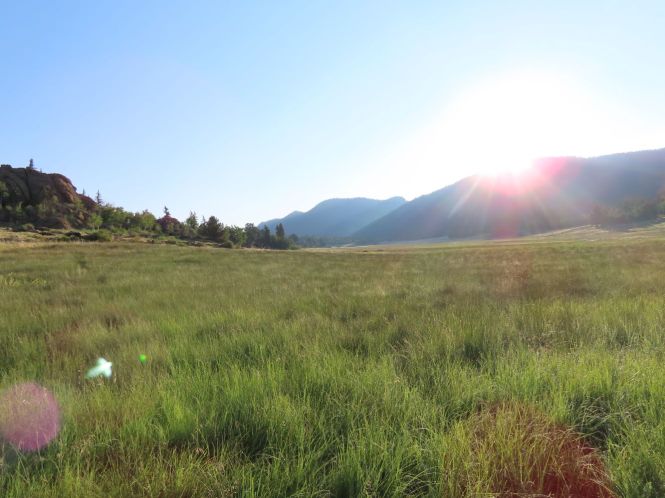
The meadow still lies in the shadow of a mountain on this early July morning and when I notice a shape gliding across it, my first thought is that it belongs to a jogger. But another glance shows a fast-approaching tall and dark outline and I realize my error. I lift my binoculars to my eyes and almost don’t believe what I see. If this were Alaska, where these quadrupeds used to nibble the flowers in our garden regularly, there would be no question in my mind. But I’m walking along the edge of Eleven Mile Reservoir in Park County, Colorado, about 55 miles west of Colorado Springs.
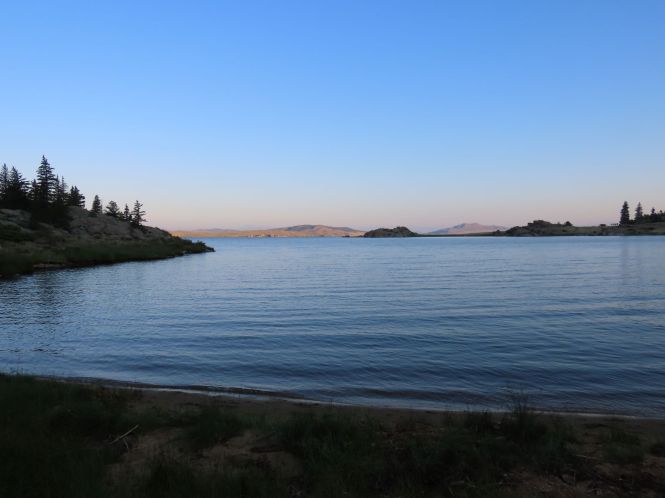
Eleven Mile Reservoir’s Corral Cove (named for the remains of an old nearby corral)
Once I’m certain that I’m no longer lying in my sleeping bag in our tent, dreaming, I’m overcome by a giddy smile. It’s been years since I have seen a moose in Colorado and I did not expect to encounter one here today.
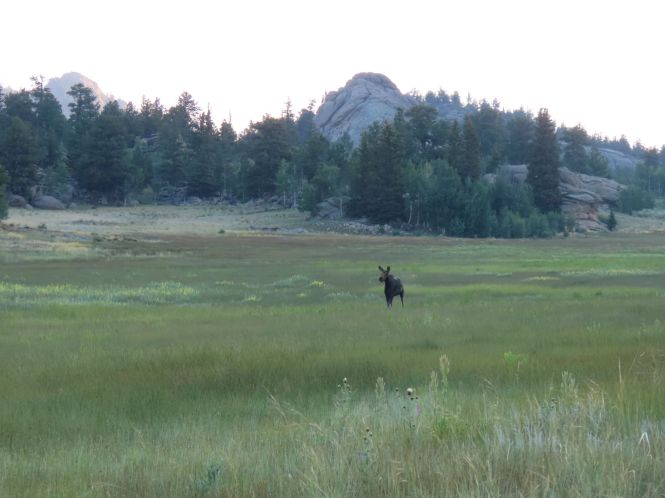
“Here I come.”
The long-legged, gangly apparition makes her way to the water’s edge and into the shallows, dipping her sizeable snout into the cool wetness a few times, giving me a suspicious look, and taking in the views. She then wanders along a narrow footpath made by fisherpeople who appear to be sleeping in today, as I’m the only person present.

“I like to get my feet wet.”
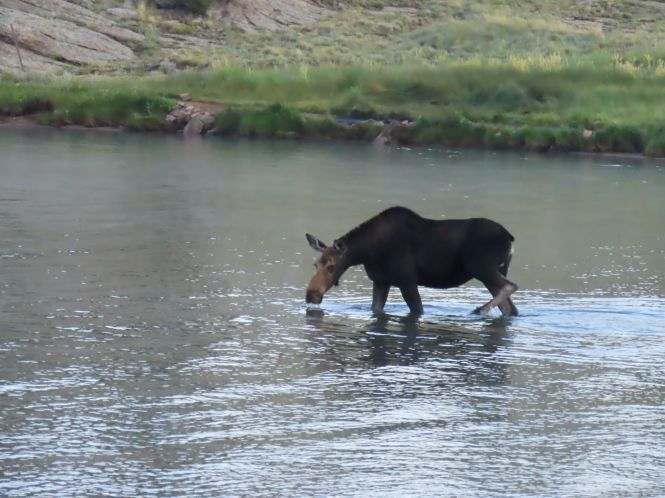
“I’m always thirsty in the morning.”
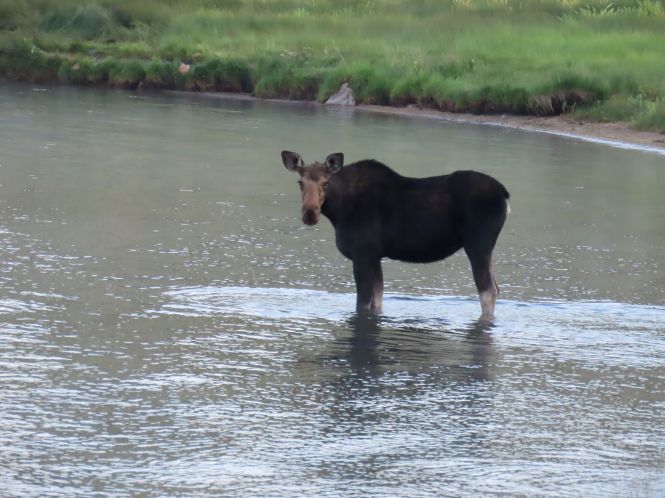
“Are you looking at ME???”

“The water feels so good. “

“What shall I do next? Join the mergansers?”
Maybe inspired by the group of Common Mergansers in the water in front of her, she finally decides that it’s a fine morning for a swim. And I mean a SWIM.
I definitely did not expect to be treated to an athletic performance, but that’s exactly what I get. I watch the moose’s brown body glide into the water and follow her head as she makes her way across the cove with strong strokes, creating ripples in her wake. I’m certain she will climb out of the water at a flat area on the opposite side but she takes only a brief look and swims on. The same thing happens at the next shallow spot, and the next. I knew moose could swim but this individual seems to be training for the swim competition in the Moose Olympics. I want to join her and feel the cool water on my skin, but my human hide is not allowed in this body of water and so I watch on, envious.
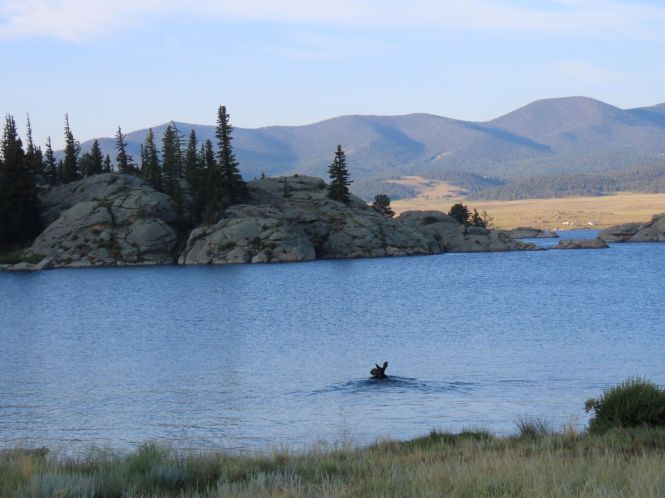
“Let’s see if I can swim across the cove.”

“Good morning to you, Double-crested Cormorant.”

“And to you, Western Grebes.”
Finally, she decides she has had enough and reemerges from the lake, very near the site where she had materialized from the meadow earlier. I lost track of time but the time stamps on my photos prove that this moose was in the water for twelve whole minutes. I suspect she swam at least one mile. Now I’m really envious, knowing that my average is much slower than hers.

“This looks like a good spot to get out of the water.”
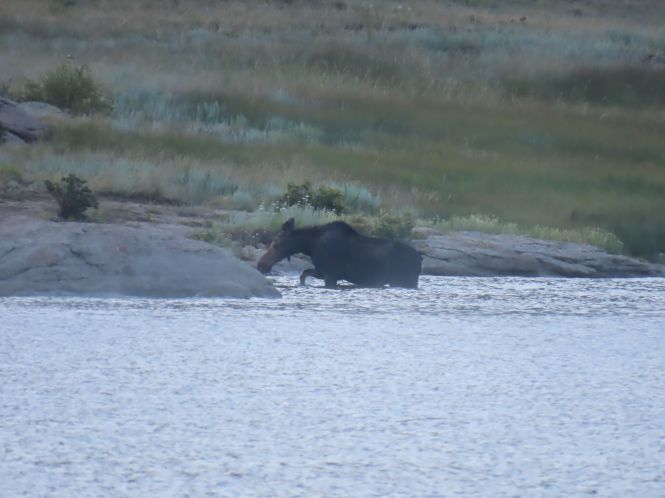
“There is nothing like starting the day with a good swim.”
As I learn later, moose (Alces alces), though native to the Rocky Mountains, were exceedingly rare in Colorado before the end of the 1970s, having been hunted nearly to extinction and entering the state only occasionally from neighboring Wyoming to the north. An article on the Colorado Parks and Wildlife (CPW) website speculates that the animals might have expanded their range southward naturally, but that spontaneous movement was aided by several waves of reintroduction. Moose numbers have since increased to an estimated 3,000 and limited hunting is now allowed.
The largest members of the deer family (cervidae), moose are horse-size, standing between 6.5 and 7.5 feet tall. Adult bull moose can weigh 900 to 1,400 pounds while females’ maximum weight ranges from 700 to 1,100 pounds. Only male moose have antlers which are shed every winter. They grow anew each year and the fact that “my” moose didn’t have antlers or nobs on its head suggest it’s a female. Please correct me if I’m wrong.
The CPW website shares the following information about moose habitat:
The term moose comes from the Algonquin Indian word meaning “eater of twigs,” and the most common place to find moose is where there is lots of brush for them to browse on. Moose have long legs, which allow them to traverse deep winter snows and thick willow habitat types. In spite of their size, they often go unnoticed as they spend a great deal of time in heavy, dark cover in willow bottoms and forests. Moose can be found in sagebrush, high in the mountains above timberline, as well in the more traditional willow, aspen, pine, and beaver pond-type habitats. Moose are more likely to live in riparian (areas located along rivers, streams, and lakes) habitats with willows, which is their primary food source. They also do well in drier habitats of oakbrush, mountain mahogany, aspen and sagebrush.
I’m so glad this particular moose does not go unnoticed on this serene morning and I feel privileged to be granted a few glimpses into her daily routine. By the time she completes her morning workout and goes on her way, the sun has climbed above the mountain, the moose meadow is bathed in light, and I get on with my day with a heart at once fuller and lighter.
 tanja britton
What a wonderful encounter. And what a swimmer she is – on land moose seem leggy, almost ungainly, but your new friend is plainly comfortable in water. Thank you for the happy memories, Tanja.
LikeLiked by 1 person
Thank you, Mr. P. It WAS wonderful to watch her stride alongside and swim inside the reservoir and I have often visualized her since. I hope she is doing well.
LikeLiked by 1 person
What a joy to see them! It doesn’t happen so frequently…especially to see them swim. You were lucky. 👍👍
LikeLiked by 2 people
Yes, you are right. I feel very lucky. Unlike your moose, mine did not sport antlers.
LikeLiked by 1 person
What a beautiful encounter!
I loved your post and your photos very much
LikeLiked by 2 people
Thank you, Luisa. I’m so glad you enjoyed the post. It was a very special encounter.
LikeLiked by 1 person
You’re more than welcome 💙
LikeLiked by 1 person
Indeed, such an amazing encounter. They look a comical creature, and have such sad faces. Encouraging, they’re making a comeback. It always takes my breath away when I read of the vastness of your wild places.
LikeLiked by 1 person
Thank you, Michael. I still marvel at the vastness of the sky and land and all of its special denizens.
LikeLiked by 1 person
What a delight to watch this magnificent creature go for a swim. Talk about being in the right place at the right time. It seemed as though she was going for a swim for reasons other than getting to the other side as she emerged close to the spot where she entered the water. Any thoughts on this?
LikeLiked by 1 person
I felt very lucky to be present at the right time, Laurie.
I have wondered about her reason to make a circuit in the water, have even wondered if my presence might have made her try avoid me, though I was never very close. All I know is that she didn’t return to that meadow but wandered up the hill on a gravel path that led to the campground.
LikeLiked by 1 person
Compared to the bovine moo you’re much more likely to experience in Colorado, the moose was an exciting encounter.
LikeLiked by 1 person
Yes, there are far more bovines in Colorado, making this moose meeting more meaningful.
LikeLike
Ah, four words in a row beginning with m. If you dropped “this” and made “meeting” plural, you could have five: “making moose meetings more meaningful.” You could even extend the string to six: “making moose meetings much more meaningful.”
LikeLiked by 1 person
I should have thought of that!
LikeLike
What a treat to see this and so special that you were the only one up to experience it. The photos of the moose are beautiful and your writing about your morning with her is poetic. Wow!
LikeLiked by 1 person
Thank you, Julie. I felt very lucky that morning.
It also makes me glad to know that you enjoyed my post.
LikeLiked by 1 person
What a great start to your morning! I don’t think I’ve ever seen a moose swim before, only in videos. Maggie
LikeLiked by 1 person
Thank you, Maggie. I had seen moose stand in a river before, but this was also the first time I have seen one swim. It was very special.
LikeLike
What a surprise Tanja! I never imagined I might be able to see a moose in Colorado, and statistically I probably won’t. But in parts of the country known to be full of moose, still haven’t seen one. Very glad you took the time to take photos. Hope you were able to enjoy the encounter without the camera also.
LikeLiked by 1 person
A surprise for me, too, Brad, but not the first moose encounter. Not surprisingly, they are most numerous in northern Colorado but they have been expanding their range southward and someone even reported one near Garden of the Gods in Colorado Springs not long ago. I will have to keep my eyes open for that one!
It’s very likely that you will see one during one of your Colorado visits.
LikeLiked by 1 person
That would be fun.
LikeLiked by 1 person
Nature. Continually offering us a surprise when we least expect it.
I know you have to be thrilled at this encounter. I certainly would be.
Your apparition became a memory.
Thank you for sharing something special with us.
LikeLiked by 1 person
I know, Wally, it’s wondrous. I live for moments like this one and I thoroughly cherish the memory.
LikeLike
Tanja, what a beautiful encounter and experience with nature’s finest! My heart and soul smile over this! I’m jealous, my friend. I remember seeing my first moose while on a float on the Snake River. Then again on my oldest son’s base in Fairbanks (several of them!). To wake up camping and see one? Magical!! I’m so happy you had this experience, my friend. Your captures and words are stunning!
LikeLiked by 1 person
Thank you, Karla, it truly was a magical experience and I still experience a release of happiness hormones when I think about the encounter. 😊
LikeLiked by 1 person
That gives me soul bumps, my friend! Yes!!❣️❣️
LikeLiked by 1 person
What a delight it must have been to witness this moose and her morning ablutions! So glad their numbers are growing where there once were thousands.
LikeLiked by 1 person
I like that: morning ablutions! I felt very fortunate to be able to witness them.
Thank you, Eliza.
LikeLiked by 1 person
Was für ein schönes Erlebnis.
Ich hoffe, dass DEIN Elch nicht gejagt wird.
Traumhaft schöne Bilder, Tanja.
Hab mich sehr gefreut.
Liebe Grüße Brigitte
LikeLiked by 1 person
Ja, ein wunderbares Erlebnis, liebe Brigitte. Auch ich hoffe, daß meinem Elch ein langes Leben sowie ein natürlicher Tod bevorstehen.
Herzlichen Dank und liebe Grüße,
Tanja
LikeLiked by 1 person
A great encounter. A great surprise.
LikeLiked by 1 person
Thank you, Neil. That captures it perfectly.
LikeLiked by 1 person
What a special treat for you, Tanja–and who knows, maybe for the moose, too! We saw quite a few moose about 9 years ago when we stayed in Rocky Mountain National Park. Such big, ungainly looking critters. So big! I remember being surprised at how big they were, somehow, I just thought they were slightly larger deer. I also have a childhood memory of our visit to Yellowstone and seeing moose there, too.
Your photos are lovely; what a way to start the day!
LikeLiked by 1 person
Thank you, Tina, I’m glad you enjoyed the photos. It definitely was a surprising and marvelous start to the day.
I’m glad you saw so many moose at RMNP. The farther north in Colorado, the more moose one is likely to encounter. We have seen them near Walden and Steamboat Springs, both in northern Colorado. Recently, someone reported a moose from Garden of the Gods in Colorado Springs! What a journey it must have behind it!
LikeLike
These are great images! I like the framing, the light, and the feeling of tranquility they evoke. There’s just something so special about images of a moose in such beautiful place and breathtaking vistas!
LikeLiked by 1 person
Thank you, Maria, it makes me happy to know that the images appealed to you. This was a magical experience for me and I know I will always cherish it. Places take on special meaning after such encounters.
LikeLiked by 1 person
What a wonderful encounter. I enjoyed seeing her gangly approach towards you and the water in your photos, and how great to be able to watch her apparently enjoying the water for its own sake. Very special.
LikeLiked by 1 person
Thank you, Carol. I still marvel when I think back to that morning. Seeing a moose take a swim was a first for me and I will never forget those moments.
LikeLiked by 1 person
Wow, you saw a moose at Elevenmile? How unexpected! What a wonderful encounter. It always amazes me how quickly and efficiently moose can swim.
LikeLiked by 1 person
Yes, very unexpected. But much appreciated. You have obviously seen moose swim before. I had seen them wade through a pond or river, but never swim. And I definitely did not anticipate such an extended time in the water.
LikeLiked by 1 person
amazing
LikeLiked by 1 person
Thank you, I’m glad you think so. It definitely was an amazing experience for me.
LikeLiked by 1 person
In Texas gibt es keine Moose, Colorado hat seine ganz eigene Schönheit. Ich war sehr gerne dort und erinnere mich an Begegnungen der besonderen Art mit Moose und Elks. Ein wunderbarer Beitrag.
Liebe Grüße
Maren
LikeLiked by 1 person
Es freut mich, daß Dir der Beitrag gefallen hat und daß Du selbst so wunderbare Naturerlebnisse in Colorado hattest, liebe Maren.
Vielen Dank und liebe Grüße,
Tanja
LikeLiked by 1 person
How lucky you were to spot a Moose! Such a beautiful animal.
LikeLiked by 1 person
Thank you, Kerry. I did feel very lucky. Moose encounters are always special.
LikeLiked by 1 person
What a treasured sight you got to behold! Thank you for sharing it with all of us! How amazing that she just went for a morning swim. Such a beautiful post. -lisa
LikeLiked by 1 person
Thank you, Lisa. It was an unexpected gift to start my day by getting to watch her start hers. If I lived in her home, I would try to start all my (summer) days with a swim, too. 😊
LikeLiked by 1 person
What a wonderful encounter! The unexpected are definitely the most magical!
LikeLiked by 1 person
Thank you, Cathy, that’s so true. It’s magical to come across someone or something completely unexpected (at least the benign version of a someone or something).
LikeLike
How absolutely amazing is that! Love watching moose (hmm, mooses, moosies, misies, mooooose you got me ha). Problem is I rarely get to actually see one much less get to watch behavior I didn’t even know they enjoyed. Every encounter we have had has been in Yellowstone and the Grand Tetons, for now on I’ll keep my eyes open when we are visiting Colorado!
LikeLiked by 1 person
Thank you, Brian, I enjoyed this enchanting moose encounter very much. At some point I learned that the plural of moose is moose because the name is derived from an Indigenous language. Interestingly, game animals often have the same singular and plural forms (e.g. deer, elk, buffalo, antelope!
You are more likely to run into a moose in Colorado in the northern part of the state, for example at Rocky Mountain National Park, or in North Park. I hope you will get to see one!
LikeLike
I’ve never seen a moose, and can only imagine what having one suddenly appear would be like. Seeing one in such a beautiful setting, and being able to witness such interesting behavior, would make the experience even more memorable.
Your mention that moose are related to deer was interesting. I’m not sure I knew that. Deer are capable of swimming relatively long distances; my own apparition took place during Hurricane Harvey, when a deer appeared in the waters of the flooded marina behind my apartment, swimming from who-knows-where. Like your moose, it found a suitable place to get out of the water, and trotted off to find a safe place to rest.
I often think of how many creatures surround us, unseen. The occasional glimpses we’re offered are treasures, for sure.
LikeLiked by 1 person
Thank you, Linda. Definitely a memorable experience, similar to your swimming deer.
I often wonder about all the goings-on that we miss, either because we aren’t present at the right place at the right time, or because things are happening on a scale that’s either too big or too small for us to realize.
All the more reason to put ourselves out there with eyes and ears and other senses wide open!
LikeLiked by 1 person
It’s interesting that you mention those ‘other senses.’ I don’t talk about it much, and certainly can’t explain it, but there are times when I suddenly have a sense that I should stop and look. I can even be in the car, trucking along the road, when I just know that it’s time to stop. More often than not, there’s something well worth seeing. Maybe even the flowers can call to us at times!
LikeLiked by 1 person
Thank you for sharing this, Linda. The same happens to me. I think the more time we spent in nature, the more we develop those other senses.
LikeLiked by 1 person
[…] Cunicularius means “miner” or “burrower” and you might have seen that species name in relation to bees or bunnies, with Colletes cunicularius referring to the spring mining bee, and Sylvilagus cunicularius to the Mexican Cottontail. When scientific names make sense and correspond to common names, they are much easier to remember. Such is also the case with the owls featured in this post. By now they are impatiently shaking their heads, telling me to stop setting the stage and raise the curtain instead. So, without further ado, allow me to introduce the charismatic Burrowing Owls (Athene cunicularia) we were fortunate to spot during a trip to Antero Reservoir in Park County, Colorado, in the middle of July (which, incidentally, followed in the wake of the Elevenmile Moose). […]
LikeLike