

I am regularly reminded that I’m a mere baby birder. Case in point: Of the world’s 117 species of kingfishers, I have (so far) only seen 2. All kingfishers are members of the Alcedinidae family with 18 different genera. They are cosmopolitan in distribution, with most species occurring in the tropical regions of Africa, Asia, and Oceania. Luckily for me, they are also represented in North America and Europe. Like many other tropical birds, they are clad in multi-hued robes and are frequently spectacular in appearance.
Ranging from tiny, hummingbird-like to crow-sized, it is their fishing prowess that has led them to be called “king of the fishers,” but some among them also eat insects, crabs, small amphibians, reptiles, and even birds.
The two kingfisher species I’m about to introduce have compact, small to medium-sized bodies, large heads and large beaks, relatively short necks, and smallish wings. They tend to sit on an exposed perch over water and habitually hover midair to locate fish before diving into the water head first to catch their prey.
The Belted Kingfisher (Megaceryle alcyon) is North America’s most common kingfisher and is distributed across the entire continent. It measures about 13 inches (33 cm) from the tip of the beak to the tip of the tail and emits a loud territorial rattle (follow this link to a recording on the Cornell website) and is often heard before it is seen. Unusually, the females are more colorful than the males, with Mrs. Kingfisher wearing red across her belly and along her sides/flanks, in addition to a blue breast band she shares with her male counterpart.
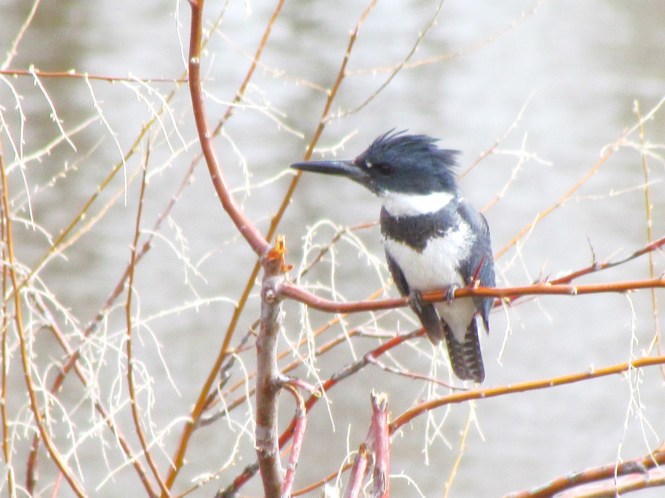
Belted Kingfisher, male/Gürtelfischer, männlich

Belted Kingfisher, female/Gürtelfischer, weiblich

Belted Kingfisher, immature female (the upper band still shows mixed colors)/Gürtelfischer, weiblich
Whenever I’m in Germany, I hope for encounters with the Common Kingfisher (Alcedo atthis). Nearly half the size of the Belted Kingfisher, the Common Kingfisher’s call is a short, quiet, and easy-to-miss whistle. Its beautiful red and blue colors, on the other hand, are more conspicuous but many sightings are fleeting, as it usually zips by at a swift speed. But I have been fortunate to come across the occasional bird willing to grant me a portrait. Both sexes are nearly identical, with females’ mandibles being partly or completely red, whereas the males’ beaks are completely black. After a review of my archives, I have to conclude that I have never taken a photo of a female.

Common Kingfisher, male/Eisvogel, männlich
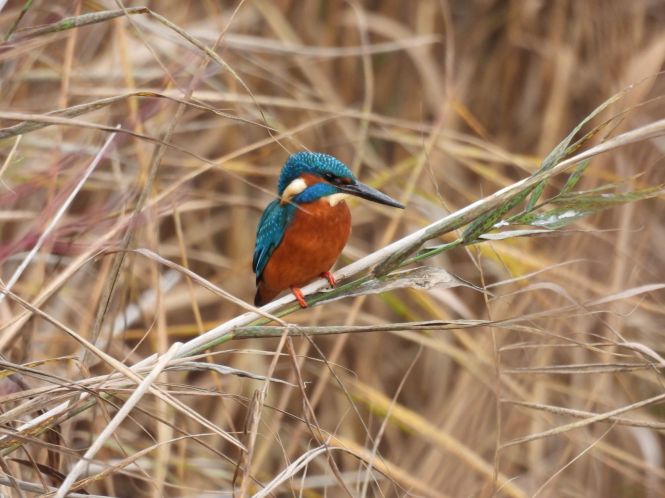
Common Kingfisher, male/Eisvogel, männlich

Common Kingfisher, male/Eisvogel, männlich
Whereas the English common name focuses on the birds’ dietary preferences, the German common name for the Common Kingfisher is Eisvogel. The word’s etymology has been debated and it might signify either “ice bird” (from Eis) or “iron bird” (from an abbreviated form of Eisen). Both ice and iron can assume a bluish hue, like the bird’s plumage.
After viewing online images of this vibrantly attired and varied family of birds (which, incidentally, also includes Australia’s and New Guinea’s iconic kookaburras), I can only hope to see a few more species during my lifetime. 2 down, 115 to go! 😊


Ganz wunderbare Fotos.
LikeLiked by 2 people
Das freut mich, vielen Dank.
LikeLike
You have taken some fabulous images of kingfishers over the years. We love the birds, but Mrs P struggles to take photos of them as we rarely encounter them and they’re always on the move. Invariably we’re alerted by their shrill call, and see little more than brief flash of colour as they whizz up or down the river. Incidentally, the Common Kingfisher clearly has a very wide range – as well as here in the UK, we’ve also seen one in India.
I’m amazed to learn there are 117 species of kingfisher worldwide. Like you, I have well over 100 still to find, though I am pleased to report that as well as the Common Kingfisher and Belted Kingfisher I also have a kookaburra on my life list!
LikeLiked by 2 people
It took many years of blurred kingfisher photos before I managed to capture a few in focus. I tend to have better luck in winter, when the vegetation is less dense and the birds aren’t as occupied with raising their families.
I was also surprised to learn about the number of species in the Alcedinidae family, including kookaburras. How exciting that you have seen one (or some) in the wild. I suspect the only way for me to meet one will be at a zoo.
LikeLiked by 1 person
…also king of beauty.
LikeLiked by 2 people
Yes, that too. Well said!
LikeLiked by 1 person
Such a swift and beautiful bird, Tanja. I have seen several, but only ever as a streak of colour along a river, as I have walked. Your images as always are superb. Besides our familiar native European kingfisher, I had not realised the variety of the species.
LikeLiked by 2 people
Thank you, Michael. I’m always thrilled to come across one that sits still long enough before it realizes that I’m interested, which invariably will lead to its hasty departure. Maybe we need to feign nonchalance . . . 😊
LikeLiked by 2 people
I sometimes wonder if birds can read our minds, or know when they’re being stared at.
LikeLiked by 1 person
I have no doubt that some birds see or sense when we are staring at them. Some are cool with it, others not.
LikeLiked by 1 person
They are beautiful.
LikeLiked by 2 people
Thank you, Dwight. I think so too and I’m always happy when I can capture the moment with my camera.
LikeLiked by 1 person
Wonderful!
LikeLiked by 2 people
Thank you, Luisa, I’m glad you think so.
LikeLiked by 1 person
You’re most welcome 🌹
LikeLiked by 2 people
What blue beauties! Good luck adding more to your list.
LikeLiked by 2 people
Thank you, Laurie. I might have a chance to see three more species in Texas, if I ever make it there, but most of the other species live on different continents that I likely won’t ever get to visit.
LikeLiked by 2 people
Bildschön und du bist gesegnet, dass du schon zwei Vertreter dieser hübschen Vogelart fotografieren konntest.
Manchmal hat frau das Glück und schnappt sich auch einen oder zwei.
Einmal sogar ein kopulierendes Paar.
Viel Glück beim birding auch weiterhin, liebe Tanja.
LikeLiked by 2 people
Dankeschön, liebe Brigitte. Wie Du selbst nachvollziehen kannst, ist mit schönen Vogelerlebnissen und -fotografien immer ein großes Glücksgefühl verbunden.
Auch Dir weiterhin viel Freude beim Birding!
LikeLiked by 2 people
Liebe Tanja, genau diese 2 Schönen habe ich auch nur gesehen von der Menge an Kingfisherbirds. Der Eisvogel ist im Teufelsmoor zu sehen und ab und zu auch an meinem Teich. Der Belted Kingfisher saß in Florida täglich auf seinem Ansitzplatz am Black Point Drive, ein leichtes Opfer für Fotografen 😉
Deien Bilder und Dein Bericht wie immer – wunderbar.
LG
Maren
LikeLiked by 2 people
Dankeschön, liebe Maren.
Wie schön, daß wir beide diese zwei Arten sehen und fotografieren konnten. In Texas hättest Du die Gelegenheit gehabt, weitere 3 Arten kennenzulernen: Green Kingfisher/Grünfischer (Chloroceryle americana), Ringed Kingfisher/Rotbrustfischer (Megaceryle torquata) und Amazon Kingfisher/Amazonasfischer (Chloroceryle amazona). Vielleicht beim nächsten Besuch!
LikeLiked by 1 person
Ich weiss, aber so als Tourist ist man auf sein Glück angewiesen. Und ich habe dort gar keinen dieser Kingfischerarten gesehen. Alles nicht so einfach wenn man nur ein paar Tage auf der Pirsch ist.
Liebe Grüße
Maren
LikeLiked by 1 person
Das nächste Mal kannst Du auf eBird schauen, welche Hotspots und welche Vogelarten es an Deinen Reisezielen gibt, das würde sicherlich helfen. Oder Dich mit einem einheimischen Vogelmenschen treffen, der Dich führen kann.
LikeLiked by 1 person
Ebird hat mir diesmal schon gut geholfen
LikeLiked by 1 person
Gut!
LikeLike
I’ve seen a belted kingfisher, but no others that I’m aware of. I had no idea there were so many! Hopefully you’re able to see more of them someday!
LikeLiked by 1 person
Before this post, I also didn’t know that there were this many kingfishers. Most of them will remain out of reach, though there is a chance to see three more species in Texas. One of these days maybe . . .
LikeLiked by 1 person
With only 2 down out of 115, you’ll either have to pick up the pace or live several thousand years.
Is the “belt” or “Gürtel” the white band around the kingfisher’s neck?
LikeLiked by 2 people
Picking up the pace and visiting Texas might net me three more species, so I think the only realistic option is choice B.
The belt question is an excellent one and, interestingly, is not answered clearly on the Cornell website (or in my printed field guide, for that matter). As far as I can tell, Gürtel and belt seem to refer to the bluish throat band in the male, and the bluish throat and red belly band in the female. So the belt is not located where a human would wear one.
LikeLike
The oldest attested form of the bird’s name in the Oxford English Dictionary is from around 1440, as king’s fisher. The next oldest attestation also has that form.
LikeLiked by 2 people
Interesting, thank you!
LikeLike
I’ve only seen the one! (and it’s not the Belted) Never managed to get a photo, one day maybe, so well done on those super images!
LikeLiked by 2 people
Thank you, Brian. It took me a number of years to get a few sharp images. I’m always thrilled when that happens.
I have no doubt that you will get a photo, and when you do, your better camera and skills will assure that it’s a fabulous one.
LikeLiked by 1 person
One day maybe, I keep hoping.
LikeLiked by 1 person
The two you’ve seen are beautiful!! We’ve seen a few on our travels, but not many pictures because they’re too quick. Maggie
LikeLiked by 2 people
Thank you, Maggie. Given your amazing travels, you have likely seen many more species than I. It’s too bad they didn’t pose for you, I would have loved to see some of those tropical beauties.
LikeLiked by 1 person
Das sind schöne Eisvogelfotofänge, liebe Tanja.
Ich habe einmal in Wuppertal mitten in der Stadt von der Schwebebahn aus, die größtenteils über der Wupper schwebt, einen Eisvogel pfeilschnell von Ufer zu Ufer fliegen sehen. Dieses leuchtende Blauorange kann man einfach nicht übersehen!
Daran kann man erkennen, daß Flüsse wieder heilen können. In meiner frühen Kindheit war die Wupper eine stinkende Chemiebrühe, und inzwischen ist die Wupper wieder rein und es gibt u.a. Reiher, Kormorane und Eisvögel.
Sonnige Grüße von Ulrike 🙂
LikeLiked by 2 people
Dankeschön, liebe Ulrike.
Welch schönes Eisvogelerlebnis Du da beschreibst. Die Farbenpracht dieses Vogels läßt mich immer wieder staunen und einen von der Schwebebahn aus zu sehen, ist natürlich noch erinnerungswürdiger.
Auch freut es mich zu hören, daß die Wupper wieder gesünder ist als in der Vergangenheit. Die Natur überrascht und beschenkt uns immer wieder, wenn wir ihr auch nur etwas entgegenkommen.
Liebe Grüße zurück,
Tanja
LikeLiked by 1 person
Fabulous!
LikeLiked by 2 people
Thank you, Cindy, much appreciated.
LikeLike
Very nice post, Tanja and beautiful photos of these striking birds. I’d never seen a kingfisher either until our trip to Costa Rica last November. I saw three different ones: Belted, Pygmy, Amazon. Strikingly beautiful, it’s thrill to see these birds. Thanks for sharing yours with us.
LikeLiked by 2 people
Thank you, Tina. They are strikingly beautiful birds. How exciting for you to see three during your trip. All the birders I know who have visited Costa Rica absolutely loved it there.
LikeLike
You should go, you would love it! The wildlife (birds, in particular), the beauty of the land, the people, and the food–all just incredible. I’ll have to scroll through my photos, but I don’t think I got any of the kingfishers. They were usually flying away. 🙂
LikeLiked by 1 person
I have no doubt that I would love it. I might never want to leave again! 😊
LikeLike
Lovely captures, Tanja. The European kingfisher is esp. vibrant and gorgeous!
LikeLiked by 2 people
Thank you, Eliza. I agree that the colors of the (uncommonly beautiful) Common Kingfisher are especially striking. I always get a happy shock when I see one in Germany.
LikeLiked by 1 person
Great images, I love the metallic hues of the European one, and the Belted is so elegant. I always remember, “”Hope” is the thing with feathers -That perches in the soul”.
LikeLiked by 2 people
Thank you, Maria. I also love the vibrant colors and hues of these birds. They seem very exotic to me, definitely not the kind of bird I knew when I was growing up.
It’s interesting that you mention the hope poem. The words are often on my mind, too. Incidentally, I wrote a post about it a number of years ago, in case you are interested:
https://tanjabrittonwriter.com/2020/01/02/hope-is-the-thing-with-feathers/
LikeLiked by 1 person
It’s an amazing post Tanja. I also have an affinity with birds, I have sparrows, warblers and doves that visit me, a daily experience that’s very uplifting for me.
LikeLiked by 1 person
Thank you, Maria. Birds are definitely the creatures that speak most directly to my soul.
LikeLiked by 1 person
oh, die sind schön fotografiert! der kuschel-schwarz-weiße gefällt mir besonders. der sieht aus wie gerade aufgestanden, lach. noch ein bisschen zerwühlt.
LikeLiked by 2 people
Vielen Dank, es freut mich, daß Dir die Vögel gefallen. Dieser Kamm des Gürtelfischers ist schon beeindruckend. Wie Du sagst, so als hätte er sich den Kamm noch nicht gekämmt. 😊
LikeLiked by 1 person
gürtelfischer ist aber auch ein wunderbarer name. vielen dank für diese erweiterung meines wortschatzes. 🙂 liebe grüße!
LikeLiked by 1 person
🙏
LikeLiked by 1 person
Wow! Beautiful!
LikeLiked by 2 people
Thank you so much for your visit and kind comment.
LikeLiked by 1 person
Your common kingfisher is beautiful. I used an image of that bird in the past, as the header photo for a post featuring a very old kingfisher-related Christmas carol. I never thought I’d know someone who actually had seen the birds in real life! The details of its feathers are so nice. The head and edge of the wing feathers look as though they’re jeweled.
I do see belted kingfishers rather regularly. There’s a certain road near the Brazoria refuge where one has been perching on the wires for several years in exactly the same spot above a ditch. This year, I’ve seen three along that wire. Friends? Family? Who knows?
I rarely see them while at work, but I certainly hear them. That rattling call is unmistakable; it always makes me smile.
LikeLiked by 2 people
I also think that the plumes of the Common Kingfisher are uncommonly and strikingly beautiful. Often one glimpses only a metallic streak as the bird zooms by but when the bird is at rest, all the gorgeous details can be studied.
Thank you for the link to your previous post about the Christmas carol, I left you a comment there.
I also smile when I hear the Belted Kingfisher’s rattle because I can visualize the bird and what it might be doing.
As I mentioned in another comment above, you might have the opportunity to encounter three more kingfisher species in Texas: the Green Kingfisher(Chloroceryle americana), the Ringed Kingfisher (Megaceryle torquata), and the Amazon Kingfisher (Chloroceryle amazona).
LikeLiked by 1 person
That Common Kingfisher is absolutely gorgeous. I’ve never seen one in the wild here, although Australia does have some Kingfishers, with what I just read that the Kookaburra being the largest (which I have photographed reasonably well). I never realised the Kookaburra was a ‘Kingfisher’ per se.
Birds in flight are really hard to photograph so don’t worry about your skills in catching one in flight. I catch them in fair focus only by luck.
Even the your female Belted Kingfisher is attractive.
LikeLiked by 2 people
Thank you, Vicki. I also love the colors of the Common Kingfisher. I thought of you when I mentioned the kookaburras. I also had no idea that they belonged to that same large family.
LikeLike
Someday I hope to see the more colourful kingfisher that is in England, like the first picture.
LikeLiked by 2 people
I hope you will. It’s always a joy to get to observe one.
LikeLiked by 1 person
I’m saddened when ornithologists add ‘common’ to a species name. It makes me think about adding ‘common’ to their name on their epitaph.
LikeLiked by 2 people
I can relate. There is definitely nothing common about this bird.
LikeLiked by 1 person
Exactly! As your photos vividly capture their uncommon beauty!
LikeLiked by 1 person
🙏
LikeLike
Absolutely beautiful pictures! I hope you get to post the other 115!
LikeLiked by 1 person
Thank you, Diane. I hope so too. 😉
LikeLike
Wunderbare Aufnahmen der verschiedenen Eisvögel. Der Kingfisher sieht lustig aus, unseren Eisvogel habe ich schon mit dem Feldstecher und von Auge (aber weit weg) gesehen. Liebe Grüsse. Ernst-
LikeLiked by 1 person
Dankeschön, lieber Ernst. Unser amerikanischer Gürtelfischer hat eine tolle Frisur, nicht wahr!
Auch ich sehe den Eisvogel oft nur beim Vorbeifliegen, doch hatte ich manche Male Glück, und er hat mir einige Photos genehmigt. 😊
LikeLiked by 1 person
Ja, seine Frisur ähnelt der Meinen – nur ist mein Haarschwanz länger als die des Gürtelfischers. Lächeln.
LikeLiked by 1 person
😊
LikeLiked by 1 person
They are beautiful birds. I hope one day I will see one.
LikeLiked by 1 person
Thank you, I also find them beautiful.
I hope you will get to meet a few kingfishers.
LikeLike
Hi Tanja. You have only 115 species of kingfishers to go!
LikeLiked by 1 person
I know, I know. Shouldn’t take me more than about 55 lifetimes (if I get to see 2 to 3 per lifetime). 😊
LikeLiked by 1 person
Outstanding post and photographs!
We grew up in Florida where the Belted Kingfisher is abundant, and noisy. Our first nature outing when we moved to Germany produced that wonderful bright flying jewel, the Common Kingfisher, and we couldn’t believe it was related to our “dull”-looking Belted variety.
Good luck on finding more of this very special species.
LikeLiked by 1 person
Thank you, Wally. It doesn’t matter how often I see kingfishers, they always amaze me. I was also surprised that these two birds are related, but then our own relations are sometimes very different from us. 😊
LikeLike
I love the photographs, Tanja! These are such beautiful birds and we do have them on the river here…but I’ve only seen them a couple of times. (That felt very special!)
LikeLiked by 1 person
Thank you, Ann. It does feel special to come across these spectacular birds, especially as they tend to be on the shy side. Let’s hope we will continue to see them.
LikeLiked by 1 person
I do hope so!
LikeLiked by 1 person
Never seen this bird, it looks absolutely stunning in your superb captures!
LikeLike
Very nice. Kingfishers are special to my heart. Thank you.
LikeLike
I didn’t realize there are so many types of kingfisher. Teddy and I saw a kingfisher on our first date, 23 years ago.
LikeLiked by 1 person
Until I prepared this post, I had no idea there were this many kingfishers either.
How nice that you remember that sighting during your first date. Maybe the kingfisher is your spirit animal.
LikeLiked by 1 person
It was rare to see a kingfisher, even then, so we both were in awe of the sighting. My spirit animal is a sloth…😉
LikeLiked by 1 person
You are the only one who can say that about yourself, everybody else would get into trouble! 🙂
LikeLiked by 1 person
😉
LikeLiked by 1 person
oops, 43 years ago!!!
LikeLiked by 1 person
Time flies when you are having fun! 😊
LikeLiked by 1 person
😂
LikeLiked by 1 person
Both of these species of kingfisher are very beautiful in their own way. I really enjoyed your photos. Kingfishers can be very difficult to photograph!
LikeLike
I’ve been birding for quite a while now Tanja and you can take credit for having encountered a Kingfisher I have not – the Common variety. That is one pretty Fisher for sure. As mentioned, the Belted is fairly ubiquitous (very accessible in our parts), but we need to get you down to Texas and the specifically the South Padre or Rio Grande Valley areas to double your sightings with the Ringed and the Green variety. Let me know if/when you ever make your way down there and I’ll get you on target.
LikeLiked by 1 person
Thank you, Brian.
There is nothing common about the Common Kingfisher and it always gives me a thrill to come across one during my visits to Germany.
Thank you for your willingness to make birding recommendations for Texas. I will let you know if I can ever get that trip organized. For family reasons, trips to Europe have to take precedence.
LikeLike