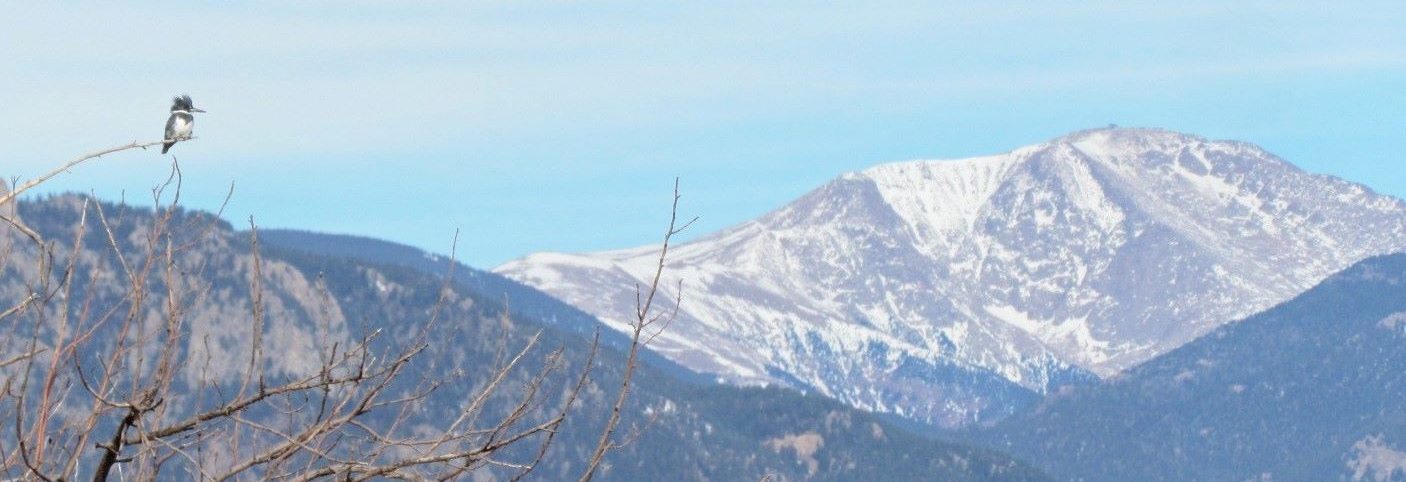

I will occasionally re-publish an older post under the heading Throwback Thursday. This one first appeared here on September 29, 2016, when my blog was but a few months young and was noticed by only a handful of fellow bloggers. I have made only a few slight changes to the original. Thank you for traveling back in time with me.
🏕🏕🏕🏕🏕🏕🏕🏕🏕🏕🏕🏕🏕
Out-of-the-way places often lead to unexpected discoveries. During a camping trip in Colorado’s San Isabel National Forest a few weeks back, my husband and I enjoyed two calm nights under a full moon at Davenport Campground adjacent to Squirrel Creek, where large historic markers recount a fascinating chapter in local history, and what follows is my own simplified version.
In the wake of southcentral Colorado’s tragic 1914 Ludlow Massacre, in which not only coal miners were killed but some of their wives and children also, unions gained increasing influence, working conditions for various laborers finally improved, and vacation time was at their disposal for the first time. The working classes became interested in recreation and discovered the plentiful woods west of Pueblo as a camping destination. It soon became evident that the unstructured foray of masses of humans into the forest created attendant problems.
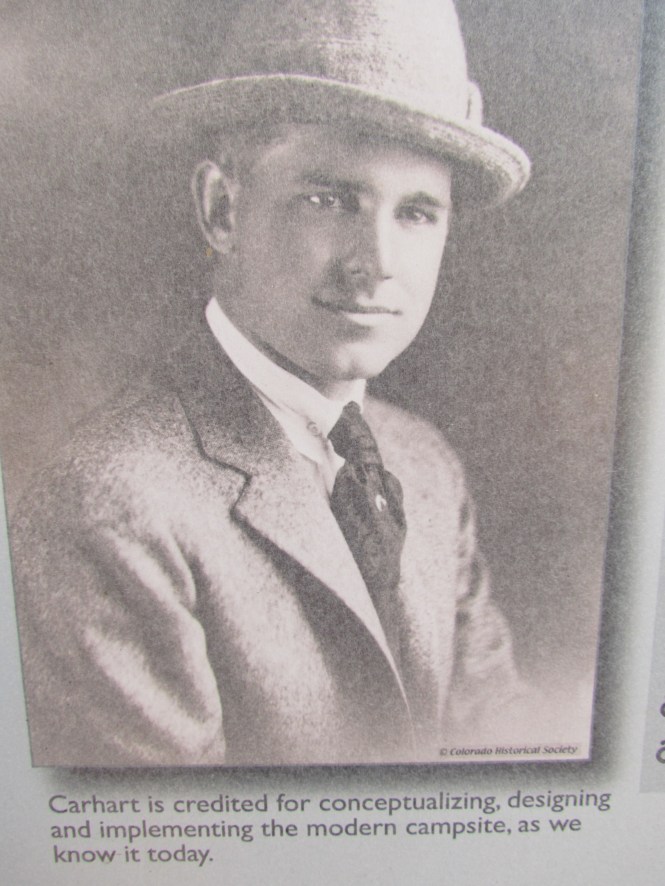
Arthur Carhart (1892-1978)
In 1919, landscape architect and World War I sanitation officer, Arthur Carhart, was recruited by the National Forest supervisor to come up with solutions to overcrowding, unsanitary conditions, and destruction of land and timber. Arthur was a visionary who anticipated the growing utilization of natural places, and the resultant need for infrastructure. When Congress refused to allot funds for recreation for the Forest Service, he did not capitulate but founded a private non-profit corporation, with Rockefeller’s Colorado Fuel & Iron one of its major contributors, the same concern responsible for the infamy committed at Ludlow.
Mr. Carhart is credited with designing the first modern campground along Squirrel Creek, with each site including space for tents, picnic tables and benches, fire rings, and access to so-called “sanitaries,” ensuring the separation of human waste from drinking water. Having camped at numerous private, state, and federal campgrounds, we were intrigued to learn who masterminded this nearly ubiquitous layout. In 1922, he also adapted a wagon trail along the stream for automobile use, which became known as Squirrel Creek Road, and improved accessibility to a mounting number of recreation sites.

Camping before the advent of structured campsites
For travelers not inclined to sleep under canvas, Carhart planned the Squirrel Creek Lodge in 1922, a two-story structure whose rooms were complemented by a center hall, two large fireplaces, a roomy kitchen and — a dance floor. What else could one ask for after escaping the sweltering heat of Pueblo or other towns, but to seek shade under the cool forest canopy and to cut a rug, dancing the wildly popular Charleston during the Roaring Twenties.
Alas, all good things must come to an end. The Great Depression followed the upbeat twenties, and competing tourist attractions by the early 1940s led to a decline in the popularity of the Squirrel Creek developments. The death knell was sounded in 1947 after a flood washed out portions of the road and campgrounds, plus several bridges.
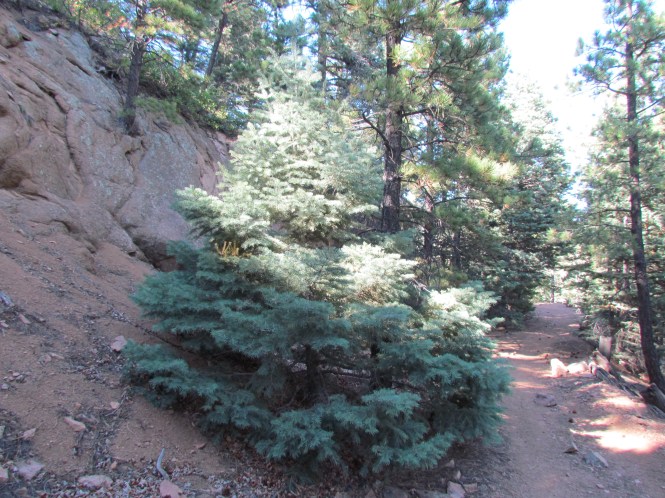
Hiking trail along the former Squirrel Creek Road
For modern-day visitors, this story comes alive along the former Squirrel Creek Road, now a hiking trail, which starts at Davenport Campground and connects to the Pueblo Mountain Park approximately 5 miles east, as the crow flies. Along its course are scattered remnants of picnic tables, fire rings, concrete anchors for wooden guardrail posts, and a reconstructed Adirondack-style picnic shelter. After years of disuse, a conflagration claimed the lodge in 1979, and all that survives today is its foundation.
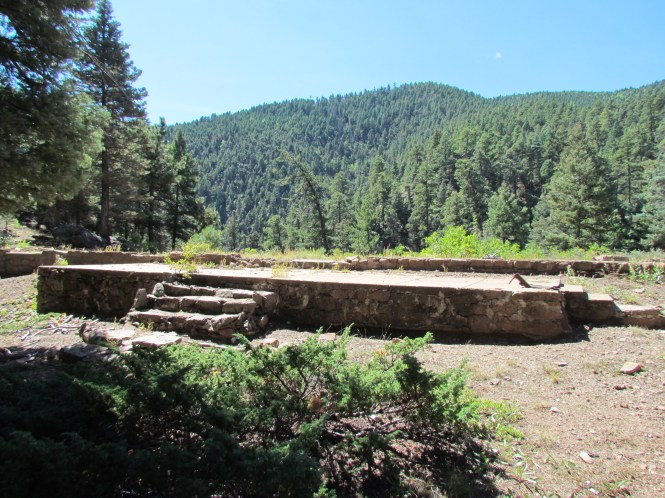
Foundation of former Squirrel Creek Lodge
However, when I listened closely, mixed in with the murmuring of Squirrel Creek, the breeze stirring the boughs of ponderosa pines, and the haunting tune of a hermit thrush, I swear I heard lively notes of dance music drifting through the air.
Click here for the German version/klicken Sie bitte hier für die deutsche Version:
 tanja britton
komme zu einem späteren zeitpunkt wieder zum lesen, bin immer noch krank und da ist es doppelt schwer längere texte am pc zu lesen. die fotos aber habe ich schon bewundern dürfen. die natur und die weite, das sieht so toll aus. wie ist das, von so viel natur umgeben – gibt es da eine innere automatik, jeden tag da hinaus zu gehen und spazieren zu gehen? liebe grüße aus berlin.
LikeLiked by 2 people
Vielen Dank für den lieben Kommentar. Die Natur und die Weite sind tatsächlich sehr einladend, und ich bin am glücklichsten, wenn ich draußen unterwegs sein kann.
Ich wünsche Dir gute Besserung!
Liebe Grüße zurück aus Colorado.
LikeLiked by 2 people
ich habe vor ein paar tagen einen vortrag angehört von einem arzt, der noch mal betonte, wie wichtig es für die gesundheit auch sei, sich draußen in der natur aufzuhalten. ich finde, das erklärt auch gut, warum man sich üblicherweise sehr wohl fühlt in der natur. es ist eine gute umgebung, mit guter luft. ich finde, dass die wirkung von natur auch gleich spürbar ist, wenn man sich in ihr bewegt. ich kann sehr gut verstehen, dass du dann am glücklichsten bist, wenn du in der natur und draußen unterwegs sein kannst. ich wünsche dir viele glückliche stunden! 🙂 liebe grüße nach colorado und danke für die guten wünsche. es geht mir wieder besser.
LikeLiked by 1 person
Es freut mich, daß es Dir wieder besser geht!
Für mich ist die Zeit, die ich in der Natur verbringe, die beste Zeit, und ich kann (und will) mir ohne sie kein Leben vorstellen. Weshalb es umso wichtiger ist, daß wir Menschen unseren Lebenswandel ändern, um diesen einzigartigen Planeten für alle Lebewesen zu erhalten. 🌎❤
LikeLiked by 1 person
I’m glad you decided to republish this post. The original was before I found your blog.
We take for granted so many things that only came about by the efforts of a person or a group of people who worked to make them happen.
LikeLiked by 3 people
That’s so true. We owe all those who left us a positive legacy a debt of gratitude.
Thank you for finding my blog. 😊
LikeLike
Although life under canvas doesn’t suit me (lodges are more my style), many folk see it as the ideal way to explore “the great outdoors”. During our many peregrinations through the US it was evident that camping is a big, well ordered business on your side of the Pond, and now I know how it all began. Thank you for sharing Mr Carhart’s fascinating story; he was indeed a visionary.
And thank you also for introducing me to the concept of “cutting a rug”, a form of words I’ve never previously encountered. Very evocative, particularly in the context of a dance as wild as the Charleston.
LikeLiked by 2 people
Thank you for going camping with me, even though it doesn’t suit you. 😊
There are few things I love better than sleeping in a tent, away from human noise and bustling, when the rising and setting of the sun frame the day and the night is filled with the sounds of howling coyotes and hooting owls (I know you would enjoy the latter). 🦉
Language is so funny, don’t you think? I always enjoy learning the differences between British and American English.
LikeLiked by 1 person
I’d relish the howling of the coyotes too. It’s the howling of the wind through the tent flap that alarms me 🙂. The prospect of not having a bed to lie on is also unappealing given the poor (decrepit!) condition of my knees and back. I do understand the attraction of camping, but sadly in my case although the spirit is (in principle) willing, the flesh is horribly weak!
I’ve thought a lot about how I use English since I began my blogging journey. The majority of my readers come from North America and Australasia, and I’ve become increasingly aware that idioms which are familiar here are meaningless or open to misinterpretation in the US, Australia etc. I sometimes modify what I write accordingly, but on other occasions I just write it “the British way” and hope for the best!
LikeLiked by 1 person
Sorry to hear about your physical ailments. They come to all of us unbidden . . . 😦
I think it’s fun to learn the nuances of English in different parts of the world.
LikeLiked by 1 person
Thank you. I’m not complaining; there are many, many people of my age in a far worse state than me, it’s just a matter of finding how best to live a comfortable and fulfilled within the envelope of my own body. It comes to us all, sadly.
LikeLiked by 1 person
Long may you remain as comfortable and fulfilled in your envelope as possible. ❤
LikeLiked by 1 person
Thank you so much for your kind words, Tanja. ❤ One of the most fulfilling parts of my life these days is meeting and getting to know people from across the world through blogging, and vicariously experiencing the things they enjoy in their own lives…even camping! 🙂
LikeLiked by 1 person
🙏🌞
LikeLiked by 1 person
Nice throwback! A subject I knew nothing about and thie piece shows how tour lovely writing style was there right from the start.
LikeLiked by 2 people
Thank you, Laurie, I’m glad you enjoyed traveling back in time.
Coming from a fellow writer, your kind comment carries special meaning. 🙏
LikeLiked by 1 person
We’re about as far into the 21st century as the people in the blue photograph were into the 20th. Tempus fugit.
LikeLiked by 2 people
It does, indeed. It was very sobering to realize that I had first published this post eight years ago.
LikeLike
Was für ein interessanter Bericht, liebe Tanja.
Schön, dass du ihn repostest.
Liebe Grüße Brigitte
LikeLiked by 2 people
Vielen Dank, liebe Brigitte. Es freut mich, daß Dir der Bericht gefallen hat.
Herzliche Grüße zurück,
Tanja
LikeLiked by 1 person
Incredible history! Thank you for your wonderful article.
LikeLiked by 2 people
Thank you for stopping by and commenting. I’m glad you enjoyed the story.
LikeLiked by 1 person
I’m glad that you decided to dig up one of your older posts. It was quite an interesting walk along history’s trail. Here’s to “Throwback Thursday”!
LikeLiked by 3 people
Thank you for taking that walk back into time with me, Julie. I’m glad you don’t mind time travel, as there will be more throwbacks. 😊
LikeLiked by 1 person
I’m glad to hear that, Tanja!
LikeLiked by 1 person
🙏
LikeLike
Ich habe mir die deutsche Version auch gegönnt. Klassse, wie Du alles so perfekt beschreibst. Bist ein großes Talent und recherchierst ordentlich. Viele Grüße aus dem Teufelsmoor
Maren
LikeLiked by 2 people
Danke, daß Du Dir die Zeit genommen hast, beide Beiträge zu lesen, liebe Maren, sowie für den netten Kommentar.
Damals habe ich noch Stunden damit verbracht, alle meine englischen Beiträge ins Deutsche zu übersetzen und manchmal denke ich, es wieder zu tun. Doch es verschlingt sehr viel Zeit (mit Computerübersetzungen habe ich nichts am Hut) und die meisten Bloggerfreunde aus Deutschland können fließend Englisch. Allerdings wäre es für mich eine gute Übung, weil mein Deutsch nach und nach einrostet.
LikeLike
Mr. Carhart’s name gave me pause. I have a couple of pieces of work clothing made by the Carhartt company; I had to check the company’s spelling to see if it was the same family (it’s not). Interestingly, the company did begin about the same time that Squirrel Creek was being developed. Despite the ravages of time, it’s nice that there’s still a trail that can be followed along the historic road.
During the Depression, the Civilian Conservation Corps built a similar place in Texas called Garner State Park. They included a pavilion and dance floor, and it’s still a tradition to go to ‘the dance’ at Garner. I’m pretty sure no one is dancing the Charleston there, but the music filled nights are just as pleasant.
LikeLiked by 2 people
I’m familiar with the rugged and robust Carhartt creations. That would have been a fitting connection!
How nice that the dance tradition survives at Garner State Park in Texas. It’s fascinating to imagine what has unfolded at all these dances in the past hundred years.
LikeLiked by 1 person
Interesting factoid, I suppose there had to be a first! Too bad the site succumbed to nature.
LikeLiked by 2 people
Thank you, Eliza, it was fascinating for us to learn that the blueprint for all modern campgrounds we enjoy today originated in this remote Colorado corner.
Somehow I’m glad that this beautiful area is no longer completely overrun with cars and noise, though depending on who camps there, loud music will still be playing (much to the chagrin of everybody else who came to escape human noise).
LikeLiked by 1 person
I’ve never understand those who go camping in a big RV and watch TV, just like at home. What’s the point?
LikeLiked by 1 person
I feel the same way about people who bring all their toys with them in huge RVs. They are definitely missing out. Their loss.
What really irks me is other campers playing loud music and not giving a hoot about other campers . . .
LikeLike
Exactly… grrr. 😡
LikeLiked by 1 person
A nice post. Viel dank. And yes I have danced Charleston. My parents loved Charleston, though it was already out of date. My mother taught us kids. She was a good dancer. But Charleston? I mean really? Fortunately she then taught us Roc N’ Roll.
One for the money
Two for the show…
LikeLiked by 2 people
Wow! I’m impressed that you know how to dance the Charleston. Good for you.
Thanks for swinging by.
LikeLiked by 1 person
💃🏼🕺
LikeLike
Actually, I knew. Not sure now… LOL
LikeLiked by 1 person
Your site started soon after mine. We’re old timers by now!
LikeLiked by 2 people
I know! That’s a little scary, isn’t it???
LikeLiked by 1 person
Ein hochinteressanter Beitrag, liebe Tanja!
LikeLiked by 3 people
Das freut mich sehr, lieber Pit! Vielen Dank.
LikeLiked by 1 person
Nice bit of history storytelling. Is Mr. Carhart the one behind the ruggedized clothing line?
LikeLiked by 1 person
Thank you, Brad.
I had never heard or seen the word “ruggedized,” but after a moment I understood your question. No, the makers of the iconic Carhartt clothing are not related to this Mr. Carhart. One other fellow blogger also wondered about this.
LikeLiked by 1 person
I’m so glad you shared this.
LikeLiked by 1 person
Thank you, I’m glad you think so.
LikeLike
A very interesting read – and a bit shocking to read up on the Ludlow Massacre and find that such a dreadful thing happened in comparatively recent times. (I hadn’t heard of it before, so had to look it up.)
LikeLiked by 1 person
Thank you for your comment. Ann. I’m not surprised that you hadn’t heard about the Ludlow Massacre. I only learned about it because there was commemoration for the 100th anniversary in 2014. Subsequently, my husband and I visited the site which is now home to a monument and historical markers.
You are right–1914 wasn’t that long ago. But many workers in various mines still had to labor with few rights and protections, and when they tried to strike, risked not only their livelihoods but also their lives, and that of their families. It’s quite sad.
LikeLiked by 1 person
Thank you for a wonderful, nostalgic post.
I grew up in south Florida camping out in the open during summer. Just sleeping on the ground, waking up with a squirrel sniffing my foot. Lots of mosquito bites!
After marrying Gini, we graduated to tent camping. Lots of good memories from outings in nine states and three foreign countries.
Holding hands under the stars following our own special version of dancing the Charleston is the meaning of life.
LikeLiked by 1 person
If I ever slept under the open sky without the benefit of a tent, I do not recollect. I’m glad that it was only a squirrel and mosquitoes that got close to you when you did!
Sleeping in a tent remains one of my favorite things to do, especially when the skies are calm and the coyotes noisy.
I appreciate your comment, Wally. Your last beautiful line brought tears to my eyes.
LikeLike
As Wally characterized it, quite the nostalgic post. I did not know about the seeds that started the modern day campground, but followed the Massacre link which was all news to me as well. Something new learned, my day is a success thanks to your repost.
LikeLiked by 1 person
Thank you, Brian. I also learn something new from your posts each time I visit your blog. It’s one of the appeals of blogging. 🙂
LikeLike
What a great idea to jump back in time and give an old post a chance to be appreciated by so many more followers, Tanja!
LikeLiked by 1 person
Thank you, Peter. I appreciate your visit and comment. I think many of us have blog posts that went nearly unnoticed when we first started blogging, so this is a good way to re-use them.
LikeLike
A lovely blog, and “Throwback Thursday” is a lovely idea! As I was reading, I kept thinking Carhart might be related to the Carhartt clothing group, but I see from your comments that they are not related.
After a busy season in a number of ways I hope top chronicle the New England Fall, my very favorite season.
Hope you are as well as you can be in these. anxiety producing times!
Cheers,
Julie
LikeLiked by 1 person
Welcome back, Julie. And thank you for traveling back in time with me and for commenting.
I look forward to your New England autumn impressions.
It’s not easy to maintain a positive outlook . . .
LikeLike
It definitely feels like “time travel”. How interesting that these structures echo the past in so many ways!
LikeLiked by 1 person
Thank you, Maria. The past really did feel palpable there.
LikeLiked by 1 person