
I have been a dedicated birder for nearly ten years (it’s one of my regrets that I didn’t start paying close attention to feathered beings until my 40s). Fellow birders have been telling me for nearly the same time that I should visit Texas for its wonderful bird life as it has both spectacular resident and migratory birds, thanks to being located along the Central Flyway, one of 4 “avian superhighways” that millions of birds use twice yearly to migrate between South and North America.
Earlier this year, when I was feeling very low, I decided to finally treat myself to and with a birding trip to said state. After some discussions with my SOB (Spouse of Birder), who tangentially enjoys birds but does not spend hours each day looking for and at them, he volunteered to accompany me, to my slight surprise and profound pleasure. After all, I would be thinking about birds, looking for birds, looking at birds, smiling at birds, giving thanks to and for birds, and taking photographs of birds, 24/7. But then again, that’s what I do most days anyhow. I suspect “bird head,” his nickname for me, is not entirely unjustified.
The plan: Drive with our own vehicle to the Texas coast, instead of flying there and renting one. Try to camp as many nights as feasible. Expect to be gone for about two weeks.
Once on the road, traveling vast distances and suffering recurring bouts of “car butt,” it became clear that we needed more time. Luckily, we had some flexibility. We returned to Colorado Springs three weeks later, after having covered nearly 3,100 miles. Out of 21 nights, we slept in our tent for 12. During the others, an absence of suitable tent sites or the presence of wind, heat, humidity, or mosquitoes (or a combination thereof) compelled us to rent motel rooms. When both temperature and humidity reach into the mid-90s (in early April!), I will put up with AC, even though I dislike enclosed rooms without fresh air.
I would like to acknowledge a debt of gratitude to fellow birder and blogger, Brian, who blogs at https://wildlifeintrigued.com/. A regular visitor to Texas from his home state of Illinois, he graciously responded to my request for recommendations with painstaking lists of birding destinations for the Texas Gulf Coast and the Rio Grande Valley, each one peppered with general ideas and detailed thoughts about what birds might be expected. Brian’s suggestions included much helpful information, especially to someone new to the area. Thank you so much, Brian! Our trip would have been far less organized without your help. We easily could have spent three more weeks on the road. Alas, we had to skip many of your suggested sites.
We left Colorado Springs on March 26, a Wednesday. The original plan called for heading straight to the Gulf of Mexico, but a big weather front was predicted to drop buckets of rain on the coast during the middle of that week, so we dallied along the way and pushed our arrival to Saturday.
We made our first stop in Pueblo, a mere 40 miles south of Colorado Springs, to visit the confluence of our local stream, Fountain Creek, with the Arkansas River, inspired by a book I was then reading, Fountain Creek: Big Lessons from a Little River, by writer, photographer, and conservation activist, Jim O’Donnell.
My acquaintance with Fountain Creek had thus far been limited to walking its banks, but on that day, it deepened (literally and figuratively) when I leaned over too far to take a photo and the crumbly bank tumbled into the water, taking me with it. According to my husband, who had wisely (his assessment) remained a few feet away from the bank, my eyes were as big as pie plates. Luckily, the creek was fairly shallow and I remained standing, holding my camera up with one arm. A waterlogged camera would have put a serious damper on our nascent journey. Instead, it recorded 2,544 photos in the coming weeks. No worries, I won’t share all of them, but plan to show a selection in a series of posts I hope to publish in the weeks to come.
To enlarge a photo, click on it. To read its caption, hover cursor over it.


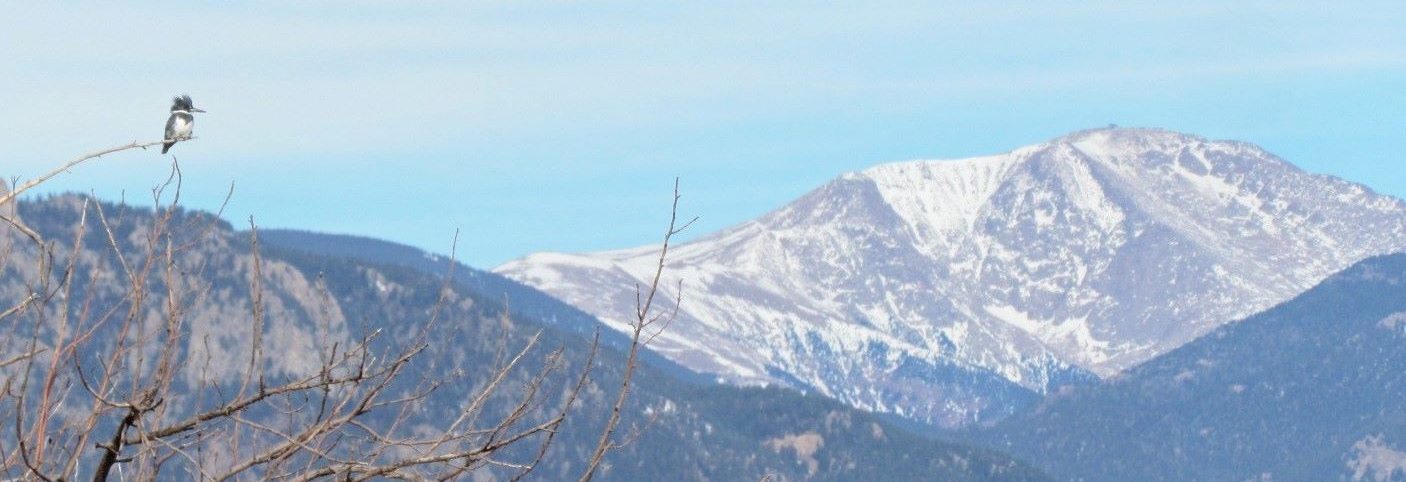
From Pueblo, I-25 took us farther south, with views of the Spanish Peaks ahead of us (seen in featured photo above) before crossing Raton Pass into northeastern New Mexico. We spent the first night at Sugarite Canyon State Park, a destination we had previously visited about a decade ago. As the vegetation in the images suggests, it was early spring. Our three-season sleeping bags were appreciated during the cool, near-freezing night, one of only a few that necessitated the warmth they had to offer. Once in Texas, they were far too thick and we slept under or without them.


The following day, we revisited nearby Capulin Volcano National Monument, a mere 38 miles to the east. Capulin is one of many now-inactive volcanoes located in what is called the Raton-Clayton Volcanic Field which erupted at various times over the last 9 million years. One trail leads down into what used to be the vent of Capulin volcano, and another circles the crater’s rim, affording impressive panoramic views.


Our second night was spent at Clayton Lake State Park. Nearly empty of campers, it offered copious winds which would be our near-constant companion henceforth, rarely easing, more often intensifying. Though we traveled only 70 miles by car from Capulin, we journeyed even farther back in time as the park is the site of more than 500 dinosaur tracks dating to the Cretaceous Period (145-66 million years ago). They were uncovered by chance. During the 1955 construction of a dam and spillway of what would become Clayton Lake, layers of basalt and shale were removed, resulting in exposure of a sandstone layer. When the lake overflowed into the spillway in 1982 and removed layers of that sandstone, the tracks that had lain hidden underneath for millions of years suddenly became visible. Surprise!


Following our night and morning near the former stomping grounds of dinosaurs, we crossed into Texas with the knowledge that we had two long days of driving ahead of us to reach the coast. Without any clear idea of where to end Friday, after 330 miles and with the setting sun upon us, we found ourselves southeast of Lubbock at Lake Alan Henry, which, luckily, still had available campsites.
I was happy to hear, then see the first of many Northern Cardinals (Cardinalis cardinalis) while my husband was pitching our tent and I was cooking supper on our camp stove. Their range extends only into the far eastern part of Colorado, so I treasured the opportunity to see them most days. Don’t you just love seeing red when it comes to feathers? The next morning, a long-tailed bird perched on a wire near the facilities gave me another happy jolt: a Scissor-tailed Flycatcher (Tyrannus forficatus). A rarity in Colorado, but a regular sight during our trip. What a magnificent bird!


What followed was our longest day in the car—515 miles. Before leaving home, I had made a reservation to camp for 3 nights at Goose Island State Park near Rockport along the Texas Coast. We ended up staying for 4 as there was much to see.
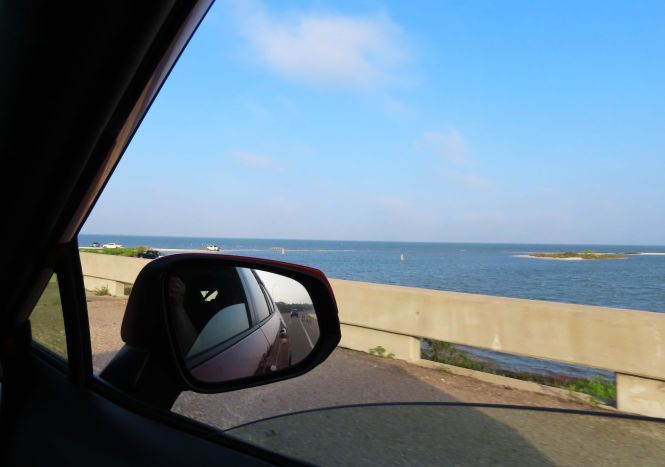
LBJ Memorial Bridge, during our approach to Goose Island, with our first view of Aransas Bay
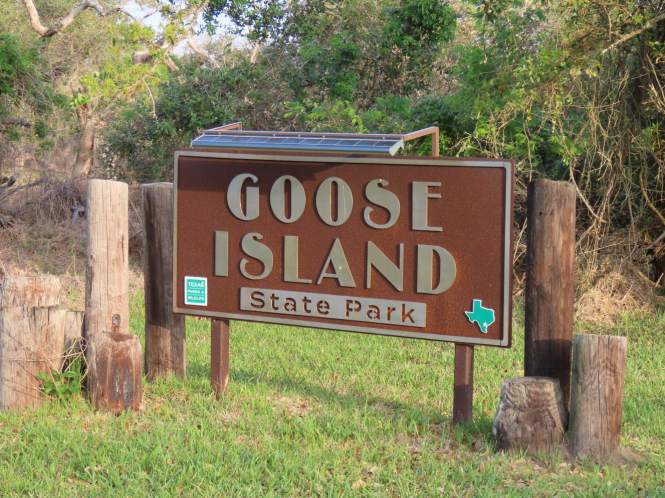
Goose Island State Park entrance sign
Camping in Texas State Parks is incredibly affordable, starting at $10/night for basic sites. When I planned our itinerary, it became obvious that the purchase of the valid-for-one-year $70 Texas State Parks Pass would be cost-effective, as it gives a $5 discount for stays of two nights or longer, and covers the day use fee, which ranged from $3 to $8 per person, dependent on the park.
The reason for going to Goose Island roughly at the center of the Texas coast, instead of starting at one end of the coast and driving to the other, was my hope to see Whooping Cranes (Grus americana)—for the first time in my life. These cranes overwinter at nearby Aransas National Wildlife Refuge and spend their summers in Canada in the vicinity of Wood Buffalo National Park. I knew there was a chance that they had left already, and several birders we talked to thought so too. We arrived at Goose Island too late in the evening to look for them, but planned to drive to Aransas NWR the following day. As we were struggling to fall asleep on this still-hot and humid evening, I tried to think positive thoughts.
Would we get to see cranes? Please check my next post to find out.
Thank you for reading!
 tanja britton
This must have been a fascinating journey into the natural world. I’m especially taken with the idea of being able to see dinosaur tracks! I hope you did see the cranes.
LikeLiked by 1 person
Thank you for your comment, Ann. You are right, it was a fascinating journey and looking at the dinosaur tracks was very special. Same place, but very different times. Trying to imagine how different their world was from ours always boggles the mind.
LikeLiked by 1 person
We could say you hadn’t planned on the confluence of Fountain Creek with yourself. It’s a relief to hear that your camera didn’t partake.
A belated (now that you’re back home) welcome to Texas. In addition to birds, I hope you got to see some of our fabulous wildflower displays.
LikeLiked by 1 person
Well said. My general interest in confluences became a little more intimate than I had bargained for.
While we did see some blooming wildflowers along I-10 and a number of other highways, we never came across anything as fabulous as what you have shared in your photographs. Either we didn’t know where to look for them, or they weren’t present. The 10 to 20 inches of rain that had fallen on some of the areas we visited might have had something to do with that, as some places were still dealing with flooding.
LikeLike
Sounds like a wonderful road trip. Looking forward to seeing some cranes. 😊
LikeLiked by 1 person
Thank you for your comment. It was a special trip, for sure. Whether or not we got to see cranes must remain a mystery for now . . . 😊
LikeLiked by 1 person
How great to see a whooping crane in the wild. Although you won’t see birds in the wild at the International Crane Foundation in Baraboo, Wisconsin, I think you would really enjoy a visit there. They have 13 species of cranes on view and work to save the birds and protect their habitats around the world.
https://ralietravels.wordpress.com/2018/11/09/whooping-it-up-in-wisconsin/
LikeLiked by 1 person
Whether or not we saw cranes in the wild is an open question at this point! 😊
I know about the International Crane Foundation and was planning to mention it in my next post. I have no doubt that I would enjoy a visit there, especially since I will never be able to see most of those cranes in their natural habitat.
Thank you for the link to your post about the Foundation. I liked and commented on it after you published it in 2018!
LikeLiked by 1 person
A great adventure, and a lot of driving, car-butt indeed! 😀
LikeLiked by 1 person
Thank you, Eliza. It was a great adventure and I’m glad we went. The long drive to and from there was a price we had to pay. Flying and renting a car or RV might have saved time, but trying to get all my birding and our camping gear there would have created other challenges.
LikeLiked by 1 person
Water in a digital camera would have been a disaster. But at least you would have saved the bulk of your photos, Tanja. Your husband with the endearing SOB description gave you such support for your birding passion. Truly admirable!
LikeLiked by 1 person
You are right, Peter, my camera would not have been happy after taking a dive in the river.
My SOB husband has always been supportive of my passion for birds and he insisted on chauffeuring me there and back so I could focus completely on birds. I’m very grateful!
LikeLiked by 1 person
Texas is definitely the place for birds! Great set of photos, Tanja! I look forward to more about this trip.
In my own little slice of the Earth, the migratory birds are coming through–so many! I hope you were able to experience a ‘fall out’ along the coast. I’ve never seen it, but those brave little birds fall out after cruising over the Gulf of Mexico–it’s quite stunning, apparently.
LikeLiked by 1 person
Thank you, Tina. I’m glad we finally fulfilled my long-held dream of birding in Texas. We experienced a couple of what I would call “mini-fall-outs” at the coast, which was impressive. So much depends on being at the right place at the right time.
I’m so glad that you are seeing many migratory birds in your garden. Here in Colorado, spring migration has been concerningly slow. Everybody hopes that the birds are merely late, or are taking a different route to their breeding grounds because of prevailing winds, rather than for more sinister reasons.
LikeLike
I should add that I’m originally from Corpus Christi. I remember visiting the Aransas Refuge as a child. I haven’t been there in a very long time!
LikeLiked by 1 person
That’s a long flight for the cranes. Wood Buffalo is very far north, parts I think are in North West Territories.
We saw dinosaur footprints in Bolivia. I found it fascinating. Looking forward to the rest of your trip. Maggie
LikeLiked by 1 person
Thank you for your comment, Maggie. The distances some birds cover during migration are amazing. Other animals, too–just think of monarch butterflies!
It would be amazing to visit Wood Buffalo NP in the summer and to watch the cranes breed!
The dinosaur footprints really left an impression–pun intended. 😊
LikeLiked by 1 person
Well that’s an epic trip, up and down the length of the UK 4 times! And you got a close up of a river!
Looking forward to future posts.
LikeLiked by 1 person
Thank you, Brian. Epic is a good term. Most of the driving was done to get to and from where we wanted to be which is proof how extensive the distances here are.
LikeLiked by 1 person
Hello dear Tanja,
What an incredible journey – on so many levels. The sheer vastness of the US never fails to amaze, as my husband & I experienced earlier this year, it’s impossible to fully appreciate unless actually there…
I have heard many wonderful things about the wildlife (and birding!) in Texas. I am so happy I can experience some of this through your words and photographs. It seems like this trip was a godsend, something you needed and I am glad you and your husband could partake in the advantage together. You make a wonderful team☺️
Perhaps it is because of my NY experience, but I assumed “SOB” had a different meaning😀 but now I know it also stands for Spouse of Birder! And how wonderful a wordpress friend could help you plan your trip! (I too, was extremely fortunate to meet a blogger and nature loving friend during my trip to NY and it was a joy to meet him and learn about local nature in-person. Sometimes, humanity does give us hope!)
Please excuse the long comment – I am enjoying your work so much. All our best to you and your husband. I will also look forward to hearing more about your journey.
Warmly,
Takami
LikeLiked by 2 people
Thank you for your comment, dear Takami. You needn’t apologize, I appreciate hearing your thoughts.
I have lived here for a long time now, but still continue to be amazed at the vastness and extensiveness of the country.
I’m very lucky that my SOB (😉) is fully supportive of my hobby (my obsession?). He insisted on acting as my chauffeur for all of this trip so I could completely focus on the birds, and whatever else struck my fancy.
I was very impressed by, and am very thankful for Brian’s wonderful recommendations for this trip. They made a big difference. And, yes, there is still much goodness to be grateful for.
Take care,
Tanja
LikeLiked by 1 person
It‘s really nice to read about Texas and to learn that there are beautiful sights and not only oil and rich white men with big cowboy hats (like J.R. Ewing). Greetings from a German sheep named Pettersson 🐑
LikeLiked by 1 person
Dear Pettersson,
Thank you for your visit and comment. I think you are the first sheep ever to visit my blog–how exciting! 😊🐑
I’m sure there are plenty of rich white men with big cowboy hats in Texas, but we tried to stay away from them as much as possible. Instead, we focused on birds and Nature in general, and not on human nature, which is far more depressing.
Kind regards,
Tanja
LikeLiked by 1 person
I see you know what life is about. Määäh 🐑
LikeLiked by 1 person
😊
LikeLiked by 1 person
Oh Tanja, I love this. Reading your account and wallowing in your photos, the memories of our own road trips come flooding back. There’s nothing like driving through that part of the US to remind you what a huge country it is!
Isn’t it great to see dinosaur tracks – a potent reminder of the passage of time…and the wonders of evolution too, given that we’re told dinosaurs are the ancestors of birds.
Looking forward to to learning more about your Texas travels.
LikeLiked by 1 person
Thank you, Mr. P. I’m glad if my post brings back memories of your own road trips in the US. I love being on the road and could have easily spent another month exploring, but only in a small RV. That would have been a good compromise between a tent and motel, because it’s still possible to “camp,” despite wind and mosquitoes.
The distances in this country still boggle my mind–1,000 miles just to get to the Texas coast!
Extinct volcanoes and dinosaurs help put things in perspective about the age and history of this planet. Maybe we need to remind ourselves that after the mass extinction that included the dinosaurs, life went on, and something new came about.
LikeLiked by 1 person
Camping’s not for us, nor an RV, so we only ever stayed in motels, ideally ones with a pancake place next door (one of the unexpected discoveries we made on our very first visit to the US is that you guys eat pancakes for breakfast…divinely decadent, and so very un-British! 🙂)
LikeLiked by 1 person
Divinely decadent pancakes for breakfast may be. But they and other sweets are partly responsible for our growing girths!
LikeLiked by 1 person
Sad but true, and guilty as charged!
LikeLiked by 1 person
Same here!
LikeLike
We’re currently touring in Scotland. A couple of days ago we were in a hotel that offered pancakes and maple syrup for breakfast. In honour of this chain of comments, and in memory of many happy visits to the US, I felt compelled to indulge myself. Shame on me! 😊
LikeLiked by 1 person
Enjoy your trip. I hope there will be many more pancake breakfasts in your future! 😊
LikeLike
Hi, Mrs. Tanja-
That an exciting trip you seem to have had! I look forward to reading the remainder of it when you are able to post it.
I am terribly sad that we were unable to see you both when you were down in our neck-of-the-woods!! How close did you make it to Houston during your trip?
Thanks for sharing you adventures!
Gavin
LikeLiked by 1 person
Thank you, Gavin.
We definitely thought about a trip to Houston to say hi, but after experiencing the traffic on the interstate near San Antonio, we were in no mood to drive in another big city. Also, we decided to travel west from Goose Island and into the Rio Grande Valley, and a trip to Houston and back down to the coast would have added another 400 miles. We simply didn’t have enough time to go everywhere we wanted to. Maybe another time!
Best,
Tanja
LikeLiked by 1 person
I totally understand that!! There is no other thing like city traffic… I’m glad you had a good trip anyway! 🙂
LikeLiked by 1 person
Liebe Tanja, ja, unsere kleinen gefiederten Freunde können wirklich zu einer Leidenschaft werden. Auch ich kann aus eigener Erfahrung sagen, dass diese tiefgehende Liebe zur Natur und den Vögeln in schwierigen Zeiten Trost spenden kann. Deine Entscheidung, nach Texas zu reisen, zeigt, wie wichtig es ist, sich selbst etwas Gutes zu tun und die Schönheit der Welt bewusst wahrzunehmen – selbst wenn man erst spät damit begonnen hat. Wie schön, dass du dabei die Unterstützung deines Partners hast – trotz seiner weniger intensiven Birding-Leidenschaft. Ich denke, das ist ein wunderbares Beispiel für gegenseitiges Verständnis und Respekt. Und ja, „bird head“ klingt nach einer liebevollen Bezeichnung für jemanden, der im Herzen immer auf der Suche nach dem nächsten gefiederten Wunder ist. Mögen deine Beobachtungen weiterhin so inspirierend bleiben!
Bis dahin….alles Liebe aus Deutschland….von Rosie
LikeLiked by 1 person
Liebe Rosie,
herzlichen Dank für Deinen liebevollen Kommentar.
Es erstaunt mich nicht, daß Du meine Leidenschaft für die Natur und Vögel teilst. Und Du kannst all die Schönheit mit Pinsel und Farbe festhalten. Das geht bei mir nur mit der Kamera. 😊
Mit den besten Wünschen,
Tanja
LikeLiked by 1 person
💕
LikeLike
Es ist wirklich erstaunlich, wieviele (Zug)-Vögel Texas hat. Mir war nicht bewusst, dass dort einer der Haupzugrouten liegt. Die Reise war ja wirklich spannend mit den ganzen Ereignissen! 😀 Ein Segen ist Dir im Bach nichts Schlimmes passiert! Ich musste grinsen, weil mir ähnliches in der Kindheit passiert ist.
Der Rotkardinal ist wunderschön! Ich bin gespannt auf Deine weiteren Berichte! VG Simone
LikeLiked by 1 person
Vielen Dank für Dein Interesse und Deinen Kommentar, liebe Simone. Texas ist einer der Staaten, der alle Vogelliebhaber anzieht, mindestens einmal im Leben.
Ich hatte wirklich Glück, daß mein Fall in den Fluß eher ein Rutsch war, und ich auf den Füßen gelandet bin. Daß Du Dich noch an Dein Kindheitsereignis erinnern kannst spricht dafür, welch tiefen Eindruck es hinterlassen hat.
Herzliche Grüße,
Tanja
LikeLiked by 1 person
Ich werde meine beiden Aufenthalte in Texas niemals vergessen, es gab so viele Augenblicke, die mich überraschten, die für immer unvergessen sind. Goose Island Statepark und Big Tree haben wir mehrmals besucht, Birdwatching inclusive. Den Scissor-tailed Flycatcher habe ich nur von weitem gesehen. Tolles BIld von Dir. Unsere Winterreise war ganz den Kranichen gewidmed, die wir mit Pits Hilfe auf einen wunderbaren Bootsfahrt auch erleben konnten. Ich glaube, ich habe gar nicht so ausführlich im Blog berichtet, aber meine Bilder sind online auf meiner Webseite. Ich freue mich so über Deinen Bericht.
Liebe Grüße
Maren
LikeLiked by 1 person
Liebe Maren,
ich danke Dir für Deine Begeisterung und es freut mich, daß meine Beiträge bei Dir schöne Erinnerungen wecken.
Wie wunderbar, daß Ihr die Kraniche im Winter zu sehen bekamt.
Scissortails haben wir des öfteren gesehen und ich gestalte vielleicht noch einen Post mit mehreren Porträts. Ich werde noch eine Weile nach von dieser Reise berichten!
Sei herzlich gegrüßt,
Tanja
LikeLike
Thank you for the shout out Tanja – I am always willing and happy to help out a fellow birder when I can, especially when it involves our adopted state of Texas ha! Feel free to reach out any planned tripped in the future and will offer up any recommendations we might have (assuming it is someplace we have been). We have been increasing our Arizona knowledge significantly – primarily southeast and we’ve called Vegas our home away from home for many a year. Can’t wait to learn if you got the chance to see those Whoopers!
LikeLiked by 2 people
Thank you, Brian, much appreciated.
I have long wanted to go to SE Arizona, so I might take you up on your offer! 😊
LikeLiked by 1 person
Wow, what a great start to your trip! I find myself noticing birds more as I’ve gotten older, and I learn so much about them from you.
LikeLiked by 1 person
Thank you, Diana. If I can help increase appreciation for birds, my life has a purpose. 😊
LikeLiked by 1 person
[…] This is part 2 of a series of posts about our road trip to Texas. If you missed part 1, click here. […]
LikeLike
I smiled several times while reading this. I was surprised to learn that two of my favorite ‘neighborhood’ birds don’t make it to your part of Colorado: the northern cardinal and the scissortail. I’m glad you got to see those, as well. And I’m glad no damage occured during your tumble. I once ended up with my own camera raised high above my head to save it from damage, although the circumstances were quite different; I tripped over a hidden stone in a family graveyard in the middle of a Kansas milo field.
I wish I’d known you were headed this way. I could have put you in touch with several hunting and fishing guides in the Rockport/Corpus/Aransas Pass area who regularly report on their sightings of various birds. It might even have been possible to set up a journey by boat into parts of the Aransas refuge. Next time! Surely you won’t be able to resist a return visit to our fair state! Now, to read on and see if you found your cranes.
LikeLiked by 1 person
Thank you for the comment, Linda, and the offer. I did not want to make too many plans during this trip, preferred to be flexible, and tried to gain my own impressions, though I probably missed a lot by not consulting with local experts. On two occasions during the trip, when I joined a guided tour, I learned a lot from local guides.
I was lucky to merely slide into the creek. I have fallen before and have damaged my camera, though never beyond repair. I used to carry a camera bag with me, but it’s too much trouble taking the camera out and putting it away constantly, so now I carry it slung over my shoulder. It’s more convenient, but also carries risks.
I will never tire of seeing cardinals or scissortails–you are fortunate to have them around you all the time.
LikeLiked by 1 person
Tanja, thanks again for helping identify our next birding stops without me having to do too much work. Your Florissant referral was fantastic! You started your birding journey much sooner than I did; I waited until I retired, and Brian pressured me into it for some huge Intrigued corporate bonuses. Thanks for sharing.
LikeLiked by 1 person
Better a late birder than never a birder! I’m glad we eventually saw the light! 😊
And I’m very glad you enjoyed your time at Florissant. It’s a very special place and will always have a special place in our hearts.
LikeLiked by 1 person
[…] For part 1, click here. […]
LikeLike
[…] For part 1, click here. […]
LikeLike
We have a few camping sites here, but El Yunque National Rainforest is the most important. It is the only tropical rainforest in North America and Caribbean.
LikeLiked by 1 person
[…] Our protected campsite at Goose Island State Park Porpoise Ruddy Turnstones Ruddy Turnstone Adult Brown Pelicans Juvenile Brown Pelican Sunset at the beach, enjoyed by us and this Great Blue Heron Palm tree at sunset […]
LikeLike
[…] Leona Turnbull Birding Center Leona Turnbull Birding Center […]
LikeLike
Dear Tanja,
I can absolute understand what your “Sitzfleisch” – as my mother used to calll it – had to endure on that trip. I’ve had (too) many of those. Well, in such a vast country as the US you have to do that if you want to see things.
Luckily for us, the Texas Gulf Coast is much closer by, about 230 miles, if we take the ferry – which we usually do since we like ferries as much as you seem to do.When we were still living in Karnes City south of San Antonio, it was even shorter – just a two-hour drive. Port Aransas is our most favourite place on the coast, but we’ve been to Rockport/Fulton, too, and to Lamar.
We love to see the birds and simply relax at the beach. We’ve been to the places you mention, too. One of our most exciting tours was one by boat to the water-side of Aransas Wildlife Refuge to see the Whooping Cranes. Absolutely fantastic!
I’m adding a few links to some of my blogposts from the coast. I hope that works.
Port Aransas Christmas lights
Port Aransas Christmas Farley Boats
Goose Island State Park and the “Big Tree”
Aransas National Wildlife Refuge [from the boat]
How to get to Port Aransas
Leonabelle Turnbull Birding Center
Just Birds
That’s quite a few, but still only a small selection. I hope you don’t mind.
LikeLike
[…] Our first sunset on South Padre Island Mural at the South Padre Island Convention Center Mural at the South Padre Island Convention Center One of many sand sculptures South Padre Island Beach at Isla Blanca Sanderlings at the beach Brown Pelican at the beach People fishing on the pier at Isla Blanca El Christo de los Pescadores (Jesus Christ of the Fisherman) Sculpture at Isla Blanca Park. It commemorates the lives of fishermen lost at sea. […]
LikeLike
[…] Laguna Atascosa Welcome Sign with Redhead Laguna Atascosa Welcome Sign with Ocelot […]
LikeLike
[…] Garner State Park April full moon (Pink Moon) Serene morning at the Rio Frio after a disrupted night […]
LikeLike