
Our encounter with the Whooping Cranes was not the only memorable one at Aransas National Wildlife Refuge. Apart from visiting the observation tower and several boardwalks, we also strolled along the 0.5 mile-short Rail Trail near the Visitor Center. A narrow foot path paralleled and circled Tomas Slough, one of the few freshwater resources on the refuge. It was filled with reeds and other aquatic plants and offered habitat to numerous birds. And reptiles.

Tomas Slough
There were signs telling us to stay out of the water, to not allow dogs in the water, and to remain vigilant. For reptiles. Large reptiles.
We resided in Alaska in the past and grew accustomed to the presence of black and brown bears, trying to remain watchful and making noise in dense vegetation in order not to surprise them and to give them time to walk away when they heard us approach. In Colorado, we also regularly hike in black bear and mountain lion habitat. One gets used to living with top predators in one’s environment after a while, but when one enters an unfamiliar setting with unfamiliar top predators who are not mammals, and who are mostly silent, one treads more gingerly. And one can feel the little hairs at the back of the head readying themselves to stand up on end at any given moment.
It didn’t take long for that moment to arrive. When we espied a long structure in the slough, we first thought it was a log. A long log. But upon closer inspection, the log was moving. Very slowly and nearly imperceptibly, but it was definitely moving. What looked like tree bark at first soon morphed into scales, and then we also noticed that the log had an eye. Which was looking at us.
Those hairs at the back our heads were certainly standing at attention now. Our first meeting in the wild with one of the resident reptiles: an American Alligator (Alligator mississippiensis). Seeing one at our local zoo regularly behind a glass wall is one thing. Standing near a large one without any intervening barriers quite another.
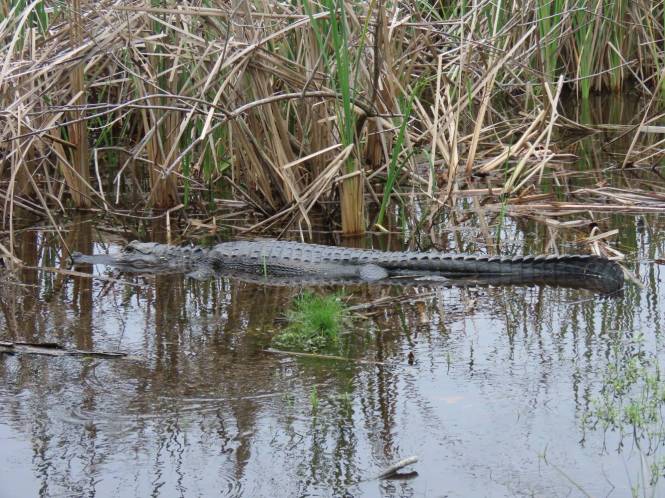
American Alligator/Mississippi Alligator

American Alligator/Mississippi Alligator
As we watched the alligator glide through the water with gentle movements of its tail, we pondered how different its lifestyle is from ours. Like most reptiles, as well as most amphibians, fish, and invertebrates, alligators are ectothermic (or cold-blooded) and their body temperature is regulated by outside temperatures. Unlike that of endothermic mammals and birds, who are warm-blooded and maintain a relatively constant temperature with the help of their metabolism.
We also learned the following from an informational sign:
Between April and June, alligators mate and begin to lay eggs. Females build a nest of vegetation that forms a natural incubator. Warmer nest temperatures produce a majority of males, while cooler temperatures primarily produce females. After 65 days, eight-inch hatchlings begin to emit a high pitched croaking sound indicating to the female to dig them out.
This fascinating phenomenon that applies to many reptiles is called temperature-dependent sex determination. Just as fascinating is the fact that the opposite temperature-to-sex relationship is true in turtles.
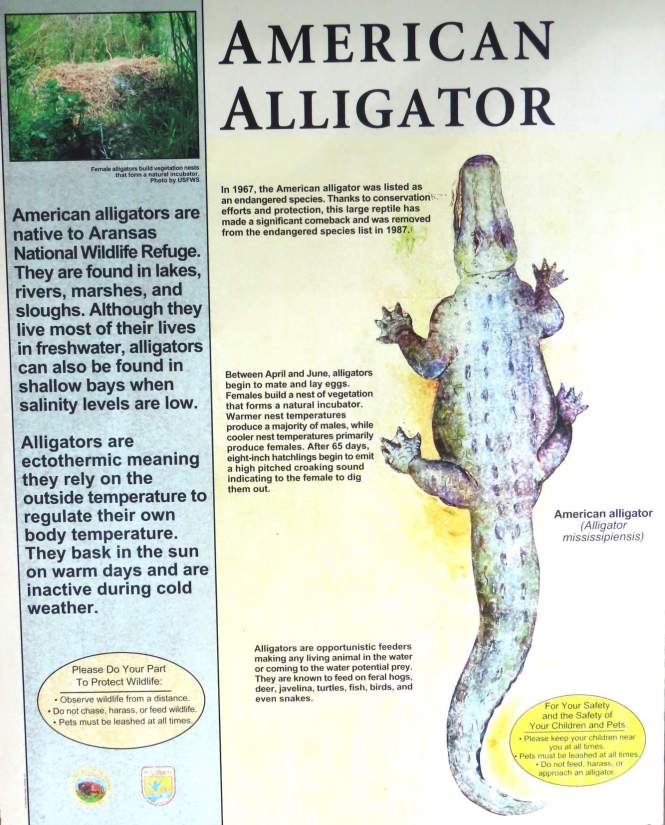
Informational sign about American Alligators/Informationstafel über Mississippi Alligatoren
It was a good day for viewing alligators, and as we continued our walk, we encountered at least six more. While they certainly knew we were present and kept their eyes on us, just as we kept our eyes on them, they never moved toward us, and often didn’t move at all, apart from blinking their eyelids occasionally. Most were about 10 to 15 yards away.
Those of us who have watched nature movies probably remember scenes showing crocodilians propel themselves like lightning out of the water to seize an unsuspecting animal from the shore, and to drag it back into the murky depth. While this is how alligators capture some prey animals, there are very few unprovoked alligator attacks on humans (online sources vary, but on average, there seem to be fewer than six per year in the US, with most of them occurring in Florida).

American Alligator/Mississippi Alligator

American Alligator/Mississippi Alligator
While we remained attentive during our walk, we never felt threatened. Spending time with these animals that seem prehistoric in many ways added another layer of fascination to our visit at Aransas National Wildlife Refuge. As I’m writing these lines near the end of May, I wonder if the next generation of alligators is poised to emerge from their eggs.
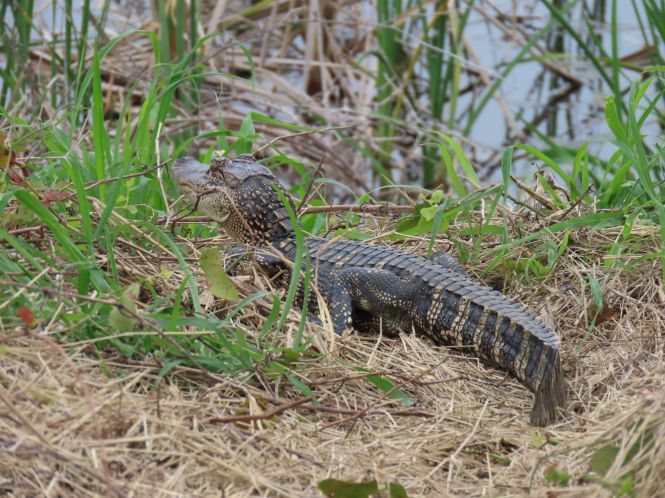
American Alligator/Mississippi Alligator. This was the smallest alligator we saw, probably born last year, or the year before. It was also the closest, about five yards away.
This is part 3 of a series of posts about our road trip to Texas.
For part 1, click here.
For part 2, click here.
 tanja britton
Those gators…brrrrr! 😬
LikeLiked by 1 person
They are definitely a little creepy.
LikeLiked by 1 person
Happy sightings. We were seeing the same animal in the Everglades.
You may know that the English word alligator comes from Spanish el lagarto, meaning ‘the lizard.’ I guess of all possible lizards, this one got singled out for the name because of its size.
LikeLiked by 1 person
I associate Florida more with alligators than Texas, maybe because they are getting more (bad) press in the former.
After seeing their size, I can relate to why they are called THE LIZARD.
LikeLike
Hi, Mrs. Tanja-
What a treat to be able to see so many alligators up close!!
Having had a similar encounter, I know that this can be a scary time!
These reptiles are so interesting.
in Louisiana, a small tourist center allows visitors the opportunity to hold a baby alligator which I have partaken of.
Thank you for the photos and information! 🐊
-Gavin
LikeLiked by 2 people
Thank you, Gavin. It was a treat, even if it made us feel slightly on edge.
I’m glad you were able to hold a baby alligator. It must have been interesting to see it up close and to touch it–the only time in their lives this experience is advisable! 🐊
Best wishes,
Tanja
LikeLiked by 1 person
Having the ability to hold one was very neat, but I would never hold one any larger. 😬
LikeLiked by 1 person
Hi. According to Wikipedia, alligators emerged about 37 million years ago, which was long after dinosaurs (and many other animal species) disappeared.
LikeLiked by 1 person
Thank you for this information, Neil. No wonder they look prehistoric!
LikeLiked by 1 person
A little spooky, aren’t they. Jan and I have encountered multiple ‘gators in the wild in South Carolina on our winter escape trips. We expect to see them in swamps and murky water environments. But to see them along sidewalks, busy roads and backyards is something else completely. Luckily, we usually see them in February when they are as slow as molasses. You did capture all of the creepiness of how silent alligators can be. One moment they aren’t there, and the next they are . . . watching you. Thanks for sharing your road trip adventures Tanja.
LikeLiked by 1 person
They definitely put us on alert, Brad. I’m not sure how I would feel having them walk across sidewalks and through yards. I’m glad I don’t live where they do. I’m glad for the experience, but I have no desire to deepen our acquaintance.
LikeLiked by 1 person
Tanja, seeing an alligator at such a close range must have shocked youa little, even though you had plenty of experience with dangerous wild life in Alaska and Colorado.
In our area we have cougars, black bears and grizzly bears. We have learned to keep our distance and with cow bells make our presence known to them.
LikeLiked by 1 person
Thank you for your comment, Peter. I’m not surprised that you can relate to spending time in bear and cougar habitat, considering where you live. Somehow those animals don’t seem as threatening to me as alligators, but that might be because we are more used to them.
LikeLiked by 1 person
Das ist wirklich eine gute Idee mit den Kuhglocken 🌞 hier, in der Lüneburger Heide, gibt es gelegentlich Schlangen. Als Kinder sind wir deswegen nicht gegangen sondern „gestampft“ … 🐑 man sieht Schlangen hier extrem selten. Wahrscheinlich zu viele Menschen in ihrem Terrain.
LikeLiked by 2 people
In Alaska, many people wear bear bells on their backpacks while hiking in bear habitat (which is basically everywhere). They are smaller than cow bells and tinkle more gently, but the sound is definitely audible to bears and, it is hoped, deters, rather than attracts them.
Snakes are a little harder to deal with–one would basically have to stomp with each step and then wait a while before taking another step. We do have rattlesnakes here in Colorado and try to watch where we step, and where we sit down.
Luckily, both bear and snake attacks are relatively rare, considering how many people invade their habitats at any given time.
LikeLiked by 2 people
That must have been an interesting, if a little scary, sighting.
I loved the photos 🐊
LikeLiked by 1 person
Thank you, Luisa. We were definitely a little on edge, but it was also fascinating to be able to watch the alligators in their natural environment.
LikeLiked by 1 person
I totally agree with you about the fascination that the experience may have caused
LikeLiked by 1 person
It looks like you saw quite a few alligators too! Great pictures, Maggie
LikeLiked by 1 person
Thank you, Maggie. Seeing these alligators in the wild was definitely an interesting experience.
LikeLiked by 1 person
Yeah, you don’t mess with the gators! I loved your write up to recognizing that the log wasn’t a log at all!
Aransas Wildlife Refuge is a special place. I haven’t been there since I was a teen, but I recall visiting there on school field trips and my oldest brother is a biologist, and naturalist, so I remember going with him. Sadly, I don’t think I ever took my kids when we’d visit Corpus. I wonder why we didn’t do that?
Glad you had such a successful trip and thanks for taking us along!
LikeLiked by 1 person
Thank you, Tina. I’m glad we were able to see gators during this trip, but I don’t think they will replace birds in my list of favorite animals. 😊
I imagine that it would have been special to visit Aransas NWR as a teenager, though I likely would not have appreciated it as much as I did now.
LikeLike
You have to know how much I loved this post. First of all, that bridge you crossed as you began walking the trail is where I was standing when I sighted my first bullfrog. And, yes: that slough was rich in alligators. A couple of tidbits might interest you. One is that crocodiles are far more aggressive than alligators; the name is Crocodile Dundee, after all. On the other hand, our wade fishermen are cautious as can be around them. Keeping your catch on a stringer’s not a wise move.
One tip I was given a few years ago involves estimating the length of a submerged gator. If you estimate the distance in inches from a point midway between its eyes to midway between its nostrils, you’ll know approximately how long the creature is. One inch equals one foot: six inches from eyes to nose, and you have a six-foot gator.
I love seeing the babies. The mama gator often will carry hatchlings to the water in her mouth — quite a gentle thing for an apex predator to do! The young will stay around the mother for quite a while; she protects them from threats that include male gators. And when the young just want to hang out, they climb aboard their mother’s back for a snooze in the sunshine.
LikeLiked by 1 person
I found this crew enjoying the sunshine at the Brazoria refuge a while back.
LikeLiked by 1 person
Wow, what an amazing photo, Linda. Thank you for showing it. We weren’t there at the right time to witness the babies.
LikeLiked by 1 person
Thank you, Linda. I’m so glad you enjoyed this post.
It’s fun to know you can visualize exactly where we were and what we saw. I’m pretty sure we heard bullfrogs there, but I don’t think we saw any.
The tip about how to estimate a gator’s size is helpful to know, just to get an idea.
To watch some young alligators emerge and be handled by Mama would be fascinating. I really enjoyed the photo you linked to in your second comment, thank you.
LikeLiked by 1 person
Gators give me the shudders, but I am not accustomed to them like Linda is, she’s very chill around them!
LikeLiked by 1 person
We didn’t feel all warm and cozy around them, but I’m grateful for the experience. I wouldn’t mind seeing the babies ride on Mom’s back.
LikeLiked by 1 person
What a thrilling and beautifully written account! The way you described that moment of realizing the “log” was actually an alligator gave me goosebumps. It’s fascinating how calmly you observed them while respecting their space—and learning about temperature-dependent sex determination was a bonus! Your comparisons to encounters with predators in Alaska and Colorado added great depth. Looking forward to the next chapter in your Texas road trip!
LikeLiked by 1 person
Thank you for visiting and commenting. I’m glad you enjoyed reading about our encounter with the alligators. It’s something we will never forget.
LikeLiked by 1 person
Of course! It’s incredible how nature always has these unforgettable moments in store for us. I’m looking forward to reading more about your journey and the unique encounters you’re having. Stay safe and keep sharing!
LikeLiked by 1 person
Thank you so much! 🙏
LikeLiked by 1 person
Yikes! I am with Eliza. Two northern women. 😉 Still, how fascinating to see them if you are brave enough.
LikeLiked by 1 person
Thank you for your comment, Laurie, I hope the photos didn’t make you feel too uncomfortable!
I’m glad we had the experience but I won’t miss having to pay close attention to large reptiles crossing our paths!
LikeLiked by 1 person
No, no. The only photos that make me twitchy are ones of snakes. While I wouldn’t want to be in the wild with alligators, it doesn’t bother me to see pictures of them.
LikeLiked by 1 person
I think there is some surviving primeval fear of snakes in many people. This made me think of a scene in a Charlie Brown cartoon in which Lucy lists all the different phobias. Turns out, the fear of snakes is ophidiophobia. This might come in handy during a Jeopardy question one of these days. 😊
LikeLiked by 1 person
I grew up in FL and when I was about 20, I was playing golf with my friend in a course so far west it was almost in the Everglades. I sliced a ball off into waist-high weeds near a pond. You’re allowed 5 min to look for a ball, I was using my club to look here and there. Finally my buddy whistles and points at his watch. I turn to leave and almost where I was standing, there was this thrashing and a gator easily 10-11’ long whips around and slides into the pond. Geez… talk about the hair on your neck standing up 😨
LikeLiked by 1 person
Yikes. That’s too close for comfort!
I’m glad you lived to tell the tale!
LikeLike
[…] For part 3, click here. […]
LikeLike
Es ist so spannend, ich lese jetzt schon zum zweiten Mal. Wir gingen all diese Wege auch und sahen auch Alligatoren, aber nicht so viele wie in Floridas Sümpfen. Boots, den alten einsamen Alligator haben wir auch gesehen beim Leonabelle Birdwatching. Texas ist sehr schön. Mir war das nicht bewußt, nicht bevor ich selber dort war.
Liebe Grüße
MAren
LikeLiked by 1 person
Ich danke Dir für den netten Kommentar, liebe Maren. Es war wirklich faszinierend, diese Alligatoren in freier Wildbahn zu sehen, aber ich sehne mich nicht unbedingt danach, mich ständig in ihrem Lebensraum zu bewegen.
Boots haben wir nicht gesehen, aber ich habe gerade einen Artikel über ihn gefunden, falls es Dich interessiert:
https://www.portasouthjetty.com/articles/boots-goes-awol-seemed-to-be-on-his-way-back-home/
Liebe Grüße,
Tanja
LikeLiked by 1 person
Ich habe den Artikel eben gelesen, danke dafür. Er ist schon ein netter Kwerl, dieser Boots. Immer wenn wir dort waren, Winter 23 und Frühjahr 24 lag er im Bereich des Stegs, gut zu beobachten. Ich hoffe, er haut nicht mehr ab, damit er nicht zwansgumgesiedelt werden muss 😉
LG
Maren
LikeLiked by 1 person
I think alligators have been stigmatized, just as sharks and other animals have (crows too). 😞
LikeLiked by 1 person
We often seem to stigmatize things that scare us.
LikeLike
I still get excited when I see an alligator even if they are commonly seen hereabouts. Magnificent and primeval animals. I remember see kittens playing around an alligator at a fish restaurant in Cajun country. Guess he preferred fish to kitten…
LikeLiked by 1 person
I think I would get excited every time, too. It’s probably best to remain a little hypervigilant around these gators. I would not let my kittens get close either!
LikeLiked by 1 person
Hello Tanja,
I can imagine how the hairs must have stood at full attention when you realized the alligator was looking a you with its stunning eye! It must have been an unforgettable experience and I’m glad you and your husband could share these moments together. I hope the baby ‘gators’ are born and happily riding on Mum’s back at this time…☺️
LikeLiked by 1 person
You are right, Takami, seeing our first wild alligators was unforgettable.
It’s nice to visualize Mama Gator with her offspring riding on her back. 🐊
LikeLiked by 1 person
Very brave of you to walk around… I’m not sure I would do it… Seen a few crocodiles in Africa… Wouldn’t want to get too close.
LikeLike
I don’t know about brave. If these gators had been aggressive, I’m sure all the signs would have told us to refrain from walking there; instead, they just cautioned us to practice common sense.
As a fellow blogger pointed out, crocodiles seem to be more aggressive, so I probably wouldn’t want to get too close to them either!
LikeLiked by 1 person
You have a point, they would not risk liability if they felt it was not safe…
LikeLiked by 1 person
[…] For part 3, click here. […]
LikeLike
[…] For part 3, click here. […]
LikeLike
They’re awe-inspiring animals, totally alien and yet – thanks mainly to movies and the media – strangely familiar too. I can see that you enjoyed good sightings, and your photos will help preserve the memories forever. Great stuff!
LikeLiked by 1 person
Thank you, Mr. P. I’m glad for the wild gator experience but am glad it was uneventful.
LikeLiked by 1 person
Ah, the mainstay of any Texas visit, the gator! I am much more comfortable around them based on all of our years going down there, but it still makes my heart skip a beat when I get a “late” recognition of one of those big uns nearby. I almost stepped on the head of one not paying attention while in Georgia one year (being stupid and walking with my eye to the camera). Never had an issue with one even when we found a mother sitting among her multitude of newborns. What I have been told over and over by the locals is they will launch out of the water for a pet dog so we are extra careful when the boys are along. Wait until you get to witness one of those prehistoric animals put on the rockets — like bison, they are far faster than you would expect.
LikeLiked by 1 person
I’ll take your word on the alligator-rocket experience. I think I can live without that one! 😬
LikeLiked by 1 person
[…] For part 3, click here. […]
LikeLike
I’ve never seen an alligator in the wild, but it would make me very uneasy as well. As you said, it’s the unfamiliarity with them. That’s so interesting about the effects of temperature. I’ve heard that in turtles but didn’t know it applied to other animals. I wonder why it’s the case, and also why it’s opposite between those two animals.
LikeLiked by 1 person
Thank you for all your visits and comments, Diana.
I’m glad we had the opportunity to see alligators in the wild but I won’t necessarily have to seek similar experiences in the future, whereas I will always seek for more opportunities to look for birds.
Temperature-dependent sex determination is a fascinating phenomenon. One wonders what the advantage is for some of the species to whom it applies. What is clear, though, is that climate change poses a threat as it might endanger the survival of certain species by affecting this mechanism (apart from all the other negative effects).
LikeLiked by 1 person
Oh interesting. I hadn’t even considered the impact of climate change, but that’s certainly a worrying threat.
LikeLiked by 1 person
[…] part 1, click here, for part 2, click here, for part 3, click here, for part 4, click here, for part 5, click here, for part 6, click here, for part 7, click […]
LikeLike
[…] part 1, click here, for part 2, click here, for part 3, click here, for part 4, click here, for part 5, click here, for part 6, click here, for part 7, […]
LikeLike
[…] lizard, the Green Anole, featured with its prominent dewlap in the photo above, as well as with the respect-filled encounter with the American Alligator. We regularly saw turtles but only caught one glance of an amphibian, the handsome Leopard […]
LikeLike