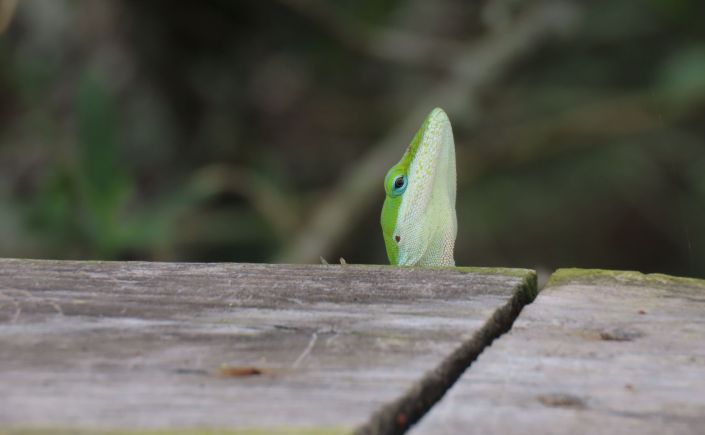
I have a new favorite reptile!
No, not the American Alligator I reported on in last week’s post. But a much smaller, much less intimidating reptile the color of an emerald who also wears blue eyeshadow. On many occasions, I have admired photographs of this attractive lizard in posts by fellow bloggers. In Texas, my husband and I personally made the acquaintance of the Green Anole (Anolis carolinensis).
From animaldiversity.org comes the following information about the anoles’ distribution:
Anolis carolinensis . . . is native to neotropical and nearctic regions. Anolis carolinensis occurs throughout much of the southeastern United States, extending north through parts of North Carolina, west to Texas, and south through Florida. While Florida was once the central portion of its United States distribution, today most Florida populations have been replaced by introduced anole species, . . . .
In other parts of its geographic range, A. carolinensis is considered an introduced species. It has become abundant in Hawaii since it was discovered in 1950. It also has been introduced and has flourished in the Ogasawara Islands of Japan, and in Cuba, the Bahamas, and Guam.


At Aransas National Wildlife Refuge, on the same day when we saw our first wild alligators, we also had the pleasure of observing our first wild Green Anole. Its sleek green body and long tail were conspicuous against a fence rail and we watched it do its lizard thing: walk, stop, bob its head, do push-ups, repeat. Then it added to the performance by projecting a reddish skin pouch from its throat. Wow!

We were impressed, but the display of what we later learned was a dewlap, was not put on for our entertainment but in hopes of attracting an anole girl (one was watching from nearby). We knew of dewlaps in moose, those long skin appendages that resemble a beard, but as opposed to the ungulates’ permanent pendulous structure, this lizard’s was temporary and collapsible. How cool is that?
Animaldiversity.org explains:
Anolis carolinensis is equipped with certain communication signals from birth. Most communication involves color variations, actions such as head bobbing or neck biting, or use of the dewlap. The dewlap is used for inter-gender communication, especially during the breeding season. Displaying the dewlap also may be used to determine competitive status between males; in these cases, dewlap displays are usually related to territorial boundary disputes. Head bobbing or courtship bobbing is performed by both males and females to communicate breeding status, but is also done while in a threatened state.
🦎 🦎 🦎 🦎 🦎 🦎 🦎 🦎 🦎 🦎 🦎 🦎 🦎
On the following day, another anole gave another very impressive performance. We were back at Goose Island State Park at a wildlife observation blind, where a Green Anole balanced on the fence right next to the bench we were sitting on. He looked just like the anole the day before.

The next time we glanced at him, he had changed his color from green to brown. Double-wow!

While we were watching, his color transformed once again before our eyes: brown being replaced by green. First on the legs, then the body, then part of the head.


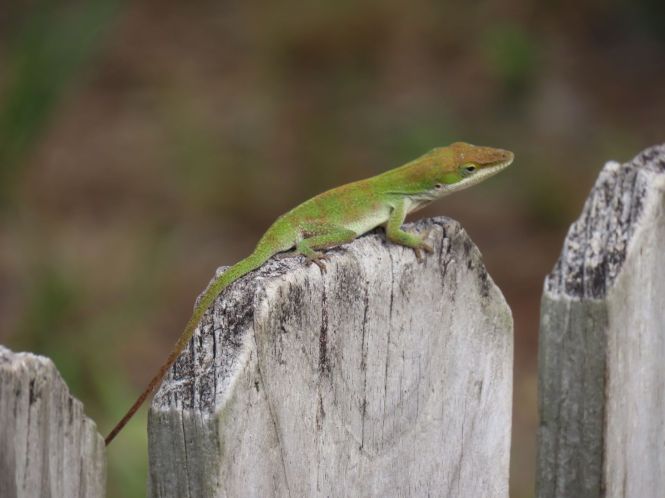
But then Mr. Anole changed his mind and went back to brown.
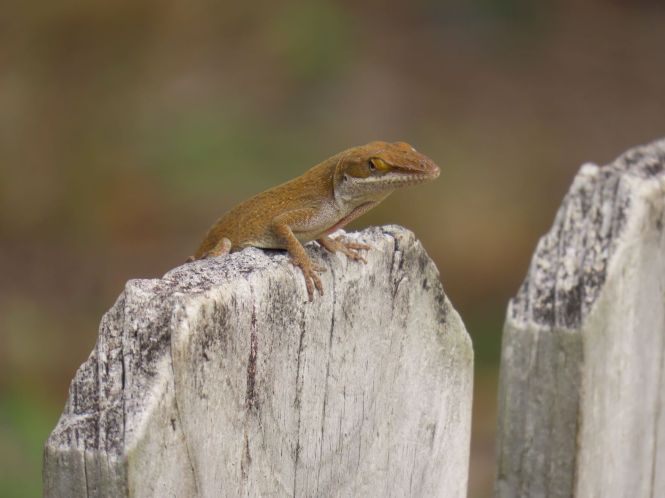
Animaldiversity.org has the following fascinating facts about color changes in anoles:
Scale colors in green anoles vary. In most cases, these lizards range from shades of brown to green or gray. At times their coloring represents combinations of these colors. Color variation results from layers of pigmented cells called chromatophores. Three types of pigment cells are present: xanthophores, cyanophores, and melanophores, each responsible for different color variations. Green anoles are capable of changing scale color in response to their external environment. Many factors affect color change and variation; most often it is dependent upon temperature and excitation, such as increased activity or competition. Darker brown and black colors, produced by melanophores, typically signal cold or stressed conditions.
We did not see anything obvious that might have stressed the lizard, unless we were the cause for his stress. We hope not. Instead, we trust that Mrs. Lizard was duly impressed with Mr. Lizard’s push-ups and dewlap displays and that the world is richer thanks to the addition of another generation of Green Anoles.
🦎 🦎 🦎 🦎 🦎 🦎 🦎 🦎 🦎 🦎 🦎 🦎 🦎
This is part 4 of a series of posts about our road trip to Texas.
For part 1, click here.
For part 2, click here.
For part 3, click here.
 tanja britton
This little creature is just charming! Thanks for sharing.
LikeLiked by 1 person
Thank you for visiting and commenting. I also fell in love with this handsome lizard.
LikeLiked by 1 person
Oh Du hast wunderschöne Bilder gemacht von den kleinen Eidechsen. Ich bin schwer begeistert. Wir haben auch ein paar gesehen, aber sie waren so schnell und ich war mit der Kamera auf Vögel fixiert. Ich genieße Deine Bilder und den schönen Grünen, den hätte ich gerne selber gesehen. Meine Anolis war braun gefleckt, aber sie hatte auch diesen kecken roten Hals. Ich bestimem sie meistens mit Google und bin mir nie sicher, ob ich richtig liege mit der Bestimmung.
LG Maren
LikeLiked by 3 people
Vielen Dank, liebe Maren. Ich hatte wirklich Glück mit diesen attraktiven Eidechsen. Es scheint ihnen nichts ausgemacht zu haben, beobachtet und fotografiert zu werden.
Ich hatte einige Photos dieser Echsen von Bloggern in Florida und Texas gesehen, deshalb wußte ich, um wen es sich dabei handelte.
LikeLiked by 1 person
Faszinierendes Reptil!
LikeLiked by 1 person
Allerdings, liebe Simone. Wir hatten wirklich Glück, weil diese Eidechsen so nett posiert haben.
LikeLiked by 1 person
What a delicate stunner!
LikeLiked by 1 person
They really are. 🦎
LikeLike
How nice, he showed you all his colors!
LikeLiked by 1 person
Yes, very nice and accommodating. And very photogenic.
LikeLiked by 1 person
Given that you knew about green anoles before visiting Texas, were you specifically hoping to see some here, or did that prior knowledge suddenly come to the fore once you spotted your first green anole here?
LikeLiked by 1 person
I really had no preconceived notions about wildlife encounters. But these anoles were very conspicuous and not shy at all. As soon as I saw them, I remembered the photos of fellow bloggers from Florida and Texas.
LikeLike
Hi Tanja,
never heard or seen anything like that. Wonderful, thanks for sharing. And I also definitely prefer these green/brown creatures to any alligator 🙂 Anna
LikeLiked by 1 person
Thank you, Anna. It was fun to watch them, and to read about what we had watched afterward.
I think I will always prefer these lizards to their much larger relatives!
LikeLiked by 1 person
Such a fine little fellow! How fun it must have been to watch him change colors.
LikeLiked by 1 person
Thank you, Laurie. It really was much fun to observe these fascinating behaviors. And lucky to be able to get photographs.
LikeLiked by 1 person
Oh wow, fantastic that you were able to see the colours change, and catch it with your camera! Maggie
LikeLiked by 1 person
Thank you, Maggie. We got very lucky on both counts!
LikeLike
Aren’t anoles just the best! That first shot is soooo anole! They are characters and add so much to the garden. Glad you’ve been introduced and that you like them as much as…everyone else!
LikeLiked by 1 person
Thank you, Tina. I was so excited to see these handsome fellows several times. I envy you for having them around all the time! 🦎🦎🦎
LikeLike
Amazing how quickly it can change colors!
When I lived it Boston many decades ago, I bought a small palm plant. Once home I realized there was a stowaway on board, a green anole (presumably rode the truck from FL). It lived a couple years on top of the stove (when it wasn’t on, of course) because the it had a pilot light which kept it warm. New England is a bit too cold for these guys!
LikeLiked by 1 person
We were really surprised at how quickly the color change happened, Eliza.
That must have been quite the surprise to find a stowaway in your palm! You buy a plant and it comes with a free anole! 😊🦎
LikeLiked by 1 person
When I was in Florida for school, one of these little bubbas snuck into the apartment through the front door as I was bringing in groceries. The cat had a ball chasing it to no avail. I eventually coaxed it out the front door! 🦎🐈🚪🌴
LikeLiked by 1 person
Who knows. It might have made a great pet. 😊
LikeLiked by 1 person
As a tropical island, we also have many Anoles. Your images show the changing color sequence so well!
LikeLiked by 1 person
I wouldn’t mind seeing these attractive anoles regularly.
LikeLike
I have never seen an Anole in person but these photos do the trick. I’m so impressed with his color changes and his pretty red throat. Dewlap sure isn’t a word you hear every day! 💚❤️
LikeLiked by 1 person
Thank you, Julie. We were so lucky to be able to observe the anoles’ fascinating behavior, and to get photos. They really are very attractive lizards.
LikeLiked by 1 person
We have a green anole living in our garage right now. He pooped on my shoe… Lizards have distinctive scat. It seems to a theme in my life, right now! 😉
LikeLiked by 1 person
I confess that I wouldn’t recognize lizard scat if I saw it.
Sorry to hear that lizard scat isn’t the only one you are dealing with . . .
LikeLiked by 1 person
LOL!
LikeLiked by 1 person
😊
LikeLiked by 1 person
What a handsome little chap! I love the way he’s peeking up to check out the world around him in the first photograph. 🙂
LikeLiked by 1 person
Thank you, Ann. I really fell in love with these attractive little lizards. That first photo was a moment of absolute luck–he just peered over the edge of the fence and stayed still for a while. Made us very happy. 😊
LikeLiked by 1 person
What a handsome fellow! And such impressive displays and beautiful coloring. I too, especially love the first image, although all are lovely. I hope he finds a partner☺️ I am enjoying your birding adventures very much.
LikeLiked by 1 person
Thank you, dear Takami, I’m so glad you are enjoying our Texas adventure.
We were absolutely thrilled to be able to observe these attractive little anoles and watch them perform their party tricks.
LikeLiked by 1 person
He has so much color! You were lucky he didn’t run away on you. Great pictures Tanja!
LikeLiked by 1 person
Thank you, Diane. We loved to be able to watch these handsome anoles. They really put on quite the show!
LikeLike
Well done.
LikeLiked by 1 person
Thank you!
LikeLiked by 1 person
[…] For part 4, click here. […]
LikeLike
Hi, Mrs. Tanja-
It is always fascinating to hear of one’s discoveries of new animals when one travels to a new area! For example, when we visited Colorado last summer, we were astonished at all of the “new” animals that we had never seen before! The chipmunks were my favorite!
I am sure that these unique animals we saw are normal occurrences for you! Likewise, we have so many of the small green anoles like you saw (as many as three or four by our doorway each day during the summer) that we consider them something everyone is familiar with! How neat that you were able to see this reptile for the first time!
~Gavin
LikeLiked by 1 person
I appreciate your visit and comment, Gavin.
Your observation is so true: some animals that are commonplace for some of us, are rare for others. I enjoy lizards wherever we see them, but these green anoles really stole my heart.
I can completely relate to your admiration of chipmunks. They might be common here (at least above a certain elevation), but they never fail to make me smile.
Be well,
Tanja
LikeLiked by 1 person
I really love these little creatures. There’s one that’s moved back onto a plant outside the window next to my computer, and occasionally I see it showing off that dewlap. It will change colors, too, but I’ve never seen the process as clearly as you did; that must have been as entertaining as it was interesting.
LikeLiked by 1 person
I also fell in love with these lovely lizards. How fun to have one live on one of your plants. We have lizards here, but they seem shyer and less conspicuous than the anoles. We were thrilled to be able to see the dewlaps and the color changes so clearly.
LikeLiked by 1 person
How cool
Is that!
LikeLiked by 1 person
It really was! Thank you!
LikeLiked by 1 person
[…] For part 4, click here. […]
LikeLike
Wow, this brings back memories. Great portfolio of photos. We too encountered a Green Anole somewhere in Texas, and your description of the press-ups and the extending dewlap reminds me how we were entranced by this little guy. Who knew that lizards could be so much fun?!
LikeLiked by 1 person
Thank you very much. I really enjoy (non-alligator) lizards whenever and wherever I see them. These very attractive emerald anoles were a wonderful addition to the lizard portfolio.
LikeLiked by 1 person
Love the Anoles. You got to witness their two cool features (beyond just their pretty lime suit) – their attraction seeking dewlap and their color morphing capabilities. I have to admit, for the longest time I thought was just a color distinction between the sexes until I finally witnessed the transformation.
LikeLiked by 1 person
I also fell in love with these very handsome lizards. Getting to witness their party tricks was an absolute bonus!
LikeLiked by 1 person
[…] For part 4, click here. […]
LikeLike
Whoa! The dewlap was already pretty cool, but then to watch it change color?! It seems the reptiles are quite the fun distraction from your birding ventures.
LikeLiked by 1 person
Thank you, Diana. Getting to meet these handsome anoles and watch them perform their party tricks was a memorable part of our trips. I’m sure you and I both have come across them during your visits to the Southwest and remember them well. They are fascinating creatures.
LikeLiked by 1 person
You know, I’m actually not sure I’ve ever seen one. If I have, it was certainly not green.
LikeLiked by 1 person
[…] part 1, click here, for part 2, click here, for part 3, click here, for part 4, click here, for part 5, click here, for part 6, click here, for part 7, click […]
LikeLike
[…] part 1, click here, for part 2, click here, for part 3, click here, for part 4, click here, for part 5, click here, for part 6, click here, for part 7, click here,for part 8, click here. […]
LikeLike