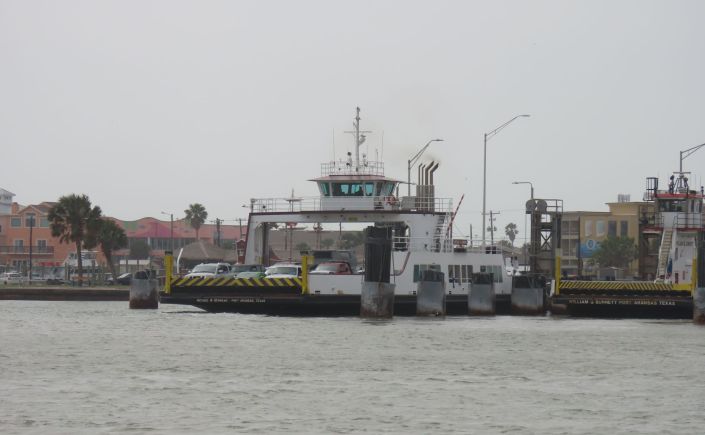
While the title given to this series of posts about our Texas road trip applies to the vast majority of our mode of travel, one leg was made not on the road but across a body of water. When I studied the map to determine our way south, I was excited to learn that State Highway 361 between Aransas Pass and Port Aransas included a stretch of water with regular and free ferry service, courtesy of the Texas Department of Transportation.
I never turn down a ride on a ferry and so we joined several rows of cars lined up at the harbor in Aransas Pass. Ferries shuttle back and forth between that town on the mainland and Port Aransas on Mustang Island for 24 hours a day, 365 days a year, weather permitting. It didn’t take long for the next ferry to arrive, the cars to get loaded, safely conveyed across Corpus Christi Bay, and deposited at the harbor of Port Aransas, with the quarter-mile route taking a regrettably short ten minutes, and the entire efficiently run enterprise no more than half an hour.
For a birder, one of the main draws in Port Aransas is Leonabelle Turnbull Birding Center. It affords access to boardwalks that course along and across Port Aransas Nature Preserve, a 1,200 acre refuge that is composed of coastal prairie, salt marsh, tidal flats, and upland marsh as well as freshwater pools, thereby harboring a range of habitats. It is also located adjacent to a wastewater treatment plant, which offers additional attractants—I will leave the details to your imagination. Fellow blogger and travel advisor, Brian, in his detailed recommendations, had written, “If you are in Port Aransas, this is where you need to be.”
To enlarge a photo, click on it. To read its caption, hover cursor over it.


His suggestion was seconded by a group of birders at Goose Island who had visited here the day before and told me about an unexpected, not-to-be-missed visitor. So it was with some anxiety—lest we miss it—that we parked the car, followed a short sidewalk past trees and a pollinator garden to the boardwalk, and scanned the water. I need not have worried as the famous and unmistakable visitor was clearly visible with the naked eye, a brilliant sentinel standing on long legs all by himself, nonchalantly preening, unfazed by the dozens of cameras pointing and clicking at him; in other words, a celebrity at ease with his fame and not entirely sure what all the buzz is about.


If you live in Florida, or along the Caribbean, you might shrug your shoulders and feel slightly underwhelmed. But for this birder short on coastal and tropical exposure, it was my first-ever encounter with an American Flamingo (Phoenicopterus ruber). The genus name, Phoenicopterus, is Latin for flamingo. It is composed of the Greek words phoenix, translatable as “purple” or “red,” plus pteron, meaning “wing.” When Linnaeus named the bird in 1578, he presumably thought that the bird’s conspicuous color needed additional mention, so he added the species name ruber, for “red.” Whether red, orange, or salmon is the right way to describe the flamingo’s feathers is debatable, but size, shape, and shade of plumage combine to make this “Red-winged Red” a sight to behold.
We arrived at Leonabelle Turnbull on a Wednesday morning but were too late to join the weekly free bird walk offered by local volunteers at 9 AM. They were still present, though, helpfully answering questions and letting me know that an American Flamingo had already excited birders’ hearts the year before, until this (the same?) individual showed up a few days earlier. As I have since learned, it is for a former local bird lover that the site was named in 2004: Leonabelle Turnbull (1925-2009), who offered free guided tours at this location for many years and was locally known as “The Bird Lady.”
Long-legged birds don’t necessarily have to be tall, and I particularly enjoyed the picturesque configuration of two of my favorite shorebirds: American Avocets (Recurvirostra americana) and Black-necked Stilts (Himantopus mexicanus). Unlike many other shorebirds who dazzle with no less elegance but more subtle patterns, they are instantly recognizable. In Colorado, I only observe them during spring and fall migration, but here, some are year-round residents and, while common, are always uncommonly striking.

American Avocets (some in breeding, others in basic plumage) and Black-necked Stilts
There was one additional area must-see bird species Brian had told me about. South of Port Aransas, I was scanning the flat landscape for signs of man-made breeding platforms. We saw a few, but they were empty. Finally, one showed a lumpy silhouette and after my trusty chauffeur pulled over the car, I got out. My heart thumped with recognition and I felt fortunate to find myself in the presence of a lone bird of prey and the only species of falcon in North America I had never before seen in the wild: an Aplomado Falcon (Falco femoralis). Most similar in appearance to American Kestrels, Aplomado Falcons are larger, with longer tails and wings and facial stripes that are horizontal rather than vertical. Aplomado means “lead-colored” in Spanish, which focuses on the falcons’ slate-colored backs.


This falcon occurs mostly in South America and in a few parts of Mexico, New Mexico, and Texas. Once common in grasslands of the southwestern US, the northern population is now endangered. According to the Mustang Island State Park website,
Aplomado Falcons “disappeared” (my quotation marks, “was disappeared” would be more accurate) in the wild in Texas more than a half-century ago. A recovery effort for this endangered species began in 1984, led by The Peregrine Fund. In the summers of 2012 and 2013, biologists released 65 captive-bred falcons at Mustang Island State Park.
On this afternoon and during another search the following morning, when my photos were taken, we saw one lone falcon at a time, for a total of two falcons, a sobering experience.
We had made a reservation for the night at Mustang Island State Park. During our drive south on State Highway 361 with Corpus Christi Bay on one side, and the Gulf of Mexico on the other, the car was buffeted by strong winds. When we inspected the state park’s campground, it was clear that it had been designed with recreational vehicles and not tents in mind. A few tents had been put up by campers braver than us, but they were either deeply bowed by the gusty winds, or even flipped over. During a walk along the beach, we received a free dermabrasion, thanks to the grains of sand whirling through the air. The flag designed to indicate wind strength and direction was hanging on by a few rugged threads. The forecast for the night: More of the same. So we bowed out, cut our camping fee losses, and decided to return to Port Aransas to look for a motel room for the night.


Thank you so much for reading.
This is part 6 of a series of posts about our road trip to Texas.
For part 1, click here, for part 2, click here, for part 3, click here, for part 4, click here, for part 5, click here.
 tanja britton
Liebe Tanja, den berühmten einsamen Flamingo haben wir nicht gesehen, aber wie Du schon schreibst, wir haben Flamingos in Florida gesehen. Ich bin begeistert, wie Du Deine Reise so ausführlich beschreibst, ganz anders als ich – und so kann ich alles mit Dir genießen und freue mich. Auf der Bank habe ich gefühlt Stunden verbracht, teils mit unseren Freunden John und Laura, teils allein mit anderen Birdwatchern und deren Riesenobjektiven.
Deine Beschreibung von Mustang Island ist toll, ich spüre den gusty Wind, er scheint immer zu wehen. Auf den Stromtrassen entlang des Highways sass eigentlich fast immer ein Osprey, einen dieser seltenen Falken haben wir nicht gesehen. Es ist ermutigend zu lesen, dass es Nachzüchtungen dieses seltenen Falken gibt, die sich in der freien Natur behaupten können, weil ihnen Lebensraum geboten wird. Die Fähre am Aransas Pass haben wir auch bewundert, haben sie unzählige Male benutzt in den zwei Aufenthalten dort. Sie fahren so effektiv und sind doch kostenlos, Perfekt.
Danke für den Bericht, wir haben es genossen..
Frohe Pfingsten
Maren
LikeLiked by 1 person
Liebe Maren,
Dein Kommentar freut mich sehr, besonders weil ich das Gefühl habe, daß ich vielleicht zu viele Details über diese Reise berichte, wenigstens für manche Leser. Es ist natürlich hilfreich, wenn jemand selbst schon mal an diesen Orten war und seine eigenen Erfahrungen mit den meinen vergleichen kann.
In Florida war ich noch nie, das wäre auch noch ein Traum, muß aber wahrscheinlich eine Weile auf sich warten lassen.
Auch Euch frohe Pfingsttage. Pfingsten wird hier so gut wie nicht gefeiert, das hast Du vielleicht mitbekommen.
Herzliche Grüße,
Tanja
LikeLiked by 1 person
Ja, unser Freund John aus Texas konnte mit meinen frohe Pfingsten Wünschen auch nicht gerade viel anfangen 😉 Dein Bericht ist wunderbar. Meine sind viel zu kurz und klären nicht wirklich auf. Ich habe gestern nochmals alle gelesen, Erinnerungen – ich liebe sie.
Herzlichst
MAren
LikeLiked by 1 person
Ich danke Dir, liebe Maren. 🙏
LikeLike
Es war wirklich scoen dort, liebe Maren, und Mary und ich denken gerne an die Zeit mit Euch zurueck.
Liebe Gruesse,
Pit
LikeLiked by 2 people
Wir auch lieber Pit, wir auch. Die Bootstour war ja auch ganz was Besonderes und die Sonne schien mitten im Texas Winter warm auf uns herab. Lg auch an Mary
Maren
LikeLiked by 1 person
I’m so pleased that the search for your target bird was successful – that Flamingo is simply stunning. I can understand why the photographers were flocking around it.
LikeLiked by 1 person
Thank you, Mr. P. It was quite amazing to see this brilliant bird stand nonchalantly in the middle of the body of water, and dozens of birders/photographers on the boardwalk trying to catch glimpses/photos.
LikeLiked by 1 person
A ferry ride and more lovely birding encounters! I’m glad it was another exciting day. I can imagine how popular the Flamingos were. I loved the group shot of the Avocets and Black-necked stilts too. Have a wonderful week, dear friend.
LikeLiked by 1 person
Thank you, Takami.
It was one lone Flamingo, and he had all the attention to himself. He didn’t seem to mind at all!
Avocets and stilts are beautiful, even more so when they intermingle.
All the best,
Tanja
LikeLiked by 1 person
Hi. Flamingos are contortionists!
LikeLiked by 1 person
Yes, Neil, great observation. That long neck was moving this way and that (though we didn’t see the bird try to tie it into a knot 😊).
LikeLiked by 1 person
I love Avocets. They are unique.
LikeLiked by 1 person
I do, too. Unique and so elegant.
LikeLiked by 1 person
Some exciting sightings, Tanja, esp. the falcon. I hope those 65 releases are elsewhere, or at least their descendants. 🤞🏼
I’ve only once been camping in wind like that, thankfully it was in a scrub pine grove, which helped. I remember the ‘dermabrasion!’ 😀
LikeLiked by 1 person
Thank you, Eliza. I share your hope for the falcons. They don’t have the luxury of motel room and have to be able to live with that wind all the time! We have camped in very windy conditions before and could have probably survived the night, but we were not in the mood to try to put up the tent in those conditions.
LikeLiked by 1 person
What a thrill to see both the flamingo and the falcon. (I was sorry to read about the falcon’s endangered status.) Sounds like you made a wise decision to stay in a motel.
LikeLiked by 1 person
It really was a thrill, Laurie. Both were life birds. It really makes one stop and think to come face to face with a creature that was nearly gone and was brought back from the brink.
LikeLiked by 1 person
Yes, yes! Just think of all the good things humans could do if they decided to create rather than destroy. Alas, destruction is easier.
LikeLiked by 1 person
Alas . . .
LikeLike
Soooo glad you got to see the Flamingo. We had already passed that stop when the pink gem showed up. I am half tempted to fly down there just to get that bird checked for the year..and it is just a fun day at Leonabelle. Was the massive one-eyed gator sunning itself in sight while you were there? Also pleased to learn you got the Aplomado. Not the easiest bird to find, but if you are in the Mustang Island or South Padre vicinity (and a birder) you have to go after that rare falcon…which is my favorite in that family. Assuming you got to watch the dolphins as you took the ferry.
LikeLiked by 2 people
I had no idea that the flamingo was there until the group of birders mentioned it to us the day before we were supposed to arrive there, so it was great luck!
The alligator was not present while we were there and I didn’t learn about him until later. I guess he left once before only to return.
Also, no dolphins during the ferry crossing. We didn’t get a chance to visit some of the other places that you had recommended, such as the the jetty or Robert’s Park. Opted to spend some time in Corpus Christi for the Cattle Tyrant but, as you know, he was a no-show.
LikeLiked by 1 person
Feel bad the Tyrant wasn’t there for you – has been like clockwork for us at that 2-3pm timeframe.
LikeLiked by 1 person
Thanks, Brian. Sometimes our plans don’t work out the way we hoped for.
LikeLiked by 1 person
I’ve really enjoyed this series, Tanja! It’s brought back so many memories (the ferry–ridden that! highway 361–driven that! the “free dermabrasion”–experienced that! lots-o-birds–yes!). Excited that you were able to see the flamingos and falcons. I recall seeing the flamingos and perhaps saw a falcon, but was not interested in birds at that point in my life, and haven’t been to the coast in some years. I will say that I don’t miss the humidity (which I didn’t notice growing up there, or the wind, which I recall with clarity).
LikeLiked by 1 person
Thank you, Tina, I’m so glad you are reliving some of your own experiences along our travel route.
We also struggled with the constant wind and the humidity, especially coming from Colorado where 10% humidity is high at times (not right now, though, we have had above-average precipitation in May and June so far).
I have regretted not paying closer attention to bird in my younger years as I might not get back to some of the places I lived at or traveled to, but that’s life.
LikeLike
It is life. Interests change and evolve, but like you, I wish I’d paid more attention…:)
LikeLiked by 1 person
Speaking of the phoenix, you must have felt reborn when you finally saw a flamingo. You got good pictures, too.
Two years ago, as part of a clockwise circuit of Corpus Christi Bay, Eve and I took the Port Aransas ferry in the same direction as you did, but then we went to Magee Beach Park on the Gulf side rather than to the birding center on the opposite side.
Sorry your plans for tent camping got abraded away. Discretion is the better part of valor, they say.
LikeLiked by 1 person
I was surprised not to come across a reference to the Phoenix when looking up the meaning of the flamingos’ genus. Just now, I came across this article which speculates that the Phoenix might have been red: https://en.wikipedia.org/wiki/Phoenix_(mythology)
There were a few additional places at Port Aransas we would have liked to visit and I think we might have done if our camping plans had worked out. As it was, the wind drove us off.
“The best laid schemes o’ Mice an’ Men gang aft agley.”
LikeLike
The article’s assumption that Phoenix and Phoenicia are related words is interesting, too.
LikeLiked by 1 person
I thought so too.
LikeLike
Speaking of your last word, too, which you’ll see misspelled to in many places (and sometimes even vice versa), it turns out that they’re etymologically the same word. The semantic development of too seems to have begun with the sense of to as ‘in that direction.’ People would have begun using to in that sense as an adverb conveying the notion ‘I’m likewise inclined in that direction,’ and from there came the sense ‘also.’ Eventually the spelling too was adopted as a way to distinguish that adverb from the preposition to.
LikeLiked by 1 person
To understand how to and too are related and to learn how to use to versus too is perhaps too complicated to some of us.
LikeLike
To some, but not too hard to you to understand too.
LikeLiked by 1 person
Thanks for letting us tag along with you and your husband on your summer road trip… really enjoying it! The flamingo is especially impressive, with it’s salmon and coral coloring and it really does seem to enjoy the limelight. 🧡❤️
LikeLiked by 1 person
Thank YOU for tagging along, Julie! The flamingo was a sight to behold. Before that, I had only seen flamingos in a zoo. I still don’t know what color it is exactly, but I like your choices of salmon and coral. That’s the artist in you who knows her color palette! 😊 🎨
LikeLiked by 1 person
Die Faehre, liebe Tanja, ist wirklich etwas ganz Besonderes, nicht wahr? Wir bevorzugen sie gegenueber der Strassenverbindung durch Corpus Christi, auch wenn diese Verbindung fuer uns die schnellere waere. Aber wenn wir erst einmal auf der Faehre sind, dann sind wir ganz entspannt, weil wir “on island time” sind.
Von der Fahrt ueber den Causeway von Aransas Pass zur Faehre und dann von der Ueberfahrt habe ich ein Video gemacht und ins Blog gestellt. Die Fahrt ist Dir ja nichts Neues, aber in dem Blogeintrag habe ich auch etwas ueber die Geschichte des Causeways geschrieben, das Dich vielleicht interessiert.
Mary war oft schon mit Ihren Eltern da und sie erinnert sich noch daran, dass sie nur ueber hoelzerne Planken gefahren sind.
Port Aransas ist uebrigens unser Lieblingsort an der Kueste. Mary hat mich schon bei meinen allerersten Besuch in den Staaten [1999] dahin mitgenommen.
LikeLiked by 1 person
Vielen Dank für den Kommentar, lieber Pit. Die Fähre hat wirklich Spaß gemacht, auch wenn die Fahrt viel zu kurz für meinen Geschmack war. Ich kann gut verstehen, daß Ihr einen Umweg macht, um nach Port Aransas zu gelangen.
Wie faszinierend, daß Mary schon seit ihrer Kindheit Port Aransas kennt. Ich kann mir vorstellen, daß sich in der Zwischenzeit viel verändert hat.
Ich freue mich auf Deinen Artikel über den Causeway.
Liebe Grüße,
Tanja
LikeLike
Hi, Mrs. Tanja-
What an exciting trip once more!
The beautiful Flamingo you were able to see was truly amazing! I have only ever seen a flamingo at the zoo. 🦩
Thank you, as always, for taking us along for your trip!! 🙂
~Gavin
LikeLiked by 1 person
Thank you, Gavin. Like you, I had only seen flamingoes in the zoo in Germany, but it was a different species than the American Flamingo. This sighting was definitely unexpected and it’s one we will never forget.
I appreciate you following along on our trip.
Best,
Tanja
LikeLiked by 1 person
I like ferry rides. Too bad that staying overnight in a tent on the wind-swept island was not an option for you. My wife and I live at the lower Arrow Lake that is part ofthe mighty Columbia river. To get to the nearst city to the West, you must take the cable ferry, a short 10 minute ride. It runs every 15 minutes and is free.
Thank you for your insightful comments, Tanja!
LikeLiked by 1 person
Thank you for your kind comment, Peter!
I bet there aren’t a lot of people who travel by ferry to and from their hometown. It’s been a long time since I have been on a cable ferry, but I enjoyed the experience.
LikeLiked by 1 person
I like the way you describe your travels in a journalistic fashion.
LikeLiked by 1 person
I appreciate your comment very much, Maria. Writing about our trip helps me process and relive it.
LikeLiked by 1 person
[…] For part 6, click here. […]
LikeLike
Whoa, a flamingo in Texas?! I had no idea they lived in the US at all, actually. How cool you got to see one!
LikeLiked by 1 person
Very cool, Diana, especially since it was completely unexpected. Thank you!
LikeLiked by 1 person
Gracious. Say Port Aransas to me, and the memories come flooding. I’ve commuted on that ferry for work, and some years went down every weekend to sail out of Island Moorings marina. We’d keep the boat there because of easier access to the Gulf; we preferred offshore sailing to the bay sailing around Galveston. My favorite ferry memory were the trips when I had to take the pet squirrel with me; he was too young to be left alone at home. More than one ferry attendant looked in the car window and said, “Ummm… lady. Is that a squirrel?”
I started going to Port A in 1987, and it certainly has changed since then. In those days, cruisers, shrimpers, and offshore fishermen made up most of the population other than locals. I’m sure there were plenty of people who focused on the wildlife, but I never met one. For some years there was a mimeographed sheet that was famous; it was titled “You know you’re from Port A if…” and it was hilarious. One I remember is “if your muffler’s attached to your truck with baling wire.” A different time, for sure.
I’ll spare you the rest, but I’m really, really curious about the flamingo. I wonder if it’s the one that’s been wandering the coast for years, nicknamed Pink Floyd? I wrote about him some time ago. Did anyone mention him by name, or happen to look for his band? The last sighting I heard about was 2023, near Seadrift, across San Antonio Bay from the Aransas Wildlife Refuge.
LikeLiked by 1 person
I just saw that you commented on the Pink Floyd post. How wonderful would it be if you actually got to see him?
LikeLiked by 1 person
I would have loved to have visited Port Aransas in the late 80s, Linda. Lucky for you to have so many memories about the place. And about traveling on the ferry with your pet squirrel. There are probably still former ferry attendants who talk about the car with the lady with the squirrel. 😊
To be honest, I didn’t remember your post about Pink Floyd until I just went back to reread it and our comments. I wonder if this flamingo is the same bird as Pink Floyd or another one. The local volunteers didn’t mention anything about an escaped bird, I had the impression they thought it was a wild bird off course. Nobody mentioned a leg band, and the bird was standing in the water, so we never saw its lower legs. It would be fascinating to know where it goes in between sightings.
LikeLiked by 1 person
[…] for part 3, click here, for part 4, click here, for part 5, click here, for part 6, click here, for part 7, click […]
LikeLike
[…] for part 3, click here, for part 4, click here, for part 5, click here, for part 6, click here, for part 7, click here,for part 8, click here. I have also added “Texas” to the menu bar on […]
LikeLike