With South Padre Island in our rear-view mirror, we followed Texas Highway 100 west, but didn’t make it very far. The South Texas Ecotourism Center in Laguna Vista, which opened in 2022, has the mission “to encourage the exploration of South Texas by highlighting its assets . . . and giving visitors, students, and locals the opportunity to experience the beauty of nature in one location interpreting the ecosystems of the area.” It offers a visitor center and an outdoor space with five different demonstration ecosystems, one mile of trails, an elevated boardwalk, and a lake, among other attractions—all very informative and interesting, and all for free.
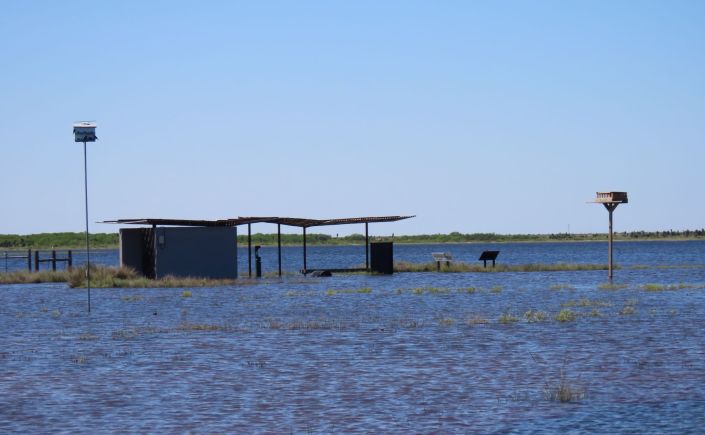
I mentioned before that this part of Texas had received downpours about ten days prior, the nearby town of Harlingen being hardest hit with 20 inches of rain. My featured photo above shows some of the residual flooding at the Ecotourism Center—in “normal” conditions, pedestrians can reach the wildlife blind which is usually on dry ground and overlooks coastal prairie, rather than being situated in the middle of a lake. The surfeit of water also prevented us from catching a glimpse of some famous local residents—Nilgai. This largest Asian species of antelope was introduced at the King Ranch in southern Texas in the 1920s to give hunters new animals to shoot at. Some escaped and established a wild population which now needs to be managed to lessen numbers and impact on local ecosystems.
Our next stop: Laguna Atascosa National Wildlife Refuge a mere 13 miles north (its Bahia Grande, or “Big Bay” portion adjacent to the Ecotourism Center was closed). Established in 1946 under the Migratory Bird Conservation Act, it is the largest National Wildlife Refuge in South Texas, with over 120,000 acres. Its eastern border sits adjacent to the Laguna Madre and it is home to numerous lakes and wetlands.
To enlarge a photo, click on it. To read its caption, hover cursor over it.


The information sheet we picked up at the Visitor Center, which was unfortunately closed due to haphazard and detrimental federal budget cuts, informed us that approximately 80% of the nation’s Redheads winter here. These handsome ducks are fittingly depicted on the welcome sign but had already dispersed by the time of our visit. We also did not get to espy any of the refuge’s famous feline residents, the striking but secretive (and endangered) Ocelot. What we did see instead in one of the local lakes were myriad mosquito larvae, poised to emerge. Somewhat to our surprise, thus far we had mostly been spared the unpleasant visits of piercing insects. This was about to change.

Pelican Lake at Laguna Atascosa NWR with myriad mosquito larvae poised to emerge
At the refuge we were tickled to make our first acquaintance with a bird whose name is a complete understatement. If I had my say, I would rename the gorgeous Green Jay (Cyanocorax yncas) and call it Many-colored Jay. With its black face and throat, blue crown, cheeks, bridge of the beak, and supraocular patches, green back, yellow-green underside as well as many-hued tail feathers, it appears to have dived into vats filled with different dyes. Texas is at the very northern end of the Green Jays’ range, with most occurring in Central America and northern South America.


All the places mentioned in this post (as well as South Padre Island) are located in the Lower Rio Grande Valley (RGV), on the north side and within the floodplain of the Rio Grande River (interestingly, it’s called Río Bravo del Norte in Spanish). It is one of my regrets about this trip that we failed to make it to where the Rio Grande River meets the Gulf of Mexico, especially as it wasn’t far away from Laguna Vista and as, years ago, we camped near the river’s headwaters in Colorado’s mountains, 1,896 miles northwest from its estuary. Not going there was due to poor planning on my part. In the end, even though we spent several days in the RGV, we did not get to stand at the actual river until it was time to point the car north again. But first, we continued to drive west, paralleling the river to our south.
My new favorite jay graces the welcome sign of our next destination, Santa Ana National Wildlife Refuge. This 2,000 acre refuge “provides a glimpse into a world that has vanished from 95% of the Lower Rio Grande Valley” (from the park brochure). While we strolled through part of that surviving, wooded world, above us in the sky the airborne migration of Broad-winged Hawks (Buteo platypterus) was unfolding as it has since time immemorial. Returning from their wintering grounds in Central and northern South America, they were on their way to the eastern states and provinces of North America for the summer.
They fill the sky in sometimes huge flocks that can contain thousands of birds at a time, and these ‘kettles’ are a prime attraction at many hawk watch sites. (Cornell)
I had never seen more than a few dozens of these hawks during migration before, but I estimate that there were several hundred, if not thousands circling in the sky, an unforgettable sight. Our single encounter with a Groove-billed Ani (Crotophaga sulcirostris) during this trip took place at Santa Ana too. This groovy member of the cuckoo family also had newly returned from places farther south.


The trees were draped in Spanish Moss, creating the impression of a haunted forest. We climbed a wildlife tower and crossed the attached suspension bridge through the tree canopy and were afforded a bird’s eye view of what little remains of the area’s original habitat.

This might have been the only view of original habitat that did not show signs of human intervention
The following day at Estero Llano Grande State Park, I joined a guided walk with one of the local rangers. Similar to my guided experience at the Birding and Nature Center on South Padre Island, the insight provided by a local, knowledgeable birder proved priceless. Among many other birds, John Yuchum helped us find Pauraques and Least Bitterns and one of the resident Eastern Screech Owls, “Fred in the Shed,” who has, indeed, been living for years in an abandoned shed.


We had seen Plain Chachalacas (Ortalis vetula) at Laguna Atascosa and Santa Ana, but none posing as well as the local residents. Tropical, chicken-like birds who live in groups in forests, they seemed very docile but a later encounter in a different locale taught us that they could become quite belligerent.


The erstwhile mosquito larvae had finally emerged from their watery world and were showing their appreciation for us. Nowhere more so than at Bentsen-Rio Grande State Park near the town of Mission. We took a ride through the park on the last free shuttle of the afternoon to get the lay of the land and had the driver, who also acted as tour guide, to ourselves. While the shuttle was moving we were fine, but each time it stopped, were surrounded by swarms of blood suckers.
A utility pole not far from the Visitor Center is the known nesting site of a pair of the world’s smallest owls and I returned to the park again later in hopes of seeing them, having dropped my tired chauffeur off at a motel. I arrived a little before 7 PM, an hour before the anticipated show time, based on previous reports. While I waited, other birders congregated until about 40 of us were staring up at the small opening in the wooden pole.


At 8:02 PM, when it was quite dusky and the mosquitoes were swarming, one of the resident Elf Owls (Micrathene whitneyi) peered out of the opening. With a height of a mere six inches, it seemed to be made mostly of eyes. I don’t think I imagined that it took one quick look around and, when confronted with dozens of binoculars and clicking cameras, quickly withdrew back into its dark cavity. I took off then, hoping it would regain its equanimity after the evening turned too dark and buggy for birders.

THE Elf Owl Power Pole at Bentsen-Rio Grande Valley State Park with THE Elf Owl! 😊
My husband and I returned to Bentsen-Rio Grande the following morning for a visit to the hawk tower. According to the local observer, it had thus far been a quiet season and day for hawk migration. I was thankful to see two new-to-me raptors at the park, a Gray Hawk and a Harris’s Hawk.


We couldn’t leave the area without visiting the nearby National Butterfly Center. Based on the name, we expected a little more than a slightly unkempt property with a number of buildings in need of TLC. The $10/person entrance fee charged by the private nonprofit running the center is apparently insufficient for proper upkeep. Recent flooding could be partially to blame and account for a paucity of flowers and insects. The only lepidopterans visible to us were a few lovely Queen butterflies.


Our last stop in the RGV was also our favorite: Falcon State Park. This might be partly due to the fact that, following more nights in motels, we were finally able to camp again. And not only camp, but have an entire campground loop to ourselves! As soon as we stepped out of the car, we were greeted by a pair of Vermilion Flycatchers, and the string of avian and other wonders continued: Cactus Wrens collecting nesting materials, a Crested Caracara perching in a nearby tree (some of you might remember that this was a life bird for me when one made an out-of-the-way appearance in Colorado earlier this year), Northern Cardinals and their cousins, Pyrrhuloxias, chiming into the evening chorus, a serene sunset, and Pauraques and Coyotes serenading us at night. And what a night it was—heat and wind had abated, the mosquitoes were manageable, and the sky was asparkle with stars.
Because of a chronic drought in southern Texas, Falcon Reservoir had shrunk significantly and we did not brave the rutted dirt road leading to the water’s edge. We hiked on a few of the trails near the campgrounds; visited the beautiful butterfly garden showcasing many native plants but, again, few butterflies; spent time watching birds at the wildlife blind supplied with a water source and oranges.


After the busyness of the Harlingen-McAllen corridor, Falcon State Park was a calming balm. We briefly considered staying for another night, but the thermometer was predicted to climb into the mid-90s once again and we didn’t want to spend the bulk of the day seeking shade, so we took our leave mid-morning, bidding the Rio Grande Valley goodbye. Almost . . .
Thank you so much for reading.
This is part 8 of a series of posts about our road trip to Texas.
For part 1, click here, for part 2, click here, for part 3, click here, for part 4, click here, for part 5, click here, for part 6, click here, for part 7, click here.
 tanja britton
FYI:
“The Laguna Atascosa National Wildlife Refuge Visitor Center is currently closed, but the closure is due to remodeling scheduled for the month of June, not explicitly because of budget cuts. However, broader context shows that the National Wildlife Refuge System, including Laguna Atascosa, is under significant strain from ongoing budget cuts and staff shortages. These financial challenges have led to closures of visitor centers and reduced public services at many refuges nationwide, with over 10% of refuges having no staff and some visitor centers closed as a result. While the Laguna Atascosa Visitor Center’s current closure is for remodeling, the overall system is facing severe impacts from budget reductions, which threaten future operations and public access.”
LikeLiked by 1 person
This might be the case in June, but we visited there in April.
The refuge then was closed for two days each week. Had already been closed for one day per week, but had to close down for an additional day because of recently decreed budget cuts. There was no mention made of remodeling plans, but then we weren’t able to enter the Visitor Center where that information might have been provided.
The budget cuts to many National Parks and Monuments will only have detrimental effects for federal employees and the landscapes and creatures they serve.
LikeLiked by 1 person
I love the Queen butterfly and Falcon State Park photos. A grand adventure!
LikeLiked by 1 person
Thank you for both your comments. It was a memorable trip for us that left a lasting impression.
LikeLiked by 1 person
My favorite redhead [wife, not duck] has long wanted to visit the Texas coast. Your series has made me want to make it happen. If nothing else, I want to see a Green Jay!
LikeLiked by 1 person
I’m glad you have a favorite redhead. 😊
I’m glad my posts have helped confirm your desire to visit the Texas coast. I can completely relate to your desire to see Green Jays. I already miss them! I hope you will make it.
LikeLiked by 1 person
Es ist ein Erlebnis dir zu folgen auf deine on the road Beiträgen, liebe Tanja.
Vielen Dank 😘
Liebe Grüße Brigitte und Buddylein
LikeLiked by 1 person
Liebe Ulrike, liebes Buddylein,
es freut mich sehr, daß Ihr uns auf unserer Reise in Gedanken begleitet.
Herzlichen Dank für Euren Besuch und den lieben Kommentar, und herzliche Grüße nach Bremen.
Tanja
LikeLiked by 1 person
Based on all your posts so far, what you found in south Texas certainly seems to have met your expectations. By visiting in hot weather you didn’t have to contend with the crowds of people who go down there in cooler weather.
The beak on the Schmalschnabelkardinal doesn’t look all that small or narrow to me, but maybe that’s in comparison to some other cardinal-like bird. The German name reminded me of the musician Artur Schnabel.
LikeLiked by 1 person
I try not to have too many specific expectations before a trip, Steve, prefer to keep an open mind. That way, I’m not disappointed if my expectations aren’t met. That does not preclude having a few regrets after the fact. As you know from personal experience, there are always things we wish we had done after the fact.
I had exactly the same thought about the Schnabel of the Schmalschnabelkardinal not looking schmal at all. It doesn’t really look much schmaler (or schmäler) than the Northern Cardinal’s.
I have listened to sounds emitted by many a Schnabel, but not by Artur Schnabel.
LikeLike
I did plenty of research in preparation for our recent Florida trip. We ended up going to maybe one-third of the places I’d put on our list. Mostly we skipped places because there were way too many of them for the amount of time we had. In some cases the institutions we wanted to visit happened to be closed on the day we were in their area.
Perhaps someday scientists will master teleportation and we can be essentially anywhere whenever we want to without the need for physical travel to get there.
LikeLiked by 1 person
It makes me feel a little better not to be the only one who doesn’t get to everything on the wish list. I had a general idea of our destinations and itinerary, but we made many ad hoc decisions. I actually like to be flexible but that also has its downsides.
I’m not sure I like the idea of teleportation. There is something to be said about preparing for and anticipating the journey before it takes place. There is already too much of instant gratification around and I don’t think it’s healthy.
LikeLike
During the entirety of the road trip, did you see as many birds as you hoped to see?
LikeLiked by 1 person
I really tried not to have too many expectations before the trip, Neil, that only sets one up for disappointment. I knew there were some resident birds I could only see in south Texas, such as Green Jays and Chachalacas, and I was very happy to get to see them.
LikeLiked by 1 person
It is truly amazing how many birds you have been able to capture on this fascinating road trip, Tanja.
LikeLiked by 1 person
Thank you, Peter. It was amazing and I’m very grateful for the experience. I also have many more bird photos to share in future posts. 😊
LikeLiked by 1 person
This seems like it’s been a wonderful trip for the two of you. I especially like the camping spot you nabbed at Falcon State Park. It seems cozy somehow, even though it is outdoors…much nicer than any motel room, I would think. 🌳🏕️
LikeLiked by 1 person
Thank you, Julie, it was a wonderful trip. Falcon State Park was a fun discovery and the conditions were really good. I prefer sleeping in a tent to a motel most nights.
LikeLiked by 1 person
Twenty inches of rain? Holy smokes. That is a horrifying number of mosquito larvae in the water, but I guess that makes sense after so much rain. I love the green jay; what a brilliantly colored bird. And the tiny owl as well. Some wonderful bird sightings!
LikeLiked by 1 person
Thank you, Diana. The Green Jay and Elf Owl were very special, for sure. The 20 inches of rain caused huge problems for some people and structures, as you can imagine. It also made a great breeding ground for mosquitoes. I’m always ambivalent about them because so many birds and other animals depend on them for sustenance. For us, on the other hand, they are a plague.
LikeLiked by 1 person
Da konntest du ja eine herrliche Ausbeute von den gefiederten Bewohnern dieser Gebiete einfangen!
VG Christa
LikeLiked by 1 person
Wie wahr, liebe Christa. Es war wirklich herrlich, so viele Vögel sehen und fotografieren zu können. Aber das war ja der Sinn der Reise und ich bin dankbar dafür.
Liebe Grüße nach Kanada,
Tanja
LikeLiked by 1 person
Some great bird sightings, but ugh, those mosquitoes must have been maddening!
LikeLiked by 1 person
Thank you, Eliza. The birds were wonderful and, as we know, many of them need the mosquitoes for sustenance. That’s always at the back of my mind when I swat at them . . .
But they definitely make our lives miserable.
LikeLiked by 1 person
20 inches of rain in a single downpour? Wow, it’s fortunate that you missed out on that, even though its aftermath was still apparent to you. I love the Green Jay, and chuckled at the reticence of the Elf Owl. Camera-shy, I guess!
LikeLiked by 1 person
The Green Jays were a lot of fun to watch and I could completely relate to the Elf Owl’s shyness. I wouldn’t want the paparazzi to take photos when I first get up in the morning!
LikeLiked by 1 person
🙂
LikeLiked by 1 person
Wow, what an absolutely awesome odyssey. All the places you saw, driving parallel to the Rio Grande, the birds and wildlife… the broad wing hawk part caught my eye.,, a sister species, the red tail, used to nest in a big dead pine tree by my house. They had a great view of the surrounding fields and their fledglings each spring never went hungry 😎 The mosquitoes, blah, usually you walk fast with a big black cloud behind you. You stop to take a picture and suddenly you’re getting itchy 😜
Great post! 😎👏
LikeLiked by 1 person
Thank you, Darryl. It was an amazing trip and it’s been fun reliving it through my posts. It’s easier to revisit some of the places without the actual mosquitoes swarming around me. 😊
LikeLiked by 1 person
I have to say Tanja, you made the absolute most of your road trip in the valley. So glad you got to see the resident elf owl at Bentsen and you one upped me with the Groove-Billed Ani I have been searching for nonstop for 6 years. I know John at Estero and he is a wonderful guide along with the Steve and his wife. I forgot to mention in your last post that Javier is also a great resource at SPI. Always enjoy seeing Fred in the shed whenever we are down there – we usually catch him at the back of the tropical area by the courts. It was our first time at Falcon this year and wow, was that really productive when we were there in January. Not sure if the Bobwhites were still in their butterfly and their blind area, but that is one of the best looks I’ve every had of those somewhat secretive birds. Did you get a chance to check out Salineño Wildlife Preserve (near Falcon). The butterfly center is a bit hit or miss, but we usually pay the fee to get the Audobon’s Oriole and “Smudgie” the hybrid. They also have an easy to see Eastern Screech-Owl. Now the big question.. were you able to spot the Pauraque without assistance?
LikeLiked by 2 people
Six trips to see one bird, sounds like someone doing a Big Year.
LikeLike
Thank you, Brian. We saw a lot but also had to skip a few places from your list that sounded just as interesting.
Having Javier and John as local guides really helped me gain a better understanding of the local ecosystems and I’m so glad for the experience. Because of all the rain, John thought that some of the Pauraques had been displaced and he couldn’t find them sitting on the ground in their accustomed spot. We flushed two, but I wasn’t able to get a photo. Then I heard them at Falcon, but it was night, and I couldn’t find any on the ground there either. John suggested that they are more secretive during the breeding season, withdrawing into denser vegetation.
Unfortunately, no Bobwhites at Falcon, and no Audubon’s Oriole (though I got to see one at the Ntl. Butterfly Center, the only one, and a life bird)
We made a brief stop at Salineño, too bad De Wind’s Yard was closed, looked like great bird habitat.
LikeLiked by 1 person
I didn’t think of the rain impact on the ground sleeping nightjars. They do.come out in droves up on the estero levee, buy not as good as seeing them during the day. The butterfly center is where we get the Audubon checked…along with smudge…be sure you got the real thing and not the hybrid there. It is always good to leave some places to explore next time!!
LikeLiked by 1 person
I just went back to the National Butterfly Center eBird site and looked at photos of both the Audubon’s Warbler and the hybrid and am happy to report that my sighting was of the Audubon’s. 🙂
LikeLiked by 1 person
One more thing: the Groove-billed Ani was complete luck. Two other birders found it and told us about it and it was still in the same location when we went looking.
LikeLiked by 1 person
Wow! Eight part road trip with more stops than I can easily remember. Looks like you had a great time in nature, flooded or not. I especially enjoyed the photo of the elf owl in what looks like, at a distance, a knot hole in the power pole. The best part is the opportunity for life birds and life memories. Thanks for sharing.
LikeLiked by 1 person
Thank you, Brad. Brian sent us to all the right places!
The Elf Owl and its hidey-hole were amazing to see. I would have never thought to look for it inside the power pole if other birders hadn’t told me about it.
The trip definitely left us with many amazing memories.
LikeLiked by 1 person
And your readers with new stories. 🙂
LikeLiked by 1 person
🙏
LikeLiked by 1 person
Hi, Mrs. Tanja-
Thank you so much for sharing more about your trip!!
Not surprisingly, you witnessed mosquitoes in Texas!!
I am sure you are familiar with the saying that “Everything is bigger in Texas”, and this definitely applies to the mosquitoes!! They seem to love me!
The small owl was so cute!! I feel so bad that it was too frightened to come out. It looked so tiny! 🙂
Your trip truly sounds like a blessing!! I can not wait to hear what comes next!
All the best,
~Gavin
LikeLiked by 1 person
Thank you for reading and commenting, Gavin.
Mosquitoes are a pain for us humans, but they are indispensable for birds and bats and so many other critters that we have to put up with them.
The Elf Owl sighting was really special. Now I would love to see one nest in a cactus in Arizona. That might have to be the destination of our next road trip!
Have a pleasant weekend.
Tanja
LikeLiked by 1 person
Thank you for taking the time to tell me of the mosquito’s purpose!! I have wondered this for a long time!!
I hope your weekend is sweet as well!! 🙂
Gavin
LikeLiked by 1 person
I’m sure mosquitoes serve many other important functions, even if they are a plague for us. We tend to take an anthropocentric view of the world, but it would be much better to take into account how everything is connected to everything else.
LikeLiked by 1 person
This is a great guide about National parks in Texas. I couldn’t believe the image of the elf owl.
LikeLiked by 1 person
Thank you, Maria. Seeing that tiny little owl peep out of the opening in the pole was very special and I hope I will never forget the moment. 😊
LikeLike
The Green Jay and the Vermilion Flycatcher are fabulous in their colourful feathers, but that tiny owl is very cute. 🙂
LikeLiked by 1 person
Thank you, Ann. It was wonderful to see so many different birds, from tiny hummingbirds to large birds of prey, each with its own beautiful details. Which is why I agree with a friend’s assessment: “My favourite bird is the one I’m looking at right now.”
LikeLiked by 1 person
Sounds like the best frame of mind for always enjoying birdwatching!
LikeLiked by 1 person
Yes, that’s true for birds. It’s generally a good attitude to try to be present in the moment and enjoy whatever it is we are looking at.
LikeLiked by 1 person
I absolutely loved your comment about teleportation. That lies very near the heart of my objections to (over)use of AI, which ends up focusing almost entirely on the ‘product’ and not at all on the process. This article isn’t necessarily related to your trip, but I think you’ll find it interesting, especially as it relates to learning and creativity.
The green jay is one of the birds I’d love to see, although this region is filled with flora and fauna that differs remarkably from anything in my area. Unfortunately, we do share those mosquitos, but I’ve found ways to discourage those. The elf owl was quite a find, and there are the chachalacas I was wondering about. I was thinking about you this morning; a fishing guide from the Corpus area mentioned that the Laguna Madre recently received eight inches of rain. Apparently the spigot hasn’t yet been turned off, and in the end it may well benefit an area that’s been quite short of moisture.
LikeLiked by 1 person
Thank you for the link, Linda. That’s an interesting but not surprising study outcome. I have grave concerns about AI and about the resultant loss of critical thinking. Brave New World has come true on so many levels it’s scary, despite it being a cautionary tale. People who don’t think for themselves for whom facts no longer matter are a dream come true for political regimes with sinister goals who engage in demagoguery.
I’m sure the rain in the drought-stricken RGV is welcome, even if smaller amounts in repeated doses would be preferable. The birds of the region, such as the Green Jays and Chachalacas were a delight to discover, along with many others I haven’t even mentioned yet. I think you would like to visit and see both avifauna and flora.
LikeLiked by 1 person
I jumped over from Yeah, Another blogger to visit your blog. A road trip through Texas! I am loving the stories and the special wildlife areas you are visiting. So much to see! Appears, not every place was what you hoped for but, plenty still to enjoy.
Thanks for sharing this with your readers. I loved it!
Velva
LikeLiked by 1 person
Hi Velva,
Thank you for jumping over to my blog to take a look around and leave a comment.
I had traveled to Texas and its amazing birds in my mind for many years before we finally made this trip happen. It was filled with amazing experiences and I’m so glad you are enjoying reading about some of them.
I appreciate the visit.
Best,
Tanja
LikeLike
How amazing – those birds are divine, the “normal” floodwater and mosquito larvae less so! Linda xx
LikeLiked by 1 person
Thank you for visiting and commenting, Linda.
The birds were indeed divine. Luckily, It’s the positive memories that endure. 😊
LikeLiked by 1 person
Perfectly put – yay you! xx
LikeLiked by 1 person
[…] for part 5, click here, for part 6, click here, for part 7, click here,for part 8, click here. I have also added “Texas” to the menu bar on top, where all my Texas posts are […]
LikeLike
Fantastische Fotos dieser wunderschönen farbprächtigen Vögel!
LikeLiked by 1 person
Vielen Dank, liebe Simone. Ich habe tatsächlich viel mehr farbige Vögel in dieser Zeit gesehen als zu Hause. Das macht tropische Vögel so unwiderstehlich!
LikeLike
Die Bilder zu betrachten, das ist zu schön. Dort waren wir nicht und ich bin weiterhin davon überzeugt, Texas ist eine Reise wert und das wissen noch nicht so viele, daher ist es auch nicht überall so voller Touris wie zum Beispiel im Yellowstone.
LG Maren
LikeLiked by 1 person
Dankeschön, liebe Maren. Wir hatten die Wahl zwischen Galveston Island und Umgebung und Rio Grande Valley. Ich bin froh, daß wir uns für letzteres entschieden haben. Die Erlebnisse dort waren wunderbar.
Die Green Jays haben mir es besonders angetan! 😊
LikeLiked by 1 person
Den Green Jay zu sehen, das ist aber auch super. Ich habe hier vor mir eine Karte von den Lower Texas Coastal Birdingtrails, da ist der gar nicht drauf und ich habe in Deinem Beitrag zum ersten Mal diesen Vogel gesehen. Danke Dir dafür. Auch die große Purpurschwalbe war mir bis vor einem Tag unbekannt. Gerade jetzt hatte mein Blogfreund Andreas aus Iowa diese Schwalbe auch erwischt. Ihr Glücklichen.
https://exnerimages.net/blog
LG Maren
LikeLiked by 1 person
Oh, das war mir nicht bewußt, daß Dir der Green Jay (Inkablaurabe) und der Purple Martin (Purpurschwalbe) noch nie über den Weg geflogen waren. Vielleicht mußt Du doch noch mal nach Texas! 😊
LikeLiked by 1 person
Ich würde schon gerne, aber ……
LikeLiked by 1 person
Ich verstehe komplett. Manchmal muß frau ein Zeichen setzen!
LikeLiked by 1 person