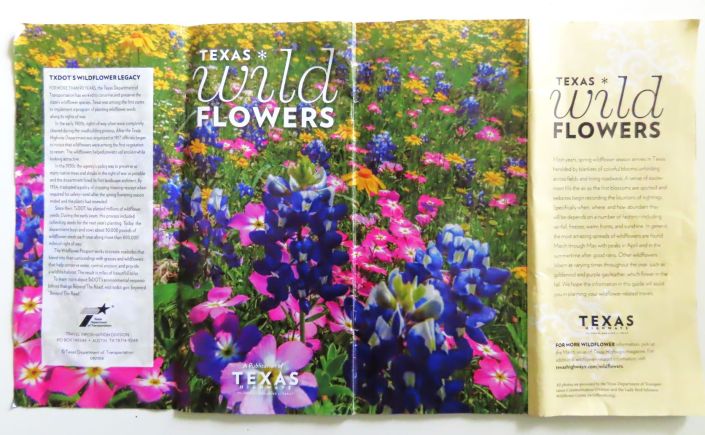
One of my favorite brochures I picked up during our Texas Road Trip this spring is titled Texas Wildflowers. Published by Texas Highways: The Travel Magazine of Texas, with an eye-catching cover of a colorful meadow, it lists the state’s different wildflower regions, contains color photos of the most common wildflowers (apparently, there are more than 5,000 species of flowering plants in the state), and advertises the times and locations of various wildflower events as well as a number of different wildflower drives. Because of limited time, we weren’t able to explore any of those floral itineraries, but we tried to pay attention to the plants present at our various destinations.
Early on during our travels, at Goose Island State Park, we made the acquaintance of the “Big Tree,” a famous example of a Live Oak (Quercus virginiana), so named because it’s an evergreen with leaves year-round, an unusual characteristic as most oaks are deciduous. This venerable tree has been rooted in this earth for over 1,000 years (and possibly close to twice as long). Just imagine the stories it could tell! It has survived dozens of hurricanes, including Harvey in 2017. Like some fellow seniors, it needs support. Several branches have been braced and it has been fenced in for protection.
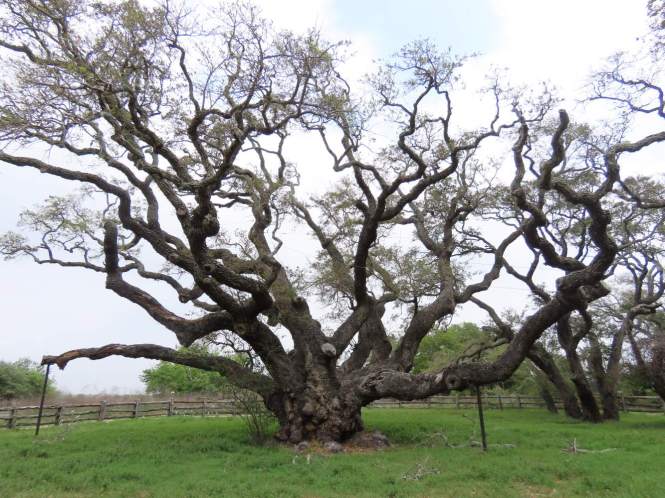
“Big Tree” at Goose Island SP, a Live Oak (Quercus virginiana)
For someone originally from Central Europe and now residing in Colorado’s semi-desert climate, the sight of various palms at the Texas Coast signaled an entirely different climate and habitat, as did the size of prickly pear cactus and yuccas. While Colorado has both, they are much taller in Texas, in many cases taller than I. Other blooming trees and shrubs also struck me as exotic.
To enlarge a photo, click on it. To read its caption, hover cursor over it.


Texas has made a conscientious effort to propagate and celebrate its wild flora, as I learned from the Texas Wildflowers booklet:
For more than 90 years, the Texas Department of Transportation has worked to conserve and preserve the state’s wildflower species. Texas was among the first states to implement a program of planting wildflower seeds along its rights of way.
In the 1930s, the agency’s policy was to preserve as many native trees and shrubs in the right of way as possible and the department hired its first landscape architect. By 1934, it adopted a policy of stopping mowing—except when required for safety—until after the spring flowering season ended and the plants had reseeded.
Since then, the TxDOT has planted millions of wildflower seeds. Today, the department buys and sows about 30,000 pounds of wildflower seeds each year along more than 800,000 miles of right of way.
One famous Texan did her part to support this floral initiative:
Lady Bird Johnson [1912-2007], will forever be associated with wildflowers from working with highway beautification to establishing the Lady Bird Johnson Wildflower Center [in Austin]. Her work went beyond beautification. Lady Bird realized that encouraging natural beauty had greater consequences, including preservation of the land and feeding the soul.
In a 1993 article in the New York Times, Lady bird indicated that it wasn’t until her husband, Lyndon B. Johnson, was elected president, and especially after his Great Society speech in 1964, that she was inspired to preserve the environment.
Her work contributed to the passage of the Highway Beautification Act of 1965 and led the Johnson Administration to be one of the most active in promoting conservation, signing into law almost 300 conservation and beautification measures.
Later, when Lady Bird returned to Texas, she noticed the changes of urban growth. She became concerned that native plants and wildflowers were at risk of extinction. At age 70, she decided to act.
Lady Bird, who died in 2007, left a legacy that reduces pollution, encourages environmentalism, preserves national parks, protects native wildflowers, and renews urban areas.
We did see some stretches of wildflowers along state highways and interstates and were able to pull over by the side of a road with little traffic to admire and photograph the perhaps best-known Texas wildflowers, bluebonnets. They were designated the Texas State Flower in 1901, and after some initial confusion, six different species of bluebonnets are now included in that rubric, with Texas Bluebonnets (Lupinus texensis) the best known.


What follows next is a haphazard selection of further floral finds. I’m an appreciator of but no authority on plants and appreciate any feedback. I suspect some fellow bloggers from Texas recognize all the species featured here, as they are experts on their state’s flora. Thanks to blog posts by Tina, Linda, and Steve, some of the species we encountered were familiar to me. The opportunity to learn from fellow bloggers is one of the windfalls of being part of this community. Thank you all for sharing your experiences, and for sharing in mine.


🌸
🌸
🌸
“Where flowers bloom, so does hope. “—Lady Bird Johnson
🌸
🌸
🌸
If you are interested in my previous posts about our road trip, you can find them under the Texas tab in the menu.
 tanja britton
A live oak — my learning of the day.
I never would have guessed that an oak tree could keep its leaves through the winter. Maybe someday in the not-so-distant future, it will grow here too — especially considering the heatwave we’re currently experiencing in Germany.
By the way, this year I discovered several black walnut trees in my garden. I have no idea how they got there. According to my AI, they originate from Texas. What a surprise!
LikeLiked by 1 person
I did not know that Black Walnuts originated in Texas, grew up with them and their delicious fruits (I like them best when they are still soft). I also found it interesting to learn about the evergreen nature of Live Oaks, though it appears that the trees shed some of their leaves throughout the year and replace them with fresh ones.
We have heard about the heat wave in Europe, are commiserating, and hope for relief soon. All creatures suffer from such heat, be they plant or animal.
LikeLiked by 1 person
That big tree is magnificent! Must have been quite a thrill to see it.
LikeLiked by 1 person
It really was, Laurie. We saw many Live Oaks during our trip, but the Big Tree was the oldest. Our lives are measly in comparison.
LikeLike
To misquote Crocodile Dundee: “Now that’s a cactus!”
LikeLiked by 1 person
Many of the cactus were as tall as trees!
LikeLiked by 1 person
Some day I would love to visit the spring wildflowers of Texas, they are legendary. I’ve learned from the same fellow bloggers that development, particularly around Austin, is eating up a lot of wild land. It is not a simple matter of resowing seed once the ecology of the soil is disturbed. That takes centuries, particularly in desert areas. Alas!
LikeLiked by 1 person
It would have been fun to follow some of the designated wildflower drives, Eliza but we were already short on time with our itinerary as it was.
The loss of extensive swaths of natural habitat is devastating. I don’t think they will ever come back. At least not during the anthropocene.
LikeLike
What an abundance of flowers!
LikeLiked by 1 person
We enjoyed seeing them!
LikeLike
Lovely collection of flora. (Suzanne)
LikeLiked by 1 person
Thank you, Suzanne. We enjoyed the variety we encountered.
LikeLike
Beautiful!
LikeLiked by 1 person
Thank you, I’m glad you think so.
LikeLiked by 1 person
I found your post really interesting, and the photos you shared simply fabulous! ❣️
LikeLiked by 1 person
Thank you, Luisa, that makes me very happy.
LikeLiked by 1 person
You are so very welcome my dear Tanja.
It’s my pleasure as always!
LikeLiked by 1 person
🙏
LikeLiked by 1 person
Excellent pictures, Tanja. A wonderful presentation of the beautiful Texas flora. That “Big Tree” really is magnificent.
LikeLiked by 1 person
Thank you, Pit. Just a small selection of the many beautiful plants in your state. I read there are more than 5,000 species of flowering plants!
LikeLike
Now you got to play in my (extended) bailiwick, even to the point of gazing upon bluebonnets, which I hope you approached closely enough to sniff.
“Texas was among the first states to implement a program of planting wildflower seeds along its rights of way.” Unfortunately, some of what the state sowed and still sows isn’t native to Texas, or even to North America. Red clover is a conspicuous example.
The rain lily with upside-down visitor is humorous.
The tree you’ve labeled a honey locust seems to be a paloverde.
LikeLiked by 1 person
Thank you for the correction, Steve. I should not have made that mistake as we have honey locust here. I really enjoyed those Paloverde (or Retama) trees, and the birds liked them too.
It might be difficult (if not impossible) to get rid of the introduced non-native wildflower species but I wonder if the seeds of non-native plants are still spread anew, or if that practice has been given up.
Seeing any plant with an insect or a bird visitor only enhances its beauty.
LikeLike
According to AI: “Yes, the Texas Department of Transportation (TxDOT) continues to sow crimson clover on highways as part of its wildflower program… Crimson clover is specifically mentioned as being seeded along the shoulders and medians of major highways in East Texas.”
It’s also not uncommon for the state or other organizations to sow seeds along roads, only to have mowers cut the wildflowers down before their seeds have matured.
LikeLiked by 1 person
The discrepancy between theory and practice is something humans specialize in.
I assume people complain about flowers getting mowed too early. It would be nice if TxDOT heeded the complaints and lived up to its claims.
LikeLike
Alas, it isn’t just TXDoT. Each jurisdiction or stretch of highway seems to have its own mowing contract, and as far as I can tell, all the contracts call for mowing on fixed dates, regardless of what stage the flowers are in.
LikeLike
That makes no sense. And runs counter to what the TxDOT prides itself for.
LikeLike
With regard to the bluebonnets, I remember kneeling for at least one of the photos but I honestly don’t remember if I sniffed them.
LikeLike
Ah, then you’ll just have to come to Austin in the spring so you can see (and sniff) colonies of bluebonnets as well as visit the Lady Bird Johnson Wildflower Center in its peak season.
LikeLiked by 1 person
I’m sure such a trip would be visually and olfactorily stimulating!
LikeLike
Great set of photos, Tanja. This spring’s wildflower bloom wasn’t the best, but some always show up and the wildflowers continue throughout summer and into autumn! Lady Bird fostered remarkable focus on the use of native plants in home and public gardens, as well as her highway beautification efforts.
I’ve never been to Goose Island, nor seen the Big Tree, but Live Oaks are majestic beings.
LikeLiked by 1 person
Thank you, Tina. It was nice to see the flowers that were in bloom but I know we missed many , either because of the flooding or because they weren’t yet flowering. It’s nice to know that you grow a number of native plants in your garden.
This was our first encounter with Live Oaks and we were very impressed by them.
LikeLike
Mrs. Tanja-
What stunning photos you featured here! I think you represented our state’s plant life well.
Bluebonnets are obviously the most commonly associated flower with Texas, but sadly, it seems as if they are becoming less and less bountiful. It was encouraging to see so many in your pictures. Many of the ones near my home have stopped appearing each year.
The Lady Bird project sounds like a beautiful act. I have never before heard of it. Thank you for sharing!
I hope that you are enjoying the month of July already, and happy Independence Day to you and Mr. Mike. 🙂
Blessings,
~Gavin
LikeLiked by 1 person
Thank you, Gavin. I’m glad you recognized many of your plants in my photos. Considering that Texas has more than 5,000 flowering plants, these images represent a tiny selection.
It’s sad that you see fewer and fewer bluebonnets. I have learned from fellow bloggers in Texas that many swaths of wildflowers are disappearing because of construction and development.
I, too, was impressed by the engagement of Lady Bird Johnson. What a beautiful legacy she left behind.
Best wishes for a happy 4th of July weekend to you and the family from both of us!
LikeLiked by 1 person
Lovely to see all the different plants, Tanja. I guess you know the bottlebrush tree is Australian. It looks right at home with the Texas flora though!
LikeLiked by 1 person
I appreciate your comment, Liz.
I did NOT know that the bottlebrush tree originated in Australia, thank you for letting me know. It seems to have adapted very well to southern Texas, we saw many of those trees and the hummingbirds loved them.
LikeLiked by 1 person
Our native birds here in NZ love them too!
LikeLiked by 1 person
Nice way to provide for pollinators as well as dressing up the many miles of barren roadsides.
LikeLiked by 1 person
Thank you, Brad. Absolutely agree. We saw many insects and birds on many of the blossoms.
LikeLiked by 1 person
These are marvelous! Several of these grow in my country also, except some of the wildflowers don’t.
LikeLiked by 1 person
Thank you, Maria.
Gaining an understanding of the global distribution of plants is still an elusive goal for me . . .
LikeLike
Für heute ist es zu spät, ich komme noch mal wieder! Aber ich wollte schon mal sagen: sehr schöne Bilder, tolle Vögel und Pflanzen. LG und gute Nacht!
LikeLiked by 1 person
Vielen Dank, liebe Almuth!
LikeLiked by 1 person
While black walnut trees do grow in Texas, my suspicion is that they extended their range into Texas rather than originating here. This article has some interesting details. I’ve come across several pieces of significant misinformation in AI synopses, so I tend to be cautious.
Live oaks do lose their leaves, but unlike many trees that shed in autumn, they tend to shed in late winter, as newly emergent leaves push the old off the branches. While they remain green in through the colder months, they’re simply on a different schedule. When January and February arrive, and masses of live oak leaves drop, it can be quite impressive — or quite a mess, depending on a person’s perspective.
Your collection of wildflowers is wonderful! I’m glad you were able to see such a variety, and it tickled me that I recognized them almost all. I well remember the days when I couldn’t have identified more than one or two, so it was a nice reminder of how much I’ve learned over the years. I recently saw some photos of currently blooming Chisos bluebonnets (Lupinus havardii); it seems that rains in the Big Bend have encouraged them, and they’re standing tall — as much as three or four feet!
LikeLiked by 1 person
Thank you, Linda. I usually skip the AI summary and it irritates me to no end that it comes up first in response to a search.
I appreciate the added information about Black Walnuts and Live Oaks. All the sources I consulted called the latter an “evergreen,” but I imagined that it had to shed its leaves at some point, gained the impression that it was doing so successively.
It is satisfying when we start to recognize more of our environment, be it plant or animal or rock, and it motivates us to keep learning. I have definitely enjoyed learning vicariously through your posts–and comments!
LikeLike
Wonderful!
LikeLiked by 1 person
Thank you very much! 🙏🌸
LikeLiked by 1 person
So much colour, not at all what I might have expected in Texas. Until I read your post I knew of Lady Bird Johnson only as the wife of LBJ, but she seems to have been a formidable and insightful person in her own right. Unsurprisingly I’ve never heard of the Highway Beautification Act, but given that it was passed 60 years ago, it was way, way ahead of its time. Way to go, Lady Bird!
LikeLiked by 1 person
Thank you, Mr. P. I had heard of Lady Bird and her environmental engagement thanks to some fellow bloggers from Texas but it was nice to see some of enduring legacy of her activism with our own eyes. I agree that she was a force of nature. We need more individuals like her!
LikeLiked by 1 person
Wirklich spannend, was du in Texas alles gefunden hast. Sehr spezielle, aber faszinierende Pflanzenarten. Wie du bin auch ich in Botanik nicht so bewandert, aber schön, daß du bei manchem Blogkollegen fündig geworden bist. Wir lernen doch immer voneinander 🙂 Der blaue Vogel, leider konnte ich die Schrift nicht vollständig lesen, ist ja wunderschön! Ich staune immer, was für Farben es gibt. Sowas ist in unseren Breiten ja eher selten. Auch die Eiche ist toll. Die würde ich zu gerne mal zeichnen. 1000 Jahre. Man kann es sich kaum vorstellen. Schön auch, daß Lady Bird Johnson sich um den Naturschutz bemüht hat (hieß sie wirklich so?). Schön auch zu lesen, daß so viele Samen verbreitet werden. Solche Projekte machen doch immer wieder Hoffnung! LG Almuth
LikeLiked by 1 person
Vielen Dank für Deinen Kommentar, liebe Almuth. Texas war in vieler Hinsicht sehr spannend!
Der blaue Vogel auf dem Baum mit den gelben Blüten ist ein Indigo Bunting (Indigofink) und er ist wunderschön. Glücklicherweise gibt so einige blaue Vögel hier.
Frau Johnson hieß Claudia Alta mit Vornamen, wurde aber seit ihrer Kindheit entweder als Ladybird, Lady oder Bird bezeichnet, und irgendwann kam es dann zu Lady Bird, und der Name blieb. Das ist doch ein netter Name.
Wenn ich zeichnen könnte, würde ich mich auch an die Eiche machen, sie ist so alt und ehrwürdig. Du könntest das viel besser machen!
Herzliche Grüße zurück,
Tanja
LikeLiked by 1 person
Das ist ja nett mit ihrem Namen! War sie so eine Vogelnärrin? Ich finde ihn sehr schön. Indigofink, nicht nur hübsch sondern auch wohlklingend! Ein wirklich betörendes Blau 🙂 LG
LikeLiked by 1 person
Es scheint nicht ganz klar zu sein, warum sie Lady Bird genannt wurde. Vielleicht hatte es damit zu tun, daß sie als Kind den Kosenamen “Ladybird” hatte, also Marienkäferchen. 🐞
LikeLiked by 1 person
Ach so, daran habe ich gar nicht gedacht! Ich war immer bei Vögeln, lach. Niedlich.
LikeLiked by 1 person
The flowers you show here are lovely. I’ve just read your comment that Texas has over 5,000 flowering plants – wow! That’s a magnificent number and I’m glad that Texas is helping to propagate them. It’s a diverse flora that deserves every conservation effort.
LikeLiked by 1 person
Thank you, Ann. I should have put that number in my post, and think I will add it. It’s an incredibly number.
It’s nice to know that the state is making an effort to propagate native plants, though if you read Steve’s comments, they also spread non-native seeds and don’t always wait for the flowers to go to seed before mowing. As with most things, there is room for improvement.
LikeLiked by 1 person
Liebe Tanja, dein Bericht und die passenden Fotos sind wirklich wunderbar! Es ist so schön zu sehen, wie du die Schönheit der Wildblumen entlang der Straßen in Texas eingefangen hast. Du hast recht, die Texas Bluebonnets (Lupinen) sind wirklich beeindruckend und ihre Bedeutung als Staatsblume macht sie noch besonderer. Ich erinnere mich, dass in meiner Kindheit auf dem Dorf immer wieder einige Felder komplett mit Lupinen eingesät wurden, um den Boden zu verbessern. Liebe Tanja, deine Reise klingt nach einem wundervollen Abenteuer, und deine Bilder bringen die Natur und die Farbenpracht Texas‘ perfekt zum Ausdruck. Danke, dass du diese schönen Momente mit uns teilst!
LikeLiked by 1 person
Liebe Rosie,
vielen Dank für Deinen netten Kommentar. Verzeihe bitte, daß ich erst heute antworte, irgendwie habe ich ihn überlesen.
Es hat Spaß gemacht, nicht nur die Vögel von Texas sondern auch die Blumen dort etwas besser kennenzulernen. Natürlich kann man in so kurzer Zeit nur einen Bruchteil der Flora und Fauna wahrnehmen, aber alle Eindrücke helfen, einen neuen Ort besser zu verstehen.
Sei herzlich gegrüßt,
Tanja
LikeLike
Definitely out of my league when it comes to flora, especially outside my woods, but I do know the Big Tree and always make a point to extend out greetings when we are in the area (now, that may be more to what hangs out in the fields next to it, but we will keep that between us). There is often a Vermilion Flycatcher or two sitting on the high-wires across the street from it. Oh, wait, I do know the Bottlebrush thanks to its ability to lure Hummers (mostly seen on Dauphin Island in our case).
LikeLiked by 1 person
Thank you, Brian. We now know the Big Tree thanks to you! 😊
I did not see Vermilion Flycatchers near that tree, as a matter of fact, the first (and only) time we saw them was at Falcon SP, where they were the first to greet us when we got out of the car at the campground.
We also enjoyed the birds near the Big Tree, the open, grassy/marshy area just across from it was partly flooded and was busy with ducks and shorebirds and terns. Nice memories!
LikeLiked by 1 person