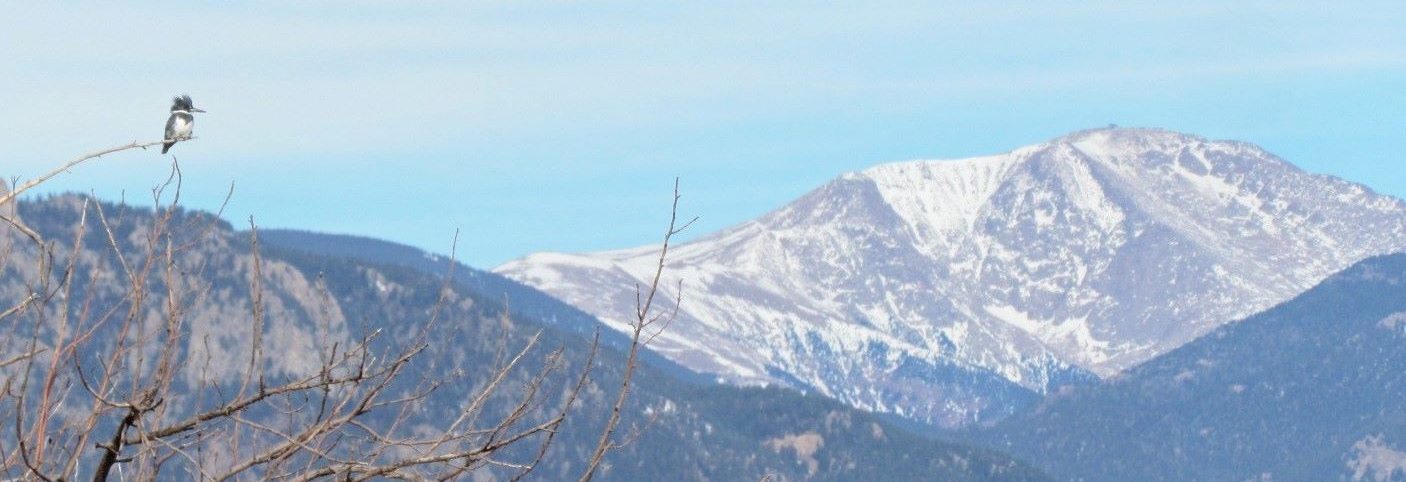
After our 18 days in Texas this spring, I submitted 79 different checklists to eBird, the citizen science website administered by the renowned Cornell Lab of Ornithology, where anybody anywhere in the world can record their bird sightings. During those 18 days, I saw an astounding-to-me 210 different species of birds, even though more experienced birders likely would have observed many more.
I don’t go birding because of numbers, but there is undeniably something satisfying in seeing a wide array of species during any given outing or period, their multitudes giving some assurance about their continued presence on this planet, at least for the time being, despite our worst efforts.
While I reveled in the beauty, charisma, and resilience of birds during our trip, I could not forget the fact that birds are in crisis. In March of this year, the State of the Birds 2025 report was published by the U.S. Committee of the North American Bird Conservation Initiative (NABCI), “a coalition of conservation and scientific organizations and entities working to advance biological, social, and scientific priorities for North American bird conservation.”
You can read the sobering and saddening report here. The following summary from the website BirdWatching is enough to make any caring person’s heart heavy:
The report is an update to the 2019 alarming investigation that concluded 3 billion birds had been lost in the last 50 years. The biggest single cause named then was habitat loss. 6 years on, it appears the situation has worsened still further, with the 2025 report stating that around one-third of all American bird species are under threat. Nearly 230 species are now suffering from declining numbers at an alarming rate.
One-third of all American birds are under threat. Let that sink in. And the situation in many other countries and on other continents is no better.
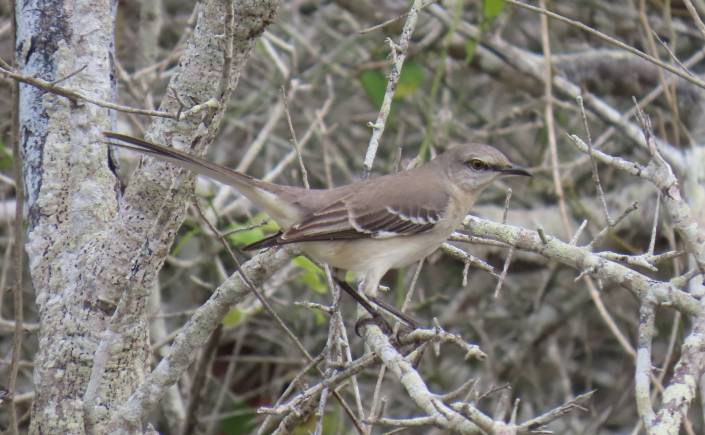
The 30% decline of numbers that was the wretched conclusion of the 2019 study applies also to the Northern Mockingbird (Mimus polyglottus) in the featured photo above. State bird of Texas (as well as of Arkansas, Florida, Mississippi, and Tennessee), its amazing ability to imitate other birds’ vocalizations has impressed and enchanted listeners throughout the ages. So much so, that
In the nineteenth century, people kept so many mockingbirds as cage birds that the birds nearly vanished from parts of the East Coast. People took nestlings out of nests or trapped adults and sold them in cities such as Philadelphia, St. Louis, and New York, where, in 1828, extraordinary singers could fetch as much as $50. (Cornell)
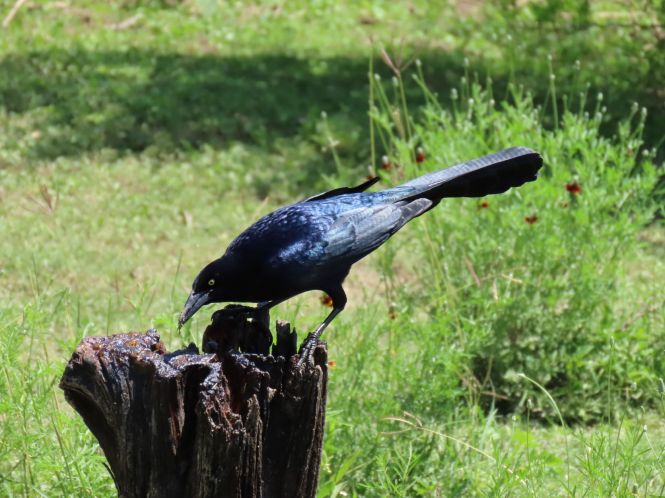
Great-tailed Grackle (Quiscalus mexicanus)/Großschwanzgrackel
If Texas ever wants or needs to choose a new state bird, I suggest the Great-tailed Grackle (Quiscalus mexicanus) as a candidate. We saw—or heard—these grackles basically everywhere in the state and I automatically started each checklist in my notebook with this species (together with the ubiquitous Laughing (-and Dancing) Gull along the coast). Unlike mockingbirds, grackles don’t imitate other avians, but their varied vocalizations frequently sound like a squeaky door, or an ailing automobile. You can listen to a few remarkable recordings here.
Also unlike the Mockingbirds, their numbers have been increasing. According to Cornell,
In 1900 the northern edge of the Great-tailed Grackle’s range barely reached southern Texas. Since the 1960s they’ve followed the spread of irrigated agriculture and urban development into the Great Plains and West, and today are one of North America’s fastest-expanding species.
Both mockingbirds and grackles occur in Colorado where I see them regularly, at least during the summer. All the other birds in this post don’t, and I had never before had the pleasure of meeting them. As a rule of thumb, the majority live in Mexico or Central or South America and their habitats only extend as far north as the Texas or more easterly Gulf Coast, or into the Rio Grande Valley. Because of their lives in the tropics or subtropical zones, they tend to be more colorful than birds living nearer the poles (the theory behind this proven phenomenon posits that more species live together in tropical communities, which resulted in the evolution of brighter colors to help separate them from one another).
The new-to-me birds ranged widely in size and weight, from the Buff-bellied Hummingbird weighing next to nothing, a mere 0.1 to 0.2 ounces (2 to 4 grams), to the Black Vulture’s comparatively hefty 54.6 to 77.6 ounces (1600 to 2200 grams), but it’s the American Flamingo who wins the ponderous prize with a weight that ranges from 74.1 to 144.6 ounces (2100 to 4100 grams).
To enlarge a photo, click on it. To read its caption, hover cursor over it.


It was nice to meet new members of familiar bird families: new waterfowl (the elegant Black-bellied Whistling Duck), new doves (the understated but pretty Inca and White-tipped Doves), new woodpeckers (the handsome Golden-fronted Woodpecker), a new tyrant flycatcher (the impossible-to-overlook Great Kiskadee), plus several new species of always-fabulous orioles.


And to encounter representatives of new-to-me families: the aforementioned lone American Flamingo at Leonabelle Turnbull Birding Center in Port Aransas as well as Monk Parakeets in Hidalgo. Native to South America, escaped pet parakeets established wild colonies along the Gulf Coast and as far north as Chicago and New York, starting in the 1960s. They build astonishing nests out of sticks and other materials on power poles in which they nest and roost communally, adding color and character to any neighborhood (not to mention a few other less desirable by-products).


It’s impossible to give each bird his or her proper due. Every one is special in her or his own regard, and every one deserves not only to be celebrated, but also to be provided with a livable planet. I find it impossible to revel in the magic of birds without considering the realities of the losses they have already faced, and the threats they still face.
I find it equally impossible to learn about the ecological interconnectedness of the Americas and free movements of avian and other animals (as well as plants, for that matter) north and south without pondering the unnaturalness of artificial and arbitrary borders, and the illogic (ill logic) of the inordinate degree to which these borders and neighboring countries have been politicized and vilified and used as pretexts to justify heartless human behavior.
If paying attention to and learning from birds has taught me anything, it’s that every creature on Earth is connected to every other creature, at times through visible strings, at others through ties unseen, and that everything we do to each other we do to ourselves. It’s only solidarity and collaboration that will be able to address the problems birds and all other Earthlings face.
🦩 🦩 🦩 🦩 🦩 🦩 🦩 🦩 🦩 🦩 🦩 🦩 🦩
I appreciate all your visits and comments, especially if you have followed all my posts about our Texas trip. This will be the last one for the time being, and I will take some time off from blogging after responding to your comments.
All posts about our road trip can be found under the Texas tab in the menu.
 tanja britton
Wunderschöne Vögel, die ich alle nicht kenne.
Tolle Aufnahmen, Tanja.
Liebe Grüße Brigitte
LikeLiked by 1 person
Herzlichen Dank, liebe Brigitte. Vor unserer Texasreise waren mir die meisten dieser Vögel auch unbekannt. So viele neue Arten kennenzulernen war ein Höhepunkt in meinem Leben.
Herzliche Grüße zurück nach Bremen,
Tanja
LikeLiked by 1 person
Impressive! You accomplished so much in 18 days.👏
LikeLiked by 1 person
Thank you. I had mostly birds on my mind during our trip. 😊
LikeLiked by 1 person
Well done! 😊
LikeLiked by 1 person
How wonderful to encounter so many birds! It gives one a little hope. The one that astonished me the most was the parakeet and the huge nest it built. I think of those poor birds stuck in cages with no ability to live their lives as they would like.
Have a good break!
LikeLiked by 1 person
Thank you, Laurie. It was wonderful to see and listen to such a variety of feathered friends and I fondly keep remembering many of those encounters.
The fact that the Monk Parakeets have adapted to new areas and are at home in those humongous nests on power poles is inspiring, it bespeaks their adaptability, which is something very much needed.
LikeLiked by 1 person
Yes, yes!
LikeLiked by 1 person
Great-tailed grackles are very common in Austin. They can often be seen in supermarket parking lots, presumably hanging around for spilled bits of food. Late in the year large numbers of them sometimes gather on telephone wires in my part of town as they prepare to settle down for the night in nearby trees. Before that settling down, they create quite a racket.
Texas also has another species, the boat-tailed grackle. Not knowing the difference, I turned to the Cornell site just now to find out how to tell them apart.
LikeLiked by 1 person
Thank you, Steve. We also encountered the grackles in parking lots, among many other spaces. And they were never quiet.
I kept hoping to come across Boat-tailed Grackles in the areas where they overlap with Great-taileds, but if any of the grackles had dark eyes, they escaped my notice.
LikeLike
Great essay. These words hit hard, and are very true: “It’s only solidarity and collaboration that will be able to address the problems birds and all other Earthlings face.”
LikeLiked by 1 person
Thank you, Neil. I can’t imagine life without birds (and many other creatures), and find it completely demoralizing that many people in power have no understanding and no care for anything but short-term gains and profits.
LikeLiked by 1 person
I’ve enjoyed all your travel posts, Tanja. You travel as I would, I think, looking with interest at the same things. It is so heartbreaking to see the destruction of habitat leading to the loss of so many of our wild relations. I believe we are heading for a precipitous cliff! 😩
LikeLiked by 1 person
Thank you, Eliza, I’m glad you journeyed along.
We are living in disquieting (to put it mildly) times and the people with power and influence are short-sighted and see only dollar signs when they envision the future.
It won’t save the world, but I will keep planting native plants in the hopes they will improve the lives of the critters in our neighborhood.
LikeLiked by 1 person
Hello Tanja,
210 different types of birds – to me that is an incredible number.
At the same time, my heart is heavy when reading the grim reports about the current state of affairs. I am sad to say it is an all-too-familiar situation in this part of the world as well. I agree with your thoughtful comment “It’s only solidarity and collaboration that will be able to address the problems birds and all other Earthlings face.” I also admit it feels more and more like a daunting task… But I’ll continue to plug away and do my part.
Thank you for sharing.
LikeLiked by 1 person
Thank you, Takami. I know you and many other fellow bloggers are also saddened by the state of the world. Your conclusion to “plug away and do your part” is really all we can do, even if it seems like a drop in the ocean.
All the best,
Tanja
LikeLiked by 1 person
Grackles as the Texas state bird would be delightful, but I’d want them to include both the great-tailed and boat-tailed, much as we have all species of bluebonnet as our state flower. I see both birds in my area; the boat-tailed are especially common around the marinas and in marshy areas like the Brazoria refuge.
We have large colonies of the monk parakeets nesting on the tall electrical transmission lines. Their huge nests are cleaned out about once a year, but the people in charge always wait until the season of nesting and raising babies is over.
LikeLiked by 1 person
Thank you, Linda. You might be in the minority in your enjoyment of grackles; many people consider them a nuisance. I was hoping to see a Boat-tailed Grackle during our visit in Texas (it would have been a life bird), but if there were any around, I did not pick them out among the many Great-taileds.
It’s nice to know that the utilities department allows the parakeets to complete their breeding before removing their nests. I imagine the birds begin building their nests anew as soon as the old ones are gone.
LikeLike
Du hast wirlich viele Vögel in Texas gesehen. Einige davon habe ich auch auf meiner Webseite. Ich habe damals jeden Birding Tag genossen, so wie Du sicher auch. Vielen Dank für´s zeigen, ich genieße.
LG Maren
LikeLiked by 1 person
Danke, liebe Maren. Du hast recht, und jeder Birding Day in Texas war etwas Besonderes. Wie schön, daß wir beide diese Gelegenheit hatten.
Vogelliebhaberische Grüße zurück,
Tanja
LikeLiked by 1 person
Hi, Mrs. Tanja-
Thank you so much for this blog post! Your photos truly brightened my morning. I loved the small Monk Parakeet you featured!! It was so adorable!
It is such a sad fact to consider the decreasing population of birds, and all creatures for that matter.
As you mentioned, it is a beautiful fact that all of creation works together. God truly displayed His handiwork throughout all of His world. I am in awe every time I stop to consider His greatness so evidently displayed.
I am sorry to hear that you will be taking a break from blogging, but I hope that you enjoy your rest. I look forward to reading more of your posts in the future.
I have so thoroughly enjoyed reading your Texas posts, and I am sad they have come to an end. It has been so much fun to try and relive your vacation.
Have a wonderful rest of your summer!!
Blessings to you,
Gavin Broom
LikeLiked by 1 person
Thank you, Gavin. I’m glad you enjoyed my blog series about your home state and I appreciate all your comments.
Guess what–there are Monk Parakeets in the greater Houston area. I’m including a link with a map of the recorded sightings on eBird for you, in case you are interested (you either have to zoom in, or enter your zipcode in the right upper corner of the page). Maybe you will have the opportunity to go looking for them (maybe at the same time you search for the Scissor-tailed Flycatchers 😊).
https://ebird.org/map/monpar?neg=true&env.minX=&env.minY=&env.maxX=&env.maxY=&zh=false&gp=false&ev=Z&excludeExX=false&excludeExAll=false&mr=1-12&bmo=1&emo=12&yr=all&byr=1900&eyr=2025
We wish you and your family a good rest of the summer as well. It will be back to school soon!
Best,
Tanja
LikeLiked by 1 person
Thank you so much for sharing the link!! I will be sure to check it out to see how close it is.
Also, thank you for the summer wishes. You are so right when you say that school is quickly approaching!! 🙂
LikeLiked by 1 person
Hope you were able to fit in all (or at least most) of your summer plans!
LikeLiked by 1 person
Your reflections are full of wisdom, Tanja. I share your views and like you hope that we, as a species, may adjust our behaviour to the benefit of all species (including our own).
It’s been great to share some of the joys of your Texas trip. Thank you for sharing, and enjoy your break from blogging…but please come back soon! 🙏
LikeLiked by 1 person
Thank you, Mr. P. I know I’m not alone in bemoaning and mourning the state of the world . . .
Thanks for following along on our Texas trip from beginning to end, and for the good wishes. Sometimes I wonder what good my blogging does, but then I’m reminded that I would miss out on regular online meetings with friends like you and Mrs. P. 😊
Warmly,
Tanja
LikeLiked by 1 person
Just to reassure you, your blogging does a massive amount of good. In my case, it reminds an old man of the many wonderful road trips we took in the US, and all the fantastic wildlife we encountered there. You and I see the world in a very similar way, and it’s great to have got to know you courtesy of the Internet. Friends indeed!
Best wishes to you and yours from Mr P
LikeLiked by 1 person
I thank both of you for your kind and encouraging words and will keep them in mind–and in my heart! 😊🙏
LikeLiked by 1 person
I suspect that by the time you made it out of Texas your ears were resenting the GT Grackles and especially those Whistling Ducks for sure. Their numbers were actually down when we were there earlier in the year due to the water issues Estero was dealing with the year before, but it was a welcome bit of quietness ha. Is suspect you also came across the White-Winged Dove (of Edge of Seventeen fame) and Common Ground Dove as they are commonly intermixed down along the border. Recognize that Audubon Oriole – one of my favorites down there. Enjoyed all you Texas posts and have yourself a good break.
LikeLiked by 1 person
Thank you for re-living our various Texas experiences, Brian. Without your targeted suggestions, our trip would have been far less organized.
I have to say that the Grackles were definitely more audible than the Whistling Ducks. We heard them whistle, but because it was a new sound, I did not ever consider it a nuisance.
I did see White-winged Doves, but didn’t mention them here because they weren’t new to me. Alas, Common Ground Doves were a miss. I looked (and had Merlin listen) for them, but if they were around, I did not see them.
Thanks again for your guidance!
LikeLiked by 1 person
You are very welcome!
LikeLiked by 1 person
Haha–grackles are everywhere! Lots of folks don’t like them, but I find them cheeky and charming. They are rather talkative, but I don’t mind that.
A few years back, I wrote about one of my resident grackles: https://mygardenersays.com/2016/08/28/a-bird-tail/ Be sure to click on the link at the end of the story. It’s a charming homage to grackles published in Texas Monthly
You had a great set of photos and yes, Texas has a wonderful variety of birds, but it is sad and concerning that birds are in serious decline. I fear a silent spring (and other seasons) is in the future.
LikeLiked by 1 person
Thank you for your comment, Tina. I also find grackles endlessly entertaining and am always astounded by their manifold vocalizations.
I appreciate the link to your fun blog post, left a comment there.
I can’t and don’t want to imagine a world without birds–and without birdsong!
LikeLike
You did see quite a collection of birds, and I think that’s part of the excitement of birding. Oh sure, you get the regular birds each and every time (eg. grackles, house sparrows, pigeons), but it’s those interesting ones, that may look or sound just a bit different, that can really catch your attention. At least with me it does. When we go on Intrigued outings with Brian, he recognizes every bird he hears near where we live. I don’t . . . yet. Every now and then some new flash of color, or most likely a new sound, catches my attention and up comes the camera. I suspect that’s how your experience was in Texas. Thanks for sharing Tanja.
LikeLiked by 1 person
Thank you for your comment, Brad.
It’s very rewarding and satisfying to see new or rare birds, but without appreciating all our feathered friends, even the common ones, birding would only become a chase. That’s not really my thing.
I also keep trying to recognize all the birds I hear by their voice alone, but am not yet there. One never stops learning!
LikeLiked by 1 person
It is so strange to see all the birds that are familiar to me on your posts! I have noticed a decline in mockingbirds in the general area but not where we live now… There is a nest in our oak tree and a mockingbird screeched at me, with a lizard in her mouth, for daring to be near her ‘home’. You still don’t see grackles out here but they roosted in the airport where I worked. Every so often one would get inside, very often sitting on my desk. The visitors were delighted by the exotic birds! Enjoy your break, K x
LikeLiked by 1 person
How fun to have a nesting mockingbird on your property. I hope they will be able to raise a large, healthy family!
And arriving at work only to find a grackle perch on your desk is not an everyday event! I imagine you sitting down next to it and discussing your respective days. That would enliven any day at work!
LikeLiked by 1 person
The grackles were one of my favorite memories of work.
LikeLiked by 1 person
I can imagine why. They are a hoot!
LikeLiked by 1 person
Once again, you have stimulated some very fond memories of our life in Texas. As usual, outstanding photographs. What a diverse collection of birds you have encountered during your road trip!
Thank you for sharing your adventures.
LikeLiked by 1 person
Thank you, Wally. It’s nice to know that you reminisced about fond memories of your time in Texas.
Compared to yours, my photographs are middling at best, but your kind comment is appreciated. 😊
LikeLike
I’m hope to make a trip down there in winter or early spring in a year or two.
LikeLiked by 1 person
I’m sure you will enjoy the variety of birds as much as we did.
LikeLiked by 1 person
You saw a good variety of birds, but it is distressing their numbers are plummeting. The orioles look amazing. I’ve seen Monk Parakeets in Central Florida, beautiful birds.
LikeLiked by 1 person
Thank you for your comment. Distressing indeed. And we continue to do nothing to reverse the trend. 😢
Glad you have made the acquaintance of the very gregarious and gorgeous Monk Parakeets.
LikeLike
I’ve lived in Texas and loved birds all my life, and adore this post so much. Your collection of Texas birds and somber reminder of the state of birds in general are an eloquent pairing of what is, and what might be – if we don’t take better care of our world.
LikeLike
so late to comment! but beautiful photos – a wonderfland of birds!
Best wishes for 2026, Linda ❤️🎄💚
LikeLike
Irgendwie vermisse ich Dich. Texas Birding bleibt sowieso immer in meiner allerbesten Erinnerung.
LG MAren
LikeLike