When Katharine Lee Bates (1859-1929) was invited to teach Chaucer and early English drama during Summer School at Colorado College in Colorado Springs in 1893, she could not have imagined that her brief but profound experience on top of Pikes Peak, our local landmark mountain, would inspire her to compose a poem which, in time, turned into one of America’s best-known songs. What started out as lines simply entitled, America, eventually became America the Beautiful.

Melinda Ponder’s 2017 Katharine Lee Bates: From Sea to Shining Sea, gives a comprehensive account of the life of a multifaceted woman who, though short in stature, became a giant in American letters and in the American psyche. Katharine Lee Bates was born in Falmouth, Massachusetts in 1859 and attended Wellesley College as one of the students of the class of 1880, beginning her studies in 1876, only one year after the college opened. She eventually returned there as professor of English literature, a position she held for more than thirty years.
Katharine was a force of nature, a born teacher and a poet at heart. She also penned many other genres and was an indefatigable promoter of fellow poets and writers as well as a social activist, who wrote and worked on behalf of the rights of women, immigrants, people of color, and otherwise underprivileged groups. As someone who clearly loved her country, she did not shy away from criticizing the United States for its many shortcomings, including its imperialism—in particular for its aggression towards Cuba and the Philippines in the Spanish-American War (1898). This stance she shared with fellow writer Mark Twain, who was aghast when the United States attacked the Philippines. In a scathing 1901 article, To the Person Sitting in Darkness, he wrote:
There must be two Americas: one that sets the captive free, and one that takes a once-captive’s new freedom away from him, and picks a quarrel with him with nothing to found it on; then kills him to get his land.
True, we have crushed a deceived and confiding people; we have turned against the weak and the friendless who trusted us; we have stamped out a just and intelligent and well-ordered republic; we have stabbed an ally in the back and slapped the face of a guest; we have bought a Shadow from an enemy that hadn’t it to sell; we have robbed a trusting friend of his land and his liberty; we have invited clean young men to shoulder a discredited musket and do bandit’s work under a flag which bandits have been accustomed to fear, not to follow; we have debauched America’s honor and blackened her face before the world . . .
The Spanish-American War convinced Katharine that it was the right time to publish a collection of poems she had written to protest the recent Boer War in South Africa. It also compelled her to revise her poem America, which had first been published in 1895 in the Congregationalist newspaper.
Melinda Ponder summarizes the genesis of the famous poem:
At the top of Pike’s Peak in 1893, Katharine had been inspired to celebrate the beauty and patriotic history of America in spite of the terrible economic depression and the sectional and class conflicts tearing the country apart. She hoped that the shared American landscape and idealism could someday create a future nation of “nobler men” where “selfish gain” wound no longer “stain” the “banner of the free.”
Ponder goes on to explain:
As Americans began to sing her poem to various melodies, they changed her words as they saw fit [the words have since been wedded to organist Samuel Ward’s 1882 melody “Materna” and are unlikely to ever be divorced from it]. And so finally, in 1904, Katharine “re-wrote it, trying to make the phraseology more simple and direct.”
But she did far more than simplify her language; she gave her poem a new theme.
She asks God
—to augment His goodness with an even greater treasure, brotherhood, if America was to be a model for people beyond its shores
—to correct, heal, and make whole the flaws of the nation, and make firm or strengthen its ‘self-control’ and its freedom within the framework of its original rule of law
—to ‘refine,’ or improve, America’s gold, its material wealth, until its success be counted in its spiritual wealth, rather than in human riches or territory
—to emphasize how her country could become worthy of divine grace
Katharine’s revised America ran in the Boston Evening Transcript on November 19, 1904, with a full-throated endorsement:
. . . a thoroughly American production well-nigh perfect as poetry, and in the most exalted strain as politics. America has only to live up to the aspirations here breathed to realize its Golden Age—the Golden Age of those idealists of late held in scant respect, the Fathers of the Declaration of Independence and the Constitution.
For easier comparison, I have placed the two versions next to one another.
| Version I (published 1894)
O beautiful for halcyon skies, For amber waves of grain, For purple mountain majesties Above the enameled plain! America! America! God shed His grace on thee, Till souls wax fair as earth and air And music-hearted sea!
O beautiful for pilgrim feet Whose stern, impassioned stress A thoroughfare for freedom beat Across the wilderness! America! America! God shed His grace on thee Till paths be wrought through wilds of thought By pilgrim foot and knee!
O beautiful for glory-tale Of liberating strife, When once or twice, for man’s avail, Men lavished precious life! America! America! God shed His grace on thee Till selfish gain no longer stain, The banner of the free!
O beautiful for patriot dream That sees beyond the years Thine alabaster cities gleam Undimmed by human tears! America! America! God shed His grace on thee Till nobler men keep once again Thy whiter jubilee! |
Version II (published 1904)
O beautiful for spacious skies, For amber waves of grain, For purple mountain majesties Above the fruited plain! America! America! God shed His grace on thee And crown thy good with brotherhood From sea to shining sea!
O beautiful for pilgrim feet Whose stern, impassioned stress A thoroughfare for freedom beat Across the wilderness! America! America! God mend thine every flaw, Confirm thy soul in self-control, Thy liberty in law!
O beautiful for heroes proved In liberating strife, Who more than self their country loved And mercy more than life! America! America! May God thy gold refine, Till all success be nobleness, And every gain divine!
O beautiful for patriot dream That sees beyond the years Thine alabaster cities gleam Undimmed by human tears! America! America! God shed His grace on thee And crown thy good with brotherhood From sea to shining sea! |
For inclusion in her 1911 publication America the Beautiful and Other Poems, Katharine renamed the poem and did one final edit, changing the first four lines of the third verse to the words we know today:
O beautiful for heroes proved
In liberating strife,
Who more than self their country loved,
And mercy more than life.
America the Beautiful is often considered a preferred alternative to The Star Bangled Banner. The search for a national anthem began in 1861 at the onset of the Civil War, but it took until 1931, when an act of Congress finally settled on The Star Spangled Banner, despite much opposition. Many wished—and still wish— for less belligerent, and more uplifting and uniting sentiments, and a tune that is easier to sing along to. Katharine herself did not advance her own creation as a possible national anthem but its popularity during her lifetime confirmed her conviction that “Americans are at heart idealists, with a fundamental faith in human brotherhood” (this term for her encompassed sisterhood as well).

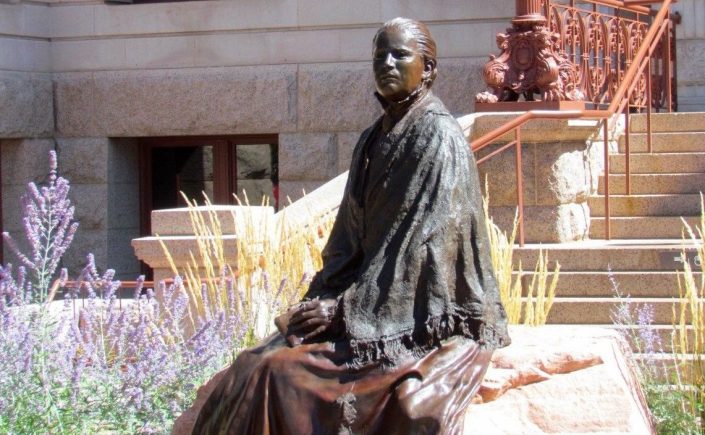
Sculpture of Katharine Lee Bates in front of the Colorado Springs Pioneers Museum (the former El Paso County Courthouse). Created by sculptor John Lajba of Omaha, Nebraska, in 2001, erected in 2002.

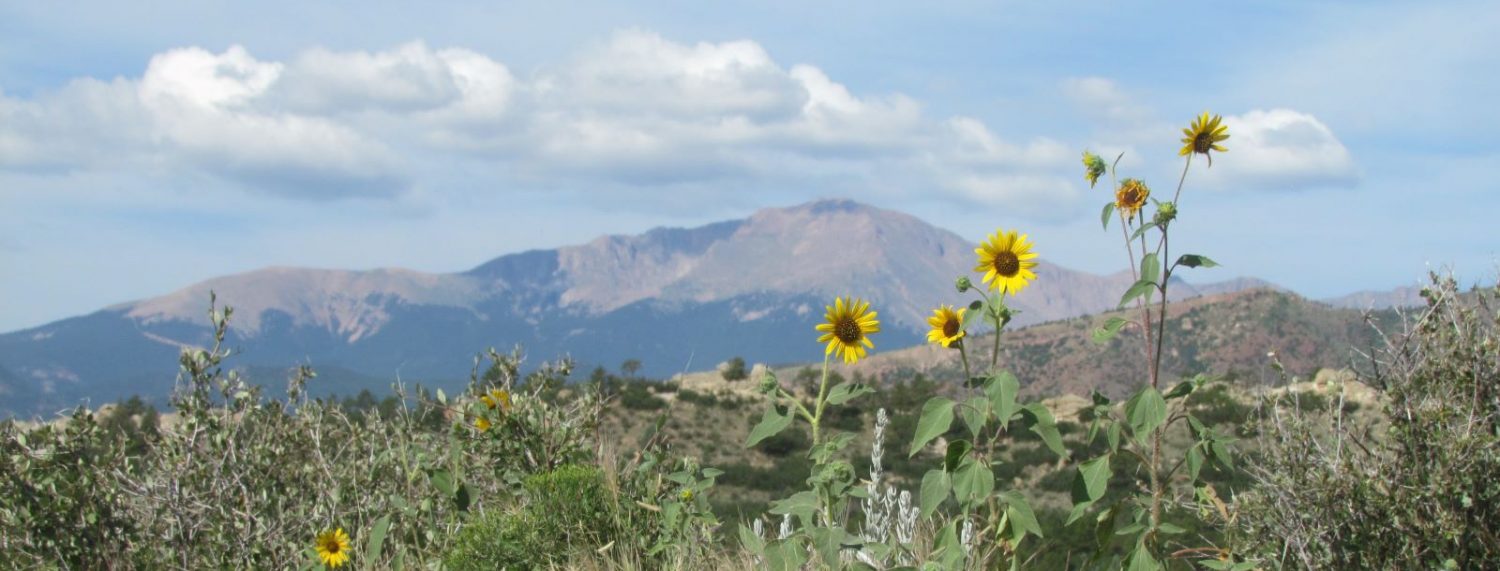
Katharine Lee Bates gazing at Pikes Peak, the source of her inspiration.
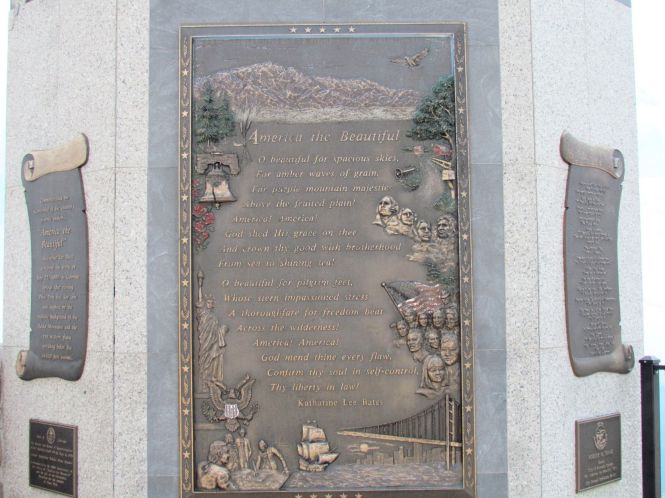
Commemorative plaque at the top of Pikes Peak with the first two verses of “America the Beautiful.”
Ponder’s informative book discusses all these points and more. It instilled in me a deep respect for the extraordinary life and accomplishments of Katharine Lee Bates. Learning about her thoughts, struggles, and activism confirmed the poignancy of something I recently heard on On Point, a podcast hosted by Meghna Chakrabarti and broadcast on weekdays on our local NPR station. Many of her thoughtful, detailed interviews have lately revolved around this anniversary year. In a conversation with Dominic Erdozain, author of the newly released book To Love a Country: The Problem of Patriotism in America, she discussed the definition of a patriot as a “loyal critic,” someone who loves his or her country but who wants to hold that country accountable and asks that it live up to its ideals. So did Mark Twain. So did Katharine Lee Bates. And so do countless courageous others day after day and year after year.
In a time when individuals who criticize their country’s past and present misconceptions and misdeeds are called “traitors” or “enemies of the state” or worse, nothing could be more relevant.
The longer my head is stuck in history books, the louder rings the truth of this essay’s title: Plus ça change, plus c’est la même chose—The more things change, the more they stay the same. And even if history does not exactly repeat itself, it “rhymes,” as someone (reportedly Mark Twain, but probably not) once quipped.
And alongside this recurring refrain runs the burning question: Why can’t we manage to keep working toward making this world a better place for everyone?


Project Gutenberg has made several of Katharine Lee Bates’s books available online.
One of those, Sigurd Our Golden Collie, and Other Comrades of the Road, includes her poem “How Birds Were Made,” in which she imagines Spirit having created birds from the leaves of trees. I wonder if she conceived that from the rustle of tree leaves, the sound of which I learned yesterday has the fancy name psithurism: ‘the calming, almost metallic rustle of dry leaves caught in a sudden breeze.’
LikeLiked by 1 person
I have accessed a few books on Project Gutenberg, a great service.
The book I read also talks about Sigurd, her beloved dog. I did not come across her poem about birds. When I think of leaves, quivering aspen foliage comes to mind, and maybe that movement reminded her of quivering wings. But it might have been the sound made by those leaves. Psithurism is an excellent word to add to the treasure trove.
LikeLike
Here’s “How Birds Were Made.”
LikeLiked by 1 person
Her words evoke birds growing from branches like leaves. It’s a lovely image.
LikeLike
Hi, Mrs. Tanja-
First of all, I really enjoyed reading your blog.
I think that in going back to your mention of this year marking the 250th birth year of our country, your post was timed perfectly!
After reading this, all I can say is wow! I have read about Katherine Lee Bates before, but never to this much detail. I am truly in awe of her song, America the Beautiful.
It has always amazed me that simply her thoughts from the top of Pikes Peak exploded into something most everyone in America knows today (or at least parts of it). That is such a beautiful story!
Thank you for sharing this wonderful story of Katherine’s life and legacy with us! I hope that her impact on our country will never be forgotten!
Blessings to you,
Gavin
LikeLiked by 1 person
Thank you, dear Gavin.
I found it very inspiring to learn how socially conscious and aware Katharine Lee Bates was, what high hopes she had for this country, and how much she wanted it to live up to its ideals.
All the best,
Tanja
LikeLiked by 1 person
She is definitely an inspiration! Thank you again for sharing this stunning post! 🙂
Gavin
LikeLiked by 1 person
My favorite patriotic song, it does speak to the ideals we all strive for.
LikeLiked by 2 people
It was eye-opening and inspiring to learn how far-reaching KLB’s vision went.
LikeLiked by 1 person
Katherine Lee Bates must have been remarkable. It is important to see patriotism framed in terms of a patriot being a loyal critic with expectations that a country upholds its ideals. That the quotation from Mark Twain sounds so contemporary is chilling.
LikeLiked by 1 person
Exactly my thoughts, Carol!
LikeLiked by 1 person
I didn’t know a thing about Katharine Lee Bates, but once I read about her interesting life and her convictions, I began to ponder. One of my great aunts, born in 1881, taught in an Iowa one-room school for a time, and then married and moved to Pueblo around 1910-1915. She was quite a writer herself, occasionally published in obscure journals, and entered a contest to provide lyrics for the Colorado state song. I wouldn’t be at all surprised if she had known about Bates, even though they weren’t exact contemporaries. These little historical accidents are fascinating.
LikeLiked by 1 person
Thank you for your comment, Linda.
Your aunt sounds like an interesting person; I’m sure she would have had fascinating stories to tell. I imagine she came across KLB’s writing at some point as she was published in many contemporary magazines, both academic and lay.
LikeLiked by 1 person
I have to confess that I’d not heard of Bates. She was clearly a remarkable woman.
The question you pose in your final paragraph is very poignant, and particularly relevant in these troubled times.
LikeLiked by 1 person
Thank you for your comment, Mr. P.
I didn’t know how well KLB was known outside of the country, or her famous poem/song.
Seeing her sculpture each time I go to my favorite museum, I keep being reminded of what a remarkable woman she was. But I’m always surprised to learn how many museum visitors don’t know about her.
LikeLiked by 1 person
Your question is one that worries me too, especially when I think about what we are doing to our precious world…
LikeLiked by 1 person
Thank you for your comment, Ann.
I often wonder how we have arrived at this moment in time, when most of our certainties no longer seem certain at all. The world is sick, and her sickness affects all of us . . .
LikeLiked by 1 person
Dear Tanja!
What a delightful moment in my day when I found your posts. Somehow I missed that you were back. Your offering is such a good reminder that we are the latest in a long line of those who struggle with tyranny. Being from Massachusetts, I knew some background about Bates, but not about the Pike’s Peak connection. Thanks for sharing it. The words make even more sense to me now.
For the first few years of my teaching, I was an elementary school general music teacher. After each memorial day, I was relieved when the teaching and singing of the Star Spangled Banner and America (My Country Tis of Thee) was finished. (Try explaining “land where my father’s died” to first graders.) 😉 America the Beautiful was always the song I could get behind fully, and of course I wished for it to be the National Anthem.
These days, I’m reminded of when I was a sixth grader in the school chorus. The music teacher taught us a beautiful melody to the inscription on the Statue of Liberty, and I remember proudly singing it to a appreciative audience.
“Give me your tired, your poor,
Your huddled masses yearning to breathe free,
The wretched refuse of your teeming shore.
Send these, the homeless, tempest-tost to me,
I lift my lamp beside the golden door!”
How did our country come to where we are now? If I were still teaching, would I even be able to teach this song to children? That’s a question that keeps me up at night.
But lately, I think I see little cracks of light coming in through the darkness…I have not given up.
I hope you are as well as can be, and savoring those moments in nature that you are able to in these climate change days.
Kindest Regards,
Julie
LikeLiked by 1 person
Dear Julie,
Thank you for stopping by and for sharing your thoughts.
I haven’t lived in this country as long as you have, but I keep asking the same question: How did we get here?
I hope those cracks of light will only grow and chase away the darkness that has enveloped us all.
I’m returning your warm wishes and kind regards and hope you too are hanging in there.
Tanja
LikeLiked by 1 person
This is so true what you said in this text Tanja, it’s good to have people like you who put back in perspective the history and the actual time we are living in…Long life to your writingXXX
LikeLiked by 1 person
You are so kind, chère Isabelle.
Merci beaucoup! 😊🙏❤️
LikeLike
What a terrific history lesson! This is the type of detail that needs to be included in schools so kids can better understand our past, instead of the glossed-over brief sketch of questionable “facts”.
Thank you for pointing us (okay, me) to a great resource. Even though I think I’m too old to learn anything new, I am constantly proven wrong.
LikeLiked by 1 person
Thank you, Wally. I hope we will never stop learning new things, especially if the stories are as inspiring as Katharine Lee Bates’s. I’m convinced that if kids (and adults) knew history better, they would be better prepared to deal with present-day challenges.
LikeLike
This is a very educational post about a formidable woman, so important to the values of this country. Thanks so much for sharing this piece of history, so well composed and conveyed.
LikeLiked by 1 person
Thank you, Maria. I have nothing but respect and admiration for Katharine Lee Bates.
LikeLiked by 1 person
Fascinating! Enjoyed the history here. I’d never seen another version of America the Beautiful before.
LikeLiked by 1 person
I appreciate you stopping by and commenting. Thank you.
What always strikes me is that many people who love this song don’t know how critical it was of the status quo, and how aspirational at the same time.
LikeLiked by 1 person
[…] well have published this post under the heading, Plus ça change, plus c’est la même chose! Like Katharine Lee Bates and like John Quincy Adams, Lillian Smith stood up and spoke out for what she believed in, looking […]
LikeLike