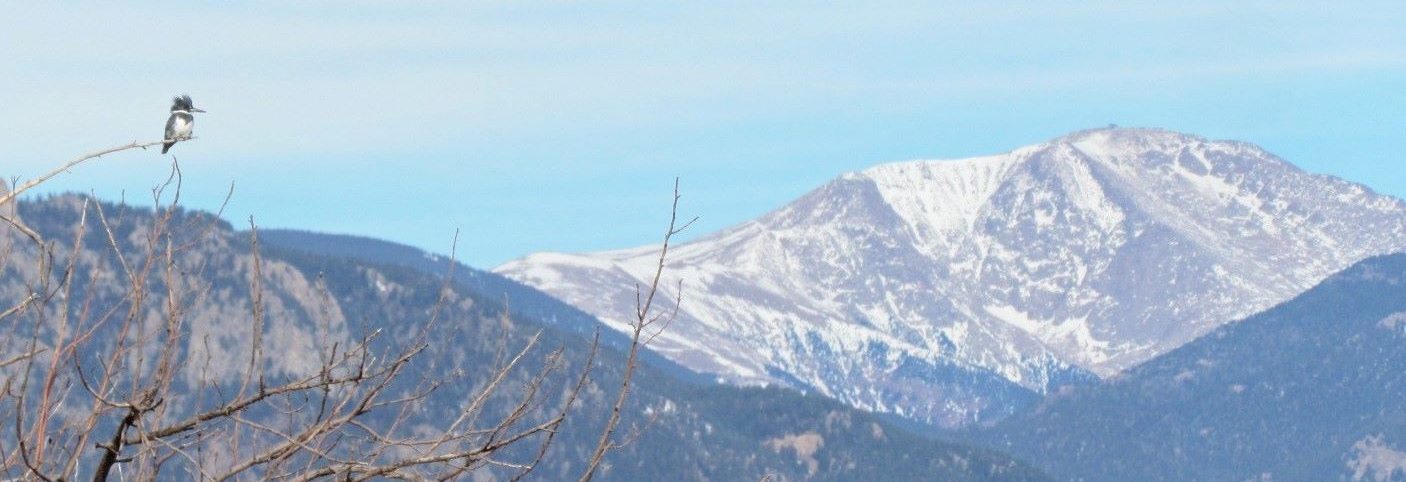

Downtown Colorado Springs is home to Monument Valley Park, a linear park that stretches for two miles on both sides of Monument Creek. This relatively short creek measures only about 27 miles between its origin near Palmer Lake north of Colorado Springs and its confluence with Fountain Creek* directly south of Monument Valley Park. Monument Creek was named for special rock formations along its northern course that resemble man-made monuments, and while the name shared by the creek and park might evoke visions of tall sandstone buttes, our stone structures aren’t quite on the scale as those in the namesake park at the Utah-Arizona border.
General William Jackson Palmer (1836-1909), a Civil War veteran who founded Colorado Springs in 1871, donated much land to the city to use as parks, convinced of the human need for natural and verdant oases. As early as the 1880s, he was agitating for a park along Monument Creek, which then formed the western fringe of the city, but various attempts at creating a sizeable one trickled out.
After selling his shares in the Denver and Rio Grande Western Railroad in 1901, which he had helped establish, Palmer personally addressed this close-to-his-heart park issue. He hired New York landscape architect Charles W. Leavitt Jr. to draw up a plan for Monument Valley Park. The elaborate design included lakes, gardens, and trails as well as athletic and cultural buildings, such as a bathhouse and club house.
Construction on the park began in 1903 and was overseen by engineer Edmond C. van Diest. Hundreds of laborers were employed. Like many western waterways, Monument Creek was prone to flash floods, and crews rechanneled the creek in an attempt prevent flooding. They created an irrigation system, graded the land, planted trees, and built a network of curving footpaths. Four lakes were also part of the design.
In 1906, Palmer suffered a horse riding accident which nearly killed him and left him paralyzed. Once sufficiently recovered, he was able to direct the completion of the project that had cost him approximately $750,000, and in 1907, he deeded Monument Valley Park to the city. It comprised 165.52 acres of land (today it measures 148 after some was sold to Colorado College), 5.74 acres of lakes, and 8.72 miles of graveled walkways.
Despite having been rechanneled, Monument Creek continued to experience periodic flooding. In the wake of two days of heavy rain, the 1935 Memorial Day flood washed out several bridges and destroyed vast portions of Monument Valley Park, including two of its four lakes. Local clean-up efforts were complemented in the late 1930s by crews employed by the Works Progress Administration, who once again realigned the creek and built retention walls for the stream and lakes.
One of the four original lakes was Shadow Lake. Following its destruction in the 1935 flood, it was recreated, but saw more floods as well as leaks in subsequent decades. During this last decade, the city stopped filling the lake and it lay mostly empty and overgrown. When voters approved the city’s retention of surplus tax revenues in 2019, the decision provided the monetary means to restore the lake.
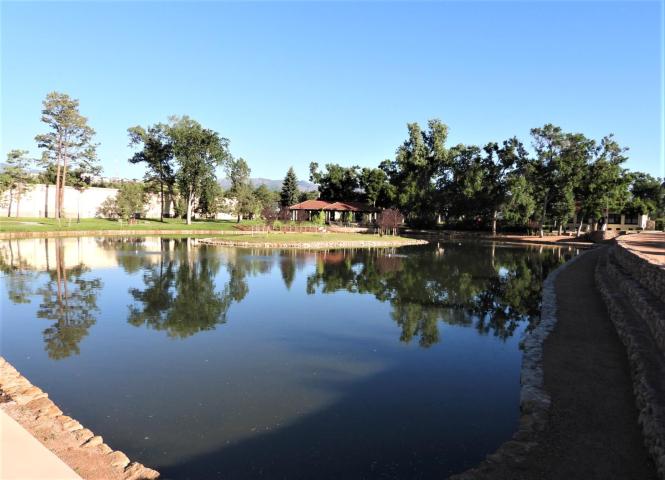
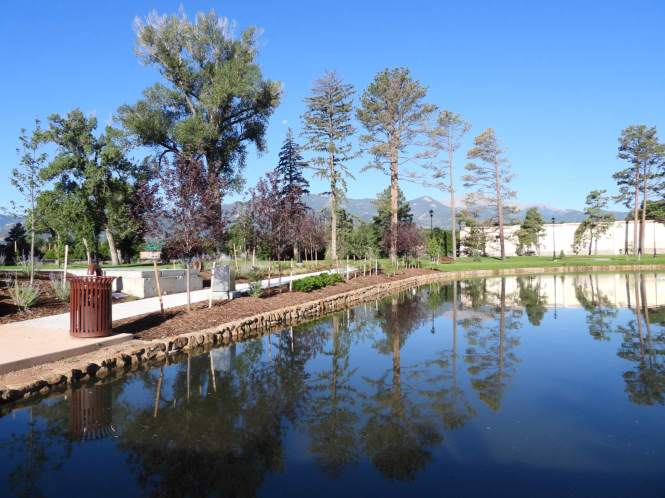
So much for this lengthy backstory. After languishing for extended periods, Shadow Lake has been resurrected for a mere $1.3M (recognize litotes when you see it). It is rimmed by a beautiful stone wall, its bed is lined with rubber against leaks, and its central island has been restored. Non-potable water fills the lake which is equipped with an aeration as well as an automated refill system that tops it off once it drops below a certain level. Attractive landscaping has added new trees, shrubs, and flowers to the periphery, as well as trees to the central isle.
December 9, 2022:


January 15, 2023:


February 26, 2023:


During semi-regular birding visits to Monument Valley Park, I have been keeping an eye on construction, which has progressed steadily since the winter. While I missed the official opening in July, I visited Shadow Lake in early August. Circling the pond on a concrete walkway, I enjoyed the quiet atmosphere of a serene summer morning. No breeze rippled the water’s surface which reflected trees and mountains. A few mallards were snoozing on the island, swallows and swifts were pirouetting above the water, and a family of Cedar Waxwings was teaching this year’s progeny how to catch insects awing.
August 4, 2023:
What is next for this iconic park in Colorado Springs? Shadow Lake has a sister to the north, Duck Pond, which has suffered from similar problems and is also slated to undergo reconstructive surgery in the near future, though the details are still being ironed out. Monument Valley Park, on the National Register of Historic Places since 2007, also has a wonderful Friends group which is active in fundraising, cleaning, and remodeling efforts. I look forward to future improvements to this gem of a park in the middle of a busy city.
+++++++++++++
*Fountain Creek flows south to Pueblo, where it joins the Arkansas River which, in turn, joins the Mississippi, so our water eventually drains into the Gulf of Mexico.
 tanja britton
think, it could become duck paradise…
LikeLiked by 1 person
I think you might be correct. 😊🦆🦆🦆
LikeLike
That is quite a story! Good luck to shadow lake. It looks as though it is a cross between a lake and a swimming pool.
LikeLiked by 1 person
I think only birds are allowed to swim in the lake, Laurie, though I have to agree that it looks quite inviting on a hot summer’s day.
LikeLiked by 1 person
Looks very pretty but a hefty price tag 😊
LikeLiked by 1 person
I thought so, too, but construction was quite involved and when one considers the incredible rise in cost of materials and labor, one can’t be too surprised.
LikeLiked by 1 person
A tranquil spot, but what a history!
LikeLiked by 1 person
Thank you, Eliza. The history definitely adds many fascinating layers to this and other places. I often wish I could have lived in different places at earlier times.
LikeLiked by 1 person
The park is looking good. The renovation costs were worth it.
LikeLiked by 1 person
Thank you, Neil, I’m glad you think so. It’s a very popular park and I think many people will enjoy the rejuvenated lake.
LikeLiked by 1 person
A very nice bit of local history. Very forward thinking of the General to set aside park land and green space way back then.
LikeLiked by 1 person
Thank you, Brad. Mr. Palmer was a true visionary in more ways than one. Each time I visit one of the many parks he donated to the city, I thank him for his foresight.
LikeLiked by 1 person
That’s a very pretty lake – I bet the ducks love the renovation!
LikeLiked by 1 person
Thank you, Kerry. If I were a duck, I would definitely hang out there. Come winter, it will be very interesting to see what other ducks besides mallards will visit the lake.
LikeLiked by 1 person
Very interesting post, Tanja! I love the before, during and after photos. I hope its sister park gets the same, or similar, treatment.
LikeLiked by 1 person
Thank you, Tina. It has been interesting to watch and document the process. I also hope Duck Pond will get another lease on life. It was home to many ducks and geese and the surrounding vegetation harbored many songbirds. I can’t wait for all of them to return.
LikeLike
Happy Shadow Lake renovation. This seems to be a case of “All’s well that ends well.” For an avid birder like you, it will be one more place likely to attract avian visitors (even beyond the few you mentioned).
A visit to Tulsa some years ago taught me that the Arkansas River passes right through the city and is in fact its main river. I was even more surprised to learn that it got to Oklahoma from Kansas, and to Kansas from the Rocky Mountains in Colorado. I guess the name Arkansas got attached to this multi-state river because explorers coming from Europe or the United States would have first encountered the river where it joins the Mississippi in what is now Arkansas.
LikeLiked by 1 person
I definitely think this project ended well, and I hope Duck Pond will have a similar happy ending. You are right in assuming that various avian visitors frequent these lakes and environs. Apart from geese and a variety of ducks, the nearby vegetation attracted a range of songbirds, especially at Duck Pond. Most of those trees were cut down and it will take decades for the plant community to get reestablished.
Here is what I found about the naming of the Arkansas River:
“The Arkansas River was known to early French explorers as “Riviere des Ark” or “Riviere d’Ozark” and to early Spanish explorers as “Rio Napestie.” It eventually derived its present-day name from the Quapaw, who lived and hunted along its banks. The name “Arkansas,” which had applied only to the lower reaches of the stream, was carried westward by American traders and trappers.”
I copied this from the following website (one assumes they did their homework): https://encyclopediaofarkansas.net/entries/Arkansas-River-2225/
LikeLike
It’s a lovely spot. I can imagine it will be well utilized, especially by people looking for a pleasant place to walk. It was interesting to read that the WPA was involved in its restoration at one point.
LikeLiked by 1 person
The park is very popular, so I have no doubt that many visitors will get to enjoy the lake. I’m always surprised to learn in just how many projects the WPA was involved. Many of the structures they built still stand today.
LikeLiked by 1 person
May it flourish!
LikeLiked by 1 person
Thank you, Cathy. I second your wish!
LikeLike
Such an uplifting story!
It always makes me smile when I’m just getting involved in the subject of your post, such as today’s water, and then- they’re there in the background! Those mountains! I keep forgetting you are “a woman of the mountains”, for sure.
Cheers,
Julie
LikeLiked by 1 person
I’m so glad you liked the story, Julie, and noticed the mountains. I never grow tired of seeing them during so many of my forays. They are definitely one of the main protagonists in most of the stories that happen around here. 🙂
Best,
Tanja
LikeLiked by 1 person
What a wonderful bit of history!
I have no doubt this will become an oasis for you to enjoy, especially early in the morning before the crowds gather.
LikeLiked by 1 person
Thank you, Wally. Being aware of all this history adds a layer of meaning to one’s explorations. I look forward to watching more life return to restored Shadow Lake and, once it’s completed, of Duck Pond as well. The latter once harbored a lot of waterfowl and I’m sure they will be back.
LikeLike
Palmer was a visionary, wasn’t he, understanding the human need for contact with the natural world. It’s good to see his vision being given a new lease of life more than a century after his passing.
LikeLiked by 1 person
I agree, Mr. P. If it weren’t for Palmer’s donations, many of our most popular parks would likely have been “developed.” We owe him a debt of gratitude!
LikeLiked by 1 person
Eine gute Geschichtsstunde für mich. Ich habe früher viel Michener gelesen, das wären auch so ansehnliche Geschichtsstunden, da konnte man sich vorstellen, wie es damals war in Colorado Saga.
LG
MAren
LikeLiked by 1 person
Das freut mich, liebe Maren. Die Geschichte dieser Gegend und Stadt ist faszinierend, und in jeder Ecke gibt es etwas Interessantes zu entdecken.
Mir war nicht bewußt daß Micheners Roman über Colorado (Centennial) auf Deutsch Colorado Saga heißt. Wieder was gelernt! Eigentlich müßte ich ihn mal lesen.
Sei herzlich gegrüßt,
Tanja
LikeLiked by 1 person
Centennial ist korrekt. Lies ihn mal – wenn Du das Buch noch nicht kennst, es fesselt sehr.
LG
Maren
LikeLiked by 1 person
Dams were put in in the Adirondacks 100 years ago or more.. That created lakes where they were wetlands before. When they fail there is major flooding. Dams can help mitigate that.
LikeLiked by 1 person
I think we are learning the hard way that while some dams are helpful, others are detrimental. I’m not a hydrologist, but I understand that nature used to control droughts and floods much better before humans started to interfere.
LikeLiked by 1 person
Hard to change things now when whole towns were built around the lakes that formed. I know some want to let the dams fail no matter the resulting damage. There was even an article online somewhere about that.
LikeLiked by 1 person
Yes, it’s very complicated . . .
LikeLiked by 1 person
That is a feel good story Tanja (much like the kitties). Again, kudos to those that pushed to make this restoration happen and eager to hear in future posts about all the wildlife that it attracts.
LikeLike