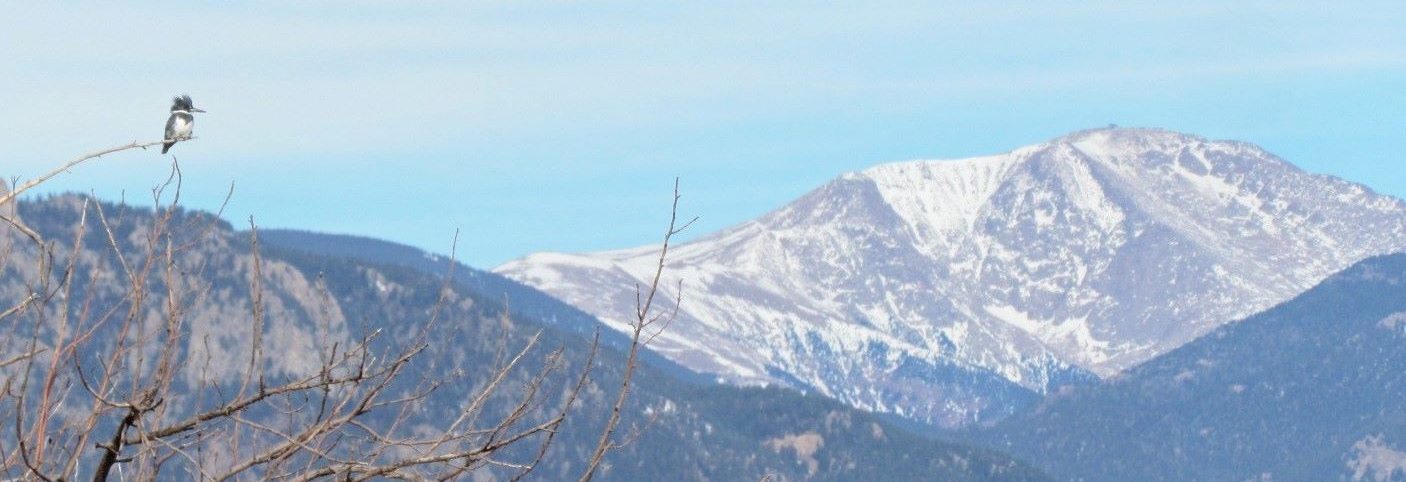

October’s full moon has long been nicknamed Hunter’s Moon, as it heralds the beginning of the hunting season in the northern hemisphere. If you pay attention to lunar cycles, you will know that this month’s Hunter’s Moon will not appear until the end of the month, October 28, to be exact, so today’s essay pertains not to this month’s Hunter’s Moon, but to another.
I recently bemoaned the seemingly accelerating passage of time, something many of you commiserated with. The mere existence of proverbs such as “tempus fugit” and “carpe diem” bespeaks the fact that this is a universal human experience. A further reminder of this truth came my way when, while reviewing old photographs, I realized that I hadn’t yet written an intended post about a trip under the influence of a Hunter’s Moon—one taken in October 2022.
That was actually the first car camping trip for my husband and me after an unintended hiatus of four looong years, owing to global and personal health concerns. Because October in Colorado’s mountains can come with nippy nighttime temperatures, we decided to travel east from the Front Range onto Colorado’s northeastern plains, where I hoped to witness at least part of the annual avian fall migration.
Summer and autumn of 2022 were hot and dry and the days in October continued in the mid-80s still. But the nights and mornings were refreshingly lovely. And what stands out most in my mind about our excursion was not the heat, but the moon, Sandhill Cranes, and fall colors!
The Hunter’s Moon in 2022 peaked on October 9, the very day we left home. Except for one evening during our 6-day journey, when howling winds and blowing sand drove us into our tent early, we nightly watched the moon’s luminous sphere climb into the firmament without fail.
We also daily heard the trumpeting calls of cranes and saw their elegant forms as they migrated from their breeding grounds north to their wintering grounds in more southern latitudes. If you have ever listened to cranes, you will never forget their otherworldly vocalizations. They harken back to bygone—and better—days, when these inspiring and charismatic birds, who have made their home on this planet for eons (crane fossils date back at least 2.5 million years!), were not confronted with loss of habitat and survival because of one species of earth dweller whose self-centered outlook endangers the existence of everybody else.
While Colorado’s aspen trees garner most of the autumnal attention for their golden transformation, Plains Cottonwoods’ seasonal changes are no less spectacular, and equally enchanting. In my mind, Colorado should have two state trees: Quaking Aspen (Populus tremuloides) to represent the Rocky Mountains, and Plains Cottonwood (Populus deltoides) to celebrate that 2/5 of the state is located on the Great Plains. Instead, the Colorado Blue Spruce (Picea pungens) holds that honor.
October 9, 2022:
A spectacular evening at Prewitt Reservoir State Wildlife Area. Once our tent was pitched on a sandy patch underneath a couple of towering cottonwood trees and the still-hot sun had set, we sat down in our camp chairs with with mugs of our standard camping nighttime drink to watch the moonrise, with unobstructed views of the eastern horizon (if you have never tried peppermint tea with a touch of Irish Cream, you don’t know what you are missing 😊). Flocks of cranes kept flying over the reservoir until darkness set in, and if you look closely, you might espy a small group of them in front of the moon.
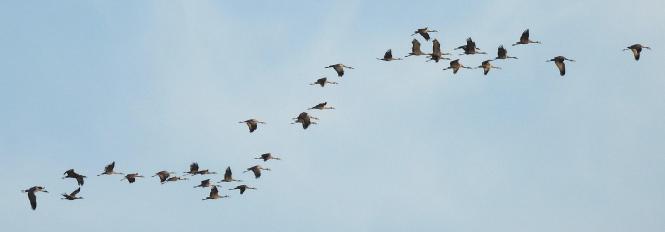
Sandhill Cranes over Prewitt Reservoir
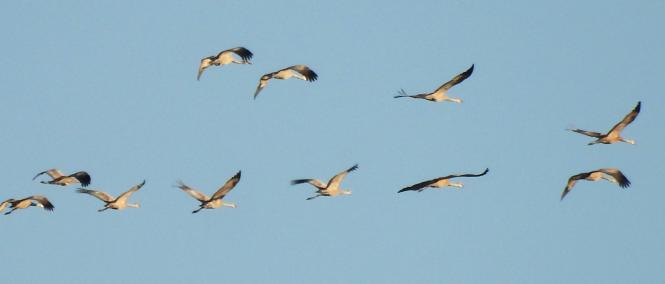
Sandhill Cranes over Prewitt Reservoir


October 10 and 11, 2022:
We spent two nights at Jackson Lake State Park. Successive waves of cranes passed overhead both in the mornings and evenings. Many other birds also gladdened the heart of this birder, waterfowl and shorebirds among them. It was the place where I saw my first-ever American Golden-Plover, a bird always considered rare in Colorado. They breed in the Arctic and overwinter in South America, and usually migrate along the coasts or the center of the North American continent.
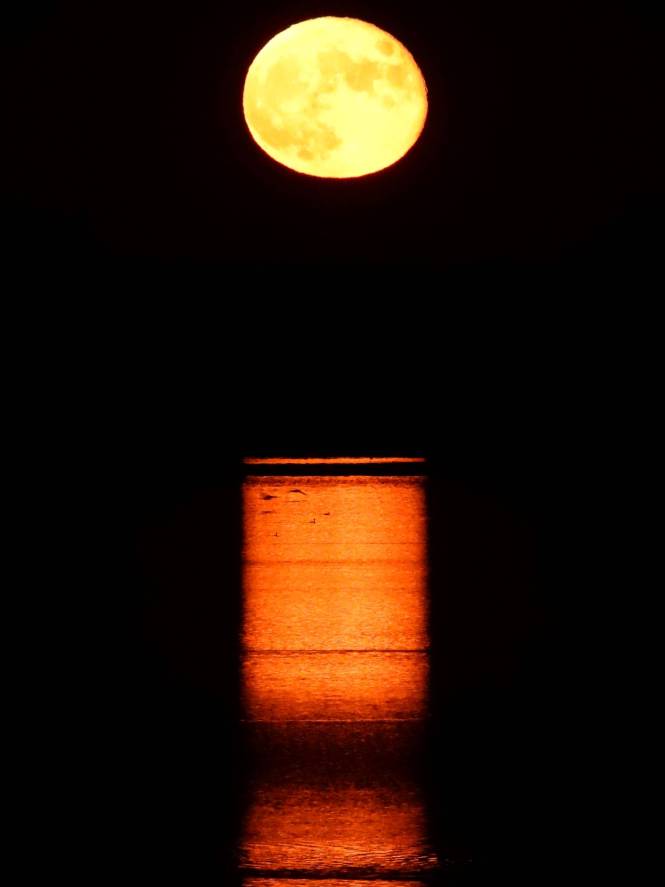
Moonrise at Jackson Lake State Park

Sunrise at Jackson Lake State Park. 2 Great Blue Herons and a gull are also greeting the day.
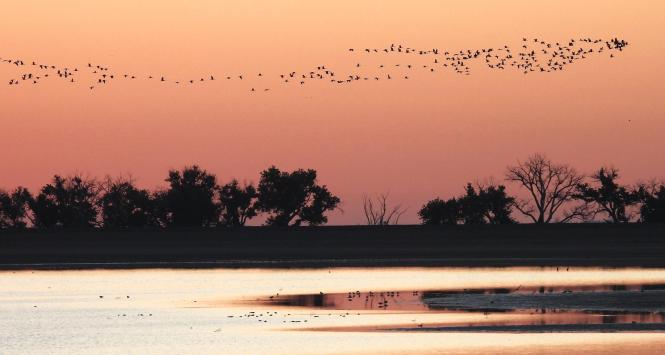
Sunrise at Jackson Lake State Park. Sandhill Cranes are getting an early start.
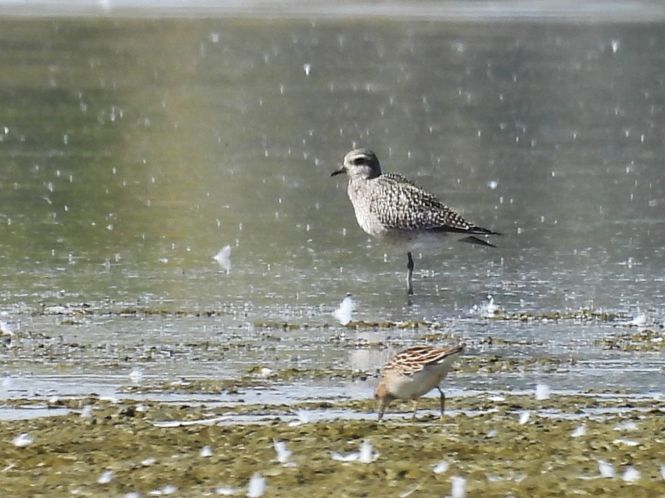
My life bird American Golden-Plover in nonbreeding plumage in the background (and a possible Baird’s Sandpiper in the foreground).
October 12 and 13, 2022:
We stayed at Crow Valley Recreation Site near Briggsdale in the Pawnee National Grasslands. Unlike our previous two destinations, it doesn’t harbor a reservoir, but thanks to Crow Creek, this is a verdant oasis in a sea of shortgrass prairie and responsible for the arboreal cover which attracts birds of all feathers. My heart skipped a beat when I made out a tall, narrow silhouette in one of the trees. A Long-horned Owl was sitting motionless on a branch, its big eyes meeting mine in a magical moment of interspecies connection. It even granted me a few photos and was still there after I ran to get my husband, so he, too, could catch a glimpse of this memorable bird.
According to the Cornell Lab of Ornithology:
Long-eared Owls are lanky owls that often seem to wear a surprised expression thanks to long ear tufts that typically point straight up like exclamation marks. These nocturnal hunters roost in dense foliage, where their camouflage makes them hard to find, and forage over grasslands for small mammals. Long-eared Owls are nimble flyers, with hearing so acute they can snatch prey in complete darkness. In spring and summer, listen for their low, breathy hoots and strange barking calls in the night.


Each time we experience some facet of the Great Plains, our awe and appreciation only increase: for the wide horizon and expansive sky, the striking sun-and moonrises and –sets, the resilience of the creatures who live off this harsh and sparse yet giving land that once provided sustenance to countless bison and pronghorn, as well as to the numerous Plains tribes who knew how to survive and thrive in this scant setting by heeding its rules and rhythms. There is much we can learn from them.
 tanja britton
Was für ein zauberhafter Artikel, was für schöne Bilder, Colorado ist ein Paradies auf Erden, hoffentlich bleibt das noch lange so.
Wir haben hier im Teufelsmoor jetzt auch die Zeit der Kraniche. Ich habe einen Blogartikel “Kraniche im Teufelsmoor” von 2020 mit einem Filmchen versehen, es zeigt die fliegenden Kraniche vor der aufgehenden Sonne und man hört ihre betörenden Rufe, Wenn Du magst, klicke mal rein. Ich verlinke das hier nicht.
Liebe Grüße
MAren
LikeLiked by 1 person
Ich danke dir, liebe Almuth. Colorado hat natürlich viele Probleme, wie andere Orte auch, aber es gibt glücklicherweise immer noch wunderbare Ecken.
Dein Kranichbeitrag hat mir auch super gut gefallen, besonders, weil das Video die Vokalisationen dieser außergewöhnlichen Vögel enthielt. Die Kraniche gehören für viele unter uns zu den wohl charismatischsten Wesen.
Herzliche Grüße,
Tanja
LikeLiked by 1 person
Wir haben Colorado mehrmals bereist, ab/an Denver. Es war wunderschön. Die Probleme, die sind mittlerweile weltweit gleich, mal mehr mal weniger und sie werden schlimmer. Glücklich sind die, die auf wunderbaren Ecken zurück greifen können und Erholung finden.
LIebe Grüße Maren
LikeLiked by 1 person
Wie wahr!
LikeLiked by 1 person
Lovely story Tanja and super photos. The Owl shot is brilliant!
I have managed to see both American and Pacific Golden Plovers in breeding plumage in the UK, seems strange you do not get more on their home continent.
LikeLiked by 1 person
Thank you, Brian. I will never forget that particular owl encounter.
Both species of plover you mentioned can be found here, just not in the part of the country where we live. The Black-bellied Plover, on the other hand, can be found more often during migration.
LikeLiked by 1 person
Wonderful captures and what a wonderful experience you enjoyed.
LikeLiked by 1 person
Thank you. It was a memorable trip.
LikeLiked by 1 person
The owl you photographed so well is an *amazing* creature!!!
LikeLiked by 1 person
Thank you, Liz. I love all owl sightings, but I have only seen this species on a handful of occasions, which makes it extra-special. 🦉
LikeLiked by 1 person
Herzlichen Dank für diese wunderbaren Bilder und den spannenden und interessanten Bericht über den Jägermond. Leider können wir hier in der Schweiz die Kranichzüge und solch einmalige Mondbilder nicht beobachten.
Liebe Grüsse. Ernst
LikeLiked by 1 person
Es freut mich sehr, daß dir der Bericht und die Photos gefallen haben, lieber Ernst. Kraniche zählen zu den wohl inspirierendsten Vögeln und mein Jahr ist unerfüllt, wenn ich sie nicht zu sehen bekomme.
Sei herzlich gegrüßt,
Tanja
LikeLiked by 1 person
What a magical trip that must have been! One to always remember.
LikeLiked by 1 person
Well said. Thank you for reading and commenting.
LikeLike
A beautiful and insightful essay.
LikeLiked by 1 person
Thank you, Neil, I’m glad you think so.
LikeLiked by 1 person
That’s an excellent minimalist moonrise picture. And what pretty orange-tinged dawn scenes you caught at Jackson Lake State Park. Given your avian theme, you may already know Gerard Manley Hopkins’s 1877 sonnet “The Windhover,” but if not, here it is:
https://www.sparknotes.com/poetry/hopkins/section2/
And you may or may not have recognized as cognates German Herbst and English harvest; autumn is the season of harvesting. You touched on a Latin relative in the adage carpe diem, whose first word means ‘to gather’ as well as ‘to seize.”
Prewitt Reservoir calls up the character of Robert E. Lee Prewitt, played by Montgomery Clift in the 1953 movie “From Here to Eternity.”
LikeLiked by 1 person
Hi Steve,
I have heard of the movie, but have never watched it. The poem I was not familiar with at all. Even after reading it a few times, it made little sense to me, so the interpretation was helpful. I looked up the poet and from what I understand, his poetic style was novel when he “invented” it, and didn’t have many fans to begin with.
The relationship between Herbst, harvest, and carpe diem is very interesting, but I assume you are the only reader who made it.
Thank you for your comment.
Tanja
LikeLike
The plains are such an under-appreciated area of the state. I’m glad you decided to go back and share these adventures! One of these days, I’d love to witness the sandhill crane migrations.
LikeLiked by 1 person
Thank you, Diana, I agree.
I hope you will get to enjoy the cranes’ migration one of these days. I would recommend to visit the Monte Vista National Wildlife Refuge during their spring migration in March, where they spend a few weeks in the tens of thousands. You will not regret it. You can attend the annual festival (https://mvcranefest.org/) but it’s also possible to explore the area on your own.
LikeLiked by 1 person
I’ve heard of that event and it’s on my list! One of these years hopefully the weather will cooperate enough for us to drive all the way down there.
LikeLiked by 1 person
I cannot imagine the sight of the real moonrise at Jackson Lake State Park – the photo is spectacular!
LikeLiked by 1 person
Thank you, dear Christa. I think those couple of moonrises must be among the most impressive we have been able to observe–ever.
LikeLiked by 1 person
What a fantastic essay Tanja! The images of the moon looked magical, and the migrating cranes with the pink sky was sublime. Don’t even get me started on the owl photo!
LikeLike
Thank you, Julie. It was a magic-filled trip and I’m glad to have been able to re-live it in the telling.
LikeLiked by 1 person
Great find with the owl. I really enjoyed the moon reflecting on the water. I’ll have to ask my daughter if she’s been camping there yet. I also just noticed your avatar is a Western Meadowlark if I’m not mistaken. I really enjoy hearing their song over the open plains.
LikeLiked by 1 person
Thank you, Brad. Colorado’s eastern plains are known for harboring an amazing avifauna and I hope you will get to experience it one of these days.
I love everything about Western Meadowlarks, in particular their lovely songs. 😊🎵
LikeLiked by 1 person
Beautiful post, Tanja. Loved the LEO and the cranes in the early light. So glad that you finally shared it!
LikeLiked by 1 person
Thank you, Eliza. But your comment stumped me, too. Not sure what you mean by LEO.
LikeLike
Long Eared Owl 🙂
LikeLiked by 1 person
Thank you for the clarification, Eliza. I racked my brain for that abbreviation, but nothing came to me. 😊🦉
LikeLiked by 1 person
A post for the season.
Even here in Florida, the mornings have a bit of “crispness”, fall flowers have been spectacular and the animals are very active.
It is a wonderful time to explore Nature.
Outstanding photographs.
LikeLiked by 1 person
Thank you, Wally. It’s hard to believe that a year has gone by since this trip, and we are preparing for another winter. Fall never lasts long enough for my taste.
LikeLike
Stunning photos, Tanja and what a wonderful getaway! Love that the owl granted you some time with it and that, in turn, you shared with us! I’ve never seen a Long-eared before, though Cornell says they’re nonbreeding in this part of Texas.
LikeLiked by 1 person
Thank you, Tina, it was definitely a getaway to remember, including the owl encounter. I had seen Long-eared Owls a few times before, but only while they were hiding in some dense branches. This moment was something far more soul-piercing.
LikeLike
So, so beautiful!!!
LikeLiked by 1 person
Thank you very much, Valerie. I’m glad you enjoyed the post.
LikeLiked by 1 person
Wow, we can see Golden Plover around where I live too! I see them often on the beach any my neighbors yard 😍
LikeLiked by 1 person
Lucky you! I wish I had a beach where the plovers might show up. 😊
LikeLike
What a great trip you had, beautifully recorded in words and photos. Must have been wonderful to see all those Sandhill Cranes on the wing, and I’m also massively jealous of your Long-eared Owl. 🦉🙂
LikeLiked by 1 person
Thank you, Mr. P. Hearing and seeing cranes is always a highlight. And you have to believe me that I don’t show owl photos with the intention to make you envious. 😊
LikeLiked by 1 person
OK, I’ll believe you, though thousands wouldn’t 🙂🙂🙂
LikeLiked by 1 person
As long as you believe me, I don’t care about the thousands. 😊
LikeLiked by 1 person
What a splendid riposte to my earlier, mischievous comment. Respect! 🙂🙂🙂
LikeLiked by 1 person
Merci beaucoup! 🙏
LikeLiked by 1 person
The cranes look so wonderful 😍
LikeLiked by 1 person
I think they are among nature’s most amazing creatures. Thankyou for your comment.
LikeLiked by 1 person
I remember we saw Hunter’s Moon last year in Yorkshire, UK and the sight was so appealing to the eyes. This is a lovely post. Thanks for sharing.
LikeLiked by 1 person
I’m glad you also had a memorable encounter with a Hunter’s Moon. I will definitely never forget those nights.
Thank you for stopping by and for commenting.
LikeLiked by 1 person
My pleasure!
LikeLiked by 1 person
Hello dear Tanja,
I am so glad you decided to share this adventure with us.
Absolutely stunning and as always you have such a special way of combining your beautiful imagery with the written word. (As a Non-native speaker of English, I am always inspired by your bilingual abilities ☺️) I am glad you were able to make this trip with your husband last year, and twice glad that you were blessed with wonderful moments.
Autumn has finally arrived in Japan although many are already grieving the shorter days (how easy it is for we humans to “complain”) and I have started to hear the calls of migratory birds in the sky. Hopefully, autumn will be a better time for all of us…
Your post has been a highlight of my week, thank you.
LikeLiked by 1 person
Thank you for your kind comment, dear Takami. As we both know, nature is inspiring on so many levels.
I hope you will enjoy autumn, including migration. Our autumn has come to a sudden end and we had our first light snow today, with more on its way tomorrow. Even if I prefer some times of year to others, it’s good to have different seasons, so I try not to complain (too much). 😊
All the best,
Tanja
LikeLike
Thank you, dear friend. Continued good wishes to you, and hope you can enjoy the snow too.
LikeLiked by 1 person
It snowed about a foot and the world looks very different!
LikeLiked by 1 person
Beautiful photographs! I especially love the moonrise and sunrise photographs – such special times of day. Sad but true: ‘one species of earth dweller whose self-centered outlook endangers the existence of everybody else’. But you help by encouraging us to appreciate the natural world and sharing the wonderful creatures that live in it. We have so much to lose!
LikeLiked by 1 person
Thank you, Ann. We, indeed, have so much to lose. I only hope that we will have a collective change of heart soon enough to change our destructive ways.
LikeLiked by 1 person
Agreed!
LikeLiked by 1 person
Such gorgeous photographs to accompany your travelogue! I’m so glad you posted them. I was especially taken with the long-eared owl. What a treat! The cottonwoods are intriguing. I don’t think I have seen them in this area. ( Swamp cottonwoods are plentiful, but they look like a whole different thing altogether. ) Hurrah for new hikes, and hikes remembered!
Julie
LikeLiked by 1 person
Thank you, Julie, it was nice for me to re-live our trip while preparing the post. I will never forget the moment when I saw the owl and froze in place, afraid it might fly off. It was absolutely magical.
I second your “hurrah for new hikes, and hikes remembered!” 😊
Best,
Tanja
LikeLike
When I saw this year’s Hunter Moon a couple of nights ago, with Jupiter next to it, I thought about your post. Somewhat ironically, the biggest regatta of our year — an offshore sailing race — is named for the Harvest Moon, but this year it ended up being scheduled for the Hunter’s Moon for a variety of reasons. There’s little more memorable than being offshore during a full moon, although your owl encounter probably comes close. I remember some nights when it was possible to read in the cockpit during the night watch — probably would be possible to spot owls in such light, too!
Your notes about the sandhill cranes were interesting. I’ve still not seen our first arrivals, but I suspect they’ll be coming in soon. We just had a strong norther blow in, and the white pelicans are here. Not only that, last week I saw migrating Monarchs crossing the bay. I wondered then if a front wasn’t coming — the butterflies always are a few days ahead of the winds.
LikeLiked by 1 person
Thank you for thinking of me and my blog, Linda, that makes me very happy. 😊
I can well imagine that a full moon offshore is completely memorable. A little bit like our moon at Jackson Lake, only with a lot more water.
Just for clarification: The Long-eared Owl encounter happened during the day, as my photo shows. I am not equipped to take nighttime photos, except for of the moon, for which my camera has an actual function.
I hope your norther brought more birds to your area, possibly even cranes. How wonderful that you get to observe migrating Monarchs. Let’s hope they will make it to their destination safely and in high numbers.
LikeLiked by 1 person
Great trip with impressive pictures and story.
I have just driven by there, never stopped. The nature over there is fantastic. It takes courage, though, to stay and sleep in these parks.
Well, enjoyed reading and seeing what you have experienced. I haven’t been anywhere since 2019.
All the best!
LikeLiked by 1 person
Thank you so much for your kind comment, Inese. I hope the next time you are in that part of the country, you will stop.
It took us a long time to get traveling again, but it feels good to explore some novel places and make new experiences.
Take care,
Tanja
LikeLike
Wunderschön Tanja.
Einfach fantastisch.
Liebe Grüße Brigitte
LikeLiked by 1 person
Vielen Dank für den netten Kommentar, liebe Brigitte. Entschuldige bitte meine sehr verspätete Antwort.
Herzliche Grüße zum Jahresende nach Bremen,
Tanja
LikeLiked by 1 person
I was in Turkiye and it never went bloody. I stayed up and nothing. Then someone said no it’s between certain hours tomorrow? I never caught up with it 🤣
LikeLike