I will occasionally re-publish an older post under the heading Throwback Thursday. This one first appeared here on July 3, 2016, when my blog was but a few months young and was noticed by only a handful of fellow bloggers. I have made only a few slight changes to the original. It’s the second of four posts about a visit to Rome in June 2015. If you missed the first, you can find it here.
Thank you for traveling back in time with me.
🇮🇹 🇮🇹 🇮🇹 🇮🇹 🇮🇹 🇮🇹 🇮🇹 🇮🇹 🇮🇹 🇮🇹 🇮🇹 🇮🇹 🇮🇹
It has been said that a year would not suffice were a pilgrim to the Holy City to seek out one church daily, and I for one believe it. Two greeted me in the vicinity of the main train station immediately upon my arrival, and I was never far from one throughout my stay. During the few days at my disposal, I dedicated one to St. Peter and the Vatican, but at least one more ecclesiastical edifice piqued my interest: Santa Maria della Vittoria, home of “The Ecstasy of Saint Teresa,” a sculpture by the seventeenth century Italian artist Gian Lorenzo Bernini (1598-1680). Though I am no connoisseur of Catholic Saints, or of Baroque art, a likeness of the monument features prominently in a spellbinding contemporary novel (and one of my all-time favorites), Cutting for Stone, by Dr. Abraham Verghese. After my literary acquaintance I was determined to encounter it “in the stone.”
The church’s impressive but understated earth-tone external façade did not prepare me for its opulent interior.

Interior of Santa Maria della Vittoria
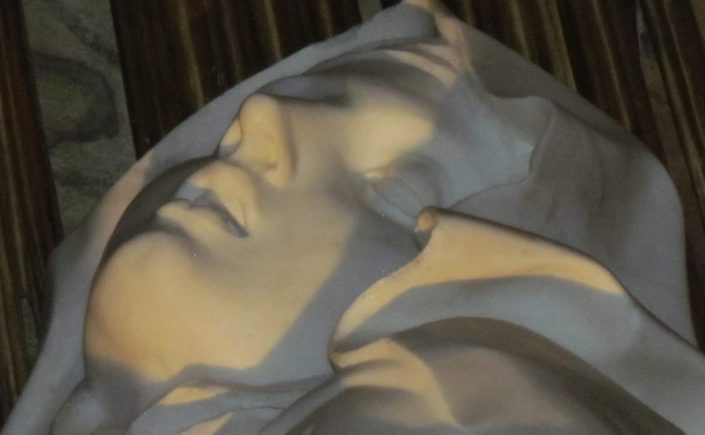
Sumptuous paintings, ornate marble columns, and stucco angels occupied the sacred sphere but despite their brilliance, my eyes did not rest on them long and were drawn instead to one of the side chapels. There, in a world of marble, the life-size luminous figures of Teresa and an angel float on a cloud, surrounded by a shrine that is illuminated by a circle of golden rays. The Saint is half-recumbent, her head extended, her eyes closed, and her face enraptured. The angel lifts her billowy dress and points an arrow at her heart.

The Ecstasy of St. Teresa
By her own report, Teresa had visions of being tormented by this angelic arrow whose flaming tip pierced her repeatedly, setting her on fire with a great love for God. The Carmelite nun who lived in Spain in the sixteenth century (1515-1582), was canonized by Pope Gregory XV in 1622, and the sculpture was completed by Bernini in 1652, in response to a commission by a Catholic Cardinal who desired it as the crown jewel for his burial chapel.
I can’t judge whether Teresa’s ecstasy is carnal, rather than chaste, which seems to have been a perpetual debate since her creation, but this realistic and exquisite piece of art by Bernini aroused my curiosity about the artist. Not knowing much beyond his name before my sojourn in Rome, repeated references to him in my guide book attested to his pervasive influence throughout the city. Next to Teresa’s inspired rendering, he was instrumental in the redesign of St. Peter’s Basilica where he created the immense bronze baldachin covering St. Peter’s tomb, and he later also fashioned the semicircular colonnades that contribute to the beautiful symmetry of St. Peter’s Square.

Fountain of the Four Rivers with the God representing the Ganges; the others show the Nile, the Danube, and the Rio de la Plata, each representing one of the four known continents of the era
Other masterpieces include the Fountain of the Four Rivers on The Piazza Navona, the Triton Fountain on the Piazza Barberini, and the whimsical Elephant with Obelisk on the Piazza della Minerva near the Pantheon, though the latter was likely completed by one of his students. Bernini, precocious artist extraordinaire, proved his special talent before the age of ten, and his mastery of sculpture and architecture proved as rich as his eighty-one years on earth, in the course of which eight successive popes employed his services.
During my all-too-brief stay in Italy’s capital, and my semi-accidental stumbling upon Bernini, I recalled a phrase attributed to Socrates: “Scio me nihil scire” (I know that I know nothing). I am reminded of this realization daily, but traveling to new frontiers has a way of magnifying it. Rome was no exception, and it would take an eternity to explore all the city has to offer. For lack of this, I must content myself with the hope of an occasional visit, and prepare to be surprised each time.
🇮🇹 🇮🇹 🇮🇹 🇮🇹 🇮🇹 🇮🇹 🇮🇹 🇮🇹 🇮🇹 🇮🇹 🇮🇹 🇮🇹 🇮🇹
There will be two more posts about my Rome trip on the next two Thursdays.
Click here for the German version/klicken Sie bitte hier für die deutsche Version:
https://tanjaschimmel.wordpress.com/2016/08/09/scio-me-nihil-scire/
 tanja britton
Simply Fabulous, just like Rome is
LikeLiked by 1 person
Thank you, Luisia. Coming from you, the comment is extra-special. 🙂
LikeLiked by 1 person
You are so very welcome my dear Tanja!
It’s my pleasure as always🌹
LikeLiked by 1 person
Wow!! Thank you for sharing!
I am always so impressed by those who are able to create beautiful, life-like sculptures!! It is a true talent!
LikeLiked by 1 person
Thank you, Gavin.
I completely agree: sculptors accomplish amazing feats. To start with a block of stone and see and then realize the finished figure is miraculous.
LikeLike
Your statement about the number of churches in Rome got me curious to do a comparison. Wikipedia says that New York City has approximately 2000 churches. Whether on average they’re as elaborate as the ones in Rome are on average, I don’t know.
LikeLiked by 1 person
That’s interesting. A quick internet search tells me there are “more than” 900 churches in Rome. I wonder if the definition of “church” differs between the two towns with regard to the building.
LikeLike
Such opulence! ‘God’s’ palaces where the clergy lived and ruled as kings. Same old story, money and power.
LikeLiked by 1 person
Yes, that’s a disconcerting thought, Eliza. If all the money spent to erect these opulent edifices had been used for the good of the people, everybody would have been better off.
A similar though even more egregious example is the gazillions spent on waging wars. Why don’t we choose to use those funds toward some positive end?
LikeLiked by 1 person
You and I are in total agreement here. John Lennon’s song ‘Imagine’ eloquently expressed that same thought.
LikeLiked by 1 person
“Imagine” is one of my favorite songs!
LikeLiked by 1 person
Wow, the interior is breath-taking. Whether it is an aid to worship, or a distraction from it, is an interesting question to ponder, but simply as a piece of artistic endeavour it appears sublime.
LikeLiked by 1 person
I agree, Mr. P. This church, as so many others, served as a site for artists to show off their amazing creations.
LikeLiked by 1 person
“ . . . it would take an eternity to explore all the city has to offer.” You’re not kidding. Rome is unbelievable. I remember reading, for instance, about well-preserved ancient streets and homes buried below present-day ground level.
LikeLiked by 1 person
You are right, Neil. There is so much history there. Every time someone digs, a historical artifact is unearthed.
LikeLiked by 1 person
Nice memories and photos Tanja. More stops to add to our list for a brief upcoming trip to the same destination.
LikeLiked by 1 person
As I mentioned in my other response, you likely won’t have time to visit all the destinations on your wish list. But I hope you will have a grand time! Happy travels.
LikeLiked by 1 person
Thanks very much. We like to leave some things undone. Experience the high priority sites/sounds/tastes first.
LikeLiked by 1 person
This is stunning photography, Tanja. I don’t know if it’s by instinct or training that prompted you to capture these Roman delights at these intriguing angles. Whatever the reason, your photos seem to inject more magic into these already gorgeous sculptures. I remember being fascinated by Bernini’s “Ecstasy of Saint Teresa” when we learned about her in art history class. I probably won’t be seeing her in the “flesh” but I am really happy to see her here. I can see why your eyes were so drawn to her. 👏
LikeLiked by 1 person
Thank you, Julie. I’m glad you enjoyed my photos. I took them so long ago that I don’t remember what went through my head then.
It’s interesting that you discussed Bernini’s sculpture of Saint Teresa. Not being very fluent in art, I only came across it in Abraham Verghese’s book. But Teresa played a central enough role that this church was one of the first places I visited.
LikeLiked by 1 person
I may have to pick up that book and give it a read. It sounds perfect for art and history lovers.
LikeLiked by 1 person
It’s about many things but I would say that medicine plays the largest role (the author is a renowned physician).
LikeLiked by 1 person
Dear Tanja,
“I know I know nothing.” Thank you for taking us back to Italy. You eloquently provided such beautiful imagery and descriptions for these awe-invoking sculptures, works of art, and architecture. I’ve dreamed of going to Rome my entire life. Thank you for sharing, dear friend. I’m fascinated by Bernini’s gift of art! WOW!
I hope your December finds peace with the falling snow, after the cranes, and the quiet times in the timber with nature providing much peace. Many blessings, my friend. 💛
LikeLiked by 1 person
Thank you for your kind comment, dear Karla. I’m not an artist or art connoisseur, but seeing Bernini’s (and many other artists’) creations left a deep impression.
I hope you will be able to realize your dream of a Rome visit. I’m dreaming of re-visiting there, but if that doesn’t happen, I’m grateful for my memories.
Your wishes for December are lovely. All of us need peace and quiet and blessings and I herewith return them to you.
Gratefully,
Tanja
LikeLike
So wie du auf Berninis Spuren wandeltest, wandelte ich in Rom auf den Spuren Michelangelos.
Rom wird als Nabel der Welt bezeichnet und für mich stimmt das zu Hundert Prozent.
Ich freue mich auf deine nächsten Beiträge.
Liebe Grüße Brigitte
LikeLiked by 1 person
Dankeschön, liebe Brigitte. Man bzw. frau könnte in Rom ganz vielen verschiedenen Spuren folgen. Michelangelos Werken bin ich natürlich auch begegnet–niemals werde ich die sixtinische Kapelle vergessen.
Liebe Grüße,
Tanja
LikeLiked by 1 person
Thanks for taking us along on this trip down memory lane–to Rome! It’s on my list, as is other parts of Italy, but I haven’t been there yet. Your photos are lovely!
LikeLiked by 1 person
Thank you, Tina. It was a memorable trip and I would love to return there. I hope you and I will both be able to (re-)visit.
LikeLike
Bernini is a master architect and sculptor in the Baroque style. Thank you for sharing these wonderful images of the Ecstasy of St. Teresa and The Fountain of the Four Rivers, or Fontana dei Quattro Fiumi, among others. Bernini is considered the father of the Baroque style, which was an expansion of the Renaissance style. Bernini studied Michelangelo’s work and was influenced by the work of Caravaggio. I’ve been also been reading about the ‘New Spanish Baroque’ also known as Mexican Baroque, refers to Baroque art developed in the entire territories that once formed the Viceroyalty of New Spain in the 17-18th Century. This goes to show how Baroque extended overseas and that Mexico also has beautiful cathedrals in the Baroque style.
LikeLiked by 1 person
Thank you, Maria. Bernini’s creations (and Michelangelo’s for that matter) are likely among the most accomplished and beautiful ever. It’s not surprising that the Baroque style was adopted and adapted by various other cultures and countries.
LikeLiked by 1 person
Amazing photos of Rome!
LikeLiked by 1 person
Thank you very much.
LikeLike
I’ve never been to Rome, so it’s fascinating to have a glimpse of its treasures…very enjoyable!
LikeLiked by 1 person
Thank you, Ann. Rome is definitely worth at least one visit!
LikeLiked by 1 person
Wonderful post!
LikeLiked by 1 person
Thank you so much! 🙏
LikeLiked by 1 person
[…] This is the third of four posts about a visit to Rome in June 2015. Click here for part 1, and here for part […]
LikeLike
So interesting to home in so specifically and appreciate the detail, especially in such a city with such a wealth of treasures from so many periods in history that it could be easy to be overwhelmed.
LikeLiked by 1 person
Thank you, Carol. There are many different ways to organize a series of blog posts about such a trip. In retrospect, I probably should have done at least one or two more as I only touched on Antiquity only peripherally.
LikeLiked by 1 person
Fascinating, but I can feel the floor beneath me already getting warm. I really like the “Scio me nihil scire” quote. I need to add it to my list of favorite Latin quotes picked up over the many years staring at stain glass windows and elaborate facades from a child through first 3 years of college.
LikeLiked by 1 person
Thank you, Brian. I think there are many cool Latin proverbs for every situation in life.
LikeLike
[…] original. It’s the third of four posts about a visit to Rome in June 2015. Click here for part 1, here for part 2, and here for part […]
LikeLike