
I will occasionally re-publish an older post under the heading Throwback Thursday. This one first appeared here on July 20, 2016, when my blog was but a few months young and was noticed by only a handful of fellow bloggers. I have made only a few slight changes to the original. It’s the fourth of four posts about a visit to Rome in June 2015. Click here for part 1, here for part 2, and here for part 3.
Thank you for traveling back in time with me.
🇮🇹 🇮🇹 🇮🇹 🇮🇹 🇮🇹 🇮🇹 🇮🇹 🇮🇹 🇮🇹 🇮🇹 🇮🇹 🇮🇹 🇮🇹
When one of Goethe’s poems entitled “Mignon” was on our lesson plan during high school in Germany decades ago, we mockingly quoted it to one another in our adolescent inanity: “Do you know the land where the lemon trees grow….” (You can click here for a link to an English translation of the poem.) I had already been reminded of Goethe’s memorable visit to Italy when happening upon his monument in the park surrounding the Villa Borghese, but when I beheld a lemon tree in the middle of Rome, on a busy sidewalk, surrounded by buildings and pavement, his verses returned unbidden.
It did not take me long to realize that what, at first, appeared exceptional and exotic in this urban setting was widespread and common, a reflection of Rome’s Mediterranean climate. Despite living at 38 degrees northern latitude in Colorado, compared with Rome’s almost 42 degrees, one does not get the sense of living in a “southern” realm at the foot of the Rocky Mountains. Rome, on the other hand, kept serving reminders of its position on the globe.

I was captivated by the verdant, lush, and, to me, tropical flora which included emblematic stone pines, descriptively called umbrella pines; enchanting mimosa trees whose pink plumes fluttered in the breeze; climbing vines covering old stone walls and rooftops as well as flowers issuing in all shapes and sizes.

Even though my destinations were mainly structures built of stone, their charm was enhanced by the plants that grew on, between, and over them. Never was I as aware of this as on my last morning in Rome. I was out of the hostel at first light, knowing that I would have to be at the airport early in the afternoon. To save time, I traveled by metro to San Giovanni station in the city’s southeast quadrant, where I intended to visit St. John Lateran Basilica. When my entrance was barred because of a bishops’ conference, a glance at the street map convinced me that I could follow the old town wall, and reach the nearby Via Appia Antica, or Appian Way.
In the gyri of my brain, likely in the vicinity of Goethe’s verses, lay the memory that this main travel corridor connected ancient Rome to Southern Italy’s port city of Brindisi, off the coast of the Adriatic Sea, which served as a nexus for trade with the Orient before Rome built its own harbor. I did not have enough time to explore it thoroughly, but I marched on its cobblestoned surface against the busy morning traffic to the famous Quo Vadis church where Peter, during his flight from Rome, encountered a vision of Jesus, which resulted in the apostle’s return to the city and his subsequent death by crucifixion. The church was closed, so I veered onto an inviting, tree-lined side street leading to one of three catacombs, the Catacombe di San Callisto, final resting place for thousands of early Christians. While this subterranean experience was impressive, even more so was the feeling of having left the big city behind me, and of being in the Italian Campagna, the busy city within walking distance notwithstanding.

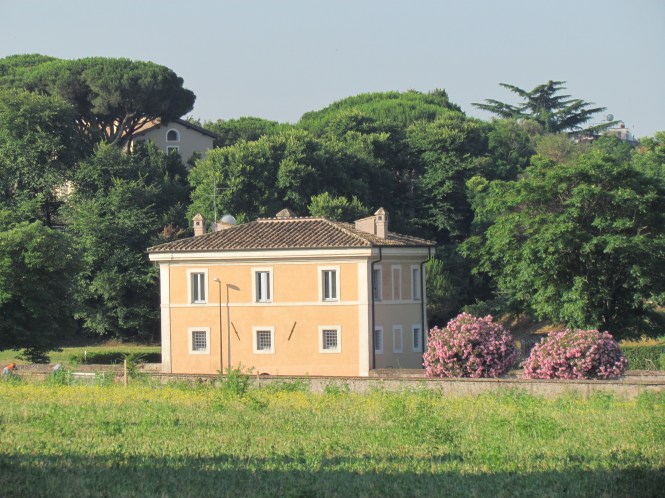
Azalea-lined paths and expanses of meadows bordering pastoral villas invoked rural Italy, with its rolling countryside and groves of olive trees, possibly the country’s most characteristic, next to lemon trees.
Within hours of my arrival in Rome it was evident that my ravenous appetite for the city would not be stilled with this trip, and within hours of my departure, I was also overcome by a hunger for additional Italian destinations, and for more sun, blooming flowers, burgeoning trees, rolling hills, the Mediterranean, sandy beaches…. For Goethe, his time in Italy was life- and career-changing. I suspect that few people can visit this country without being moved to their core. I know I was.
To guarantee a return to Rome, I had already followed the custom of tossing coins into the Trevi Fountain over my shoulder. Inadvertently, I also left a cardigan hanging over a fence somewhere south of the city. I hope this might ensure a return to rural Italy. So far, I am still dreaming about the fulfillment of both wishes.
🇮🇹 🇮🇹 🇮🇹 🇮🇹 🇮🇹 🇮🇹 🇮🇹 🇮🇹 🇮🇹 🇮🇹 🇮🇹 🇮🇹 🇮🇹
This concluded the reposts about my Rome trip. Thank you for traveling back in time with me.
Click here for the German version/klicken Sie bitte hier für die deutsche Version:
https://tanjaschimmel.wordpress.com/2016/08/22/eine-reise-kommt-selten-allein/
 tanja britton
Wonderful images and great descriptions and observations on our loved Roma 😘
LikeLiked by 2 people
I’m so glad to continue to receive your positive comments about my visit in Rome, dear Luisa. Thank you! 🙏
LikeLiked by 2 people
You’re more than welcome, dearest Tanja 💫
LikeLiked by 2 people
Enchanting, Tanja. I have never been to Italy, but you paint a beautiful picture here. Those mimosa flowers do look exotic.
LikeLiked by 3 people
Thank you, Michael. I’m so glad you found this enchanting. Rome and environs definitely had the same effect on me.
LikeLiked by 2 people
oh, wie schön!
LikeLiked by 2 people
Es freut mich, dass es Dir gefallen hat. Herzlichen Dank. 🙏
LikeLiked by 3 people
danke fürs zeigen dieser fotos. ich finde die bäume wirklich sehr beeindruckend. und überhaupt möchte ich auch gern mal nach rom reisen.
LikeLiked by 2 people
Ich hoffe, Du kannst Dir den Traum einer Romreise erfüllen.
LikeLiked by 2 people
danke. ich denke, das werde ich tun – vielleicht schon im nächsten jahr.
LikeLiked by 1 person
Wow!! The flora in Rome looks stunning!!
I imagine walking in the same places Jesus did was eye-opening!
Thank you for sharing such a beautiful article.
LikeLiked by 3 people
Thank you, Gavin.
The combination of natural beauty, rich history, and impressive architecture makes Rome endlessly fascinating to explore. I think I only scratched the surface with my four posts.
LikeLiked by 1 person
Beautiful Rome well shared with beautiful photos and description
LikeLiked by 3 people
Thank you very much. Visiting Rome was an amazing experience.
LikeLiked by 2 people
😊
LikeLiked by 2 people
Himmlisch.
Rom ist einfach himmlisch.
Ich habe mal in Rom ein Zitronenbäumchen gekauft für meinen Wintergarten.
Er war furchtbar schwer, aber ich durfte ihn damals mit ins Flugzeug nehmen!
Allerdings sollte ich ihn anschnallen 😅
Was für herrliche Erinnerungen du weckst.
Ich wünsche dir von Herzen, dass du zurückkehren wirst.
Viele liebe Grüße Brigitte
LikeLiked by 3 people
Herzlichen Dank, liebe Brigitte. Ich bin froh, daß meine Berichte schöne Erinnerungen bei Dir geweckt haben.
Es ist erstaunlich, daß Dir erlaubt wurde, ein Zitronenbäumchen mit ins Flugzeug zu nehmen! Irgendwie war vieles so viel einfacher vor nicht allzu langer Zeit.
Mal sehen, ob mir bzw. uns nochmals die Gelegenheit geboten wird, Rom zu erleben.
Ganz liebe Grüße,
Tanja
LikeLiked by 2 people
I’m fantasizing the sudden arrival at your door of a package containing that cardogan that’s been missing for nine years.
LikeLiked by 3 people
That would indeed be a great surprise, and not an unwelcome one. It used to be a favorite cardigan and has not been replaced since.
And knowing you, “cardogan” wasn’t a typo. Try as I might, I cannot find an online reference. Thank you for clarifying the alternate spelling.
LikeLiked by 1 person
I’m a poor typist, and i and o are next to each other on the keyboard.
LikeLiked by 2 people
You missed your chance to tell an interesting etymological story. 🙂
LikeLiked by 1 person
I love the mimosa trees!
LikeLiked by 3 people
Thank you, Diana. So did I. They were enchanting.
LikeLiked by 2 people
Italy is transformational, romantic and unforgettable. How can one NOT fall in love with Italy? ❤️💚
LikeLiked by 3 people
So true, Eliza. I assume you speak from experience.
LikeLiked by 1 person
I think it is my favorite country to visit. 🙂
LikeLiked by 2 people
Good for you!
LikeLiked by 1 person
A lemon tree in the middle of Rome! I think this says it all about the Italian way of life…what a heavenly spot to visit. I hope you do get there again and I’m so glad you are sharing the city through your eyes and lens. 😍 I do enjoy these Throwback Thursdays posts.
LikeLiked by 3 people
Thank you, Julie, I’m so glad you enjoyed traveling back to Rome with me. It was an eye-opening and enchanting experience.
LikeLiked by 2 people
You would be looking for a long time to locate a lemon tree outdooers in Canada. I guess the same is true for your Wahlheimat Colorado, Tanja.
LikeLiked by 3 people
That is very true, Peter. Growing a lemon tree might be possible in a green house with a higher humidity, but I won’t run into one by happenstance. 😊🍋🍋🍋
LikeLiked by 1 person
It was shocking to us on our recent trip to Spain, how many tropical plants there are, and as in Rome, even in the middle of the city. The mimosa tree is gorgeous. I wonder if it’s related to the smaller mimosa plant I’ve see in south Asia where the leaves curl up when you touch it. Maggie
LikeLiked by 3 people
Learning about different conditions on so many different levels is one of the appeals of travels, isn’t it. My travel experience is far more limited than yours but a glimpse into the Mediterranean botany was fascinating.
Thank you, Maggie!
LikeLiked by 2 people
Fascinating!
LikeLiked by 3 people
Thank you, Cathy. It was a fascinating trip.
LikeLiked by 1 person
Thanks so much for sharing this wonderful post about Goethe’s love for Italy and your experience with the rural side of the country. Yes, many of the plants, trees, and palm trees that grow in the Mediterranean, also grow in the tropics. What’s really interesting is that California also has Mediterranean climate because they experience hot summers with plenty of sunshine and mild winters with rain. California is part of the North American Mediterranean climate zone (NAMCZ), which also includes southwestern Oregon, a portion of western Nevada, and northwestern Baja California, Mexico.
LikeLiked by 3 people
Thank you, Maria. Having grown up near the 50th degree northern latitude, I had no experience with the plants I encountered in Rome and was fascinated by them. Unfortunately, I don’t have any understanding of plant distribution across the globe but I always think that I should try to learn more about global botany. It would be easier in connection with more travel, but that likely won’t come to fruition.
LikeLiked by 2 people
Danke vielmals für diesen interessant bebilderten Bericht. Er weckt Erinnerungen. Ich habe 1964 auch eine Münze in den Trevi geworfen, bin aber leider nicht zurück gekehrt.
Liebe Tanja, ich wünsche dir frohe Festtage und einen guten Rutsch in Neue Jahr.
Ernst
LikeLiked by 3 people
Lieber Ernst,
es freut mich, daß Du wenigstens in Gedanken zurück nach Rom gereist bist. Ich denke mir, daß viele Menschen Münzen in den Trevi Brunnen schmeißen, ohne jemals nach Rome zurückreisen zu können. Wir können aber wenigstens in Erinnerungen schwelgen und das ist auch etwas wert.
Auch Dir wünsche ich schöne Festtage sowie einen guten Rutsch.
Herzlichst,
Tanja
LikeLiked by 2 people
I love the fluffiness of the mimosa flowers – I’d have had to reach out and stroke them! 🙂
LikeLiked by 3 people
Thank you, Ann. The flowers were wonderfully fluffy–like soft feathers (I actually did stroke them 😊).
LikeLiked by 2 people
Ah, that made me smile! 😄
LikeLiked by 2 people
Hi Tanja
Ja, das Land, wo die Zitronen blühen, verführerisch, wie Goethe es sah. Zumindest verführte es ihn, viel jüngere Bauwerke als klassisch anzusehen.
Außer das Klima lieben wir fast alles an Italien, die Kultur und das Essen und Trinken besonders.
Danke für die feinen Fotos
The Fab Four of Cley
🙂 🙂 🙂 🙂
LikeLiked by 3 people
Lieber Klausbernd,
vielen Dank für den netten Kommentar. Verführerisch beschreibt Rom und Italien sehr gut. Und was das Essen und Trinken angeht, gibt es auch keinerlei Einwände. 😊
Liebe Grüße und Ciao,
Tanja
LikeLiked by 2 people
I so enjoyed this post, Tanja. The photos are evocative as well as pleasant, and I always learn something (or some ‘things’) from your posts. What struck me here was how familiar so much of the plant life is. The mimosa tree (Albizia julibrissin) isn’t native here, but it’s well established across portions of the state; people call it the ‘silk tree’ for obvious reasons. Everyone likes touching those silky flowers!
I was interested to see another familiar plant in the photo with the azaleas. The pink flowers on the right are oleander (Nerium oleander). They’re not native here either, but they’re grown everywhere. In fact, Galveston has an oleander festival every spring. They come in a variety of shades: white, pink, magenta, rose. Many of them froze to the ground when we had our terrible freeze a few years ago, but the rootstock held, and now they’re tall and blooming again.
LikeLiked by 3 people
I’m so glad you enjoyed the post, Linda. Thank you for letting me know.
I wish I had a better understanding of plants and their global distribution and variations. I keep thinking I need to read a book that provides an overview but I have yet to come across one.
LikeLiked by 2 people
The Royal Botanical Gardens which have some of the largest gardens (in UK, Ontario, and Spain), have an online database where you can find 1,433,000 global plant names, with images, and to my surprise even maps with exact native distributions. This is the link:
https://powo.science.kew.org
LikeLiked by 2 people
Thank you for the link!
LikeLiked by 1 person
When you type the name of the plant, it will give you a thumbnail, but then you have to press on the thumbnail again and it will give you the information and a world map with all the plant’s native and introduced ranges. You can move the map with your finger and see all the world’s regions. The BONAP’s North America Atlas only focuses on North America only, it will not include neighboring countries
LikeLiked by 2 people
I was mistaken, the Biota of North America Project (BONAP) maps only include both the United States and Canada ONLY. The term ‘North America’ includes 23 independent countries:
Canada, Mexico, United States of America, Bermuda,
Greenland, Saint Pierre and Miquelon, Central America and the Caribbean. The BONAP maps do not include these regions. I found that for example, Indian grass (Sorghastrum nutans) is native to all of Central America and the US and Canada.
LikeLiked by 3 people
Thank you for the added information, Maria.
LikeLiked by 1 person
Thank you, Tanja, for sharing memories and images of your Roman holiday. It’s nearly half a century since I was there, and it’s good to be reminded of a very special city.
LikeLiked by 5 people
Thank you, Mr. P. I hope I will make it back there before half a century lapses but, as we know, there are no guarantees.
LikeLiked by 3 people
I loved the images, but your prose was even more delightful! What a terrific post you have crafted! ✍️
LikeLiked by 3 people
Your comment lifted my spirits. Thank you so much! 🙏
LikeLiked by 3 people
Thanks for sharing images and impressions of Italy few get to see.
LikeLiked by 2 people
Thank you, Brad. Maybe you will get to see them as well. 😊
LikeLiked by 2 people
Wonderful ♥️
LikeLiked by 1 person
Thank you!
LikeLike
Was für eine Blumenpracht liebe Tanja und so schöne Erinnerungen! Wer würde da nicht wiederkehren wollen 🙂 Ich war bislang nur in Venedig, aber auch das läßt mich nicht los. Ich wünsche dir, daß deine Träume in Erfüllung gehen und du noch mal eine schöne Zeit dort verbringen kannst! LG Almuth
LikeLike
Dankeschön, liebe Almuth. Die kurzen Einblicke in die Flora Italiens in und um Rom haben es mir angetan. Venedig war auch beeindruckend, doch auf andere Art. Vielleicht schaffen wir es beide nochmals nach Italien.
LikeLiked by 1 person
Informative Content…
LikeLiked by 1 person
Thank you!
LikeLiked by 1 person
[…] Throwback Thursday: Travel begets more Travel […]
LikeLiked by 1 person