For humans, the term snowbirds designates individuals who try to escape winter and snow by moving to warmer, more temperate climes for a period of time.
In the avian world, John James Audubon applied the name Snow Bird (Fringilla nivalis) to what has since been renamed Dark-eyed Junco (Junco hyemalis). Etymologically, both species names are derived from Latin: nivalis from nix, meaning “snow,” and hyemalis from hiems, meaning “winter” (of which the wintry adjective “hibernal” is also a derivative).
The Birds of America, Audubon’s magnum opus, includes a pair of Snow Birds on plate 13. Audubon’s illustration and description of his encounters with these birds in Louisiana can be found by clicking on this link. They make it clear that he was looking at what we now call Slate-colored Juncos, one of six distinct regional subspecies of Dark-eyed Juncos, and the only one widespread in the Southeast. At one point, all six were considered separate species but have since been lumped together (at least for the time being). Most populations tend to breed in more northerly climes before migrating to more southerly regions during the winter, where their arrival might coincide with that of snow, hence their name. According to Audubon.org,
In winter over much of the continent, flocks of Juncos can be found around woodland edges and suburban yards, feeding on the ground, making ticking calls as they fly up into the bushes. East of the plains the Juncos are all gray and white, but in the West they come in various color patterns, with reddish-brown on the back or sides or both; some of these were once regarded as different species. The forms have separate ranges in summer, but in winter several types may occur in the same flock in parts of the West.
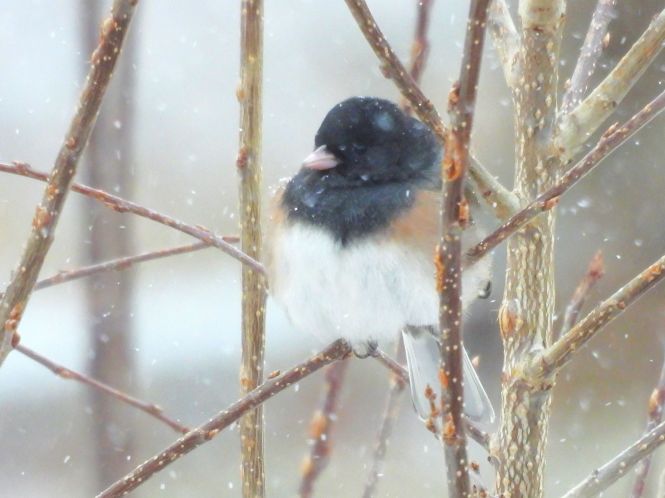
A true Snow Bird: Dark-eyed Junco, Oregon subspecies (“Winterammer” in German). The others are Slate-colored, Pink-sided, White-winged, Gray-headed, and Red-backed. In Colorado, we get to see all but the Red-backed Junco. Conveniently, all have in common conspicuous white outer tail feathers which flash when the birds are in flight and can aid in identification.
While I wish I could present you with attractive images of all six different subspecies of Dark-eyed Juncos, in today’s post, I’m applying the term Snow Bird more broadly to all those feathered friends who, for part of their lives, have to deal with snow. What follows is a small selection of sightings in Colorado Springs.
My first gallery shows a handful of birds who bless us with their presence in this part of Colorado year-round. Not only do they manage to survive frigid winter temperatures, they also have to adapt to hot summer days that might see the thermometer climb into the torturous 90s (30s in Celsius) or, rarely, into the furnatial 100s (40s in Celsius). How do they do it?
To enlarge a photo, click on it. To read its caption, hover cursor over it.


The availability of food is the prime motivator for most living beings and among two of our year-round residents, this is brought into berry focus by American Robins and Cedar Waxwings. Though some are medium-distant migrants, they often remain in a region dependent on the availability of food. Probably among the few living creatures who don’t need a reminder to “eat more fruit,” flocks of them will roam different neighborhoods in search of fruit left over from the previous season, including juniper berries. If one gets lucky, it’s possible to observe them during one of their feeding frenzies, when they gobble one berry after the other, too preoccupied to mind the nearby spectator and photographer. My heart always leaps for joy when I happen across what I call a “happiness” or “cheerfulness” or “delight” of robins or waxwings or both (they often frequent the same stands of trees).


Then there are the snow birds who come here for several months because our central Colorado winters are mild compared to those in their northern breeding ranges, with some geese summering as far north as the Alaskan or Canadian Arctic. Others, such as kinglets and dippers migrate vertically from higher elevations to lower ones to escape harsher conditions. I will never cease to marvel at North America’s only aquatic water bird, the American Dipper, who can walk and swim underwater with open eyes in search for aquatic insects in water that was ice only a minute ago.


While the birds in the gallery above are currently expected along the Front Range of the Rocky Mountains, the ones in the gallery below are not. At this time of year, the Hermit Thrush is supposed to be in more southern states or Mexico, the Rusty Blackbird in the southeastern United States, and the Golden-crowned Sparrow on the California Coast. Instead, the latter has been enhancing the magic of Garden of the Gods with its magical presence since it was first sighted in early December 2024, living more or less under the same group of shrubs.


🦉 🦉 🦉 🦉 🦉 🦉 🦉 🦉 🦉 🦉 🦉 🦉 🦉
Dear Snow Birds. Whether you are expected, unexpected, or rare, I’m grateful for each one of you and full of admiration for your ability to brave Colorado’s fickle winters, which can range from mild to severe. I worry about you when conditions are particularly harsh, as is the case right now, and I hope that the food and water that I and fellow bird lovers put outside help you survive. The buffet will keep getting refilled, so please stop by often and stay as long as necessary.
 tanja britton
Eine interessante Auflistung von Vögeln, die bei dir im Winter zu beobachten sind. Dabei sind auch einige die man bei uns beobachten kann ,aber auch welche die ich nur aus Büchern kenne.
Danke für dein Beitrag .
LG Werner
LikeLiked by 1 person
Danke für Dein Interesse und Deinen Kommentar, lieber Werner. Ich finde es auch immer interessant zu lernen, welche Vögel es sowohl hier als auch in Europa gibt.
Ich hinke etwas mit Bloglesen hinterher, besuche aber Deinen bald wieder!
Liebe Grüße,
Tanja
LikeLike
Lovely selection of birds toughing it out. Luckily we don’t get these conditions anymore (tempting fate).
Check the id on the White-fronted Goose. I think it may be a Greylag as white-fronts have dark barring across the belly.
LikeLiked by 1 person
Can’t edit my comment but enlarging the image I see it’s a juv Greenland White-front. What do Americans say “my bad”
Many apologies for doubting you.
LikeLiked by 1 person
No need to apologize! I appreciate getting feedback, have been wrong many times before.
LikeLiked by 1 person
It will teach me to open the image to full size first before opening my mouth!
Greenland White-fronts are quite rare visitors, juveniles even more so, to the UK, ours tend to come from Siberia and the bills are pinker.
LikeLiked by 1 person
I don’t have enough experience to ID the different subspecies (or regional variants). As we all know, sometimes ignorance is bliss. 😊
LikeLiked by 1 person
Thank you, Brian. I’m so impressed with birds’ ability to survive so many different conditions.
I also appreciate your thoughts on the goose. The Graylag Geese we see here are almost exclusively domestic, or descended from domestic geese.
LikeLike
Die Winterammer habe ich bei Freunden in Texas gesehen, American Robbin auch, aber der Seidenschwanz, der fehlt mir noch in meiner Vogelsammlung. Leider haben wir in diesem Jahr unsere USA Birding Reise abgesagt, bzw gar nicht gebucht. Es ist alles etwas sehr Ungewöhnlich, was in den USA passiert. Man muss abwarten. Ich hoffe weiter auf Frieden, auf Naturschutz, KLimaschutz und freundliche Menschen. Mich erfreut DEin Beitrag jedenfalls sehr.
Dir einen herzlichen Gruß
Maren
LikeLiked by 1 person
Liebe Maren,
wie schön, daß Du die Bekanntschaft mit einigen dieser Vögel gemacht hast. Hoffentlich begegnest Du auch irgendwann mal einem Seidenschwanz. Diese Vögel sind sehr charismatisch.
Ich kann verstehen, daß Ihr keine USA-Reise unternehmen wollt. “Ungewöhnlich” ist eine starke Untertreibung für das, was hier vor sich geht. Es ist wie ein furchtbarer Alptraum, von dem man bzw. frau nicht erwachen kann. Die Attribute, die Du da in Deiner Wunschliste aufzählst, sind das genaue Gegenteil von dem, was die hier Regierenden anstreben. Ich befürchte das Schlimmste . . . 😢
Dir alles Gute,
Tanja
LikeLiked by 1 person
Ich auch liebe Tanja, ich auch.
Dir auch alles Gute, möge bald der Fühling kommen
Maren
LikeLiked by 1 person
Danke, liebe Maren. Versuchen wir, tapfer und hoffnungsvoll zu bleiben.
LikeLiked by 1 person
Great post and wonderful images!
Thanks a lot for sharing, dear Tanja❣️❣️❣️
LikeLiked by 1 person
As always, thank you for your enthusiastic response, dear Luisa. It’s much appreciated! 🙏
LikeLiked by 1 person
You are so very welcome my dear Tanja .
It’s my pleasure as always! 🤗
LikeLiked by 1 person
Hi, Mrs. Tanja-
You are very knowledgeable in this field!! Thank you for sharing all of the interesting information and the beautiful photos.
I think it is a wonder that all of the “Snow Birds” were crafted with dull colors! I imagine this is so that they can blend in with the winter scenery.
Wishing you the best in this cold winter!
~Gavin
LikeLiked by 1 person
Thank you, Gavin, I’m glad you enjoyed a glimpse of our snow birds.
Your observation about the color of birds’ colors is very astute. I think it’s most obvious for those birds whose plumage changes completely during different seasons, such as ptarmigans. In the summer, their feathers are brown and mottled to blend in with the vegetation, and in the winter, the feathers are white, to blend in with the snow. That’s so amazing!
Best wishes,
Tanja
LikeLiked by 1 person
That definitely is amazing!!
LikeLiked by 1 person
While some find the adjective hibernal,
Being Latin, is therefore infernal,
You’ve used it quite boldly
In weather that’s coldly
To warm up this page in your journal.
LikeLiked by 1 person
To call hibernal infernal
Is bold and cold.
But your inspired rhyme
Makes everything fine.
LikeLiked by 1 person
Should you so wish, there’s a way to keep from adding a space between each line in a poem and the next. When you get to the end of a line, type Shift-Enter or Shift-Return to create a new line immediately after the previous one.
LikeLiked by 1 person
Yes, thank you!
LikeLike
Thanks for that tip on line spacing. I found a workaround, but yours is much simpler.
LikeLiked by 1 person
I am very touched by your last paragraph – and I hope that many people think like you!
Kindest regards, Christa
LikeLiked by 1 person
Thank you, dear Christa. I know there are many people who feel this way about birds and I’m pretty sure you are one of them. 😊
All the best,
Tanja
LikeLiked by 1 person
What a lovely, lovely post! Sure made me smile. Amazing how these birds can survive winter. We have the same situation in Maine with many birds that spend the winter. Wonderful pictures, especially of that owl.
LikeLiked by 1 person
Thank you so much, Laurie. It makes me happy to know you enjoyed the post. And even happier to know that you also take care of your snow birds. 😊
LikeLiked by 1 person
Great collection! I feel like most of what I’m seeing this time of year is geese and mourning doves. Clearly I need to be more observant!
LikeLiked by 1 person
Thank you, Diana. I love birds so much that I constantly look and listen for them. Denver has so many wonderful birding hotspots and I’m sure you will see them everywhere once you start looking.
LikeLiked by 1 person
Great post, Tanja. Thank you for reminding me how much I love birds, and – back in the day – how much Mrs P and I loved adding new species to our “list” of North American birds. We spotted most of the birds you feature at some point, but never in the depths of an American winter – we’re not THAT brave! 🙂
LikeLiked by 1 person
Thank you, Mr. P. How nice that you were able to see most of these birds during one of your trips to North America. Compared to some places, our winters are really not that bad. It gets cold and snowy, but usually only for short stretches of time with warmer periods in between.
LikeLiked by 1 person
Beautiful set of images of birds… I do love birds; they are simply wonderful. (Suzanne)
LikeLiked by 1 person
Thank you, Suzanne. I couldn’t agree more with your opinion about birds. 😊
LikeLike
What an abundance of different bird species you have in your neck of the woods at this time of the year, Tanja! I’d bet that some of them have migrated all the way from Canada.
LikeLiked by 1 person
Thank you, Peter. You are right: some of our snow birds will be in Canada come spring. Maybe you will get to see them there! 😊
LikeLike
I wish these birds well. I might not have said this a number of years ago, but then I started reading your articles.
LikeLiked by 1 person
Thank you, Neil. You don’t know how happy your statement makes me. 😊🙏
LikeLiked by 1 person
Toi toi toi für deine Wintervögel.
Ich zeigte ja vor einigen Tagen einen Weißstorch der schon zurück ist.
Leider haben wir gerade heftige Minusgrade.
Aber er hat warme Federn.
Nur die Beine und Füße frieren.
Aber sie stehen deswegen ja auf einem Bein.
Immer abwechselnd, so bleibt immer ein Bein warm.
Deine Vögel sind genauso schlau und du gibst ihnen Nahrung.
Alles wird gut 🥰
Was man von der Politik gerade nicht erwarten kann.
Ich bin erschüttert 🇺🇦
Sei gegrüßt von den Bees liebe Tanja
LikeLiked by 1 person
Dankeschön, liebe Brigitte. Ich weiß schon, daß Vögel gut ausgerüstet sind, bewundere aber trotzdem ihre Fähigkeiten, sich an so viele verschiedene Bedingungen anzupassen.
Wie Du (und viele andere) sind auch wir erschüttert über das, was hier gerade passiert, und welche globalen Auswirkungen das hat. Es ist wie ein furchtbarer Alptraum . . . 😢
Paßt auf Euch auf!
Herzlichst,
Tanja
LikeLiked by 1 person
Ja, Vögel sind einfach großartig.
Das Wort mag ich auch schon nicht mehr schreiben, weil es zu Nummer 47 liebsten Worten gehört.
I’m permanently exhausted at time.
Die Nachrichten hier wie dort machen mich krank.
Aber man darf die Hoffnung nicht aufgeben.
Und wie ein Zeichen von oben fliegen gerade Kraniche über meinem Haus.
Pass auch gut auf dich auf, liebe Tanja.
Liebe Grüße Brigitte und Buddylein
LikeLiked by 1 person
GsD gibt es noch Vögel, liebe Brigitte, sonst wäre alles noch schwerer zu ertragen. Aber wir machen es ihnen nicht leicht, und ich befürchte, daß die große Mehrheit der Menschen andere Prioritäten hat als Artenerhalt und Umweltschutz, besonders viele Politiker. Das sollte und müßte anders sein, denn ohne Natur und gesunde Umwelt macht alles andere kein Sinn.
Ohne Hoffnung zu leben ist schwer, aber es ist auch schwer, Zeichen der Hoffnung zu finden. Ich hoffe, es wird alles nicht so schlimm, wie wir befürchten.
Genieße die Kraniche!
Herzlichst,
Tanja
LikeLiked by 1 person
Our winter birds are esp. appreciated, for sure. This cold weather we’ve been having has caused a feeding frenzy at our feeders. We sometimes have to fill the feeders two or three times a day, particularly thistle and meal worm feeders. Hope it helps!
LikeLiked by 1 person
Your birds say “thank you, dear Eliza.” It’s comforting to know that there are many bird lovers who do their best to help these marvelous creatures survive.
LikeLiked by 1 person
Wonderful post and photos, Tanja, I love your Dear Snow Birds. Impressive Great Horned Owl, magnificent! By all means, this winter many birds have become Snow Birds for the first time around the country with all the crazy snow storm patterns. I often wonder if snow confuses them.
LikeLiked by 1 person
Thank you, Donna. I often worry about the birds when the weather is so crazy. They will need to learn to adapt to new conditions, just as we humans. It will not be easy for anybody.
LikeLiked by 1 person
Danke für die vielen schönen Aufnahmen und den treffenden Text dazu.
Liebe Grüsse. Ernst
LikeLiked by 1 person
Es freut mich, daß es Dir gefallen hat, lieber Ernst.
Herzlichen Dank für Deinen Besuch und Kommentar.
Tanja
LikeLiked by 1 person
You are spot on Tanja, these winter birds are a delight. I think seeing them in the snow covered trees and shrubbery is such a treat for the eyes and soul. I see few birds here in Canada in the winter, so thanks for sharing this! 🐦⬛☃️
LikeLiked by 1 person
Thank you, Julie, I’m glad you enjoyed a selection of our snow birds. We have many more birds in the summer, but I’m very grateful for the hardy ones who can survive the winter here. It would be much harder for me to bear the season without the presence of our feathered friends.
LikeLiked by 1 person
What beautiful pictures Tanja! We have a bird feeder a few feet from our window where I sit and I love watching the winter birds too.
LikeLiked by 1 person
Thank you, Diane. Your birds also thank you for feeding them. 😊🐦
LikeLike
Thanks for such an interesting post about the variety of birds surviving in the winter. They have unique skills that have made them adapt so efficiently to their environment. This adaptability is in itself nature’s wisdom. It’s made to work in perfect order. Thank you!
LikeLiked by 2 people
Thank you, Maria. Nature and its creatures are very wise indeed, but I’m afraid we humans have interfered so much that what has been true for eons is now changing and we can no longer rely on the old wisdoms.
LikeLiked by 1 person
Particularly old wisdoms such as Elon Musk’s. “Musk’s actions on climate change are sometimes contradictory. In 2021, he committed $100 million to a contest intended to help accelerate technologies that can remove carbon dioxide from the atmosphere. But last year, he spent the equivalent of nearly seven weeks in flight, criss-crossing the globe in heavily emitting private jets.
“Musk’s track record on the policy front [is] poor, and putting our faith in him as some sort of purported climate champion seems increasingly ill-advised,” said Michael Mann, a climate scientist at the University of Pennsylvania.”-Politico
LikeLike
Putting our faith in any of his suggestions is ill-advised, to put it mildly. He is wrecking not only the climate but all the institutions of this country. I do not understand how he is allowed to wield the power he does.
LikeLiked by 1 person
😞
LikeLike
Sadly so!
LikeLike
We share many of the birds you’ve shown here; how I wish we shared the robins and waxwings a little more often! Like Eliza, our below-freezing temperatures have increased the number of birds coming to the feeders, and it’s been a delight to see so many goldfinches and pine warblers. I do have one pair of chickadees that aren’t nearly ready for hand-feeding, but they no longer fly away from the feeder when I go out, and if they’re not around when I refill the feeders, it only takes a whistle and here they come!
Today, for the first time in months, I heard a clear, two-note call: familiar, and yet not. After some thought, and a trip to the audio files, I realized I was hearing the spring song of a male black-capped chickadee! Then, I realized that the whistle I use when I fill the feeders is a similar two-note call. Perhaps that’s the reason the birds come so readily!
LikeLiked by 1 person
I’m glad you have been enjoying higher numbers of visitors to your feeders, Linda. And it’s very nice to imagine your chickadees waiting for your two-toned whistle before visiting the feeder. Apparently you speak fluent chickadese! 😊
LikeLiked by 1 person
Your bird residents are delightful and clearly very adaptable too. I hope that there are many other people also helping to keep them fed through winter!
LikeLiked by 1 person
Thank you, Ann. I know there are many bird lovers all around the world who care and provide for the birds in their neighborhoods. Let’s hope it makes a positive difference!
LikeLiked by 1 person
Such lovely images dear Tanja. I adore them all, but the Dark-eyed Junco in the snow really touched me. There are so many beautiful birds right in your backyard. I am glad there are people who care for our avian friends.
LikeLiked by 1 person
Thank you, Takami. I’m glad you enjoyed the post. I also love it when the juncos live up to their name and are all fluffed up while the flakes are swirling around them. 😊
LikeLiked by 1 person
Thanks for sharing your snowbirds Tanja. We also have dark-eyed juncos, but the slate-colored variety. I think they look like feathered ping-pong balls as they bounce along the ground or our deck looking for a snack to eat. Based on my daughter’s description of winter in Denver, your winters are a bit milder than ours in Illinois. I just wish the European Starlings would migrate right past and not stop to intimidate the birds that need the extra caloric intake during the cold. Can Spring be far behind now?
LikeLiked by 1 person
Thank you, Brad. I love juncos–they help me get through winter. It’s nice that we have so many varieties here in Colorado.
As far as spring in the Rockies, I wouldn’t hold my breath until we are halfway into May which is when we usually get our last blizzard.
I hope your starlings will share space and food with your other birds. They are here to stay.
LikeLiked by 1 person
Ugh, WP lost my long comment. Won’t take the time to replicate, but always enjoy seeing the Juncos as they remind me winter is a coming and their departure is a signal that it is time to start bring out the cooler clothes. Smiled with I saw your Dipper – that bird has been eluding me for a couple of years now – apparently need to make my way out there! Enjoyed the collection.
LikeLiked by 1 person
Thank you, Brian. Sorry about losing your comment. That has happened to me, too, and it’s very frustrating. I try to copy my comments before I hit the “send” button, but I don’t always remember.
I love dippers. They are so amazing, wading and swimming in near-freezing water with their eyes open. I hope you not only will get to see one, but also get to hear it–their songs are lovely (https://www.allaboutbirds.org/guide/American_Dipper/sounds)
LikeLiked by 1 person