
If the “bobkitten” encounter I wrote about two posts ago was unexpected, it wasn’t my first with this species and, with any luck, won’t have been the last one in our local environs. I’m not sure the same can be said about my meeting with the protagonist of today’s post, which was even more unexpected. As opposed to the young bobcat I happened across by myself, I can’t take credit for finding the winged wonder in the featured photo above, which my husband has imaginatively named “Bald-Eagle-with-a-toupee.”
I am subscribed to a WhatsApp group that reports rare or otherwise special bird sightings in our corner of Colorado and on Monday, March 10, someone mentioned having come across a Facebook post by a surprised Texas birder whose niece had seen and photographed the bird above in Pueblo County in Colorado just south of El Paso County, where we reside. As the range map shows, her surprise was justified as the species is not expected in our state.
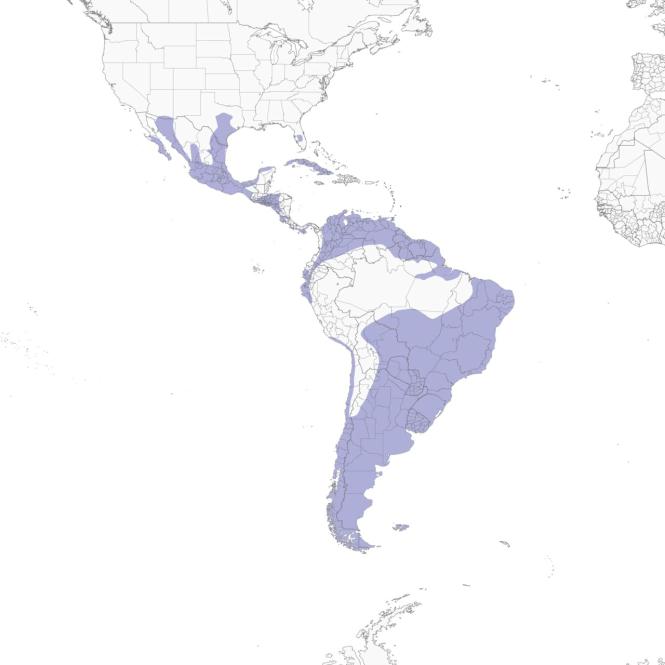
Range map of the bird in question from Cornell Lab of Ornithology
The following day, Pueblo County’s most expert birder was able to find the out-of-place visitor again and since then, Colorado’s birding community has been atwitter with excitement (though acroak would be more apropos as the bird’s vocalizations have nothing twittering about them and resemble a corvid’s much more).

Surprise visitor on a power pole
If you live in, or have visited, parts of Texas, Mexico, the Caribbean, or Central or South America, you might have recognized this striking raptor as a Crested Caracara, or Schopfkarakara in German (Caracara plancus), which Cornell’s All About Birds website describes as follows:
The Crested Caracara looks like a hawk with its sharp beak and talons, behaves like a vulture, and is technically a large tropical black-and-white falcon. It is instantly recognizable standing tall on long yellow-orange legs with a sharp black cap set against a white neck and yellow-orange face. The Crested Caracara is a bird of open country and reaches only a few states in the southern U.S. It flies low on flat wings, and routinely walks on the ground.
It is not everyday that I have the opportunity to make the acquaintance of a novel bird species so close to home, especially of one so far out of its usual range. So when fellow birders still reported it on Wednesday, March 12, I drove the relatively minor distance of fifty-five-plus miles (88 kilometers). I need not have worried about finding the exact location at the end of a twelve-mile stretch (19 km) on a gravel road. Parked cars and scattered groups of people with binoculars, spotting scopes, and cameras reassured me that I was at the right spot.

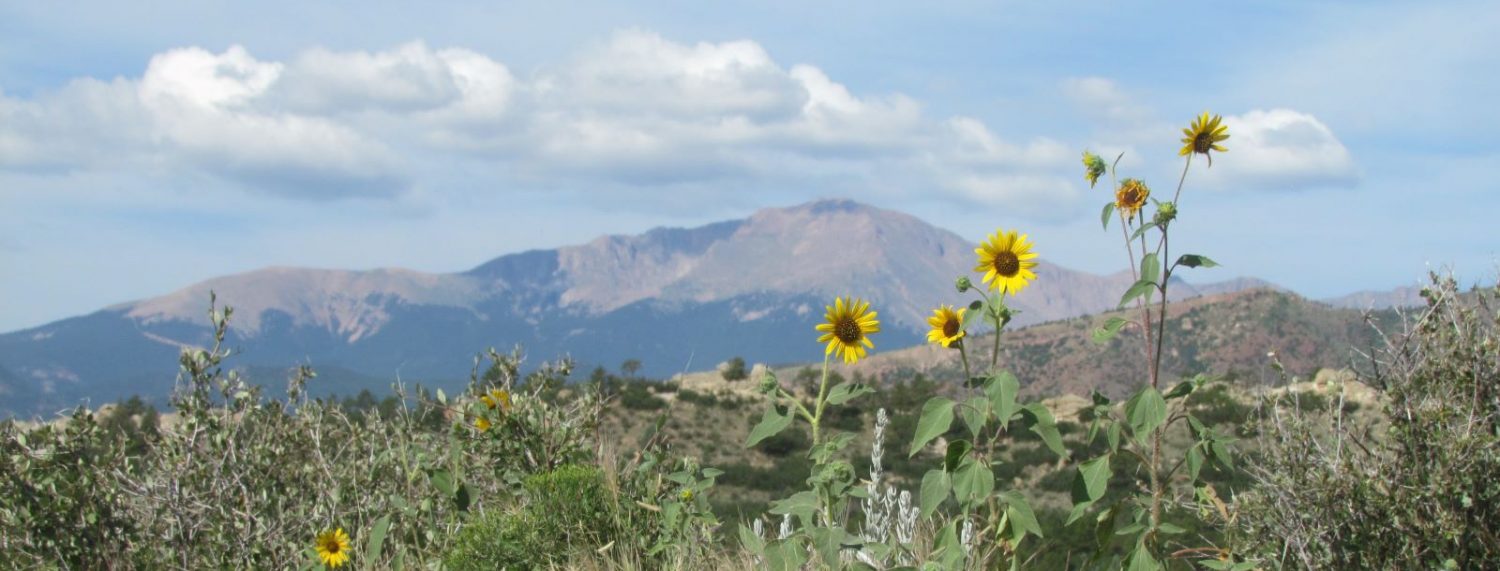
Pikes Peak seen from Pueblo County, near the location where the bird has been hanging out
It is also not everyday that one gets to see the hoped-for bird within minutes of arrival but thanks to numerous helpful individuals who had been observing its movements before my arrival, this is exactly what happened. Conspicuous the Caracara certainly was, both in appearance and stature. A creature that measures 21 to 24 inches (53 to 61 centimeters) from its beak to its tail and balances on long legs is definitely easier to spot than a tiny, 4 to 5 inch-long (10 to 13 cm) warbler moving around the canopy of a tree. Furthermore, it seemed completely unfazed by the many eyes and lenses upon it.

Crested Caracara on the ground

Crested Caracara on the ground next to a cow
As we learned from the local rancher, it had been present for at least ten days previously; he first noticed it when it attempted to steal the afterbirth of one of his cows after she had given birth. Reportedly, Mama Cow did not look favorably on the Caracara’s attempted thievery and defended her placenta, intending it for her own consumption. The fact that cows are placentavores was news to me. They seem to do so to still their hunger after a delivery, replenish some of their depleted protein stores and, perhaps most importantly, remove food from a potential predator who might be attracted by the afterbirth’s smell and pose a threat to the newborn calf. As an aside, some humans likewise engage in placentophagy or placentophagia, though it is not recommended (read the Mayo Clinic’s statement here).
Like vultures, Caracaras eat mostly carrion but also feed on live animals ranging from insects to mammals. One suspects that our visitor has been able to nibble on at least portions of placentas following the deliveries of several pregnant cows as it has remained in the vicinity for nearly three weeks, and possibly longer (it was still present as of March 18).
I never observed it feed, but I watched it walk, perch on different power poles, and fly short distances. As I have since learned, Caracaras are frequently found on the ground where locomotion is facilitated by their long legs. Another fascinating detail is their ability change the color of their facial skin patches, which can range from a light yellow to red, based on their mood. Both sexes are indistinguishable from a distance, so we don’t know if this a male or female.

Crested Caracara on a utility pole, even a little closer
As unique as this sighting was for me, it actually represented the 9th documented appearance of a Crested Caracara in Colorado. Others have been observed as far north as Minnesota and Ontario and Prince Edward Island in Canada. Nobody knows for sure why some birds occur so far from their typical habitat but it’s likely related to unusual weather events or problems with navigational skills. While it’s exciting to see a bird outside its normal range, the experience always leaves me feeling slightly sad. Most of the time we don’t find out what happens to the individual and whether it makes its way back to where it’s supposed to be.
Wherever this resourceful bird came from and however it arrived, my hope is that it will be able to reconnect with its kin. Good luck, Caracara!


Interesting that you and I should both publish a post on the same day about encountering a bird outside its normal range, albeit that yours presumably got there naturally while mine most definitely did not! The Crested Caracara is a wonderful bird, and although I’ve never seen this species in the wild I once enjoyed watching the antics of one at a Bird of Prey Centre a few miles from here – very impressive and entertaining. Yet again, I find myself jealous of your encounter.
I just had to laugh at your sentence that reads “Parked cars and scattered groups of people with binoculars, spotting scopes, and cameras reassured me that I was at the right spot.” I totally recognise that experience…when multiple birders are gathered in one spot wielding expensive pieces of optical equipment you can be sure that something unexpected is in the vicinity!
LikeLiked by 1 person
Yes, that’s a funny coincidence, Mr. P (or is it synchronicity? 😊).
I suspect that the caracara flew to Colorado on his own wings and wasn’t smuggled in someone’s luggage, but who knows.
Birders definitely resemble one another, regardless of country.
LikeLiked by 1 person
That’s an amazing bird! Thanks for sharing. Definitely new to me.
LikeLiked by 1 person
Thank you. It was new to me as well! 😊
LikeLiked by 1 person
Your post points out yet again the annoying fact that birds refuse to consult range maps and to stay in their proper places. A.D., which has long stood for anno domini, could as well refer to avian disobedience. And speaking of appropriateness (or the lack thereof), the first part of the name crested caracara could refer to the peaks of your fabled mountains.
LikeLiked by 1 person
Avian disobedience sounds very harsh. I prefer the term avian dislocation. 😊
I’m sure the caracara prefers to carry his toupee-like crest on his head, rather than an entire mountain range.
LikeLiked by 1 person
I recognized the Caracara immediately; they’re so common here that I often see one when I’m out and about. You mentioned a few things that I’m familiar with: their recognizable flight patterns, their feeding with vultures, and their tendency to walk hither and yon. I’ve seen them hunting grasshoppers in the refuges: rather successfully, as a matter of fact. There was a mated pair that lived at the Brazoria refuge for a time; they provided me with one of my own unexpected experiences.
I’m so glad you were able to see this handsome bird. It’s one of my favorites. One day on Galveston Island I saw one perched on a power pole just like the one in your photos. For some reason, a mockingbird took offense at its presence and made a concerted effort to drive it away. It took a while, but Caracara finally flew off: perhaps tired of the racket.
LikeLiked by 1 person
I’m not surprised that you knew this bird right away, Linda, and that it’s among your favorites. It must be fun to run into them regularly and get to know their behavior. Apparently, they interact a lot with their peers; I have read about some fun interactions.
I’m always amazed at the audacity of smaller birds when it comes to harassing raptors. The latter seem able to end the former’s life easily, yet most of the time, they will take off to avoid conflicts.
LikeLiked by 1 person
Like Linda, I knew immediately what this big bird was! I don’t see them as often here in north Austin, though just the other day, one winged over my neighborhood. Further south, they’re common in the sky, perched on various poles, and on the ground.
Your description of the toupee is perfect! I’d never thought about it, but yeah, that’s what the dab of black at the head looks like. Fun post, Tanja!
LikeLiked by 1 person
Thank you, Tina. I didn’t know if they were common in Austin, but it’s nice to know that you get to see them from time to time.
I can’t really take credit for the toupee as it was my husband’s suggestion, but I also think it describes the head perfectly. It would be interesting to see that toupee erect in order to be able to relate to the “crest.”
LikeLike
Oh, my goodness! It really does look like a toupee. 😁
LikeLiked by 1 person
I thought so, too! 😊
LikeLiked by 1 person
Morning, Tanja. Maybe more than one example of this species is in your area, but hasn’t/haven’t been spotted yet?
LikeLiked by 1 person
I wonder about that all the time, Neil. If it hadn’t been for someone posting a photo on Facebook and someone else reacting to it, we might have never learned of the presence of this bird. It’s possible that there are other individuals around, and other rare species, too, that no one ever gets to see. It’s tantalizing to imagine!
LikeLiked by 1 person
It does indeed look like a bald eagle with a toupee, great description. Fantastic rare bird sighing and a +1 that may be difficult to repeat, especially in Colorado. I’ll wager some of the recent very strong storms blew this unsuspecting bird off course. Hopefully it will be able to find its way home. Or maybe it will stick around to start a new northern installment of Caracara?
LikeLiked by 1 person
Thank you, Brad, I was very happy to be able to see this caracara as a life bird in Colorado. I also think it’s unlikely that I will see another one in Colorado, but who knows. Things are changing and they might start to expand their range north. In order for them to start a new northern population, we will need at least one more bird of the opposite sex to get lost here. 😊
LikeLiked by 1 person
Or one carrying eggs…?
LikeLiked by 1 person
An interesting thought. It would have to be perfect timing, and the bird would need to be able to do this all by herself.
LikeLiked by 1 person
That would be a challenge as a single mom in a new neighborhood.
LikeLiked by 1 person
Yes, it would be.
LikeLiked by 1 person
Oh wow! I’ve seen Caracaras in Peru and Bolivia (I don’t know if they were crested which type), but to see one in Colorado – lucky you! Maggie
LikeLiked by 1 person
Good for you for having seen caracaras in S. America. This bird was definitely not on my radar, but I’m not complaining. 😊
LikeLiked by 1 person
Hi, Mrs. Tanja-
What a neat encounter! I have never seen one of these birds before! I imagine it was a joy to see it! I too hope that it can find its way home, wherever that may be.
Thank you for taking us on this adventure!
Gavin Broom
LikeLiked by 1 person
Thank you, Gavin. Seeing the caracara made me very happy. Let’s hope (s)he will be fine.
I just looked at reports of caracara sightings in Texas, and they definitely occur in the greater Houston area. I’m sure you would be able to find one if you started looking. Maybe you could go to a Nature Center and ask, in case you are interested.
Let me know if you see one!
Tanja
LikeLiked by 1 person
Oh, how interesting! I may have to look into that! 🙂
LikeLiked by 1 person
👍
LikeLike
Congratulations on a wonderful find!
We’re fortunate here in west-central Florida as the Crested Caracara breeds locally. Fascinating birds. Around here, they tend to nest in rather short palm trees which have had the wind flatten their tops. Perfect bowl-shape left for the big birds.
LikeLiked by 1 person
Thank you. This was definitely a fun encounter and hundreds of birders from all over the state came to see this bird.
How nice that you have a local breeding population in what does sound like a perfect treetop. I once read a book about this species and was very impressed with their intelligence and antics. Would love to spend more time with them.
LikeLike
du lebst wirklich an einem schönen ort. tolle bilder wieder. dieser vogel ist interessant. scheint die lage zu überblicken. 🙂 liebe grüße!
LikeLiked by 1 person
Vielen Dank, das stimmt. Die Landschaft ist wirklich wunderbar und der Vogel war eine tolle Überraschung. Deine Beschreibung paßt sehr gut.
Herzliche Grüße zurück,
Tanja
LikeLiked by 1 person
The word “caracara” is derived from a South American indigenous language, likely Tupi, and refers to the bird’s unique calls. Crested Caracaras belong to the falcon family (Falconiformes), while Bald Eagles belong to the eagle family (Accipitridae). According to IFAS: “The Importance of Cattle Ranches to Caracara
In Florida, up to 80% of nesting pairs of northern crested caracara are found on private cattle ranches. In fact, caracaras that breed on lands used for cattle grazing appear to have a higher breeding success and produce more young than those that breed in managed natural habitat. This may be because shorter grass increases visibility and reduces the birds’ risk of being killed by other predators, or makes it easier for caracaras to walk around and hunt on the ground. It could also be that these cattle lands provide increased nutrients for insects that become concentrated at dung piles, which the caracara actively flip during hunting. Overall, pasturelands are the most important habitat for the continued survival of this species in Florida, and their conversion to urban land uses is a major threat to northern crested caracaras.”-https://edis.ifas.ufl.edu/publication/UW452
The importance of pasture lands may apply to other States as well.
What makes a bird a ‘vagrant’? According to an AI search I did:
Causes of Vagrancy:
Weather: Strong winds or storms can push birds off course during migration, causing them to end up in unexpected areas.
Navigation: Some birds may have faulty internal compass mechanisms, leading them to deviate from their normal routes.
Inexperience: Young, inexperienced birds may get lost or wander off course during their first migrations.
Climate Change: Climate change can lead to shifts in species ranges, with birds potentially venturing into new areas as conditions become more suitable.
Population Growth: Growing bird populations might lead to more individuals venturing out of their normal range, potentially becoming vagrants as they explore new areas or search for resources.
LikeLiked by 1 person
Thank you for the additional interesting information, Maria.
LikeLiked by 1 person
Nice. I’ve seen caracaras in Baja California, and last year in Argentina… Pretty birds.
LikeLiked by 1 person
Good for you. I hope to see more of them in their normal range.
LikeLiked by 1 person
At first I thought it was a bald eagle. Then, upon closer inspection I saw the black cap. Beautiful bird! What a thrill it must have been to see it. One for the list?
LikeLiked by 1 person
Thank you, Laurie. The caracara definitely resembles a Bald Eagle. And, yes, it was a life bird for me, which made the encounter even more special. 😊
LikeLiked by 1 person
What a wonderful experience, Tanja! I learned about these remarkable birds from photos taken by a photographer in Arizona. Delighted for you!
LikeLiked by 1 person
Thank you, Liz. The photographer in Arizona probably sees these caracaras regularly, but it was definitely unexpected for me and all the other hundreds of birders who came looking at this bird. It made a lot of people very happy. 😊
LikeLiked by 1 person
Such an unusual bird and an exciting sighting so far north. I actually read a book about them a few years ago, it was quite interesting as this bird isn’t your run of the mill type when it comes to behavior.
Great shots, Tanja!
LikeLiked by 1 person
Thank you, Eliza. I was very happy about this unexpected meeting.
If I remember correctly, you and I read the same book and commented on it a few years back. I think the book was “A Most Remarkable Creature,” by Jonathan Meiburg.
LikeLike
Yes, that was it. A very remarkable creature!
LikeLiked by 1 person
Indeed!
LikeLike
Fabulous and exciting sighting! Great shots, Tanja! I’ve seen them in Florida only.
LikeLiked by 1 person
Thank you, Donna, it was a very exciting sighting. And my first ever, so it was extra special. 😊
LikeLiked by 1 person
What a great sighting! We see them now and then here in Florida – always a treat! I like how your husband described it!
LikeLiked by 1 person
Thank you, Pam, it was a very special sighting. Lucky for you to get to see them from time to time. Florida has an amazing variety of birds!
LikeLiked by 1 person
Great sighting. Thanks for sharing. (Suzanne)
LikeLiked by 1 person
Thank you, Suzanne. I’m sure you have come across this species during your various travels!
LikeLike
Not this one. We have only seen the yellow-headed caracara.
LikeLiked by 1 person
Interesting. You might meet the crested variety during one of your trips.
LikeLike
Hello Tanja,
What a striking bird and exciting encounter! I love your husband’s description “Bald-Eagle-with-a-toupee.” 😊 It was very interesting and informative to learn more of its habits and character traits. I also hope he/she will make his/her way back home safely after enjoying their time in Colorado.
It’s also heartwarming how other birders were eager to help out and share information. Moments like these provide some much-needed hope for humanity. This made my day – thank you for sharing.
LikeLiked by 1 person
Thank you, dear Takami, this bird made a lot of people very happy. And it makes me glad to know that my experience brought you a little joy. We all need to focus on the things that are still positive and good!
Warmly,
Tanja
LikeLiked by 1 person
Oh, that mountain range in the background always makes the hair on the back of my neck stand up. I just love it.
LikeLiked by 1 person
Thank you for your comment. I love it, too and gaze at it with admiration and appreciation each new day. 😊
LikeLike
Oh wie ich mir Deine Freude doch gut vorstellen kann. Jede neue Vogelbegegnung ist ein Fest. Heutzutage weiss man sowieso nicht, ob man alle Zugvogel wiedersehen wird. Ich weiß nicht, ob es bei Euch auch so ist. Aber bei uns ab Italien/Belgien südlich werden die Vögel immer noch gejagd, in Netzen gefangen usw. Offiziell ist das natürlich verboten, aber zu viele Menschen halten sich nicht an diese Verbote. Delikatesse ist und bleibt wohl Delikatesse. Was ist aber schon dran an Amsel, Drossel, Fink und Star. Lebend sind sie wertvoll, im Kochtopf nicht.
Wie auch immer, Deinem in Colorado seltenen Schopfcaracara wünsche ich alles Glück der Welt, In Texas habe ich diesen Vogel gesehen.
Lieben Gruß
Maren
LikeLiked by 1 person
Vielen Dank, liebe Maren. Ich finde es auch entsetzlich, daß wilde Vögel noch immer gefangen und gegessen werden, doch wenn dieser Brauch jahrhundertelang praktiziert wurde, ist er nur schwer zu brechen.
Ich habe mir gedacht, daß Du Schopfkarakaras bei Deinen Besuchen in Texas gesehen hast, dort kommen sie häufig vor.
Hoffen wir, daß es unserem Karakara in Colorado gut ergehen wird, oder wenigstens, daß es wieder “nach Hause” zurückfindet.
Herzliche Grüße,
Tanja
LikeLike
What an unusual looking bird even when in its normal range, even more so when unexpected. I love the toupee comparison.
I was also interested to learn of this raptor that hunts while walking, as it reminded me of our (much larger and totally unrelated) secretarybird (Sagittarius serpentarius) that also hunts while walking (apparently it seldom eats carrion though). And “our” (unrelated) African Harrier-Hawk (Polyboroides typus) also has the interesting ability to change the colour of its bare facial skin.
LikeLiked by 1 person
[…] nesting materials, a Crested Caracara perching in a nearby tree (some of you might remember that this was a life bird for me when one made an out-of-the-way appearance in Colorado earlier this year), Northern Cardinals and […]
LikeLike