Following my first visit at Notre-Dame de Paris in late September of 2025, I learned that it was, once again, possible to climb the towers of the cathedral, something I had never done before. When planning my return trip to Germany by train, I allotted enough time between my arrival in Paris on October 1 and the departure of my TGV (train à grande vitesse) to Mannheim in Germany to gift myself a second trip to the cathedral.
This time, I hoped to study not only the inside but also enjoy the panorama from above. I had unsuccessfully tried to make an online reservation for a time slot for the towers, as only a limited number of visitors at a time are allowed on the narrow 424 stairs to the South Tower (there are no elevators). All the spots were reserved, for hours in advance. Not surprising, as the towers had reopened to the public as recently as September 24! I explained my limited time dilemma to the guard at the entrance gate who told me that I was welcome to wait for a possible opening slot, no guarantees. So I did, and got lucky.
Before an hour had elapsed, I was allowed to pay my 16 Euros for a ticket (credit card only, unlike the interior of the cathedral, the towers are not accessible for free, but it’s money well spent). I passed a metal turnstile, advanced to the check-in station where I had to show the contents of my backpack to another guard, then started climbing the well-trodden stone steps (the same ones some of the 400 firefighters had raced up in heavy gear to fight the fire).
There were several landings where one could catch one’s breath and learn more about the history of the cathedral. Between the first landing and the second, we ascended a gorgeous double spiral staircase built from oak.
To enlarge a photo in a gallery, click on it. To read its caption, hover cursor over it.


And after some more heavy breathing we reached the top, to be greeted by the building’s famous chimeras. Not gargoyles, mind you, at least not at first. Who knew there were differences? Both are grotesques, fanciful or fantastic creatures that arose in their creators’ minds, but the first are purely decorative, whereas the latter act as waterspouts.
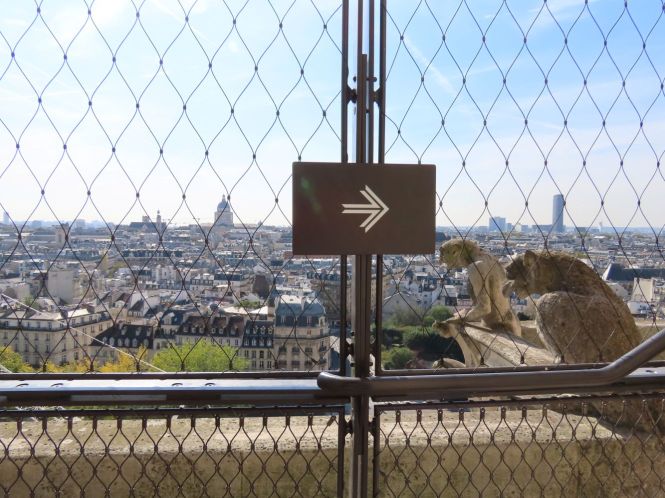
On top of the South Tower, where chimeras welcomed us.


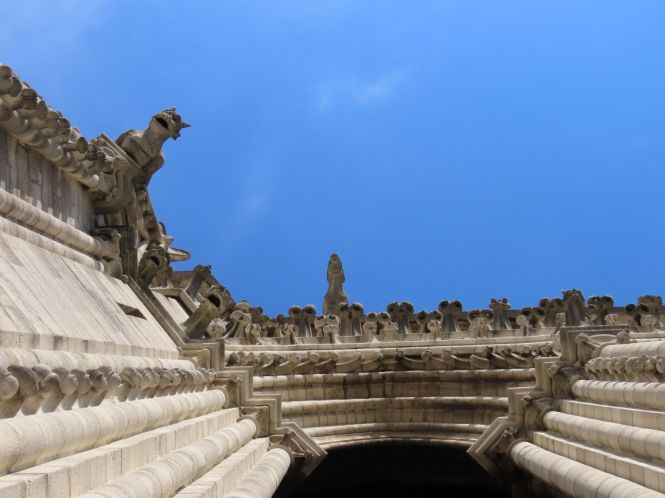
Looking up, it becomes obvious that gargoyles function as waterspouts.
Once on top, we were allowed to wander and explore on our own, taking as much time as we wanted, looking near and far. Apart from marveling at the fact that firefighters had prevented the two towers from collapsing, enabling me to be standing here now, I also admired the completely new spire which had crashed into the nave in an enormous burst of embers and flames. It was topped by a new weathervane, a golden rooster—the successor to the molten and marred metal structure I had photographed inside the cathedral. The new lead roof was also in evidence, alongside ongoing restorations.


The “forest,” a wooden roof structure that was consumed by the fire had been reconstructed and equipped with “modern fire prevention technologies.”
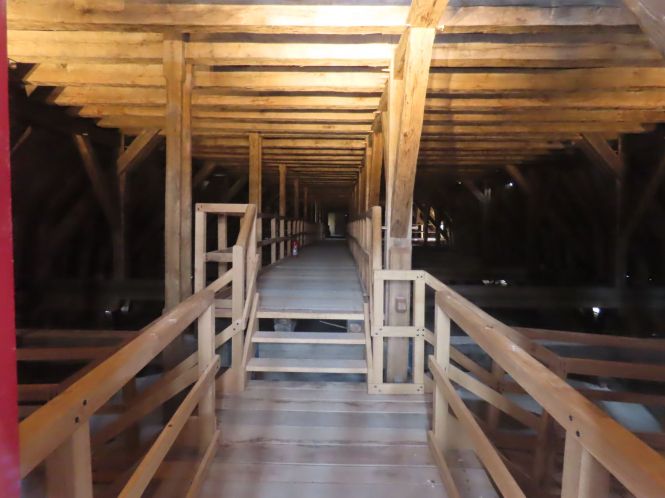
The “Charpente.” Known as “the forest,” this roof structure is 10 meters tall and 100 meters long. It burned completely and was replaced with 1,200 oak trees from France.
Also available for viewing were Notre-Dame’s famous church bells. Between the South and North Towers, the church houses 10 different bells and the consensus is that they would have caused the towers and possibly some or all of the stone walls to collapse had they plummeted from their belfries (the wooden structures that hold them in place). Some of these bells were removed, cleaned, and restored after the fire. The one named “Bourdon Emanuel” is Notre-Dame’s largest and oldest, weighing 13 metric tons (13,271 kg) and dating to 1686. It is the second-largest bell in all of France, the largest being the Savoyarde at Sacré-Coeur de Paris (it weighs 19 metric tons, or 18,835 kg).
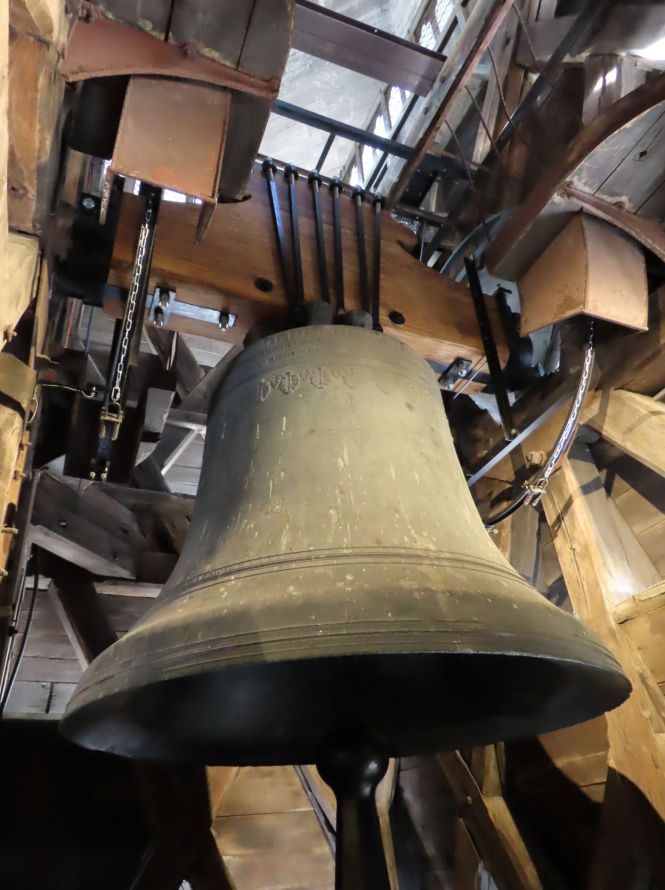
Bourdon Emmanuel, cast in 1686. Second largest bell in France.
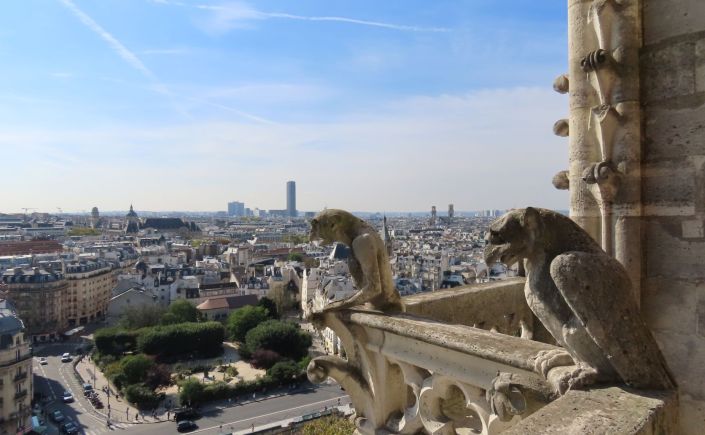
One of the main reasons I wanted to stand on top of the towers was my desire to gain a bird’s eye view of one of my favorite cities. Even at an altitude of “only” 69 meters (226 feet), compared to the Eiffel Tower’s 301 meters (984 feet), one gets a sense of being above the busyness and fray of the French capital. Seeing one branch of the Seine River on each side of the church elucidates the location of Notre-Dame on the Île de la Cité, one of two natural islands at the heart of Paris (the other is Île Saint-Louis). And without enough time to travel to other iconic Paris landmarks, I was consoled by being able ability to behold and appreciate them from this elevated point of view, if only at a distance.
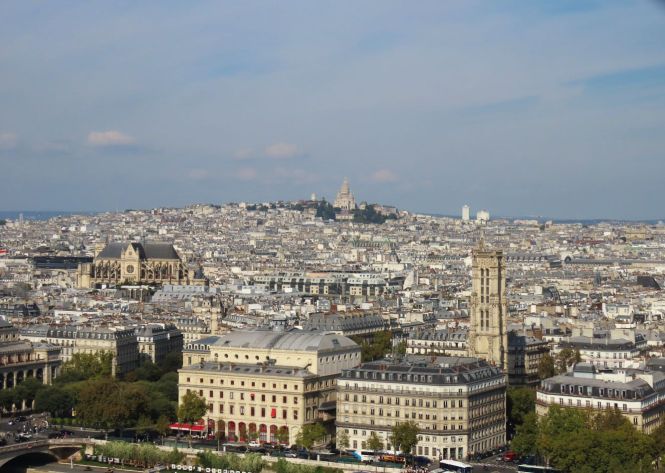
View of Montmartre and Basilique du Sacré-Coeur de Paris.
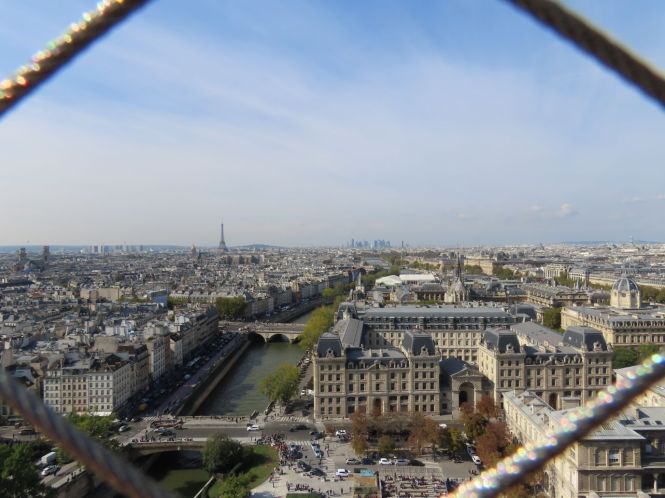
View of La Seine, La Tour Eiffel, and La Défense in the hazy distance.
Au revoir, Paris!

