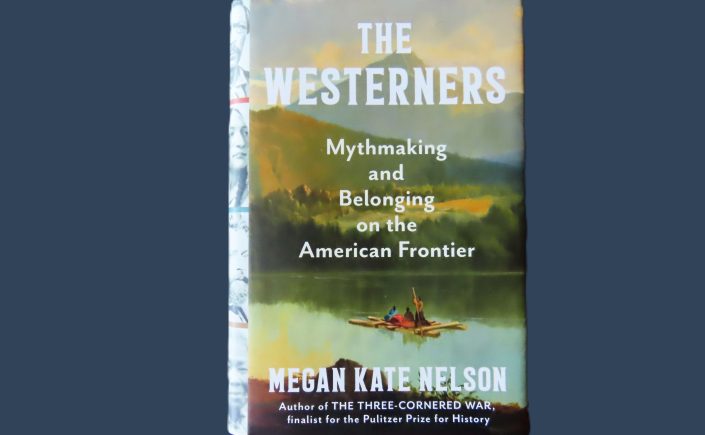
If you are familiar with my blog, you might remember a number of posts about the local Colorado Springs Pioneers’ Museum, where I have been a volunteer docent since 2015. This year, our Curator of History started to volunteer her precious time to host a monthly book club for volunteers. It has been an exercise both stimulating and sobering, and our most recent read was no exception.
In contrast to previous works discussed, we had not one but two opportunities to meet the author. She was the featured speaker of the museum’s monthly regional history lecture series in late August, and in early September, book club members were invited to join museum staff for another meeting with the author.
From the back flap, I had learned the following about her:
Born and raised in Colorado, Morgan Kate Nelson is a writer and historian now based in Boston, Massachusetts. She has written about U.S. western history, the Civil War, and American culture for The New York Times, The Washington Post, The Atlantic, Slate, Time, and Smithsonian Magazine. Nelson earned her BA in history and literature from Harvard University and her PhD in American studies from the University of Iowa. She is the author of Saving Yellowstone; The Three-Cornered War, a finalist for the Pulitzer Prize; Ruin Nation; and Trembling Earth.
It’s a special treat to meet an author in person, particularly if their writing speaks to us, and I’m grateful for the opportunity. Hers is another book that confirms why it’s important to understand the past in order to help explain the present.
The following quotes from the author’s prologue illustrate the objective of this work, “shattering the traditional frontier myth”:
The frontier myth is a fantasy that white Americans have repeated over time to create a national community. It has, from the beginning, marginalized, ignored, or entirely erased the actual people who explored, fought over, excavated, and built the American West in the nineteenth century. They were Indigenous peoples who had claimed this region as their homelands for thousands of years; women and men who were at first Spanish, then Mexican, then American citizens as national borders moved around them; Black Americans, who migrated with their enslavers and then claimed for themselves the freedoms the West offered; white women who rejected cultural expectations and forged paths of their own; and Asian immigrants, who arrived at Pacific ports and spread out from there to build lives in a foreign land.
The frontier myth’s erasure of their lives was no accident. Politicians, newspaper editors, surveyors, artists, writers, and historians did it deliberately. Removing people from a central national narrative effectively eliminates them from the body politic, making it easier to take their property and their civil rights away.
While the West offered opportunities and freedoms to all comers in the early nineteenth century, it became a more restrictive place in the years after the Civil War. The federal government, controlled mostly by the Republican Party, increasingly exerted its power in the West and provided incentives for white settlers to migrate to the region. The frontier myth undergirded their policies.
Proponents of the frontier myth tried to obscure the fact that the real people who built the West had much in common with white pioneers. They had a high tolerance for risk, they traveled thousands of miles as they chased their own dreams, crossing paths in unexpected ways. They faced challenges on their journeys throughout the region and often persevered.
Unlike the pioneers of the frontier myth, however, these real people journeyed through the West not only from the East, but in many different directions.
Centering diverse communities in a history of the nineteenth-century American West challenges popular notions of what the region was and is, who created it, and who is allowed to claim it as home. It helps to understand how the erasure of many and diverse peoples from our national history leads to racist and oppressive policies that impact all American lives, across the country. The national embrace of the frontier myth obscured, recast, or erased the lives of the real people who shaped national events. It was one of the most egregious acts of revisionist history in American life.
In her prologue, the author also gives a brief overview of the individuals whose lives are explored in more detail in the subsequent chapters:
Sacajawea, born a Northern Shoshone in present-day Idaho, was abducted to the Upper Missouri River Valley by another tribe. Together with her “husband,” Toussaint Charbonneau (who had bought her), she joined Lewis and Clark, who likely would never have made it to the Pacific and back without her help.
María Gertrudis Barceló, born in New Spain, became a Mexican citizen after independence in 1821, and an American citizen after the end of the Mexican-American War. She was one of the richest and most powerful businesswomen in New Mexico who ran several gambling establishments, specializing in the card game monte.
Jim Beckwourth, born to a White enslaver father and a Black mother in Virginia. He became a fur trader, scout, and sometime entrepreneur. Paradoxically, he also participated in the Sand Creek Massacre, where he fought with the perpetrators against the Southern Cheyenne for whom he had previously acted as Indian agent. He later helped describe some of the atrocities which led to the US government declaring the attack a massacre. His autobiography was discredited as being made up of lies because of his background and unusual life.
Ovando Hollister, who left his Shaker upbringing in New York. He joined Colorado’s 1st Volunteers who helped foil an attempt by Confederate forces from Texas to take over the California and Colorado gold fields and turn all southwestern territories into slaveholding states. He became a newspaper reporter, printer, book author, and proponent of Indian removal, eventually settling in Utah, where he attempted to limit the influence of Mormonism.
Little Wolf, a Northern Cheyenne chief, who defended his ancestral homelands from invasion by white settlers. After his band was forced to move to Indian Territory (the future state of Oklahoma), they escaped back home, being mercilessly pursued by the US Army on their 1,500-mile return. His steadfast resistance to being banished again led to the creation of a Northern Cheyenne reservation in present-day Montana.
Ella Watson, a Canadian immigrant to Kansas in the wake of the 1862 Homestead Act. She became a homesteader in Wyoming who wanted to raise her own cattle. When she refused to sell her land and water rights to cattlemen, they accused her and her husband of cattle rustling and lynched them in cold blood. The murderers were acquitted by a jury after being defended by lawyers paid by the Wyoming Stock Growers Association. False newspaper articles about the couple became accepted truth, and Ella was conflated with another woman, who did, in fact, rustle cattle.
Polly Bemis, a Chinese immigrant, sold by her parents to a trader when she was 16. Without having any clue about her final destination, she was shipped from her home province in southeastern China to Canton and from there, on to Hong Kong, San Francisco (California), Portland (Oregon), and eventually to Warren, a small community in Idaho. Like countless other immigrants from China, she felt the effects of anti-Chinese legislation. The 1875 Page Act prohibited involuntary emigration from China, Japan, and other Pacific Rim countries, with the stated goal of preventing trafficking of women as sex workers. It was followed by the 1882 Chinese Exclusion Act that prohibited any further immigration from China and excluded even long-term residents from becoming US citizens. The 1888 second Chinese Exclusion Act barred Chinese laborers from entering the country, even if they were long-term residents, thereby preventing them from being able to leave and return to the country for any reason. In 1892, Congress passed the even more restrictive Geary Act. It required all Chinese laborers to be registered and to carry a certificate with a photo at all times to avoid deportation. The only other American residents at the time required to be photographed were convicted criminals. These acts were not fully repealed until 1965.
If you are still reading, thank you! I would like to share two more quotes.
The first concerns the Lewis and Clark Expedition:
. . . [in 1814], a Philadelphia publisher printed two thousand copies of History of the Expedition under the Command of Captains Lewis and Clark. The editor based the account on expedition diaries but often embellished them to create a dramatic narrative of an adventure into the wilderness, with Lewis and Clark as the frontier heroes. He omitted many of the Corps’s encounters with Indigenous peoples and much of its scientific work.
Sacajawea did not appear often in these volumes, and for the rest of the nineteenth century, most Americans did not even know her name.
But Sacajawea is present in the records that the men of the Corps kept in 1805 and 1806. They mention her and her work hundreds of times. They listened to her stories and her advice, and they accepted her as a member of the Corps. Sacajawea was so much more than just the interpreter’s wife. She was an interpreter in her own right. A cultural broker. A botanist. A mother. And an explorer. She was an Indigenous woman traveling through an Indigenous world, taking its measure. It would take more than one hundred years for Americans to recognize the vital role she played in the federal government’s first survey of the lands between the Pacific and the Knife River Villages [along the upper Missouri].
The second quote discusses the importance of Chinese immigrants for the Transcontinental Railroad:
‘Without them,’ the railroad’s president and California’s Governor Leland Stanford wrote to President Andrew Johnson in October 1865, ‘it would be impossible to complete the western portion of this great national enterprise.’
By the time the Central Pacific’s tracks were nearing Promontory Summit in Utah in the spring of 1869, nearly twenty thousand Chinese workers had built the road from Sacramento. They were the single-largest workforce laboring for a private enterprise in American history.
By the time they made it through the Sierras, descended into the arid Great Basin of Nevada, and approached Promontory Summit in Utah, Chinese workers had prepared the way for more than 600 of the Central Pacific’s 690 miles of railroad.
The ceremony was full of pomp and bloviation. One thousand people had gathered at Promontory Summit. . . . After the crowd dispersed, eight Chinese men removed the ceremonial spikes and pounded the rails into place that joined the eastern and western lines. [Photographer] Russell took another photograph. This was the only image taken that day that depicted the Chinese workers whose labor made the construction of the Central Pacific line and the completion of the transcontinental railroad possible.
This is not a book one reads to feel good about history. It made me feel sad—and mad—in many instances. This is a book that shows our human foibles, failures, and failings, that exhorts us to look in the rearview mirror, and to acknowledge that many of the stories we have been telling ourselves for so long have had a very one-sided slant, focusing on the accomplishments of one group of people while ignoring all others.
Again—the longer my head is stuck in history books, the louder rings the truth of this essay’s title: Plus ça change, plus c’est la même chose—The more things change, the more they stay the same. And even if history does not exactly repeat itself, it “rhymes,” as someone (reportedly Mark Twain, but probably not) once quipped.
And alongside this recurring refrain runs the burning question: Why do we keep repeating the mistakes of the past?


This sounds like a powerful and important book. I truly wish I’d had the opportunity to sit alongside you and listen to Morgan Kate Nelson speak about her work. She is clearly a formidable, challenging historian, my kind of historian.
Of the people mentioned in your post, the one name I know well is Sacajawea. I was aware from previous reading that her part in the Lewis and Clark Expedition has long been underrated. The others are largely unknown to me, so I think I should try to track down Nelson’s book to find out more. It will be a fascinating but sobering read, one that would have been useful when I briefly studied US history at university half a century ago!
LikeLiked by 1 person
Thank you for taking the time to read and comment on this post, Mr. P. I apologize for the delayed response.
I also think this is an important and timely book, if also depressing, as some of the same attitudes toward “others” still prevail. I hope we can keep discussing these problems publicly and, more importantly, work toward resolving them.
If you end up reading this book, I hope it will be an enriching experience.
LikeLiked by 1 person
“Why do we keep repeating the mistakes of the past?” Because of human nature, which if it does change, changes so very slowly as not to be discernible over the mere millennia of recorded history.
One indication of the contradictions inherent in human nature is the summary you give for Ovando Hollister, who “helped foil an attempt by Confederate forces from Texas to take over the California and Colorado gold fields and turn all southwestern territories into slaveholding states, ” but who later “became a… proponent of Indian removal….”
LikeLiked by 1 person
Thank you for taking the time to read and comment (twice) on this post, Steve. I apologize for the delayed response.
One of the points we discussed with the author was exactly the one you mention: the contradictions within a single person or a group of people that seem paradoxical and impossible to reconcile.
I used to think that human nature was mostly bad and, on a global level and across time, still believe that view has been proven correct. But on a personal level, I see and experience good, even altruistic behavior that only confirms the seeming contradictions of the human condition.
I don’t have any answers, only more and more questions. And more and more sadness.
LikeLike
The notion of history not repeating itself but rhyming traces back to Theodore Reik’s 1965 essay “The Unreachables”: “There are recurring cycles, ups and downs, but the course of events is essentially the same, with small variations. It has been said that history repeats itself. This is perhaps not quite correct; it merely rhymes.”
One somewhat similar predecessor from close to a century earlier relied more on images than sounds. In The Gilded Age, which was a satirical novel from 1873 and not a historical account, authors Mark Twain and Charles Dudley Warner quoted from an account in a newspaper: “History never repeats itself, but the Kaleidoscopic combinations of the pictured present often seem to be constructed out of the broken fragments of antique legends.”
LikeLiked by 1 person
I don’t disagree with the facts; I just disagree with the premise. I am not a scholar, and my only book was written to illustrate that every writer has a slant. The clear left bias of your author causes her to attribute the “myth of the west” to evil motives. I would suggest it was more just an effort to sell books and papers.
The indigenous people were treated badly, but they weren’t so noble either. Until Tecumseh, the Shawnee here in Ohio didn’t burn their captives at the stake, they roasted them keeping the flames away from their bodies to prolong the agony.
I am glad your author presents these individuals to us, but she is biased by current politics; the Republicans of the 19th Century were the good guys, the abolitionists, the fighters against the political spoils system, the trust busters – well, at least better than most of their opponents.
LikeLiked by 1 person
Thank you for taking the time to read and comment on this post. I apologize for the delayed response.
If all writing is biased, I will always choose to read the words that bend toward justice–for the earth, for nature, for humankind. I’m sure the author, an intelligent historian, is well aware of the fact that the Republicans of yesteryear would no longer recognize today’s party that has sold its soul.
It’s undeniable that humans of all backgrounds have committed atrocities on one another. Using that fact as an excuse to keep committing them while claiming to be the one exceptional country better than any other, ever, is disingenuous at best, evil at worst.
LikeLike
I’m with Platypus Man. Wish I could have been there too. Two sideways comments: Back in the days of old, when I was in fourth grade. My teacher had a series of biographies in her class room, and the illustrations were silhouettes. My favorite was Bird Girl who became Bird Woman who was Sacajawea. I don’t know how accurate it was—probably not at all— but at a young girl I was very much aware of her and admired her tremendously. Second: I am pretty sure I saw a movie about Polly. Can’t remember the name. Finally, as a Franco-American, I am very aware of what it’s like to have language suppressed and history wiped out. Nothing good comes of it.
LikeLiked by 1 person
Thank you for taking the time to read and comment on this post, Laurie. I apologize for the delayed response.
And thanks for sharing your personal experiences. If our present reality proves anything, it’s that any advances we have made as humankind are always at risk of being taken away again. We can never rest on our laurels, so to speak.
LikeLiked by 1 person
Guten Tag, Tanja!
Thank you so much for the work you do locally in support of the Pioneer’s Museum. Volunteers play such an important role in our society but, sadly, seldom receive any praise. Consider yourself “praised”!
In my small and humble opinion, there is only one way for us to attempt preventing history from repeating. The answer lies with our children. As responsible parents, we must ensure our young are learning actual history as well as why history books have been “selectively edited” over the years. Neither one of these actions are easy.
As with most things in life, discovering the truth is quite challenging. In the same breath, we must never stop seeking it.
Computer finally replaced, data almost restored, back on line with a few limitations. Fall weather has arrived in central Florida in the form of morning temperatures dipping all the way down to 60 F!! Time to go to the swamp ………
LikeLiked by 1 person
Thank you for taking the time to read and comment on this post, Wally. I apologize for the delayed response.
I also believe in the importance of teaching history. To each generation. It’s appalling how quickly we forget. The parallels between what happened in Germany in the 1930s and what is happening not only in this country but in countries all across the globe in the 2020s are striking. We know how Hitler came to power, how he exploited the liberal laws that had been created in the Weimar Republic. Yet we area allowing autocrats everywhere to take away our hard-fought liberties. Not in order to create a better world, but only to enhance their own interests. It’s completely disheartening.
I’m glad you are back online and ready to experience Florida’s fall weather. Enjoy!
LikeLike
Interesting post, Tanja. I am familiar with a few, not all, of the historical figures you profile. I think human history (and modern activities) is always messy and frequently maddening. I’d like to think we improve over time and maybe we do. Its seems we still have a way to go…
Kudos for your work as a docent and caretaker of your local history!
LikeLiked by 1 person
Thank you for taking the time to read and comment on this post, Tina. I apologize for the delayed response.
Messy and maddening are good descriptions for the human-made world. Yet, at the same time, individual humans do so much good, all the time. That fact is what keeps me from giving up all hope.
LikeLike
Hi, there!
I hope that you are doing well!
I really enjoyed reading you post, and once again, congratulations on meeting another author! What a gift!
I have always been so moved by the story of Sacajawe. I picture her as one who gave up so much for the comfort of her husband and travel companions.
All of the historical figures that you mentioned have such deep stories that truly moved me, as I read them.
Thank you again for sharing this beautiful and touching book.
Blessings to you,
Gavin B.
LikeLiked by 1 person
Thank you for taking the time to read and comment on this post, Gavin, I appreciate your thoughts. And apologize for the delayed response.
I also find the stories told by this author very touching and moving and think we can learn so much by studying the experiences of the individuals she presents. And, I hope, resolve to do better in the future, as individuals, communities, nations.
Best wishes,
Tanja
LikeLiked by 1 person
Tanja, thanks für sharing this important book with us. Unfortunately, it seems to be more important every day. Although I’m not too optimistic that the people and politicians read it who could benefit the most …
LikeLiked by 1 person
Thank you for taking the time to read and comment on this post, Anna. I apologize for the delayed response.
Sadly, I also think that most authors mostly write for those who already agree with them. We seem to have entered an era when we think we know it all.
Has it ever been different?
LikeLike
Please don’t worry about any delays. And well, no, it probably has never been different (that only those who agree anyway read the important books).
LikeLiked by 1 person
Evidently, getting to the truth of the past is no easy thing and requires a lot of work and determination to uncover real events and to see through the fog of myth!
LikeLiked by 1 person
Thank you for taking the time to read and comment on this post, Ann.
I think there remains much room for improvement when it comes to history books. They need to be more balanced and inclusive.
LikeLiked by 1 person
Hi Tanja,
There is so much one could say about even the excerpts above, it’s hard to know where to begin. I, too have long be fascinated with Sacajawea, and was glad to see her featured at the Museum of Westward Expansion when I visited a few years back.
Here we are, just days from the midterms, discussing the injustices of yesterday that continue in this moment. I only hope to feel somewhat better about the goodness and character of people next week. Fingers crossed. Thanks for the thoughtful blog post.
Julie
LikeLiked by 1 person
Thank you for taking the time to read and comment on this post, Julie.
While one could despair when looking at the horrible things humans have done to one another throughout history, I’m always encouraged and buoyed by the positive acts and actions from individuals. It’s the only fact that still gives me hope, and when flooded by negative news, I need to remind myself of that parallel reality.
Sharing in your hope,
Tanja
LikeLiked by 1 person
Tanja, this is fascinating—the way you lay out Nelson’s prologue argument makes a strong case for how deliberate erasure shaped policy, not just storytelling. The list of figures (Sacajawea, Barceló, Beckwourth) really drives home how varied the paths west actually were. It’s a reminder that houses and towns carry the same layered history as people do. Here in Springfield, old foundations and sidewalks often reveal decades of patchwork repairs, each one a quiet record of who lived there and what they could afford at the time. Did Nelson say whether she sees this myth being actively retaught in schools now, or mostly corrected at the academic level?
LikeLike