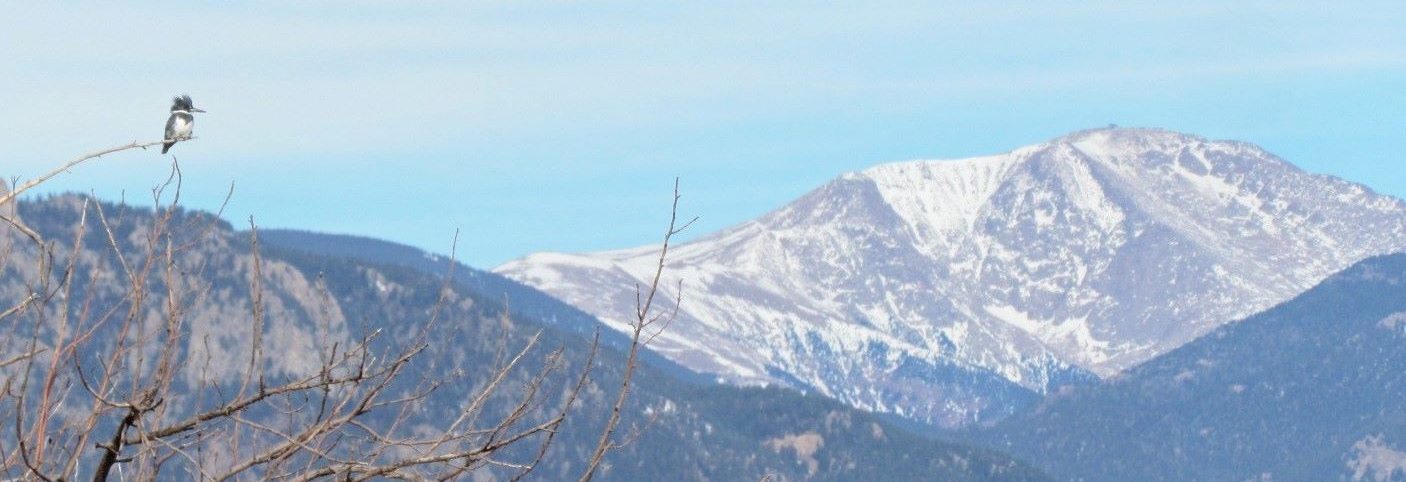

Among the cranes of southwestern Colorado’s Monte Vista National Wildlife Refuge, there is escape to be had. From all the human-caused cacophony and heartbreak; from the terrible news that assault us whenever we turn on the radio, television, or electronic gadgets.

In the spectacular setting of this high mountain valley, the western population of one of the oldest extant avian species that—miragically—has survived on this planet for at least 2.5 million years, spends a few weeks each spring and autumn to feed on grain left behind on the area’s agricultural fields, while migrating between their wintering grounds farther south and their breeding grounds in more northern latitudes. (There is a southeastern US Sandhill Crane population, but it is mostly nonmigratory.)

Tens of thousands of cranes roost along the edge of shallow bodies of water at night and forage during the day, with individual families sticking close together. Unless death intervenes, pairs mate for life. Tall and striking, with reddish crowns and eyes as well as a tutu-like derrière, these long-legged birds perform dances while trying to impress their mates.
They typically raise one (and seldom up to three) offspring in nests placed at the edge of all-important wetlands and the juveniles stay with their parents for nine to ten months. In the photos above and below, the juvenile birds are marked by residual brown wing feathers.


“Their annual return is the ticking of the geologic clock. Upon the place of their return they confer a peculiar distinction. Amid the endless mediocrity of the commonplace, a crane marsh hold a paleontological patent of nobility, won in the march of aeons . . . ”
From “Marshland Elegy” by Aldo Leopold


While the youngsters feed, adult cranes often keep a weary eye on their surroundings, trying to detect any potential danger. These gregarious birds watch out for one another, talk to one another in their soul-stirring voices (listen here for some recordings), and travel in formations discernible in the sky with the unaided eye.
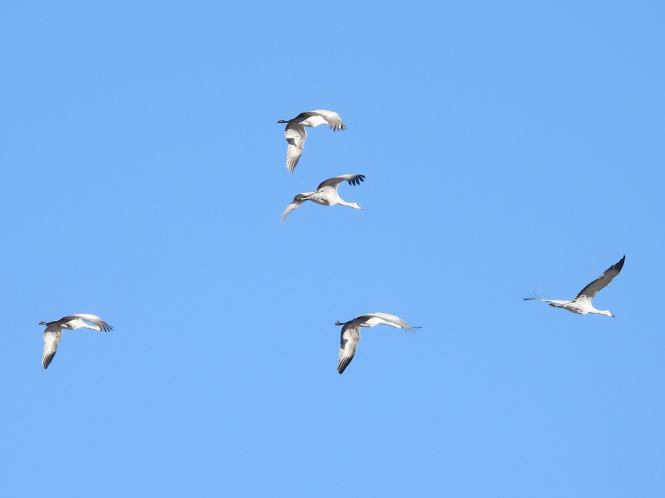

Among the cranes, there is beauty, grace, elegance, caring, solidarity, dance, and music.
Reasons aplenty to draw me to them time and again.
Reminders that there are creatures on this earth who have survived by simply living their lives, without imperiling others, without committing atrocious acts on one another, without telling one another how to live and what to believe.
For a species whose presence on our precious planet has been far shorter and far less inspiring than the cranes’, there are many lessons to be learned.
 tanja britton
Great post, Tanja. Cranes are magical birds, particularly when seen in large groups. And your thoughtful penultimate paragraph is spot-on, I agree absolutely with its message.
LikeLiked by 1 person
Thank you, I’m glad you agree with my thoughts and appreciate cranes as much as I do. Spending time in their presence is magical indeed.
LikeLiked by 2 people
Wonderful article and amazing photos!!!
LikeLiked by 1 person
Thank you, Luisa, much appreciated.
LikeLiked by 1 person
You’re always greatly welcome, dear Tanja 💙
LikeLiked by 1 person
Ich weiß nicht ob dein schöner Beitrag mich mehr traurig oder mehr hoffnungsvoll macht.
Erst wenn die Menschheit sich selber ausgerottet hat wird es wieder Hoffnung für die Natur geben fürchte ich.
LikeLike
Herzlichen Dank für Deinen Kommentar, liebe Brigitte. Es tut mir leid, daß meine Antwort so lange gedauert hat, aber irgendwie ist der Kommentar im Spam gelandet.
Ich teile leider Deine deprimierende Einstellung, was die Menschheit angeht. Wir wissen eigentlich, was zu tun ist, doch leben wir einfach weiter so in den Tag hinein, als gäbe es keine Probleme. Und all das Geld, das mit Waffen und Krieg verschwendet wird, hätte schon mehrmals den Welthunger und andere Probleme lösen können. 😢
LikeLiked by 1 person
Yours are different from ours in colours, but what a treat when they are back! I spotted the first ones just yesterday.
LikeLiked by 1 person
Seeing cranes never grows old, does it?! Enjoy your encounters.
LikeLiked by 1 person
Such an eloquent post! Years ago, I saw a group of cranes in a nearby field. A magical experience. I was also lucky enough to see them fly, and I felt as though I were looking at a Japanese woodcut come to life.
LikeLiked by 1 person
Thank you, Laurie. How nice that you had this magical experience and still remember it. I’m grateful that I can refresh my fond crane memories by traveling to this destination.
LikeLiked by 1 person
A beautifully written essay.
LikeLiked by 1 person
Thank you, Neil, it makes me glad you think so.
LikeLiked by 1 person
Awesome!
LikeLiked by 1 person
Thank you, Michael!
LikeLiked by 1 person
You’re welcome, Tanja.
LikeLiked by 1 person
Soul-stirring to behold!
LikeLiked by 1 person
That’s true on many levels, Eliza. Thank you!
LikeLiked by 1 person
I like the portmanteau “miragically,” which I hadn’t seen before your use of it. I found an online instance of the word from 2010.
Your mention of a “mostly nonmigratory” population raises the question of whether in a given year all the birds in that group do the same thing, versus some migrating and others staying put. Either way, the question arises of how the birds, whether collectively or individually—”decide” whether to migrate or not.
LikeLiked by 1 person
Hi Steve. The population of the Florida sub-species (see my comments to Tanja) does not migrate. According to a wildlife biologist I asked, the urge/non-urge to migrate is a genetic feature peculiar to a specific species (or sub-species in this case). Disclosure: I am not an expert. At anything.
LikeLiked by 1 person
If I understand correctly, no individual birds do anything different from what the subspecies as a whole does, regarding migration.
LikeLike
Granted, but you’ll never convince me that individual birds of certain species (particularly American Coots) don’t ‘decide’ to stay while their flocks depart. It’s common to see one or two coots in every marina here right through the winter. The flock gathers, increases in size, and then suddenly disappears, on its way to ‘wherever.’ Meanwhile, ol’ feathery lonesome paddles around by itself, eating algae from the floating docks and apparently enjoying itself.
On the other hand, the sandhills, like the whooping cranes, come and go as great flocks, and once they’re gone, they’re gone. They may be some early arrivals or stragglers in a given year, but I’ve never heard of a crane lingering into spring. The urge to get moving is obviously strong.
LikeLiked by 1 person
I appreciate your response, Wally.
LikeLike
Thank you, Steve. I have used the portmanteau once before but it must have escaped your notice. I was not aware of the existence of this word until it slipped out during a conversation with a friend. But, as we established before, “there is nothing new under the sun.”
You raise a very interesting question about migration and I appreciate Wally’s and Linda’s responses. While genetics, weather, length of daytime, availability of food, and “peer pressure” all influence when birds migrate, there are always individual or groups of birds who don’t follow the standard or predicted pattern and I don’t know if anybody knows exactly why. But it’s fascinating to ponder.
LikeLike
Beautiful pictures and words Tanja. Cranes area a majestic bird. Maggie
LikeLiked by 1 person
They truly are wondrous creatures, Maggie. Thank you for your comment.
LikeLiked by 1 person
Very nice Tanja. I always think of the Sandhill Crane as being from the Sandhills in Nebraska. I’ll have to add Monte Vista (Mountain View?) to our future birding locations next time we are in Colorado.
LikeLiked by 1 person
As far as I know, the cranes’ presence in Nebraska’s sandhills is responsible for their name. Luckily, they also occur in other areas.
And it’s very likely that the town Monte Vista and the NWR were so named because there are breathtaking mountain views in at least three directions. I hope you will get to visit there one of these days during the cranes’ migration.
LikeLiked by 1 person
You have provided a very nice tribute to the Sandhill Crane. Being able to observe any aspect of their life cycle really is “miragical”.
We’re very fortunate here in central Florida to host one of those resident groups you referenced. The Florida Sandhill Crane (Antigone canadensis pratensis) is a sub-species of the Greater Sandhill Crane. Current population is likely between 4-5,000. They do not migrate.
The Florida birds are joined each winter by the migration of 25-30,000 Greater Sandhill Cranes. Some of the migrants move further south and many remain within the state.
I realized how much I take “our” residents for granted when I visited Bosque del Apache NWR in New Mexico. The incredible experience of 30,000 cranes in one field was exhilarating!
LikeLiked by 1 person
Thank you for both of your comments, Wally.
I thought of you when I mentioned the nonmigratory cranes, and of how lucky you are to get to see them year-round. I find them so inspiring and encountering them is deeply meaningful for me.
My visits to Bosque del Apache did not coincide with the cranes’ residence, but I hope to return while they overwinter there.
LikeLike
Your inspiring photo essay made me think of the song “Blowing in the wind” with the lamenting line “When will they ever learn!?”. Indeed there is much to learn from the cranes, Tanja.
LikeLiked by 1 person
Thank you for your comment, Peter, and for mentioning that beautiful, haunting song. When, indeed, will we ever learn?
LikeLiked by 2 people
Every year I eagerly search the fields for these birds, and if I can find even a few, I’m happy. I saw more than usual this year, out in the rice fields, but as usual they were too far away for decent photos. That said, they weren’t too far away to hear those distinctive calls; I love listening to them ‘talk’ to one another.
LikeLiked by 1 person
I’m glad you also had the opportunity to see and hear some cranes this year, Linda. It’s not unusual to hear them before one sees them and their vocalizations are like nothing else in nature. I also love listening to their conversations.
LikeLiked by 1 person
They’re a beautiful bird and your photos are excellent. I particularly like your capture of the cranes flying in the air.
Partly because they look so graceful in flight (and partly because I admire your skill in photographing them in the air.) Something I’ve only captured one or twice and then, by pure good luck.
LikeLiked by 1 person
Thank you, Vicki, I appreciate your comment. I also have a hard time capturing birds in flight and my photos leave a lot to be desired, but I was pleased to take a few that were mostly in focus. The images don’t do their beauty and grace justice and the moment is often enhanced by their otherworldly call. I actually captured flight and sound in some short video clips but somehow haven’t managed to upload those to WP.
LikeLiked by 1 person
Perhaps, try uploading to a YouTube first and copying the YouTube video across to WordPress might be an easier option?
I’ve done it with my microscope video of the caterpillar moving (you may remember).
Personally, I’ve never worked out how to transfer a video (with sound) of a bird direct from my camera, but that failure could merely be lack of knowledge and poor computer skill on my part.
LikeLiked by 1 person
Thank you for the suggestion, Vicki. The YouTube thought had crossed my mind, but I hadn’t bothered to give it a try. I might, though. My technical skills are also more limited than I would wish.
LikeLike
NICE PICS
LikeLiked by 1 person
Thank you. I’m glad you think so.
LikeLike
Thank you, I’m glad you agree with my thoughts and appreciate cranes
LikeLiked by 1 person
I appreciate your visit and comment very much. Thank you.
LikeLike
So “many lessons ” to be learned from these elegant creatures, indeed Tanja, from their empathy toward one another to their resourcefulness, even using our agricultural leftovers for sustenance! I especially liked the photos of the juveniles feeding together, although all of the photos are great. The “tutu” description of their rumps fits perfectly and it made me smile.😄
LikeLiked by 1 person
Thank you for your comment, Julie. I wish our species were more open to learning from the cranes and other creatures, they have a lot to teach us.
)I’m glad my tutu comparison made you smile. It did the same to me. 😊
LikeLiked by 1 person
Diese Vögel sind sehr majestätisch und die Bilder toll. Danke für die guten Informationen. Leider haben wir in der Schweiz keine Kraniche. Ernst
LikeLiked by 1 person
Es freut mich sehr, daß Dir die Bilder und der Text gefallen haben, lieber Ernst. Vielleicht kannst Du Kraniche ja mal in einem der Nachbarländer sichten. Ich finde, sie sind eine Reise wert.
Liebe Grüße zurück,
Tanja
LikeLiked by 1 person
Das ist immer ein Erlebnis, das man in jedem Jahr erleben möchte. Wie bei uns im Teufelsmoor, wenn die Kraniche ziehen und ordentlich Lärm machen. Wunderschöne Bilder. Ich danke Dir
Liebe Grüße
Maren
LikeLiked by 1 person
Du hast recht, liebe Maren. Den Kranichzug mitzuerleben, ist jedes Jahr ein Höhepunkt. Du hast es noch besser, weil Du nicht ganz so weit reisen mußt wie ich. Ich bin immer dankbar, wenn es hier klappt.
Herzliche Grüße zurück,
Tanja
LikeLiked by 1 person
Ich sehe und höre die Kraniche zu gerne, allerdings sehe ich sie nur am Himmel. Tausende zu erleben muß wundervoll sein. Ihre Rufe rühren mich immer sehr. Schöne Fotos sind dir gelungen liebe Tanja. Ich wünsche dir schöne Ostertage! LG Almuth
LikeLiked by 1 person
In Deutschland sehe ich die Kraniche auch meistens nur am Himmel. Bzw. höre sie. Ihre Stimmen berühren mich auch immer zutiefst.
Ich wünsche Dir auch eine schöne Osterzeit.
Herzliche Grüße zurück,
Tanja
LikeLiked by 1 person
Herzlichen Dank Tanja. Es gibt einige Orte, an denen man die rastenden Kraniche sehen kann. So von Ferne. Leider ist das ein bißchen weiter weg. Ich möchte das irgendwann gerne mal sehen, Ich hoffe, die Gelegenheit ergibt sich in naher Zukunft. LG Almuth
LikeLike
Love to see both the cranes in your excellent photographs and the post itself, which is an escape from the madness of this world. The wildlife refuge must feel like a haven for stressed humans too!
LikeLiked by 1 person
Thank you, Ann, I appreciate your comment. I know the wildlife refuge is a haven for me, and I suspect the same is true for many other humans. We all need similar places of escape from the sad realities of the human-caused mayhem.
LikeLiked by 1 person
Beautiful post
LikeLiked by 1 person
Thank you, Lisa. Spending time with the cranes is always a highlight of my year.
LikeLiked by 1 person
Such a poetic look at cranes and a wonderful injection of hope.
LikeLiked by 1 person
I’m so glad you enjoyed the cranes and their timeless message. Thank you for stopping by and commenting.
LikeLiked by 1 person
A beautiful and powerful post, Tanja. I have never seen Sandhill Cranes in person, so this was a real treat. And I think I might have mentioned this before, but I always enjoy the wondrous mountain backdrops in many of you photos.
Plus, I learned the new word, “miragically”!
Hope you are well….I’m waiting on snow forecast here for Thursday…
Cheers,
Julie
LikeLiked by 1 person
Thank you, Julie. My year definitely feels more complete if I find some time to witness the cranes’ migration. And seeing them in the wonderful setting of the San Luis Valley adds another layer of joy to the experience.
Thank you also for noticing the word “miragical.” It describes particularly wondrous things but one has to be careful not to use it too often.
I hope whatever snow you might receive won’t do damage to all your greenery.
Happy April,
Tanja
LikeLiked by 1 person
[…] Last week’s post was a love song to the spectacular Sandhill Cranes who migrate through Colorado’s San Luis Valley twice a year. This week’s is a tribute to the no less spectacular setting where the cranes congregate each spring and autumn. […]
LikeLike
I so wish to be in that place, when I look at your images, Tanja.
LikeLiked by 1 person
Thank you, Karin. I feel exactly the same way and already miss them. 😊
LikeLike
Sandhills are a wonder to watch. So large, so confident and their colts are so damn cute. Never seen them in their older juvi states before. A few tend to hang out just north of us and we try to make a point to go visit them during the late spring/early summer time period. Amen to the lessons we can learn.
LikeLiked by 1 person
Thank you, Brian. I never tire of hearing or watching cranes. I have yet to witness the colts as the adults only breed in northern Colorado, but I hope to make it there in the summer. I also hope you will get a chance to see them once you are back home.
LikeLike
[…] Among the Cranes . . . […]
LikeLike
[…] return trip to Colorado Springs from the Sandhill Cranes in the San Luis Valley follows US 50. After the happy encounter with a pair of nest-building American Dippers along the […]
LikeLike
Yet another experience I’ve been wanting to have! Cranes are such magnificent birds. Also, lovely parting words, Tanja! Many lessons to be learned indeed.
LikeLiked by 1 person
Thank you, Diana. All birds are special, but cranes are especially so. I think every Coloradan should experience spring migration of the Sandhill Cranes in the San Luis Valley at least once. 🙂
LikeLiked by 1 person
I hope your escape to see these beautiful birds in their spectacular environs enabled you to feel somewhat replenished. Certainly something to savour. Thanks for the the lovely descriptions and photographs.
LikeLiked by 1 person
Thank you, Carol. Spending time with the cranes never fails to fill me with wonder and recharge my soul.
LikeLiked by 1 person
In the ring, beneath the glow,
A Sandhill crane and peacock show,
Feathers fly, a dance so free,
Grace and color for all to see.
With beak and wing, they spar and play,
In a waltz of hues, both night and day,
Each move a tale, a story told,
Of elegance and courage bold.
The crane’s stance tall, a master’s grace,
The peacock’s strut, a vibrant chase,
Together they dance, in joyous flight,
Painting the ring with colors bright.
In this arena, they find their bliss,
A spectacle of nature’s kiss,
For in their bout, we come to know,
The beauty that in chaos grows.
-Devlin Clayjoy
LikeLike