
As we are enjoying the four* different species of hummingbirds that frequent our garden each summer (well, mostly enjoying, except for their regular acts of aggression towards one another—mostly by males, they just can’t help themselves), I think back to some truly enchanting encounters with these marvels exactly one year ago.
In early August 2025, my husband and I undertook a one-plus-week camping trip to northwest Colorado, the greater Steamboat Springs area. When we drove into a forest service campground in the Routt National Forest and noticed a number of these flying jewels hovering near a picnic table, we knew this was our site—no difficult decisions necessary (sometimes, having too many choices is painful, creating “die Qual der Wahl,” as German speakers see it, literally, the agony of choice).
When a few of them showed no fear and regularly perched near us, I regretted having forgotten to pack one of our hummingbird feeders. What to do?
To enlarge a photo in the gallery, click on it. To read its caption, hover cursor over it.


Enter our water jugs. Recycled milk containers that happened to have red caps. Hummingbirds LOVE red, and other warm colors, which indicate nutrient-rich nectar in blooming plants. That’s why we are encouraged to plant flowers on that end of the color spectrum as a nectar source for our garden visitors, and that’s why most feeders have some red parts (please do NOT use red food coloring—no creature under the sun needs artificial dyes in their food).
Next step: Create sugar water, an accepted nectar alternative. Our food box happened to contain a jar with white sugar (the only one suitable to make nectar; according to the experts, we should never use brown sugar or honey).
Proceed as follows:
Mix 4 parts of water with 1 part of sugar, stir well until sugar is completely dissolved.
Pour a small amount of this sugar solution into the red caps.
Place on the picnic table.
Wait.
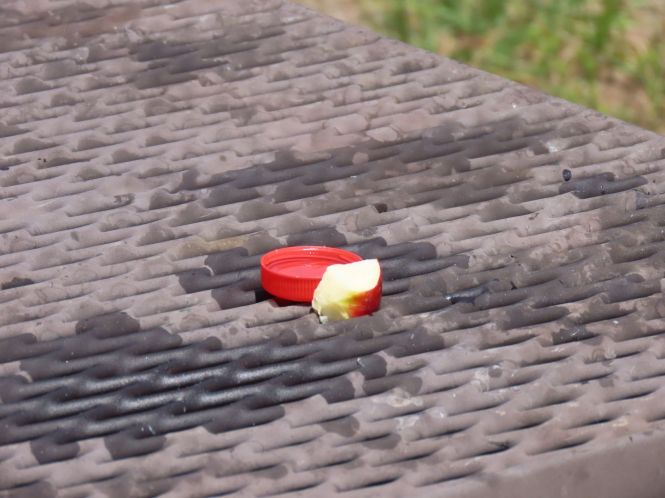
I was curious to see if the apple was of interest to them. It was not, they completely ignored it.
We did not have to wait long. I suspect that other campers before us had been feeding these hummingbirds because no sooner were the caps on the table than there were takers. Not one. Not two. Up to 5 hovered above this sweet source of energy, needed to fuel their incredibly high metabolism.


They were so unconcerned about our presence, we felt emboldened. Even when we held the lids in our hands, they did not shy away from us. When a hummingbird is this near, one not only hears the sound but also feels a gentle caress of air created by the beating of their wings. Remarkable wings, able to beat up to 70 times per second, impossible to behold with our eyes.


Whenever we spent time at our campsite, we pulled out the improvised feeders and were swarmed within minutes. The caps were frequently refilled, and we relished watching these energetic and vibrant creatures from up close.
The day we left, we bade them goodbye. And good luck.
All hummingbirds that grace Colorado with their estival presence are migratory. Each of these birds, many juveniles among them, will have to make their way back to one part of Mexico or another, to spend the winter. Imagining the travels and travails of these tiny tots that weigh between 4.25 and 5.25 ounces (120-150 g) always makes me worry for them, and that worry is well-founded. Of the four species we see regularly in Colorado, all but the Black-chinned Hummingbird are listed as Birds of Conservation Concern, according the US Fish & Wildlife Service. Twice a year, they have to fly anywhere from hundreds to thousands of miles, depending on where they summer. Some Rufous Hummingbirds who breed in southeastern Alaska and overwinter in Mexico are known to cover 3,900 miles—one way!
Whenever and wherever I see hummingbirds, I’m profoundly touched by and grateful for their presence, and deeply moved by the fact that they will return year after year to the same location, as long as we don’t stand in their way. So if you are lucky enough to live in a place hummingbirds visit for part (or all) of the year, consider helping them by planting native plants and/or supplementing their natural diet with some added calories. You will be blessed by getting to know some of nature’s flying gems.
* Broad-tailed Hummingbird, Black-chinned Hummingbird, Calliope Hummingbird, Rufous Hummingbird


This is amazing!
LikeLiked by 2 people
Thank you. It really was and I hope I will never forget it.
LikeLiked by 2 people
Tja, sowas Schickes haben wir hier nicht zu bieten!
Wenn wir Besuch vom Taubenschwänzchen (Beispiel: https://2puzzle4.wordpress.com/2026/08/02/gewohnliches-seifenkraut-gefragter-als-gedacht/ ) bekommen, sind wir bereits hocherfreut.
LikeLiked by 2 people
Taubenschwänzchen sind immer etwas Besonderes, auch hier. Leider sind sie dieses Jahr seltener als in vorherigen Jahren. Und Kolibris gibt es halt nur in Amerika. Dafür gibt es in Deutschland Kreaturen, die wir hier nicht zu sehen bekommen. 😊
LikeLiked by 1 person
To misquote Congreve: “Nature has Charms to sooth a savage Breast,” and this post is so much more positive than your last couple.
It never would have occurred to me to use a bottle cap. Thanks so much.
LikeLiked by 2 people
Thank you for commenting. I’m glad you enjoyed this post.
I wish they could all be positive. But with everything going on and weighing on my heart and soul, some of my posts will express that gravitas.
LikeLiked by 2 people
Wow what wonderful birds and to be so close!
Amazing how they migrate so far for such a tiny creature.
Lovely post Tanja.
LikeLiked by 2 people
Thank you, Brian. It’s a memory to cherish.
LikeLiked by 2 people
Hummingbirds are so amazing. I have seen very few in my life. I once was at a bus stop in the Philadelphia suburbs and saw a hummingbird in a bush a foot away from me. That was maybe 20 years ago. I haven’t encountered one since then.
LikeLiked by 2 people
Thank you, Neil. They really are tiny little marvels.
I hope you will be blessed with more hummingbird sightings, sometime, somewhere!
LikeLiked by 2 people
Hummingbirds are such cute birds, it’s a pity we don’t have them in my country. 🙁
LikeLiked by 2 people
Thank you for your comment.
Hummingbirds are very special and I feel fortunate to get to experience them every summer.
I’m sure you have amazing birds right where you are. 🙂
LikeLiked by 2 people
I admit that yes, for example, the tits. 🐦
LikeLiked by 2 people
You are right. Whenever I get to spend time in Germany, I enjoy seeing and hearing them. Robins also!
LikeLiked by 2 people
That’s so neat😊
LikeLiked by 2 people
Thank you, Dwight. It really was. 🙂
LikeLiked by 1 person
What endearing pictures of the hummingbird on a red container cap held in a person’s fingers. You had yourselves a little avian estival festival.
“Flying gems” is a colorful description. I like the rhyming German phrase Die Qual der Wahl. I wondered if there’s a relationship to the English verb quail that means ‘to shrink back in fear,’ and it seems there is: the American Heritage Dictionary says quail is “probably from Middle Dutch quelen, to suffer.”
LikeLiked by 2 people
We felt very privileged to be privy to the avian estival festival.
I thought you might comment on the German quote. Thank you for the language lesson. 🙂
LikeLiked by 1 person
Sweet encounter, Tanja. I’m sure it is a memorable one. We only have one species, the ruby-throat. I’ve long offered plants in my gardens that they prefer and wild jewelweed is a favorite in late summer. I love watching them and hearing them zoom past me as they busily go about their business. I only started feeding them sugar water a few years ago to supplement any short falls. They remember food sources year to year and will return in spring to the same place. I hang annual plants off my deck and remember once seeing a returning hummer hovering where they plants were the previous summer, so I knew it was in its memory. I hadn’t hung new plants yet as we were still getting frosts. I quickly remedied that, running out to buy new annuals to hang there. 😍
LikeLiked by 2 people
Thank you, Eliza, very memorable.
I can relate completely to your experiences and I’m always amazed and humbled by the fact that these tiny creatures will return not only to the same garden year after year, but to the same spot where a favorite plant or feeder once beckoned. Just imagine if we had similar navigational skills!
I would love to have a garden full with native plants sufficient to sate their appetites. But our wildly unpredictable springs cause many plants to bloom up to two months early, only to freeze in April or May when the hummingbirds first arrive; and the dire water situation and scorching summers that make it challenging to keep many flowers alive.
I’m sure your hummingbirds appreciate everything your lovely garden has to offer, including the annuals you obtained expressly for them. 🙂
LikeLiked by 2 people
Hello Tanja,
What a memorable encounter with these amazing birds. The images bring a warm feeling to my heart – thank you for making my day.
LikeLiked by 2 people
Thank you for your kind words, dear Takami. I don’t think we will ever forget those moments. 🙂
LikeLiked by 2 people
Your photos are absolutely stunning, and your clever milk jug cap idea was brilliant!
It is incredible that you got to experience them up close, and your insights on their migration remind us how precious these flying gems really are.
LikeLiked by 2 people
Thank you, Luisa.
They are very precious and I hope there will always be hummingbirds in this world! ❤️
LikeLiked by 2 people
Thank you, I completely agree! ❤️
Just a fun fact: we don’t have real hummingbirds here in Italy, as they are native to the Americas.
But we do have a fascinating insect called the “Hummingbird Hawk-moth” that mimics them perfectly while feeding on flowers!
LikeLiked by 2 people
These moths are amazing, aren’t they? We have some of them as well and I often have to look more than once before I can tell if they are insects or birds.
LikeLiked by 2 people
You’re most welcome, my dear Tanja!
I always learn something new from your posts!
LikeLiked by 2 people
How kind of you to say, Luisa. 😊🙏
LikeLiked by 2 people
What a fun post! Yes, they’ll come to nectar when it’s packaged well ( 🙂 ) and how smart you are to have worked with what you had on hand. I don’t typically put out hummer feeders, there’s too much in my garden they prefer and they don’t really come when I have had a feeder available. The upside is that the blooms are healthier, the downside is that I only get to enjoy their antics from a distance.
All of those you mentioned have come through Central Texas on their way to Mexico and back again in spring. Great post!!
LikeLiked by 1 person
What a fun post! Yes, they’ll come to nectar when it’s packaged well ( 🙂 ) and how smart you are to have worked with what you had on hand. I don’t typically put out hummer feeders, there’s too much in my garden they prefer and they don’t really come when I have had a feeder available. The upside is that the blooms are healthier, the downside is that I only get to enjoy their antics from a distance.
All of those you mentioned have come through Central Texas on their way to Mexico and back again in spring. Great post!!
LikeLiked by 2 people
Thank you, Tina.
I wish we had enough native plants to sustain them, but the changing climate is making that more difficult. This year, our insanely warm March had all the plants thinking it was May, only to be hit by at least two frosts in April and May. Some of the flowers were either done blooming by the time the first hummingbirds returned or never opened. We still have several plants with buds that never opened. Add to that a hot, dry summer and a mega-drought with worsening water woes. We are lucky if we can keep the drought-tolerant plants alive.
I will remind all our visitors to stop by your welcoming garden on their way south! 🙂
LikeLiked by 1 person
Was für eine zauberhafte Geschichte. Ich beneide Euch um die vielen Vogelarten, es ist mir eine ewige Freude, mich an die Texas Reisen zu erinnern. Und jetzt dieser Bericht macht mich so froh. Danke dafür. Es ist toll, dass Du 4 Kolibriarten im Garten hast. Wir haben gar keine Kolibris in ganze Europa nicht. Aber das weißt du ja.
LIebe Grüße
Maren
LikeLiked by 2 people
Vielen Dank, liebe Maren. Wie Du Dir vorstellen kannst, war (und bin noch immer) verzückt, als mir bewußt wurde, daß es solche Wesen hier in meiner neuen Heimat gibt. Sie sind wahre Wunder und ich genieße die Monate, in denen sie uns hier beglücken.
Liebe Grüße zurück,
Tanja
LikeLiked by 1 person
Ich habe noch nie einen Kolibri gesehen und freue mich umso mehr über deine Fotos und deine schöne Geschichte dazu. Einfach zauberhaft. Vielen Dank dafür. LG Anna
LikeLiked by 2 people
Herzlichen Dank, liebe Anna! 😊
LikeLiked by 2 people
What a great way to describe these tiny birds, Tanja, “flying jewels”! I remember a time while we were up at my aunt and uncle’s cottage and a hummingbird flew right into my mother. We couldn’t figure out why until we realized it must have been because she was wearing a deep purple housecoat.
LikeLiked by 2 people
Thank you, Julie.
It’s really fascinating to see how quickly they will hone into vibrant colors. When my husband’s beard was more red than white, they would hover right in front of his chin. 🙂
They also check out red bags, red tape, or our red car! That alone makes me feel that I owe them something that’s actually edible! 🙂
LikeLiked by 2 people
LOL! Love that about the beard. 😄
LikeLiked by 2 people
He loves it too. 🙂
LikeLiked by 2 people
What a treat to have these whirring visitors come so close. Little beauties! We have ruby-throated in Maine. Such sweet zippers!
LikeLiked by 2 people
Thank you, Laurie.
Whirring Visitors and Sweet Zippers sounds like the title of a future blog post about your rubythroats! 🙂
LikeLiked by 1 person
Amazing that you could hold the tap with the hummingbird on it!
(We have hummingbirds at the country house in Mexico. But we use a birdfeeder…)
LikeLiked by 2 people
I appreciate your comment!
We also thought it was amazing. We only used the caps because we had not brought one of our hummingbird feeders we use at home.
I’m fairly certain that you see many more hummingbird species in Mexico than we do here in Colorado.
LikeLiked by 2 people
I had a hummingbird in my hands recently, but only because it had banged itself against a large window we have. And inside. So I put gloves on and picked it up gently, took it outside, gave it a bit of sugar water. After a few minutes it flew away.
But in the country house, there’s only one species as far as I can see.
LikeLiked by 2 people
Wonderful. I have been privileged to see hummers in the US, and several other countries too, but never got as close as you managed. And I had no idea that these terrific birds are so addicted to the colour red. Thank you for sharing your uplifting experience!
LikeLiked by 2 people
Thank you, Mr. P. It’s the memory of moments like these that sustains me when I have difficulty with our human-made reality.
LikeLiked by 2 people
Zauberhafte Geschöpfe Tanja.
Wie schön, dass ihr ihnen so nahe kommen dürft.
😍😍😍😍😍😍
LikeLiked by 2 people
Dankeschön, liebe Brigitte. Diese wunderbaren Wesen erstaunen mich immer wieder mit ihren vielen ungewöhnlichen Eigenschaften. Diese Begegnungen zählen bisher zu den ungewöhnlichsten. ❤️
LikeLiked by 2 people
How amazing and sweet! I will have to try this as we have hummingbirds where I live!
LikeLiked by 2 people
Thank you, Christa. If you sit near your feeders and let them get accustomed to your presence first, they likely will start coming closer and closer. Some stores sell “hummingbird rings,” tiny feeders attached to a ring you can put on one of your fingers. If we had had one with us during this trip, I have no doubt they would have sipped from that as well.
LikeLiked by 2 people
Now that you mention their preference for red, I remember that the few I’ve seen locally have been hovering around Turk’s cap or sage: both bright red flowers. The bottle cap idea was genius. I never would have expected such a ‘feeder’ to attract them, but clearly my idea of what hummingbirds will accept is far too limited!
LikeLiked by 2 people
They definitely gravitate to the red flowers first, if there are any. They also love our pink common milkweed and purple echinacea, but I have also observed them on white chokecherry blossoms early in the year, if the bloom coincides with their arrival. As is true for most of us, the hungrier we are, the less discerning we become.
LikeLiked by 2 people
Outstanding experience!
We recently moved to a new location and have not yet been able to attract any hummers to the new yard. Soon, we hope.
All those photographs are just fabulous.
LikeLiked by 2 people
Thank you, Wally. We still cherish the memories, as well as the images.
I hope you like your new home, and that the hummingbirds will also come to like it.
LikeLiked by 1 person
Hi, Mrs. Tanja-
What a beautiful experience you were able to have! I think it is so special that you were able to hold the bottle cap and have a hummingbird land on it while in your hand! I have never seen a hummingbird get that close before. It sounds like you were truly blessed by their presence!
We have hummingbirds that visit us in the spring, and around the month of August to early September. I actually saw the first one of the season on our feeder a little over a week ago, but I have yet to see another.
I am in awe of the beauty and power that surrounds these tiny birds!
Thank you for sharing this encounter!
Blessings,
Gavin Broom
LikeLiked by 2 people
Thank you, Gavin. This was definitely the closest we have ever been to hummingbirds, and we still smile when we think of those moments or review the photos.
I suspect you will see more and more hummingbirds in the month to come, as many of the ones who spend the summers farther north will travel through Texas on their way back to Mexico. I hope you will have time to sit down, watch, and enjoy them.
Take care,
Tanja
LikeLiked by 2 people
I can’t believe they drank out of your hand! What a beautiful lesson.
LikeLiked by 3 people
Well–not directly out of our hands! But very nearly. 🙂
I will never forget this experience.
LikeLiked by 2 people
Ah, great idea with the bottle caps!
We have just one type of hummingbird in Massachusetts, the Ruby-throated, but I don’t put feeders up any more since a bear took down the whole metal pole and the feeder. Some people just bring the feeders in each night, but we just hope we have enough natural nectar for them in the yard. The scarlet runners, hosta flowers, zinnias and especially the butterfly bush have been enough to keep them coming back. Still, I think bottle caps on the deck would be fun for close-up pics. What fun to have the little one drink from the cap while you hold it in your hand!
Cheers,
Julie
LikeLiked by 2 people
Thank you, Julie.
In an ideal world, I would also like to be able to offer them sufficient native plants to subsist on, but even during a “normal” year with regard to temperature and rain that might be difficult. During this year (and probably the ones ahead), it’s impossible. Because of a poor snowpack and little rain, even the drought-tolerant wildflowers are suffering. If they didn’t freeze, they are shorter with smaller blossoms and also don’t bloom as long. I’m really concerned.
LikeLiked by 2 people
I am so sorry to hear about the drought in your area, Tanja. I watch a lot of gardening shows, and I get furious when they suggest how we are all going to start gardening with drought tolerant plantings. And sure, for the short run we should, because acting locally is the best we can do now. But, why are those shows not talking more about ways to STOP global warming, as well?
Sigh…
Here endeth my mini rant.
😉
Julie
LikeLiked by 2 people
Rant all you want, Julie. I do, too. Sometimes we need to get rid of all that tension!
LikeLiked by 1 person
They’re just starting to funnel through here too. I sooo look forward to my first RTH late summer in Houston … it means dog days of summer are on their way out.
Imagine my surprise when I clicked to see you are still blogging! (And I am woefully out of touch.) Hope you’re well, Tanja. We are lives full of joy and nature over here as usual.
LikeLiked by 2 people
Hi Shannon,
What a nice surprise to hear from you, thank you for leaving a comment.
If you had checked a month ago, you would not have found any new posts. I took a long break and just started blogging again. If you want to know about my honest state of mind, you can read this post (no obligation): https://tanjabrittonwriter.com/2026/07/06/hello-friend/
Glad to hear that things are “as usual” with you.
Best wishes,
Tanja
LikeLiked by 1 person
What a wonderful encounter, Tanja! Happy for you and for the hummingbirds too. 🙂
LikeLiked by 2 people
Thank you, Ann. Let’s hope it was a win-win. 🙂
LikeLiked by 2 people
Liebe Tanja,
deine Fotos sind wunderschön – und bei diesen kleinen Flugkünstlern bekommt der Begriff „fliegendes Juwel“ tatsächlich eine ziemlich überzeugende Beweislage.
Besonders schön finde ich, wie aus einer vergessenen Futterstation und ein paar roten Deckeln plötzlich ein kleines Naturtheater entsteht. Manchmal braucht es offenbar weder große Pläne noch perfekte Ausrüstung, sondern nur etwas Einfallsreichtum und die richtige Farbe am richtigen Ort.
Dass die Kolibris so schnell Vertrauen fassten, hat mich besonders berührt. Vielleicht erinnern uns solche Begegnungen daran, dass Natur nicht nur etwas ist, das wir beobachten. Manchmal lässt sie uns für einen kurzen Moment Teil ihrer eigenen Geschichte werden.
Und fünf Kolibris gleichzeitig am improvisierten Buffet – da kann selbst das beste Camping-Frühstück kaum mithalten. 😉
Herzliche Grüße….von Rosie
LikeLiked by 2 people
Ich danke Dir wiederum für einen so netten Kommentar, liebe Rosie.
Auch wir waren sehr bewegt davon, wie zutraulich diese Kolibris waren und wir sehr sie darauf vertraut haben, daß wir Freunde und nicht Feinde sind. Solche Glücksmomente machen mich aber nicht nur froh, weil ich mir bewußt bin, wie viele Lebewesen uns Menschen ihren Untergang zu “verdanken” haben.
Ich bin davon überzeugt, daß wir mehr für unsere Umwelt einsetzen würden, wenn mehr Menschen solche oder ähnlich eindrucksvolle Naturmomente erleben könnten.
Von Herzen,
Tanja
LikeLiked by 2 people
❣️
LikeLiked by 1 person
Humming birds are absolutely beautiful. I have only seen them once in the Dominican Republic as I haven’t crossed over the Atlantic that many times. How lucky you are to see them every year in your backyard, Tanja! I didn’t know that they were migratory. For being the smallest birds, they sure make a long flight to warmer locations.
LikeLiked by 2 people
Thank you, Pooja. We definitely appreciate having them for a few months each summer. 🙂
LikeLiked by 2 people
Ich habe Deinen Beitrag heute Morgen vor der Arbeit gelesen. Deine Schilderungen waren ein kleines Glück für mich und haben mich durch einen Tag mit ärgerlichen Vorkommnissen stimmungserhebend begleitet.
LikeLiked by 2 people
Und Dein Kommentar hat wiederum bei mir ein Glücksgefühl hervorgerufen. Vielen Dank. 😊🙏
LikeLiked by 1 person
Oh my gosh, how cool! I see the occasional hummingbird in my back yard, but never such a close encounter. Perhaps I should invest in a hummingbird feeder and some homemade nectar. Great photos!
LikeLiked by 2 people
Thank you, Diana. We do have hummingbirds in our garden, but this encounter was unlike anything we experience at home.
I’m fairly certain that you will be rewarded with closer hummingbird encounters if you put out a feeder. I see and hear them everywhere I go.
LikeLiked by 2 people
Ooohhh, was für schöne Bilder von diesen zauberhaften kleinen Vögeln! Du bist ein Glückspilz, die Hummingbirds in deinem Garten zu haben. Das ihr auf eurer Campingtour so belohnt wurdet, ist einfach wunderbar. Und wie schön, daß die kleinen niedlichen Dinger so zutraulich waren. Bei den ersten Bildern sieht man so schmucke Punkte auf der Vogelbrust. Sind das die Männchen oder die Weibchen? Mir sind diese bunten Flecken vorher noch nie aufgefallen. Sieht aus, wie ein Schmuckstück. LG Almuth
LikeLiked by 2 people
Wie sind tatsächlich Glückspilze in der Hinsicht, liebe Almuth. Es dauert nicht mehr lange und die Kolibris werden sich auf den Weg Richtung Süden machen, deshalb genießen wir sie jetzt noch täglich.
Die meisten erwachsenen Männchen haben eine Art Halskrause, doch die Weibchen sowie die Jugendlichen haben Punkte. Besonders im ersten Lebensjahr sind letztere oft nur schwer zu unterscheiden. Und es sieht tatsächlich so aus, als hätten sie Schmuckstücke angelegt. Und je nach Sonneneinstrahlung, ändert sich die Farbe. Es ist die reinste Magie! 😊
LikeLiked by 2 people
Magie scheint mir das richtige Wort zu sein 🙂 Ich mag den Ausdruck marvellous so gerne, wenn es auch nicht so häufig Verwendung zu finden scheint? Ich glaube, ich kenne es aus alten Hollywoodfilmen. Danke für die Erklärung und genießt eure Gäste. Ich erfreue mich auch gerade noch an den Schwalben. Die Mauersegler sind schon seit 4 Wochen weg.
LikeLiked by 2 people
Oh, das geht jetzt alles irgendwie zu schnell, wenn ich auch froh bin, dass die schlimmste Sommerhitze vorbei ist (hoffe ich wenigstens).
LikeLiked by 2 people
[…] The ground squirrel who has just made a lucky escape likely felt the weasel’s claws and did not pay attention to its coat, understandably so. It was saved by a human passerby who surprised the hunting weasel, and we are only privy to the excitement because we hear the squealing ground squirrel before it runs off. This event takes place in the same forest service campground which provides us with hummingbird magic. […]
LikeLiked by 1 person
Hummies, Hummies everywhere! Fantastic interactions with these little birds. What a great memory to have. I’ve never had one eating out of my hand, but have had them land on feeders I was carrying to the stands in the yard. I’ve even had a few bounce off me thinking I was trying to take their food source away.
LikeLiked by 2 people
Great memories, indeed! Here at home, they also get quite accustomed to our presence and sometimes check out our faces or (red) clothes, but the closeness we experienced at that campground has not been repeated (yet?).
Thank you for stopping by and commenting, Brad.
LikeLiked by 1 person