Better late than never!
It took a looong time for us to visit this regionally and nationally renowned Denver destination that opened in its first iteration in 1951, but we finally made it on July 21. We don’t particularly like to drive to and in Denver, Colorado’s capital city, because traffic is atrocious, despite (or because of) eight-lane highways, but as we had to be in the area for a morning appointment, we finally explored this locale so long on our wish list. Denver Botanic Gardens technically applies to three different locations, but this post refers to the main campus on York Street in east-central Denver.
Denver had suffered the first three-digit-temperature-day of the summer the day before (100 degrees F/38 degrees C or higher), but the thermometer “only” climbed to 97 degrees F/36 degrees C on the day of our visit (thus far in 2026, the 100-degree-threshhold has been reached or exceeded on six separated days, an unprecedented and unwelcome record). Thank goodness for the shade created by trees—so many beautiful trees! And for a few air-conditioned buildings, where we could while away the hottest hours of the day. This included having lunch at one of two cafés, and appreciating the indoor portion of the art exhibit A New Humanism by Jaume Plensa, an internationally acclaimed (but new-to-us) artist from Spain, whose works are on display between April 18 and September 7.
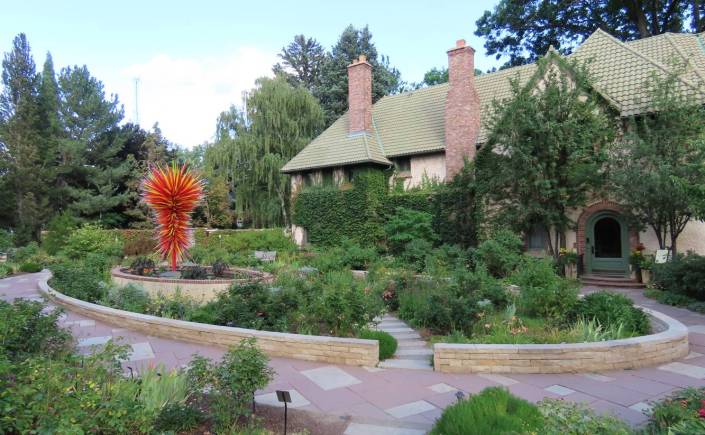
You might have noticed the signature glass creation in the featured photo above by another renowned artist. It graces the gardens that surround Waring House, which serves as the home for administrative offices. If you thought of Dale Chihuly, your hunch would be correct. Created for this site in 2014, he entitled the sculpture “Colorado,” to represent the dense, spiky shape of yucca flowers as well as the vibrant colors of Colorado sunsets.
We also spent time inside the Boettcher Memorial Tropical Conservatory which keeps a steady temperature of 77 degrees F/25 degrees C, but with a much higher humidity than the ambient air of the semidesert climate that prevails at the western edge of the Great Plains. This architecturally interesting concrete and Plexiglas building was created in 1966 and received landmark status in 1973. According to a Wikipedia article, it was designed to channel condensation to the walls so it wouldn’t drip on visitors. We were not aware of this while we were there, but we can attest that no water droplets fell on us while we admired a variety of tropical plants, a cacao (or cocoa) tree among them. The first time I held a cacao pod in Côte d’Ivoire many years ago, I had no idea where chocolate came from, despite having eaten (too much of) it all my life. Informational signs highlighted the incredible biodiversity of tropical rainforests and underlined the need to protect them.
To enlarge a photo, click on it. To read its caption, hover cursor over it.


The map of the Botanic Gardens displayed in various locations and available as a brochure uses a color-code for the 52 different kinds of plantings organized under the following headings: Gardens of the West, Internationally Inspired Gardens, Ornamental Gardens, Shady Gardens, and Water Gardens. We generally followed the east-west layout of the gardens which cover nearly 24 acres (about 9.7 hectares), moving from the conservatory to the Japanese garden on the western end of the property which abuts Denver’s famous Cheesman Park. Interestingly, both properties used to be cemeteries and even though most human remains have been reinterred in different graveyards, human bones are still unearthed occasionally.


Click here to open a digital map that can be enlarged.


A surprise for us was the existence of the Colorado Springs Waterway Garden, financed by our local El Pomar Foundation, the legacy of Julie and Spencer Penrose, whom I have mentioned on my blog before. They founded the Broadmoor Hotel and Cheyenne Mountain Zoo, places I have taken you to via several blog posts.


It’s difficult to pick favorites among so many different garden designs but, apart from the Shofu-En Japanese Garden, which radiated a serene atmosphere also attractive to various birds and bunnies, the magnificent Monet Pool with its bounty of water lilies was a magnet we gravitated to more than once, as did numerous damsel- and dragonflies whose silken wings glittered in the sunlight.

Monet Pool setting, with monumental metal wire sculptures of two human heads by Jaume Plensa

Monet Pool with cloud reflections and “Star of Zanzibar,” a tropical day flowering waterlily

Unidentified water lily
When we left the gardens behind us after nearly 7 short-lived hours, we found out that our entrance fee could be upgraded to an annual membership, and we gladly did. It would be lovely to see the different plants and plantings during different seasons and I hope we (ok, mostly my husband—he gave me permission to blame him 😊) can overcome our (his) aversion to Denver traffic, in order to be rewarded with more memorable moments at this green gem in the middle of a metropolis.


Tanja, so happy you went and enjoyed it so much! You’ve motivated me to go back … especially since it’s starting to cool down a bit😊
LikeLiked by 1 person
Thank you, Dwight. I’m glad if you have nice memories of the place and I hope you will enjoy a future visit.
I don’t know about Woodland Park, but we have had daily rain for the last three days, measuring 1+ inches each time. Maybe a little too much all at once, but after the previous months, we are very grateful.
LikeLiked by 1 person
We’re definitely grateful up! I’m not sure how much we got, but it’s been so dry all summer … and warmer than normal it seems.
LikeLiked by 1 person
Cooler and rainier days are much appreciated!
LikeLiked by 1 person
Lovely place in the heart of the city, pity you had to endure the traffic. I’m finding myself less confident on major roads nowadays, guess the bravado of youth has passed.
Love the lily ponds, I could have spent ages by those.
We have a day coach trip to a special garden in a couple of weeks, with the drought we have had this summer it will be interesting to see what thrives. Mrs H says we need to sort out our little patch which suffered badly from lack of rain.
LikeLiked by 1 person
If we were in Europe, there would be a train we could hop on in order to get there. One has been discussed for decades, but we are still waiting . . .
We also enjoyed the whole range of lily ponds–there is more than one. I’m sure it would have been easy for you to while away a day there, watching and photographing the lilies and the visiting damsel- and dragonflies.
I hope you can save your garden pond and I hope you, too, will get some much-needed relief from the drought.
LikeLiked by 1 person
We have started getting some rain and cooler temps. The pond’s ok but needed topping up a few times, it’s the flowers that have take the hit. We may have to wait until spring to see if any re-grow.
LikeLiked by 1 person
We had to water our plants a lot this summer, but recent rains have helped.
I hope your flowers merely took a break and will revive next spring!
LikeLike
What a lovely outing at a beautiful place. I sincerely hope you and your husband will be able to visit the gardens again🌿☺️
LikeLiked by 1 person
Thank you, Takami, it really is a beautiful place.
There is a Japanese Tea House which offers tea ceremonies and I hope we can attend one of them at some point. It would be a new experience for us.
LikeLiked by 1 person
Delightful! 😃
LikeLiked by 1 person
Thank you, I’m glad you think so. We definitely found it so!
LikeLiked by 1 person
Hi, Mrs. Tanja-
Wow! What a beautiful garden! I loved all of the stunning pictures that you shared!
The Monet Pool especially caught my eye, as it reminded me of Claude Monet’s Water Lilies painting! I wonder if this pool was named in honor of this famous work of art?
I am glad that you were able to visit this gem after wanting to for so long, and thank you for bringing us along with you!
Blessings,
Gavin
LikeLiked by 1 person
Thank you, Gavin, I’m glad you enjoyed visiting the gardens with us from afar.
Your assumption about the Monet Pool and Claude Monet’s Water Lilies is absolutely correct. I think for many of us, his paintings of water lilies are among the most recognizable artistic masterworks.
Many greetings,
Tanja
LikeLiked by 1 person
I am so glad to hear that! Being I just finished a college art appreciation course this summer, Monet’s painting is fresh on my mind! It was a pleasure to see it acknowledged in such a beautiful way, once again!
LikeLiked by 1 person
That sounds like a fascinating course, I hope you enjoyed it.
I have always wanted to visit Monet’s gardens at Giverny in France but have never made it there (yet).
LikeLiked by 1 person
When I saw your opening photo, my first thought was ‘Chihuly!’ My second thought was ‘yucca flower.’ Thanks for confirming both!
It’s a beautiful place. There are some places in Houston I’ve avoided because of traffic, but it may be that I need to overcome my aversion (at least once) and take T.S. Eliot’s line to heart: “Let us go then, you and I, Let us go and make our visit.”
I always enjoy seeing our native water lilies. They’re less dramatic than some of the cultivars, but their yellow, blue, and white are equally pleasing. It was fun seeing the garden surrounded by the urban buildings, and it seems that the entire site has been well planned, making it easy to take in its offerings. Like you, I’ve purchased annual passes to a couple of places, and really enjoy being able to visit them when time allows. I know you’ll enjoy getting back to this garden once things have cooled down.
LikeLiked by 1 person
I am not surprised that you recognized Chihuly’s signature style, Linda. I’m impressed that you also thought of a yucca!
I’m always glad when we take T.S.Eliot’s advice and explore some Denver destination or another. It has so many wonderful museums and parks and cultural events, that we have never been disappointed. The traffic is simply something we have to put up with. Shamefully, there is still no train between Colorado Springs and Denver, which has been discussed for decades. I hope we live long enough to see its completion.
I honestly don’t know much about our native water lilies, but I enjoyed the various colors and shapes available in the many bodies of water at the Botanic Gardens.
I hope you and we will make use of our annual memberships. 🙂
LikeLiked by 1 person
Despite the horrible traffic, you’ll be back. You and your husband discovered a terrific place.
LikeLiked by 1 person
Thank you, Neil. I hope you are right. 🙂
LikeLiked by 1 person
What a stunning oasis! The Monet Pool and Jaume Plensa’s sculptures look absolutely magical.
LikeLiked by 1 person
Thank you, Luisa. The place definitely exerted its magic on us. 🙂
LikeLiked by 1 person
That is so beautiful to hear! Some places just have a unique soul
LikeLiked by 1 person
The red Chihuly sculpture immediately jumped out at me in your opening picture. His work is so distinctive.
Did you join the Denver Botanic Gardens at a level that gives you AHS reciprocal membership?
LikeLiked by 1 person
I’m not surprised you recognized Chihuly’s sculpture right away. I didn’t know about him until relatively recently, but now I also recognize his artistic style.
And I’m happy to report that our membership is AHS reciprocal. 🙂
LikeLike
We have reciprocal AHS privileges through our membership at the Lady Bird Johnson Wildflower Center. That has given us free admission at botanical gardens in some of the far-flung places we’ve traveled to. We’ve done a similar thing with art museums.
LikeLiked by 1 person
It’s definitely a nice option to have available.
LikeLike
Simply – Wow!
A true oasis where one could get lost in reverie for, in my case, days at a time.
Thank you for highlighting this special place, Tanja.
LikeLiked by 1 person
Thank you, Wally. We were fairly enchanted by the various gardens we visited.
LikeLike
What a lovely place for a day trip Tanja! I especially like the Monet Pool with its waterlilies and sculpture. 😍
LikeLiked by 1 person
Thank you, Julie, I’m glad you like it.
I think the Monet Pool would be a particularly inviting place for a painter like you. Bring your sketchbook whenever you decide to visit! 🙂
LikeLiked by 1 person
One of the best botanical gardens in the country and one that’s on my bucket list. Hope you get there seasonally to show us more! 👍🏼
LikeLiked by 1 person
I’m glad to learn that you have heard good things about this place. I hope you will be able to see it for yourself one of these days. And that we will follow through with our plan.
LikeLike
Botanische Gärten sind wunderschön und wahrscheinlich auch Überlebensorte für Flora und möglicherweise auch für Fauna.
Danke fürs Zeigen liebe Tanja.
Viele Grüße Brigitte
LikeLiked by 1 person
Dankeschön, liebe Brigitte, es freut mich, daß Dir die Bilder gefallen haben. Und wahrscheinlich hast Du recht, daß botanische Gärten und Zoos so einiges gemein haben.
Liebe Grüße,
Tanja
LikeLiked by 1 person
Wunderschön. Danke fürs Teilen.
LikeLiked by 1 person
Das freut mich, liebe Anna, vielen Dank.
LikeLike
Hey, I have actually been there! Photographed my first Black-Crowned Night Heron there hunting one of their ponds. No idea at the time what it was (many years ago). Remembering asking the groundskeeper there what it was and getting a blank stare in response.
LikeLiked by 1 person
Good for you! We saw some birds, but definitely not a night heron. That would have been so cool!
LikeLiked by 1 person
I love botanical gardens. The Fairchild Botanical Gardens in Miami also has a Tropical Conservatory. It was named after Dr. David Fairchild: A renowned United States Department of Agriculture (USDA) plant explorer who introduced thousands of foreign plants—like mangos and avocados—to the United States. (https://en.wikipedia.org/wiki/David_Fairchild)
A very interesting man.
The Denver Botanical Garden looks beautiful through your images. I particularly like your last image, the pink Nymphaea hybrid (the water lily) with variegated maroon and green leaf patterns. These are widespread across the world, but ‘Nelumbo’ is considered the true lotus, and it’s less common. They are a different family (but have similar habits). You have native ones around Texas (Nelumbo lutea), but I just read they’re also native to Central and South America.
LikeLiked by 1 person
Thank you, Maria. I have visited only a handful of Botanic Gardens so far, but have always enjoyed them, even if I might not have been as interested in plants as I am now.
I have never visited Florida, but if I ever make it to Miama and we have time, we might check out the Fairchild Botanical Gardens.
There were many water lilies in Denver, and I loved some of their elaborate leaves as much as the flowers.
LikeLiked by 1 person
A gorgeous gallery of photos from the Denver Botanic Garden, Tanja. Really makes me wish I had made it there during the short time we lived in Colorado. 😉
LikeLiked by 1 person
Thank you, Pepper. I’m glad we finally visited the Botanic Gardens in Denver.
I can’t count the number of times I have returned home from a trip wishing I had been able to visit more destinations! We never have enough time to do everything we might want to.
LikeLiked by 1 person
So true! 😉
LikeLiked by 1 person
Aren’t the gardens great? I’m the opposite of you, I so rarely brave the drive down south and have left much unexplored down your way. Glad you made it up here to see the gardens!
LikeLiked by 1 person
Really great, Diana, I’m so glad we finally got to experience them.
Let’s hope we can both visit some of the destinations in our respective home towns (cities!). 🙂
LikeLiked by 1 person
I didn’t know you hadn’t been! Glad you got a membership so you can visit again.
LikeLiked by 1 person
Hi Andrea,
We haven’t really talked since that day!
I suspect you have been there more than once! I hope we will make use of our membership!
I hope you have benefitted from this month’s monsoon!
Best,
Tanja
LikeLike
Hi Tanja!
I really enjoyed your tour, even if I found it at this late date. It looks like a wonderful place, with so much to explore! I loved how the exhibits make you feel like you are in a different world, and then-oh, wait- that’s the Denver skyline beyond! Quite a trick they pulled off there.
The Japanese Tea Garden looks astounding! I can’t think of any place I could travel to around here that would even come close to it.
I was pleased that I did recognize the Chihuly artwork right away. Years ago, I saw a Chihuly exhibit at the MFA Boston, and I have never forgotten it. That’s nice that you can enjoy that piece any time you go there. When you come East to study American history up close 😉 I know you’ll enjoy Maine’s Botanic Garden By the Sea, and my “local”, The New England Botanic Garden. I enjoyed comparing the dry background of Denver to the Oceanside of Maine and the gently rolling hills of New England’s Botanic garden. Hurrah for different environments!
Thanks especially for your lovely photos with captions. I always like studying your galleries.
Hope you are getting a bit cooler with rain. Our weather here has really moderated, at least for now.
Best,
Julie
LikeLiked by 1 person
Thank you, Julie, I’m glad you enjoyed the post.
It was really striking to see the high rises so near but to feel as if we were miles away from the city. They did a great job.
The Japanese Garden was serene and lovely, and I hope to be able to spend more time there.
We have greatly enjoyed several bouts of rain in the last several weeks as well as slightly cooler temperatures; on some days, one feels an autumnal tinge in the air. September and October are usually among our nicest months here, we are hoping the same will be true this year.
I wish you a good week ahead.
Tanja
LikeLiked by 1 person
I can totally understand why you upgraded to annual membership. This looks like a great place to visit; it’s hard to beat a pond of flowering water lilies.
I totally understand your husband’s aversion to big city driving; I’m exactly the same these days. For major urban journeys we now plan ahead meticulously to minimise any surprises; it’s not foolproof, but it does help with my confidence levels. I hope your husband manages OK, and that the two of you enjoy many more visits to the Botanic Gardens.
LikeLiked by 1 person
The water lilies were quite spectacular, though I suspect they won’t be around after the first frost.
I find it incomprehensible that there is no train between Denver and other Colorado towns, which would make travel so much easier, and ease some of the congestion on the roads. I don’t know that we will see a train in our lifetime, so in the meantime, we have to go by car.
I just need to tell my husband to close his eyes or wear eye flaps until I get us to our destination. 🙂
LikeLiked by 1 person