It has been more than a decade since we last visited Utah where, for a number of years, we enjoyed camping and exploring the state’s iconic national parks, including Arches NP, Canyonlands NP, Capital Reef NP, Bryce Canyon NP, Zion NP, Natural Bridges NM, and others. Much to my chagrin, we have never made it to the Great Salt Lake, which remains high on my wish list.
This desire to see the Great Salt Lake has been fueled by the writing of someone I respect highly: Terry Tempest Williams. To call her Utah’s most famous daughter is no exaggeration. It was during one of our trips to Utah that I first came across her books in a national park gift shop.
Most contain an assortment of interweaving and interconnected essays that cover her recurring themes: Education. Family. Love. Loss. Disease, especially cancer, brought on by nuclear testing done by the US government in the deserts of the American West. Faith. Mormonism, the religion she grew up in but out of. Dreams, which play a large role in her life, ever since her paternal grandmother, a Jungian scholar, taught her grandchildren the importance of paying attention to and interpreting them. Mother Nature, her rights, the threats she is under, and the need to preserve and restore her.
Much of Terry’s writing centers on her home state, its iconic Great Salt Lake (one of her beloved destinations when growing up near Salt Lake City), and the desert landscape that she and her husband now call home in southeastern Utah.
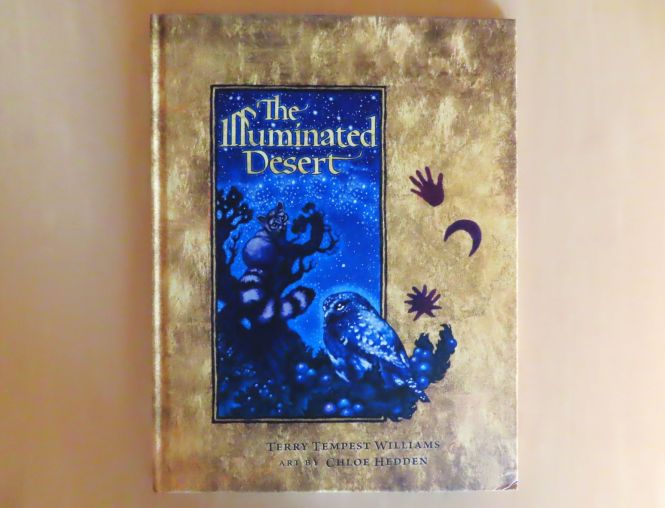
The Illuminated Desert is patterned after illuminated manuscripts commonplace in the Middle Ages. It is a collaboration between Terry Tempest Williams and fellow Utahn and artist, Chloe Hedden.
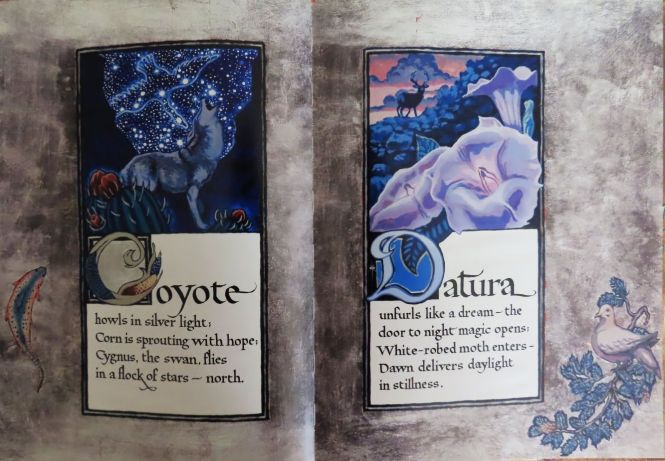
Detail of the intricate creations inside this abecedarian book.
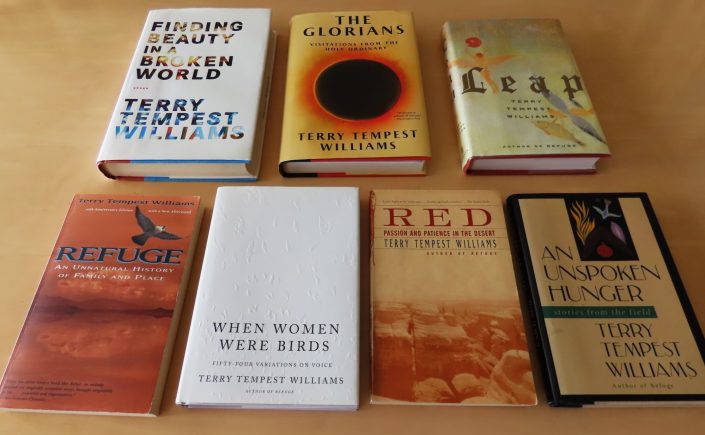
If I had to pick a favorite book, it would be Refuge. Closely followed by When Women Were Birds.
Published in 1991, Refuge recounts the year 1983, when Terry accompanies her mother through her losing battle with cancer, and Great Salt Lake through its struggle with record-high water levels, something nearly inconceivable now that the lake has seen record-low levels. Each chapter, save the last, bears the title of one species of bird whose fate is inextricably linked to that of the Great Salt Lake.
When Women Were Birds, published in 2012, picks up after the 1987 death of Terry’s mother who bequeathed her journals to her daughter, journals enough to fill three shelves. Imagine the author’s surprise when she discovers that her mother had not written a single word in any of them. After her initial bafflement, she sets out to make sense of that poignant gesture by dedicating 54 chapters to her mother’s remarkable personality, one for each of her (too short) life, giving her mother voice.
In March of this year, I learned of the author’s latest release and the fact that she would be on book tour in Boulder, Colorado. When I tried to get tickets to the event, it was already sold out. As it turned out, on the appointed day, Colorado’s Front Range saw one of last winter’s rare snows which would have made for treacherous travel. That same month, I happened across an interview on NPR between Terry Tempest Williams and Meghna Chakrabarti, host of the podcast On Point, in which they discussed her new book.
Not long thereafter, I went to one of our local Indy bookshops, intending to buy a copy for myself as well as for my dear friend, Andrea, whose April birthday was coming up. Much to my chagrin, they only had one single copy, so I bought it for Andrea and set it aside, waiting for other copies to come in. At least that was the plan. Every time I walked past the volume, I was tempted to pick it up, yet I did not want to read and risk creasing it. But resistance was futile. Once I started, I kept reading, until it was finished, a day or two later. Luckily, the next copy arrived in time for Andrea’s birthday, smooth and uncrinkled (this really should be a word).
An unexpected gift to both Andrea and me was the opportunity to attend an event with Terry Tempest Williams after all. Her trip to Boulder in March wasn’t the only one to Colorado. She was chosen as the recipient of The Frank Waters Award, presented by our local Pikes Peak Library District, which took place on June 6, at a hotel 5 minutes away from where I live. Andrea and I attended the luncheon and award ceremony, followed by the keynote address by Terry. Afterward, she graciously gave us a few minutes of her time. Andrea had once attended a writing workshop by her and was able to briefly catch up; I was grateful that she signed my copy of her book.

The Glorians: Visitations from the Holy Ordinary covers the years from 2020 until 2025, from the start of the Pandemic to the graduation of one class of Terry’s students at Harvard Divinity School, where she served as writer-in-residence from 2017 until 2026. It grew out of a dream in which she was told to “create the Epic Documentation of the Glorians.”
She has no idea what or who are the Glorians, but they reveal themselves to her, and she in turn introduces them to us, the readers, throughout the book. Terry’s dream takes place in Cassandra’s ruined temple and I wonder if the author considers herself a voice in the tradition of Cassandra, the Trojan priestess, who was given the gift of prophecy by the Greek God Apollo. When she refused to make love to him in gratitude, he also “gifted” her a curse: That nobody would believe her predictions, even though all would prove true.
If you have been reading my blog posts for a while, you know how much I care about Nature and how anxious and worried I am about the havoc we have wreaked upon her. You also know my great admiration for environmentally conscious and caring writers, such as Robin Wall Kimmerer. Terry Tempest Williams is another such writer.
As mentioned above, her writing is centered around Utah in general and often returns to the Great Salt Lake. Like many southwestern bodies of water, the lake’s levels are precariously low because of the decades-long drought that holds this part of the country in its grip. From the website of the Great Salt Lake Commissioner’s Office, I copied the following statement (I recommend you also take a look at the associated graph showing the lake levels):
It [Great Salt Lake] is a terminal basin, meaning it has no outlet, and once water arrives in the lake, it stays until it evaporates. So less water reaching the lake will, over time, ensure a smaller lake. Drought and warmer temperatures may also speed up the lake’s decline.
Runoff from the Uinta, Wasatch and Bear River ranges provides the primary water source for the lake. This runoff feeds the lake’s largest tributaries: the Bear River, the Jordan River and the Weber River. Combined, these sources supply nearly 70% of the lake’s water. The majority of the remaining water comes from direct precipitation on the lake, groundwater and intermittent streams in the West Desert.
The remediation of the lake’s devastating decline is one of Utah’s top priorities, and one hopes that efforts to raise the water level will be successful. And not only because Salt Lake City is scheduled to host the 2034 Winter Olympics and wants to make a good impression.
There are far more important reasons, some of which are given in the following extended excerpts of Terry’s gut-punching chapter, The Wings of Herons. Please bear with me, this is a very lengthy quote. The passages in boldface reflect my own emphasis.
Place our hands on the pulse of a dying lake. Watch the wings of herons burst into flames. The heat of climate collapse tells me there must be something deeper than hope. A sinking sun sets fire on the horizon—a display of blazing colors on Great Salt Lake—a commonplace ritual is intensifying in this era of retreat. The lack of water is creating more belief in what a saline body can hold even as it approaches and dodges death.
For millenia, our Mother Lake has been a flashing mirror calling millions of migrating birds down to her salt-quilled waters to feed on brine shrimp and flies, to rest and nest on the emerald wetlands that border this inland sea.
In 1987, I witnessed Great Salt Lake peak at 4,212 feet above sea level. Her reach was historic. For as far as I could see—water—a liquid hand covering a basin the size of Delaware and Rhode Island combined.
In July 2021, Great Salt Lake retreated to an epic low: 4,190 feet above sea level. Little did I know the following November would bring lower lake levels at the historic elevation of 4,188.5 feet. Standing on the causeway to Antelope Island looking northwest, all I can see is a horizon of salt.
Great Salt Lake is evaporating before our eyes, leaving a salt-encrusted, foul-smelling lake bottom laced with toxic chemicals from the industries that have mined the lake for salt, magnesium, and potash for decades. Lithium may be next. Scientists warn that our Mother Lake will continue to retreat, exposing more of her arsenic-tainted lakebed if we do nothing.
The death of Great Salt Lake will be catastrophic; the impact on twelve million migrating birds in the western hemisphere will be an ecological tragedy. The Bear River Migratory Bird Refuge, seventy-seven thousand acres of critical wetland habitat to over 330 species of birds, is an expansive marsh on the margins of the Great Salt Lake that sparkles and sings. No longer. We now witness bone-dry canals bordered by brittle reeds and rushes. The blue lanes of water—teeming with western grebes, ruddy ducks and redheads, cinnamon teals and pintails, that once flowed into generous ponds where avocets and stilts foraged in the shallows—have been replaced by sun-baked, drought-caked playas.
There is no refuge—only a brutal silence of all that is missing.
Shock makes tears impossible.
The heat of sorrow rushes into my heart. As one who has been raised and buoyed up by the Bear River Migratory Refuge, I know my life through the lives of these birds. Their paucity is a profound disorientation. Individual birds are still here. But where are the multitudes? Where am I? Where are we in this moment of drought and despair?
These birds are mute from the drought and diversions made for watering alfalfa that we export to feed cows in other states. We who live among the birds are also mute. Some of us, many of us, are trying to speak. Who is listening?
I want honest conversations that do not end on the obligatory hopeful note.
We do not get to sing that song anymore.
There is a real world and it is dying.
If the facts don’t matter anymore and misinformation does; if we fail to listen to the indigenous wisdom of First Nations and we remain unmoved by another way of being in right relationship to the Earth; and if the stories and statistics scientists are bringing to us do not stir us to action on behalf of a living world that is suffering; and if the lives of our children and the future of our children’s children are not first on our minds and thwarting the easy sleep of our privilege—then the question must be asked: Are we too dead to the world to feel alive?
Believe the long-legged birds who are circling above us, desperately looking for water. Believe the forests that are burning whose surviving trees will later stand as sentinels, charred witnesses to animal bodies reduced to ash. Believe in flash floods roaring through burnt canyons, gathering debris in rivers running black in the desert, even in times of drought. Believe Great Salt Lake is retreating in plain sight, leaving what’s left to the dust devils whipping up clouds of chemicals resting on the dry lakebed so we can inhale the toxic world we have created. Believe in the once-shimmering bodies of water on the horizon that are now nothing more than a mirage made of heat-waves death-dancing on the salt flats. Believe in the silences.
Before we can save this world we are losing, we must first learn how to savor what remains.
This is more than an ecological crisis—it is a spiritual one.
The Earth will survive us.
We are the ones being baptized by fire.
+ + + + + + + + + + + + +
Today, September 08, is the author’s birthday.
Happy Birthday, Terry! May you continue to speak truth like Cassandra.
And may we finally learn to listen.
+ + + + + + + + + + + + +
Thank you if you managed to stay with me until the end of this long post.


I have long wanted to read her but somehow never have. So many books, so little time! Maybe this will be the year I finally read her. In seven days I will be 69, and I plan on reading 70 books in time for my 70th birthday. Hers will be one of my books.
LikeLiked by 1 person
Thank you for your comment, Laurie.
I like your idea of reading (at least) 70 books in the coming year and hope one of them will be Terry’s. Have you narrowed down your selection yet? That alone would be a difficult decision!
I don’t know if it’s considered bad form to wish you a happy birthday early, but I hope it will be a lovely day. All the best,
Tanja
LikeLiked by 1 person
No, I haven’t narrowed done my selection. When it comes to books I like to wing it, and I never wonder what I am going to read. So many good books out there!
LikeLiked by 1 person
As we know, reading one book often leads us to picking up another, even if it wasn’t previously on our wish list.
Have fun making your selection!
LikeLiked by 1 person
This is a writer that I haven’t come across before but your post about her makes a big impression on me. I’m particularly struck by the contrast between her mother’s empty journals and Terry’s own, very important, words.
LikeLiked by 1 person
Thank you for taking the time to read and comment, Ann.
I find all her books striking in different ways but can’t even begin to imagine what it must have felt like to expect to read about your mother’s life and thoughts and to find only empty journals. It took her a long time to write about it.
LikeLiked by 1 person
That must have been a most peculiar experience and hard to come to terms with. It does inspire all sorts of questions!
LikeLiked by 1 person
Thank you for this fascinating read. I’d heard of Williams, but will try to find the interview you mentioned from “On Point”. She’s now on my ‘to read’ list!
I’ve been to Utah and Salt Lake City and the mountains in that area, but never spent much time there. It was a long time ago and I’m sure much has changed.
LikeLiked by 1 person
Thank you for taking the time to read and comment, Tina.
There have been many interviews with the author lately, and I’m taking the liberty to send you two links (the first was broadcast on On Point, the second on Wild Card, with Rachel Martin):
https://www.wbur.org/onpoint/2026/03/13/how-to-find-glory-in-the-ordinary
https://www.npr.org/2026/07/09/nx-s1-5886304/terry-tempest-williams-glorian-utah-nature-southwest-poety-mormon-great-salt-lake
LikeLiked by 1 person
Thanks for these–I just bookmarked them!
LikeLiked by 1 person
Andrea is lucky to have you as a friend, Tanja.
You’ve captured the spirit and intensity of Terry’s work beautifully. The thoughtful reflections you’ve offered here celebrate her voice and the landscapes she treasures. I suspect new readers will be discovering her writing thanks to you.
LikeLiked by 1 person
Dear Andrea,
Thank you for reading and commenting. Coming from you, it means a lot.
I am the lucky one! 😊
LikeLike
I’ve heard of her, as she narrates part of the Ken Burns National Parks documentaries, but I’ve never read her books. From her words in the documentary and the ones you share here, though, I have a suspicion I would very much enjoy her books!
LikeLiked by 1 person
Thank you for your comment, Diana.
I hope you will be able to read some of her writing and form your own opinion!
LikeLiked by 1 person
Hi, Mrs. Tanja-
Thank you so much for sharing such a beautiful post!
Terry Williams truly sounds like an amazing writer, and I thank you for introducing me to her work.
What a privilege that you were able to meet her! I am so glad you were able to have such a special encounter.
I apologize for being a few days late in reading and responding. Nevertheless, I quite enjoyed your post, as always!
Blessings to you,
Gavin Broom
LikeLiked by 1 person
Dear Gavin,
Please don’t apologize! You are not obligated to read my posts and comment on them, even though I really appreciate that you do!
We all get sidetracked occasionally, for whatever reason. Getting sick is definitely not a fun reason but I’m glad that you are better.
I was excited to meet this author I have admired for many years. Her books are thought-provoking and deeply moving, as evidenced by the excerpt I chose. Much of her writing about nature is upsetting and saddening because she shows what poor caretakers we have been, and continue to be, though there is always the encouragement and hope to do better.
Thank you for your comment.
Take care,
Tanja
LikeLiked by 1 person
Despite having lived in Salt Lake City in the early ’80s, I always paid more attention to the mountains than the lake. Of course, at the time I’d not developed much interest in the natural world as a whole, and as far as I know I never heard a mention of this author. I was aware of Antelope Island, though. Do you happen to follow Ron Dudley’s “Feathered Photography” blog? He lives in Utah, and has a multitude of posts devoted to Antelope Island that probably would interest you. I’m sure I remember him spending time in the Bear River refuge as well; you can search his blog for photos from that area.
LikeLiked by 1 person
Thank you for your comment, Linda. I think TTW became known nationally following the publication of “Refuge,” which was in 1991, so I ‘m not surprised that you didn’t hear about her in Utah in the 1980s.
I am not familiar with Ron Dudley’s blog but will check it out. Thank you for the suggestion.
LikeLiked by 1 person
Thanks for this introduction. I am a great believer in the messages from the DreamTime.
LikeLiked by 1 person
Thank you, VJ.
I have not been willing or able to delve into my dreams as I’m having mostly nightmares these days (years). Living through them once seems enough already. Even though I know why I’m having some of them, I’m unable to change some of the realities that are influencing the dreams.
LikeLiked by 1 person
Nightmares are often the gold that gives us insight and hope. I understand that they can be frightening.
LikeLiked by 1 person
I had not heard of this author, but I have put her on my list. I didn’t really know much about the Salt Lake, and that is absolutely frightening. For me the most powerful quote was:
I want honest conversations that do not end on the obligatory hopeful note.
We do not get to sing that song anymore.
There is a real world and it is dying.
I try to be positive, but some days are better than others….
LikeLiked by 1 person
Thank you for taking the time to read and comment, Julie. Those words you quoted are also the most profound and shocking to me.
To pretend everything is or will be ok, as much as we all want it to be seems like wishful thinking by now.
I admit to turning more and more cynical . . .
LikeLiked by 1 person