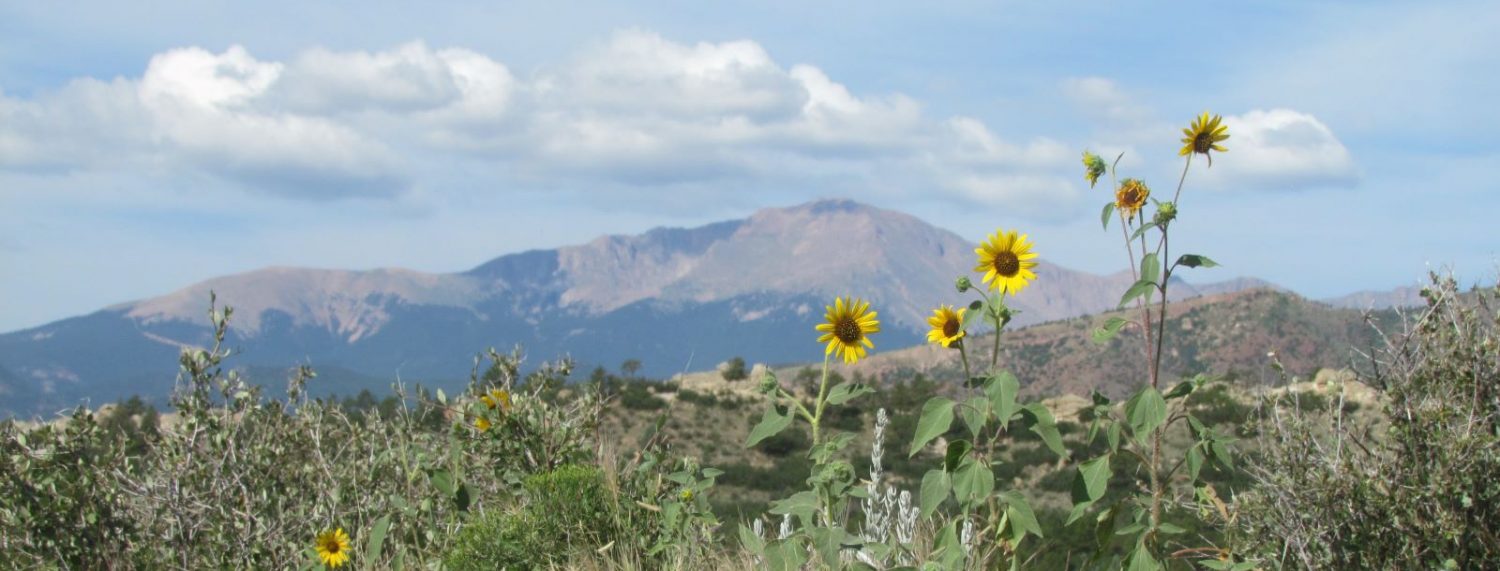

How do we know it’s springtime along Colorado’s Front Range? How does anybody anywhere know it’s springtime?
It’s because the dandelions are blooming, showing their bright and cheerful faces to the supraterranean world! 😊
I wonder if that’s true where you live, too. Because the Common Dandelion (Taraxacum officinale) has spread from its original home in Eurasia and is considered one of the most successful plants globally, so it might be a nearly universal harbinger of spring. Might such a species ever be removed from the non-native list? If you have any insight, I would be curious to hear your thoughts on the matter.
Flower species undoubtedly native to Colorado and indicative of the beginning of spring are the white or pink or purple Pasque Flowers (Pulsatilla patens) and the always-white-as-snow Sand Lilies (Leucocrinum montanum). After several months in which brown or, less commonly, white, were the predominant hues, the eyes rejoice to behold different shades and shapes. The same is true when the grass finally starts to turn green and emerging leaves on shrubs and trees follow suit. And even if crabapple trees (Malum spp.) are introduced, their popularity make them very conspicuous—including for insects, who are irresistibly drawn to the voluptuous blossoms whose colors also range from white to almost purple. No less popular are lilac bushes (Syringa spp.) and as the header photo shows, they might bloom in Colorado Springs while Pikes Peak directly to the west is still in winter mode.
When warmer weather revives flora and insects, other fauna awakens too. As poikilothermic beings, reptiles are dependent on heat to function and they often sun themselves in plain sight, a boon for the photographer. This handsome male was already thinking of spring love, showing off his attractive blue belly to a potential mate.
To enlarge a photo, click on it. To read its caption, hover cursor over it.


I always look forward to the transformations described above, but the most eagerly awaited sign that spring has, indeed, arrived, is the advent of migratory birds. Representative of the myriad families of feathered friends who grace us with their presence only temporarily, I’m sharing photos of a couple of shorebirds and warblers.
Many North American shorebirds overwinter in Central or South America and breed in the Arctic, stopping repeatedly along this incredibly long route to refuel. They are elegant birds and it’s a joy to watch them forage along the shores of inland lakes while also trying to identify them, which is often challenging.
With regard to warblers, we occasionally see out-of-the way individuals who were blown here by the prevailing winds. One species that winters along the coast of the Caribbean and spends summers mostly in the southeastern United States is the Prothonotary Warbler with a brilliantly yellow body and slate-colored wings. When a male appeared at one of our local birding hotspots in early April, local birders were atwitter and yours truly was happy to see this handsome creature for the first time in my life. Its unusual name is derived from prothonotaries, papal clerks in the Roman Catholic Church who wore yellow robes (protos meaning first and notarius, scribe).


Last but not least, spring wouldn’t be spring without spring babies and as is usually the case, the common and ubiquitous Canada Geese are also the first to enlarge their families. Goslings clad in yellow down never fail to lift one’s spirit. The spirit that is ready for spring after a long winter.
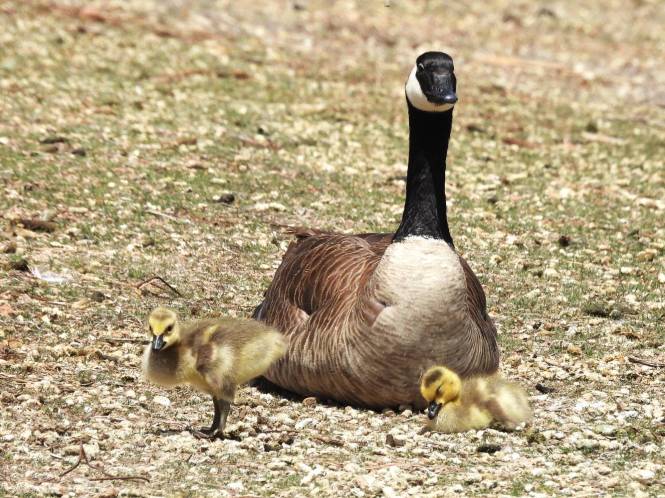
Canada Goose and goslings/Kanadagans mit Gänseküken oder Gössel (wie man in Norddeutschland zu sagen pflegt)


Beautiful captures. I am partial to the Avocet.
LikeLiked by 1 person
Thank you for the compliment. I also love avocets, especially when they are in full breeding plumage. If you are interested, here are some photos of the American Avocet, which is different from its European cousin:
https://tanjabrittonwriter.com/2022/04/20/april-brings-avocets/
LikeLiked by 1 person
They are really very beautiful. Both types. 🥰
LikeLiked by 1 person
They truly are.
LikeLiked by 1 person
Spring rolls on whatever the climate throws at it. Again this year here in Norfolk UK cold and wet. The plants do ok, birds arrive but it’s the insects that suffer.
Lovely warbler, I can see why you were pleased to see that.
LikeLiked by 1 person
Thank you for your comment, Brian. I’m grateful that spring still arrives, though for how much longer one wonders. If the birds arrive and don’t find any insects, that’s very bad news. 😢
LikeLike
The yellow bird is spectacular. This year, have you seen any other birds for the first time ever?
LikeLiked by 1 person
Thank you, Neil, that warbler is exquisitely handsome. He was my first life bird for the year, but the year is still young.
LikeLiked by 1 person
Tanja, I enjoyed this so much! Happy May and spring in beautiful, Colorado. Your photos and descriptions are perfect. Dandelions~I’m the weird girl, sitting in a city when I’d rather be in the country, wanting to keep dandelions just as they are. They’ll be mowed over. And I’ll go hike, because I have two good hours, and see the birds, wild flowers, and lizards greet me as I welcome all of us into a new season. Sending you well wishes and hugs! 🏔️🥾💐
LikeLiked by 1 person
I appreciate your kind comment, Karla. May brings us much loveliness and happiness, all given freely and fully and ready for us to welcome with open arms. I’m so grateful for all its gifts. Keep enjoying this wonderful month.
LikeLiked by 1 person
How beautiful, Tanja. It’s my blessing to visit you! I’m so grateful for the gift of another day. I know you are, too!
LikeLiked by 1 person
May you enjoy the gifts of many, many, many more days, dear Karla!
LikeLiked by 1 person
Thank you, my dear friend!! You too, Tanja!
LikeLiked by 1 person
Fröhlichen Frühling, even if spring comes not early but late to Colorado. And speaking of alliteration, I like the sound of your phrase “shades and shapes,” words of Anglo-Saxon origin (with cognates in German). Botanists have named the Pasque flower Pulsatilla, meaning ‘little pushed one’ (with push being etymologically the same word as pulse), presumably for the characteristic way the flower pushes up from the ground.
That pretty yellow warbler is another bird, like the better known cardinal, named after the raiment of a Catholic official. That got me wondering, and a search turned up a bishop bird as well.
Your question’s a difficult one. It’s common for species to expand their ranges even with no human mediation, thanks to your avian friends and to the wind. One way to deal with the question is to distinguish between the terms native and naturalized, with Taraxacum officinale falling into the former category in Europe but the latter category in America.
LikeLiked by 1 person
Thank you for your comment, Steve. We always come back to language, don’t we? You etymological explanations encompass everything from the Anglo-Saxons to the Catholic Church to the naturalization of dandelions. They, unlike other species, don’t need any cumbersome documents to naturalize.
LikeLike
You have captured the spring light so nicely in these Tanja. We too, are starting to see dandelions here and I think of them differently than I used to, more beneficial and less of a pest plant. I’m thinking of making fried fritters, with some of their flowers this year because I think we might as well make use of some of nature’s offerings. I didn’t realize they were not native to our home here in North America.
LikeLiked by 1 person
Thank you, Julie. I think it’s a good idea to think differently of dandelions. It’s hard to believe the amount of poison people pour on their properties in the futile attempt to get rid of them. I dig them from our lawn, otherwise they would completely take over, but especially early in the season I let them bloom until other flowers are available to provide nectar for pollinators. And I always think we should make salad from them as the leaves are very nutritious. Your fritters sound intriguing, I hope you will enjoy them.
LikeLiked by 1 person
Happy Spring, Tanja! Great shots, all, but that Prothonotary Warbler–woo hoo! I had to go to Costa Rica to see one (a couple, actually), even though they migrate through Texas. They are really beautiful birds.
LikeLiked by 1 person
Thank you, Tina. I wouldn’t mind a trip to Costa Rica, but I’m very happy that I got to see the warbler right in front of our doorstep, so to speak. 😊
LikeLike
Yay, Spring near the mountains!
LikeLiked by 1 person
Yay, indeed, Brad. Spring is my favorite time of year.
LikeLiked by 1 person
Happy May Day, Tanja. Spring is here at last and here’s to enjoying the warm half of the year!
LikeLiked by 1 person
.Thank you, Eliza. I hope you had a Happy May Day as well. And that you will have more happy May days to come.
LikeLiked by 1 person
Kürzlich war ich in Düsseldorf, und dort befinden sich sogar an den Uferrändern des Kö-Grabens mitten in der Stadt Kanadagänse. Ein Küken tappte fast bis auf den Bürgersteig, und ich wollte es schon vorsichtig umleiten, aber angesichts der aufmerksamen und wenig scheuen Gänseeltern hielt ich doch lieber einen Meter Sicherheitsabstand. Das Küken wendete sich dann von selbst wieder der Rasenfläche zu.
Liebe Grüße von Ulrike
LikeLiked by 1 person
Liebe Ulrike,
wie Du selbst erlebt hast, haben sich die Kanadagänse erfolgreich in Europa angesiedelt. Wie gut, daß es Menschen wie Dich gibt, die auf ihr Wohl achten. Ich glaube, daß wir in Zukunft noch viele weitere Arten inmitten der Städte finden werden, weil sich die Vögel dort einen neuen Lebensraum aufbauen müssen. Halt also weiterhin die Augen auf.
Liebe Grüße,
Tanja
LikeLiked by 1 person
Lustig, auch ich sah gestern die ersten Kanada Gans Gössel 💛
Wer entscheidet denn, wer wo heimisch ist oder nicht.
Menschen wandern, Tiere wandern, Pflanzen wandern.
“Zitat” In der historischen Forschung wird als sogenannte Völkerwanderung im engeren Sinne die Migration vor allem germanischer Gruppen in Mittel- und Südeuropa im Zeitraum vom Einbruch der Hunnen nach Europa circa 375/376 bis zum Einfall der Langobarden in Italien 568 bezeichnet” Zitat Ende
Und
Zitat “Der Gewöhnliche Löwenzahn stammt ursprünglich aus dem westlichen Asien und Europa” Zitat Ende
Also auch gewandert 😊
Jeder sucht sich nach Möglichkeit auf Mutter Erde den Platz, auf dem es ihm gut geht und er sich weiter vermehren kann. Das ist wohl der Sinn jeglichen Lebens glaube ich.
Tolerieren wir also Migration und freuen uns über Vielfältigkeit.
Liebe Grüße 😊
LikeLiked by 1 person
Dankeschön für den Kommentar und die Informationen, liebe Brigitte. Du hast natürlich recht, daß Bewegung und Wanderung quasi seit Anfang zum Leben dazugehören. Und Dein Motto “Tolerieren wir also die Migratin und freuen uns über die Vielfältigkeit” sollten wir uns alle auf die Fahnen schreiben!
Liebe Grüße zum Wochenende,
Tanja
LikeLiked by 1 person
Yes, true for Maine, too. Dandelions signal spring. Love those babies.
LikeLiked by 1 person
Is there any other plant that is so ubiquitous and so pretty, yet so maligned?
LikeLiked by 1 person
Vielen Dank für den tollen Bericht. Ich war im Spital, OP, bin wieder zuhause. Geht.
LikeLiked by 1 person
Vielen Dank für den Besuch und Kommentar, lieber Ernst. Ich wünsche Dir gute Genesung!
Liebe Maigrüße,
Tanja
LikeLike
You have produced a wonderful description of Spring’s arrival. The re-awakening of the land and its inhabitants each year is cause for celebration.
All of your photographs are incredible. Thank you for sharing your message of this glorious season!
LikeLiked by 1 person
Thank you, Wally. Spring has–and always will be–my favorite time of year and I look forward to this one and, I hope, many more.
LikeLike
Ah, that’s how the Prothonotary Warbler got its name, I often wondered about that. Such a vividly coloured bird, although I guess it would be perfectly camouflaged for a life amongst the dandelions 🙂 Here in my part of the UK dandelions seem to be particularly prolific this Spring; they have a bad reputation amongst gardeners, but they are such cheerful, resilient flowers that I can’t help admiring them.
When does a non-native species finally escape that pejorative description? I was surprised to learn the other day that the brown hare is regarded as a non-native species in the Britain, having been brought here by the Romans 2,000 years ago! Yet British folklore is riddled with stories and songs about hares, which are deeply embedded within our rural culture. I can hardly think of a more British species, yet the textbooks dismiss it as non-native. Surely it’s earned the right to be accepted as “one of ours”, just like your prolific dandelions!
LikeLiked by 1 person
I like the idea of warbler and dandelion being in cahoots. There is a children’s story somewhere in that combination!
I also question the dandelions’ bad reputation. They are beautiful, beneficial, and nutritious, yet gardeners wage war against them. There is something wrong with that approach, especially when it involves poisons that kill not only the plant, but myriad other creatures–and are known human carcinogens. 😦
Thank you for sharing the story of the hare. I had no idea. Steve made an interesting comment about the difference between native and naturalized above, which makes sense. But I also think there comes a time when that differentiation no longer matters.
LikeLiked by 1 person
Many gardeners seem intent on imposing order onto apparent chaos. It’s a control thing, I suppose, but flawed in my view as Nature follows its own rules and therein lies true beauty.
Change is a natural phenomenon. Everything changes in the end (although our own species does hasten the process a bit!) There comes a time when we need to accept it, rather than fight it. Welcome, Mr & Mrs Hare! Welcome, you bright and bold dandelions!
LikeLiked by 1 person
Amen!
LikeLiked by 1 person
Dandelions are the sign for us too. Long before the grass comes to life the dandelions have already taken over. Love your collection of spring pictures. Maggie
LikeLiked by 1 person
Thank you, Maggie. I think dandelions will be around long after the era of humanoids ends.
LikeLiked by 1 person
Quite the contrast Tanja, you managed to capture in this single blog one both my favorite and least favorite yellow – the Prothonotary Warbler and the dreaded Dandelion. I tell everyone the latter is why I live in the country so I don’t have to deal with the same of neighbors seeing them in my yard. As you pointed out, they are an excellent sign Spring is a comin’ and the start of a coming migraine hehehe. On the other hand, I have always considered the Prothonotary the creme de la creme of the Warblers. That coal black eye against that brilliant yellow is just gorgeous. Not to give anything away, but I was able to introduce Brad to his first Prothonotary in the wild this week. Cute Goslings – is it just me or is their fine feathering nearly autofocus proof – seems like I am always having to fine tune my focus whenever trying to capture those fluff balls.
LikeLiked by 1 person
*goslings*
LikeLiked by 1 person
Thank you, Brian. The Prothonotary Warbler was an absolute joy to behold. Luckily, he didn’t seem to mind the attention of a large gaggle of birders for several days in a row. Brad must be thrilled about his life bird as well.
Maybe the goslings’ fluffy feathers always flutter a little, causing problems for the camera (and photographer) to focus. I had never thought of it, but your comment made me wonder.
LikeLike
Seems our springs have much in common – dandelions have been keeping early bees happy, then they’ve graduated to the apple & crab apple blossom, pasque flowers and lilacs. (And the woodpigeons are in the lilacs too – scoffing the young leaves!)
LikeLiked by 1 person
That’s a great observation, Ann. I guess it’s because most of these plants have traveled from Europe to America (planned or unplanned) and become well-established.
LikeLiked by 1 person
Great selection of photos !
LikeLiked by 1 person
Thank you, Cathy.
LikeLike
We do see the common dandelion here, but the best dandelion is one that resembles it only in appearance: Pyrrhopappus pauciflorus. It’s often called Texas dandelion, but its other common name, smallflower desert chicory, suggests its closer relationship to other plants.
Our rain lilies often push up through barren earth like the pasque flowers. I’ve never seen one, but perhaps one day I’ll have the chance — if I ever can bear to leave our Texas spring for a different area of the country! Others of your signs are all around us now: baby mallards, the arrival of green herons, and so on. I’ve missed a good bit of spring because of work responsibilities that kept me at home, but the good news is that there’s ‘early’ spring and ‘late’ spring, and it’s not too late to catch the end of the season!
LikeLiked by 1 person
Thank you for your comment, Linda. I can definitely see the connection between your pretty Texas dandelions and chicory.
And I’m glad you get to enjoy “late” spring after missing out part of your “early” season. I can never get too much of spring, always feel that it passes too quickly.
LikeLiked by 1 person
The ‘native’ and ‘non-native’ plants debate is a hot one in the internet. All I can say is that I come from an island and the flora from P.R. resembles that of the Pacific, and vice versa. Which one was there first, when or how? This is the reason why I don’t believe in this kind of purism. The Common Dandelion (Taraxacum officinale) is one of the best examples of ‘naturalization’. Unfortunately, I have to say that some plants that simply ‘spread’ by ‘unknown’ means are immediately considered ‘non-native’ or even ‘exotic’.
LikeLike