
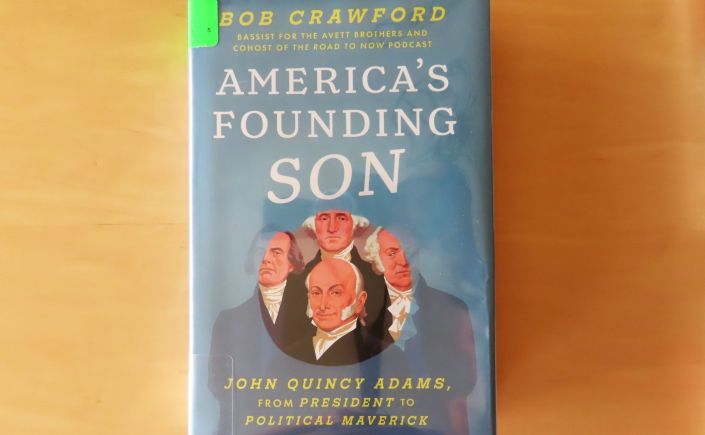
One stimulating aspect of the semi-quincentennial of the signing of the Declaration of Independence has been the revival of an interest in the history and trajectory of this country, as well as the publication of a trove of new books. One such work I learned about while listening to On Point on our local NPR station. Host Meghna Chakrabarti talked to Bob Crawford, bassist for the Grammy-nominated Avett Brothers, co-host of the history podcast The Road to Now, and author of the recently published, America’s Founding Son: John Quincy Adams, From President to Political Maverick.
If you think back to history class, you might remember that John Adams was the second President of the United States, whose one-term presidency (1797-1801) was sandwiched between George Washington’s and Thomas Jefferson’s two terms. John Quincy Adams (1767-1848) was the second child and eldest son of John Sr. and his wife Abigail. Like his Founding Father (interestingly, this term was not used widely before the 1910s and 1920s), he had an illustrious political career. After spending several years of his adolescence in Europe and graduating from Harvard, he received his law degree, then went on to function as Minister to the Netherlands and Prussia, as Massachusetts Senator, as Minister to Russia, and as US Secretary of State, before serving as the sixth US President from 1825-1829.
His famous family legacy was also a liability. Hailing from Massachusetts, the Adamses were the only two among the nation’s first six presidents not to belong to what has been called “the Virginia Dynasty” (Washington, Jefferson, Madison, and Monroe). This strong early representation of a southern state and southern politicians was one factor that led to the “institution” of slavery becoming deeply entrenched in American society, with reverberations to this day.
The Adamses’ known opinion about slavery was one of the reasons each served only one term. It didn’t help that John Quincy was chosen President by the House of Representatives, after the number of electoral votes in the presidential election of 1824 did not show a clear majority. His main opponent, Andrew Jackson, who had garnered 99 electoral votes, versus John Quincy’s 84, was understandably upset. He and his supporters never forgave John Quincy and did their utmost to make him a one-term, and ineffective head of state, in which they succeeded.
Unlike any former President before or since, John Quincy decided to return to Congress after his presidential term, serving as Massachusetts Representative from 1831 until 1848, the year of his death. It was during that chapter that he accomplished what I find most admirable in a life spent in service to his country.
Slavery and the difficult and prolonged fight for its abolition became John Quincy’s quest, though he has been called a reluctant abolitionist, at least at the beginning of his political career. He was aware of the hot potato-status of the topic and was willing to tolerate slavery in some states in an attempt to preserve the Union. Any discussion of the issue had the southern slave states threatening to secede, and they held the country hostage for nearly 90 years. While he served in the House, John Quincy finally realized that it was no longer possible to try to keep the country together at all cost, and he became an outspoken critic of the political machinations of the southern states, and the evils associated with buying, selling, abusing, even killing human beings for financial gain.
Even though he was not a proponent of immediatism (abolishing slavery immediately), he riled his fellow southern congressmen by submitting petition after petition by US citizens in favor of abolition. He was a fervent believer in the Constitution, especially its First Amendment, which includes the right to petition the government for a redress of grievances. In those days, it was the role of representatives to present those petitions to Congress. So many anti-slavery petitions were submitted that the Southerners refused to hear and address them. Rather, in 1836, they passed the first of several gag rules, which stated: “All petitions, memorials, resolutions, propositions, or papers, relating in any way, or to any extent whatsoever, to the subject of slavery or the abolition of the slavery, shall, without being either printed or referred, be laid on the table and that no further action whatsoever shall be taken.”
In other words, the people’s representatives decided not to listen to their constituents because they didn’t like what they had to say!
John Quincy tried everything in his power to circumvent the gag rule, which he considered unconstitutional, and he succeeded. For this his peers wanted him censured—more than once. Some even wanted to try him for treason when, in 1842, he had the temerity to present a petition from citizens of Haverhill, Massachusetts, who suggested to dissolve the Union rather than let slavery continue. The Southern representatives accused him of disloyalty and of not being “a true American.“ They did not seem bothered by their own double standard, as each time anybody dared criticize them, they threatened to secede. After days of heated discussion and self-defense, in which John Quincy proved why he had become known as “Old Man Eloquent,” the House decided to table the motion to censure him by a vote of 109 to 93.
Among his courageous actions was serving as a (pro bono) lawyer before the US Supreme Court in 1841 on behalf the men and women abducted from their native Sierra Leone and smuggled to America on the ship Amistad (the International Slave Trade had been outlawed in 1808). In the end, the judges ruled 7-1 in favor of the captives.
Even though John Quincy did not live to see emancipation, in 1844, after many previous failed attempts, he finally succeeded in getting the gag rule overturned. His fight for what he thought the United States should aspire to, continued until the end of his earthly existence. He suffered a stroke (his second) while attempting to speak to his fellow representatives in February 1848, when he was 80 years old. After losing consciousness, he was moved to the chamber of the Speaker of the House, in the US Capitol, where he died two days later.
It was chilling to be reminded of the excuses and explanations people dreamed up in order to justify an obviously unjust and unjustifiable “institution,” from the very beginning of this country. Even Thomas Jefferson, who helped draft the Declaration of Independence, knew that it was, at best, hypocritical to exclude Black persons from the ideals espoused by a nation that boldly stated, “all men are created equal.” Despite being an enslaver himself, he wanted to include a reference to the abomination of the slave trade. His original draft includes one additional grievance, namely that King George III “has waged cruel war against human nature itself, violating its most sacred rights of life & liberty in the persons of a distant people who never offended him, captivating & carrying them into slavery in another hemisphere.” Jefferson was told to scratch that statement, and he did. I wonder if its inclusion would have led him (and other Framers) to free their enslaved persons, though why they didn’t do it even without this clause is a question historians have debated ever since.
Apart from learning about John Quincy’s thoughts on many issues (he kept a diary for 60-plus years, filling nearly fourteen thousand pages, a boon to historians), I made the acquaintance of a number of other individuals whose full-length biographies would make for enthralling reading:
David Walker, a free Black man whose pamphlet Appeal to the Coloured Citizens of the World was considered the most influential treatise since Thomas Paine’s Common Sense.
Benjamin Lundy, a Quaker and itinerant abolitionist who printed a series of abolitionist newspapers and traveled as far as Canada and Mexico to look for potential places where Blacks might be welcome to create their own free communities.
William Lloyd Garrison, who, after meeting and being inspired by Lundy, would go on to publish The Liberator, the country’s most influential abolitionist newspaper.
Theodore Weld and Angelina Grimké, both abolitionists, who met while fighting for a common cause, and later married. Theodore Weld spent many years as an anti-slavery orator before becoming a writer, authoring such books as The Bible Against Slavery and American Slavery as It Is. John Quincy’s response to the latter: “The stomach heaves at the perusal of the numberless cases of human suffering inflicted by human hands.” The book also inspired future abolitionists, Harriet Beecher Stowe among them. She would go on to write Uncle Tom’s Cabin, the 1852 book that so moved many readers and energized the public sentiment against slavery. When Lincoln met her in 1862, he famously called her “the little woman who started this great war.”
Angelina was also an advocate for women’s suffrage. Her disapproving opponents called her Devilina—and all because she wanted all people—Black and White, men and women—to be treated equally.
Name-calling is one thing, and, sadly, it has pervaded politics since time immemorial. The same can probably be said about mob violence. But while the former might be an undesirable side effect of a society where freedom of speech is held in high esteem, the latter should never be tolerated, regardless of which side commits it. It was appalling to read about the many instances of violence, including murder, committed by throngs of pro-slavery groups, most of whom were never prosecuted. Some infamous ones happened in 1838. In Alton, Illinois, a pro-slavery mob killed Elijah Lovejoy, editor of the antislavery Alton Observer, after previously unsuccessfully trying to intimidate him by destroying his printing press three successive times. Later that year, in Philadelphia, Pennsylvania Hall opened as a center for free speech and discussion, not only for abolition, but also for science, philosophy, and religion. Only a few days after its dedication, a mob of “generally respectable and well dressed [men]” attacked and burned it to the ground. So much for freedom of speech. Freedom of the press. Freedom. Period.
As someone who knew the constitution like the back of his hand, John Quincy Adams didn’t beat about the bush, and I wish we could get his reaction in this day and age, when people still cherry-pick the parts of the Constitution they like, and ignore those that don’t serve their ideological views.
Again—the longer my head is stuck in history books, the louder rings the truth of this essay’s title: Plus ça change, plus c’est la même chose—The more things change, the more they stay the same. And even if history does not exactly repeat itself, it “rhymes,” as someone (reportedly Mark Twain, but probably not) once quipped.
And alongside this recurring refrain runs the burning question that still keeps me awake at night: When will we finally learn and persist in doing better?
 tanja britton
Tanja, this is an outstanding, powerful essay. Thank you so much for taking the time and trouble to write it and share it with your WordPress audience. Half a century ago I studied US history at university for a few months, but JQA never made it onto the syllabus, which – if I remember correctly – was dominated by Jefferson, Washington and Lincoln. Based on what you have written that is a great shame, JQA sounds like a really interesting guy, way ahead of his time. His impressive attempts to help create a more just society in the US deserve to be much better known.
Incidentally, your assertion that ‘if history does not exactly repeat itself, it “rhymes,” ‘ is new to me but I love it and will most definitely use it in the future!
Your final paragraph is perfect. Well said, my friend.
C’est vrai, ma chère Tanja. Plus ça change, plus c’est la même chose…but it doesn’t have to be that way.
LikeLiked by 3 people
Thank you, Mr. P, I’m glad my book review spoke to you.
I agree with your assessment of JQA and wish he were better known. While I’m always appalled by how wrong so many of us have been so much of the time, it gives me hopes that there have always been individuals and groups who swam against the current and stood up for their convictions. It’s those people who have helped advance so many good causes and tried to improve the lot of humankind.
You are right–things don’t have to repeat themselves but, somehow, we seem unable (or, more likely, unwilling) to reform.
LikeLiked by 1 person
Thanks for a great read, Tanja. “Devilina”. They’re never short of derogatory terms for women they don’t like – and the vocabulary ever expands. I read a fascinating essay on Substack a few weeks ago by a female writer and it offers marvellous insight into female power and the history of suppressing it. The title has a taboo word avoided in polite society(!) so I’ll just give you this link.
LikeLiked by 1 person
Thank you for your comment, Liz, as well as for the link.
Wow, that is a powerful essay. I had no idea of the history of this charged word. But I’m not at all surprised at its suppression, and the suppression of women and their capabilities throughout the ages.
Of course, not all men feel threatened by women, but there are many who would like to confine us to certain realms and tell us how to live, and what we are allowed to do and not to do. As we know, the reactionary forces will always try to regain the ground they have lost.
LikeLiked by 1 person
Was there something in particular that led you to read a biography of John Quincy Adams?
Here’s one “tell” that an aphorism is likely not by a person it’s ascribed to: the first known appearance of the aphorism comes many years after the person’s death. That seems to be the case with “History doesn’t repeat itself, but it rhymes” (or variations thereof). According to Quote Investigator, the first known occurrence of that thought was by Theodor Reik in 1970, 60 years after Mark Twain’s death. Because Mark Twain did say and write many witty things, he’s high on the list of writers to whom sayings are misattributed.
That in turn raises the question of why a person would attribute a quotation to someone who didn’t say it. Honest error? Laziness? Mendacity? All of those are parts of human nature.
LikeLiked by 1 person
It was the NPR interview I mention in the first paragraph that made me want to learn more about JQA and his times. Also, I read “The Education of Henry Adams” a few years ago, something you and I “talked about” either on your blog or mine, so I already had an interest in the Adams family.
I read that article on Quote investigator about who might, or might not, have uttered that quote. I previously used the same quote in my article about “America the Beautiful,” which also) contained a (proven) Mark Twain quote, and it made sense then to include the possible attribution to Twain.
But it might have been better to say: “possibly Mark Twain, but probably not,” with a link to the article you listed. I think I will amend it.
It’s understandable why it has been attributed to him, it fits other pithy remarks he made.
LikeLike
Hello Tanja,
It sounds interesting to jump to the second generation as Mr. Crawford does with John Quincy Adams. I liked “The Quartet” by Joseph Ellis, which addressed Washington, Hamilton, Madison, and John Jay, as it included two presidents and two who were not. In John Quincy, you point out the interesting element that he was a dedicated legislator after his time in the high office.
Your question: “When will we finally learn and start to do better?” Something must have “started” sometime because our world is not the same as the Adams period, and there are thousands of ways in which things are better. Maybe we need to “consistently” do better. Understanding the past is probably helpful in that regard. Thanks for sharing your reading and perspective.
LikeLiked by 1 person
Thank you for taking the time to read and comment, Doug.
The book you read also sounds very interesting. Instead of shrinking after reading one book, the TBR pile always grows, doesn’t it?! 🙂
Of course, some things have improved. We don’t have slavery in this country any longer, but there are real threats to human rights, voting rights, freedom of speech, etc. People are, once again, called un-American just because they criticize what one group of people considers American. That’s very dangerous and it will take courageous individuals like JQA to stand up and protect the Constitution and the rights it confers to the American people (us).
LikeLiked by 1 person
Oh ein schwerer Text für mich, aber ein bisschen kenne ich mich eh in der amerikanischen Geschichte aus. Ich versuche, so wenig News zu lesen oder zu hören/sehen, möglichst in meinem kleinen Gartenkönigreich zu bleiben mit all meinem Herzen zur Natur um uns herum. Leider gelingt das nicht. Niemand ist eine Insel. Oder, die Hoffnung stirbt zuletzt.
LG Maren
LikeLiked by 1 person
Kein Problem, liebe Maren. Ich bin hin- und hergerissen, was Nachrichten angeht. Eine Weile lang habe ich sie komplett ignoriert, aber irgendwie fühle ich mich dadurch uninformiert und unverantwortlich. Aber da ich ja wahrscheinlich sowieso nichts an den politischen Realitäten ändern kann, wünsche ich mir auch oft, einfach allem entkommen zu können und mich nur um den Garten und seine Bewohner zu kümmern.
Paß auf Dich auf,
Tanja
LikeLike
First of all, I am a big fan of the Avett Brothers and this book sounds fascinating. Second, you might be interested in knowing that Elijah Lovejoy went to Colby College in Waterville, Maine, where I was born over a century later. Colby has a yearly Lovejoy award that is awarded to a journalist.
LikeLiked by 1 person
I appreciate your comment, Laurie.
I must admit that I had never heard of the Avett Brothers until I heard this interview! I’m glad you like them.
And how touching that Elijah Lovejoy is still commemorated today through the award given in his name. What a courageous man he was, and what a senseless waste of a life. It makes me so sad.
LikeLiked by 1 person
If you type in Avett Brothers Tiny Desk NPR, you will get a real treat.
LikeLiked by 1 person
Thank you, Laurie. That was fun.
LikeLiked by 1 person
Wonderful slice of American history, Tanja! The Adams family were quite remarkable, I think. John Sr and matriarch Abigail were a true ‘power couple’ and gave so much of themselves to the founding of the US.
Change has always been difficult, rife with complications and backward steps.
If you haven’t seen Ken Burns’ The American Revolution, you should. I’m not sure it’s his best (as has been touted), I personally preferred The Civil War and The Brooklyn Bridge, but it’s very good.
LikeLike
Wonderful slice of American history, Tanja! The Adams family were quite remarkable, I think. John Sr and matriarch Abigail were a true ‘power couple’ and gave so much of themselves to the founding of the US.
Change has always been difficult, rife with complications and backward steps. While history doesn’t exactly repeat, there are certainly repeating themes and elements, if we would only notice and learn.
If you haven’t seen Ken Burns’ The American Revolution, you should. I’m not sure it’s his best (as has been touted), I personally preferred The Civil War and The Brooklyn Bridge, but it’s very good.
LikeLiked by 2 people
I appreciate your comment, Tina.
I have been meaning to read a biography of Abigail and think I will enjoy it even more now that I have learned something about her son and his times.
I keep hoping that we will, indeed, stop repeating some of the same mistakes but I’m not sure we can. Just as children often don’t listen to their parents, so each new generation seems destined to get some things wrong over and over. Not all, mind you, but still (too) many.
My husband and I just finished watching “The American Revolution” not long ago. I agree that it’s not Ken Burns’s best, but we learned a lot. After having also seen “The Civil War” now this, I have to admit to feeling even more trepidation about Americans taking up arms against fellow Americans. More people than ever own guns, and they have only become more deadly. I hope I’m wrong about this.
LikeLiked by 2 people
I read a biography about her years ago, though I don’t recall the author. She was an amazing person, really remarkable for her time. There are several that seem to be considered the current “best” ones. One by Woody Holton: Abigail Adams: A Live and one by Joseph J Ellis: First Family: Abigail and John. I should read one of those…:)
LikeLiked by 1 person
Thank you for the suggestions, Tina.
LikeLike
Hi, Mrs. Tanja-
I really enjoyed reading your post! Thank you for taking the time to showcase this book about President John Quincy Adams that sounds so impactful! I am grateful for your essay that brings up so many important subjects.
Perhaps my favorite part of your post was your title! I also think that President Adams is a man from whom our country can learn so much. He stood for what he believed, no matter the persecution from others that he faced! How beautiful!
Thank you again for this post!
Blessings,
Gavin Broom
LikeLiked by 1 person
Thank you for reading and commenting, Gavin.
As much as I enjoy studying history, I find it incredibly frustrating that improving the lives of and for people has taken such a long time. And that, very often, progress made is again taken away by individuals or groups who don’t have the greater good of humankind at heart. I think that’s what’s happening right now all across the globe and it’s deeply concerning. All the more important to learn about individuals like JQA and their quest.
All the best,
Tanja
LikeLiked by 1 person
I’m not that familiar with American History, so thanks for that.
A song came to my mind: Where have all the flowers gone? Well, right now, all we can do is stand as firm as we can, until “they” learn again.
LikeLiked by 2 people
Thank you for your comment, and the link to this beautiful, bitter-sweet song.
It seems we can only ever learn the hard way.
LikeLiked by 1 person
I’ve rediscovered that great song recently. I have a lot of PP&M songs (LP and CD) but not that one. It’s perfect. And one day, they will learn. Until the next war… Sadly.
LikeLiked by 1 person
It is sad and tragic and so unnecessary.
LikeLiked by 1 person
Wow, Tanja, what a thorough and wonderful article! I have not read a John Adams biography for many years. This is will go on my list. I agree with some comments below and say I, too thought Ken Burn’s latest video was nowhere near his best; in fact I didn’t finish it. And Abigail Adams was truly fascinating, and remarkably strong. She was tending the farm and advising John via letters for months at a time when he was gone! I know you’d enjoy reading more about her.
Change is so slow! I visit Concord often (Old North Bridge/ Thoreau/ Emerson/ Alcott/ Hawthorne Houses and exhibits. It wasn’t until 2010 that an exhibit about slavery was built there!
I hope your article might be published in a journal one day.
I also think you would really like to visit Massachusetts to see not only the John Adams grounds, but so much other history in one place. Bucket list, maybe?
Cheers,
Julie
LikeLiked by 1 person
Thank you, Julie, I enjoyed learning more about the son of the very famous parents who get a lot more press. This book alludes to his parents, but it does a very good job of not putting them into the center of attention. I think it wasn’t easy to be born into this family and to feel pressure to become someone and accomplish great things. But that’s probably true for most offspring of famous parents.
You have so much history in your back yard and you are absolutely right that I would love to explore it first-hand. It’s on my wish list. 🙂
LikeLike
A compelling look at how questions of freedom, equality and political principles remain relevant across generations.
LikeLiked by 1 person
Thank you. That’s so true.
We can never take those principles for granted as there are forces that would like nothing better than to take them away again.
LikeLiked by 1 person
Tanja, thank you for a fascinating look backwards which, as you point out, underscores how human nature can so easily forget the lessons of the past.
LikeLiked by 1 person
Thank you, Wally.
Somehow, we seem doomed to forget all the hard lessons we have already learned. Or, more likely, we are unwilling to hold fast to those truths that, somehow, all of us, on some level, know we should live by.
LikeLike
This is a fascinating reminder of how recently slavery existed and makes me wonder how on earth people only a few generations back from us could accept it. It’s a thought that shocks me!
LikeLiked by 1 person
I’m as appalled as you are, Ann. Especially as slavery is still practiced in some form in various places.
LikeLiked by 1 person
I love aphorisms and my favorite were from Heraclitus, François de La Rochefoucauld (Maxims), and Nietzsche (Beyond Good and Evil). I found your post on John Quincy Adams very interesting, with some in-depth descriptions of his character and sense of justice and morale.
LikeLiked by 1 person
Thank you, Maria. I’m glad my book review appealed to you.
I think aphorisms appeal to us because they manage to encapsulate some profound truths in a very pithy way.
LikeLiked by 1 person