This is part 6 of a series.
Click here for part 1 (Overview), here for part 2 (Chaco Canyon), here for part 3 (Mesa Verde), here for part 4 (Hovenweep), and here for part 5 (Bandelier).
If you have followed my blog for a while, you might remember my initial four-part series about Ancestral Puebloans from 2017 (that’s hard to believe). In 2024, I added a fifth post and here is another offering. While we haven’t visited any Ancestral Puebloan sites lately, I have been trying to work on my backlog. It is not necessary to read or re-read all previous posts before delving into this one, but if you are not familiar with the theme, I would recommend visiting Ancestral Puebloans-Part 1: Overview.
Chimney Rock had been on our wish list ever since we started exploring the Four Corners Region. For one reason or another, the site was always closed when we were in the vicinity, but in the summer of 2024, while preparing to leave for a rendezvous at Mesa Verde National Park in southwestern Colorado with friends from France touring the American Southwest, I was excited to learn that Chimney Rock, located in the same corner of the state, would be open to the public (access is available only in summer and early fall and the exact dates change from year to year).
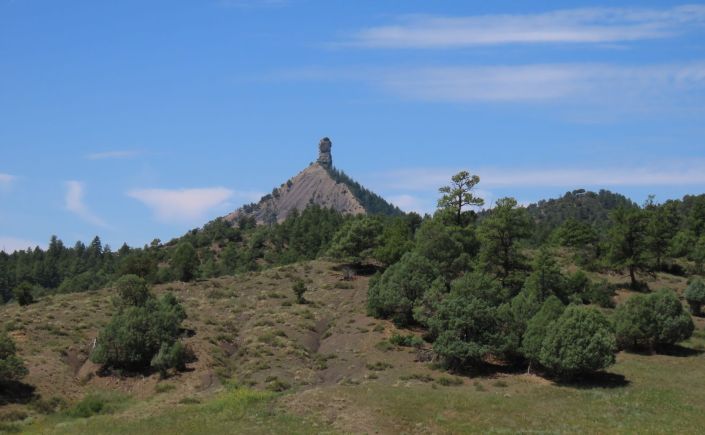
After traveling a short distance south from Colorado Highway 160 between Pagosa Springs and Durango, the aptly named landmark towering over the surrounding landscape let us know we were near.
We made the obligatory stop at the entrance to take a photo and read the park signs. Chimney Rock was declared a National Monument in 2012 (the country’s 103rd) and covers an area of 4,726 acres (1.913 hectares) inside the San Juan National Forest. Archeological evidence shows that Indigenous Peoples have been living in the region for at least 12,000 years, and between AD 925 and AD 1125, it was home to an estimated 2,000 Ancestral Puebloans (though not more than 250 people at any given point). Today, it is still considered of great significance for a number of Indigenous tribes and is surrounded by the Southern Ute Reservation.
To enlarge a photo in the gallery, click on it. To read its caption, hover cursor over it.


We checked in at a kiosk with my husband’s America the Beautiful Senior Lifetime National Parks Pass (available to American citizens 62 or older), studied the map, and started our self-guided tour at the Visitor Center and adjacent amphitheater. We watched the documentary offered by the National Park Service, a must for us, as most of these films are very informative and give a great overview.


Then we drove the short (2.5 to 3-miles) park road to its end. From the parking lot, we hiked the 1/3-mile Great House Trail past the eponymous Ancestral Puebloan structure. Chimney Rock and Companion Rock seemed to grow in size during our approach, dominating the landscape. These two pinnacles served as important markers to Ancestral astronomers who realized that every so many years, a celestial phenomenon was observable between the formations from the Great House (and possibly from other nearby structures).
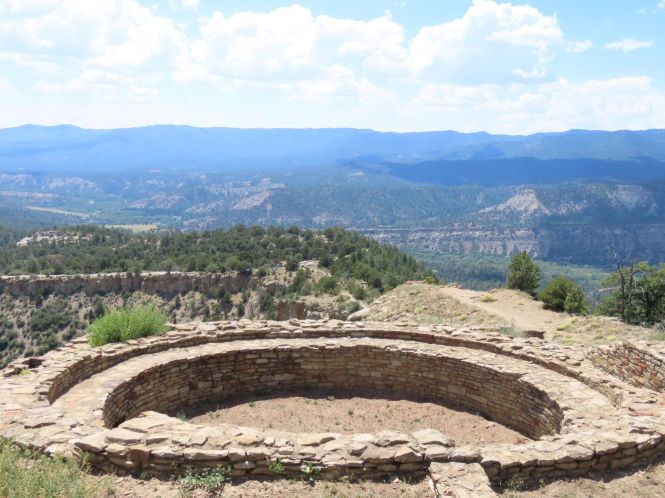
“The Chacoan style Great House is the most significant Ancestral Puebloan structure on the mesa, as well as an extraordinary engineering feat. It is one of 200 structures and 167 sites within Chimney Rock National Monument.”


From one of the park’s informational signs:
Chimney Rock is a recognized archaeoastronomy resource in Northern America that illustrates the Ancestral Puebloans’ knowledge and use of astronomy in their lives. Evidence suggests they may have adopted rituals based on celestial events such as solstices and equinoxes. An especially important astronomical event, the Northern Major Lunar Standstill, happens every 18.6 years when the moon rises between the two pinnacles as seen from the Great House.
If you had never heard of a Major Lunar Standstill, you are not alone. I won’t try to explain it, but here is a link to a Wikipedia article. According to the park’s website, the last Lunar Standstill happened in 2024 and 2025 and several viewing events were offered during those years (they did not coincide with the time of our visit). The next Northern lunar standstill will not happen again until 2044, and who knows where we will be by then.
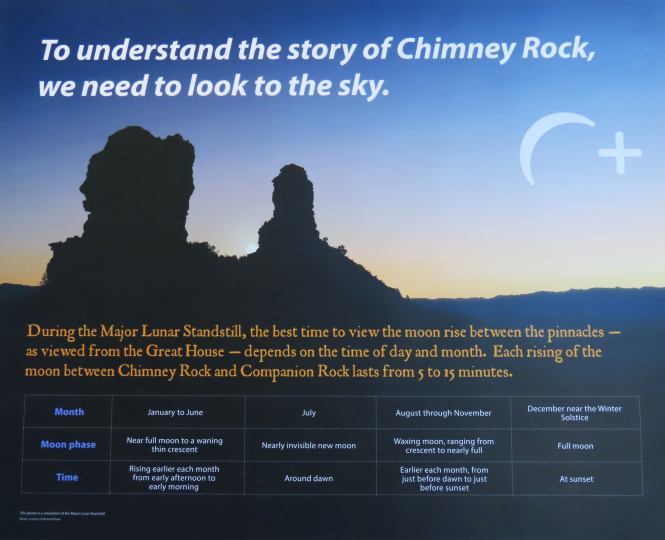
This table lists the best times to view the moon rise between the pinnacles during the Major Lunar Standstill
After returning to the parking lot, we walked the ¼-mile Upper Mesa Village Trail past surviving structures of pit houses, aboveground rooms, and the Great Kiva, at a diameter of 40 feet the area’s largest, reading informative signs along the way.
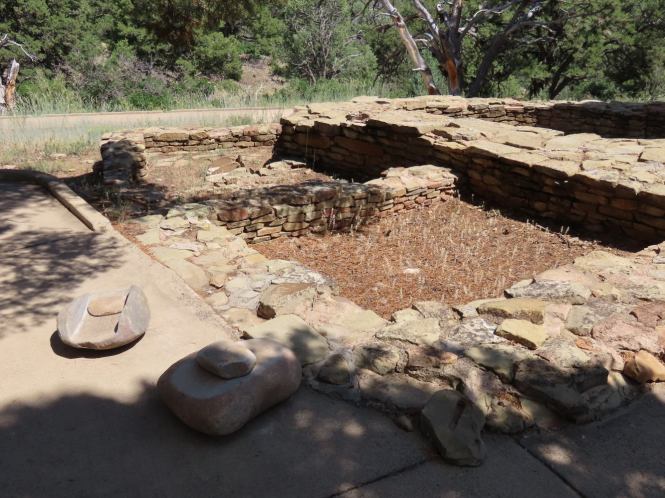
One of the structures along the Upper Mesa Trail, plus two manos and metates
One of them reminded us that, like many of the ancient communities sprinkled across the Colorado Plateau, the ones at Chimney Rock were part of a network centered in and around Chaco Canyon, 90-as-the-crow-flies miles away in present-day New Mexico. They shared intellectual, spiritual, and economic connections, and its crucial role was acknowledged when it was made a National Historical Park in 1907, and a World Heritage Site in 1987.
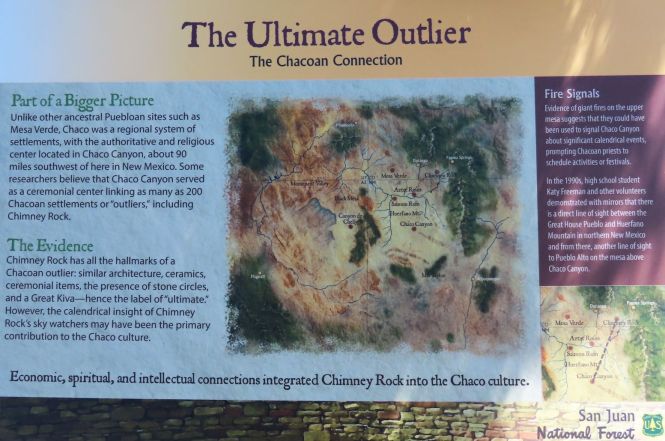
The Chacoan Connection. If you aren’t familiar with Chaco Canyon, click here to read my post.
As with visits to other Ancestral Puebloan sites, the mind was boggled by the stunning as well as challenging natural setting, and by the resourcefulness of the people who made their homes here, raised their families, observed the night sky, and dreamed their dreams.
To once again echo my husband’s deferential question whenever we experience the world of these ancient civilizations: Who were these Ancestral Puebloans?
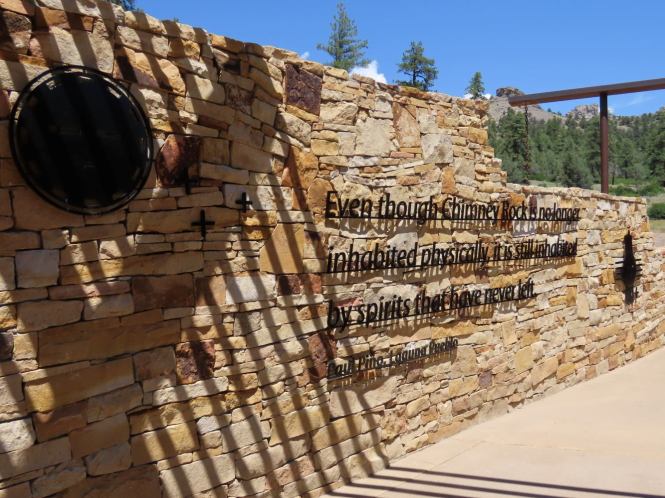
Ancestral Puebloan sites are sacred for modern-day Indigenous individuals who believe their ancestors still dwell here


I’ll definitely add this to my list to visit, Tanja! Looks so interesting – thank you for sharing.
LikeLiked by 1 person
I’m glad this piqued your interest, Dwight.
Thanks for stopping by!
LikeLike
Thank you for sharing this history with us. Your articles are written with such care and your beautiful images allow us a glimpse into a different world.
LikeLiked by 1 person
Thank you, dear Takami. I appreciate your kind sentiment very much!
LikeLiked by 1 person
Very well written and presented, Tanja. Thanks for sharing.
LikeLiked by 1 person
Much appreciated, Michael. Thank you!
LikeLiked by 1 person
You’re most welcome, Tanja.
LikeLike
There are several formations called Chimney Rock, including one in western Nebraska that you may well have visited.
LikeLiked by 1 person
In a similar spirit to the deferential question that closes your post, we can pose the one that François Villon asked over five centuries ago: “Mais où sont les neiges d’antan?”
LikeLiked by 1 person
I might need to ask my husband to compose a ballad out of his question!
LikeLike
If he does, can I claim 10% of the royalties for having started him down that road?
LikeLiked by 1 person
Don’t start counting your royalties yet!
LikeLike
It’s amazing how much is unknown about past human history. And about so many other subjects. Dark matter, for instance.
LikeLiked by 1 person
So true, Neil. There are likely more things we don’t know about than things we do. Yet we consider ourselves masters of the universe.
LikeLiked by 1 person
Wonderful to see you feature Chimney Rock and its archaeological features, Tanja. If readers are interested learning more about the site’s status as an astronomical observatory, they might seek out the Guide to Prehistoric Astronomy in the Southwest by J. McKim Malville. He was a professor at the University of Colorado who did significant research at Chimney Rock in the 1980s. https://bookshop.org/p/books/guide-to-prehistoric-astronomy-in-the-southwest-mckim-malville/7fd66f03065a00e2
LikeLiked by 1 person
Thank you for your comment, Andrea, and for the book suggestion. The cover looks familiar, I might have seen it in a bookstore, but have definitely not read it. Sounds fascinating!
LikeLike
Fine post, Tanja. It’s an amazing site!
LikeLiked by 1 person
Thank you, Eliza, we enjoyed our visit there very much.
The entire Southwest is filled with reminders of these ancient, intriguing civilizations.
LikeLiked by 1 person
Who indeed? And it’s a fine thing to wonder about other people and other cultures. What a magnificent place!
LikeLiked by 1 person
Thank you, Laurie. It’s definitely magnificent, in addition to being mysterious. To have had such elaborate societies one thousand years ago is quite remarkable.
LikeLiked by 1 person
Hi, there!
What a beautiful post, and such a fascinating National Monument.
During our summer road trip this year, we toured Mesa Verde National Park, which was a true gift! This National Monument reminded me of the park because of the similar landscape.
I wish that we could know more than we do about the people who once lived in these areas. I think that to time-travel back for one day to see what life truly looked like for them would reveal so much. I imagine it would especially show the advancement of humanity over the years!
Again, I really enjoyed your post, and I thank you for sharing it!
Blessings,
Gavin B.
LikeLiked by 1 person
Hi Gavin,
Thank you for your comment. I’m glad you enjoyed my post.
How exciting that you were able to visit Mesa Verde NP. It’s much larger than this National Monument but, as you observed, the landscape is similar, as both are located in southwestern Colorado.
If you would like to see my post about Mesa Verde, here is a link:
Ancestral Puebloans-Part 3: Mesa Verde – tanja britton
I agree that traveling back one thousand-plus years would be quite fascinating. But since we can’t, it’s intriguing to imagine what live would have been like for them.
Happy time-travel in our minds.
Tanja
LikeLiked by 1 person
Thanks for the tour through your post and wonderful photos.
LikeLiked by 1 person
Thank you for your interest and comment, Pepper.
LikeLiked by 1 person
My pleasure. 😊
LikeLiked by 1 person
Very interesting post, Tanja. There’s so much in the American Southwest. Incredible landforms and history. I’ve only been to Chaco, but would like to visit Mesa Verde and Chimney Rock–as well as others. Thanks for this informative post!
LikeLiked by 1 person
Thank you, Tina. I’m in complete agreement and enjoy visiting the Southwest whenever we can. Preferably not during the summer months! 🙂
LikeLike
My husband and I loved this place so much. Thanks for bringing back those memories! It actually sounds like we may have been here around the same time.
LikeLiked by 1 person
Thank you, Diana. I remember reading your excellent blog post about Chimney Rock. Just checked–you published it in July 2024 and in my comment, I mentioned looking forward to our visit 🙂
LikeLiked by 1 person
Looks like an amazing site. It always boggles my mind that we can stand somewhere amongst the remains of the lives that were lived so long ago!
LikeLiked by 1 person
Thank you, Ann. I feel the same way. If those walls and stones could talk . . .
LikeLiked by 1 person
I needed this today! The fact that the remains of the “Great House” still sit there stoic, in the face of every thing going on in the world today, gives me hope. I can only imagine how special it must have been for the Pueblo people who lived there, to see the moon rising between the two rock pinnacles. 😍
LikeLiked by 1 person
Thank you for your comment, Julie, though it also made me a little sad, because you sound sad. There is no need to explain as you know that I can relate!
I can also try to imagine what it must have felt like to watch the moon appear every so often between those rock formations. It gives me goosebumps just thinking about it. 🙂
LikeLiked by 1 person
Yes more goosebumps. That’s what we need right now!💫
LikeLiked by 1 person
But only the good kind, please!
LikeLiked by 1 person
😄
LikeLiked by 1 person
How wonderful that you were able to visit such a historical and quite mystical site! I especially enjoyed your photos. Although I’ve never traveled to the Four Corners area, I’m a Tony Hillerman fan, and your post helps me understand those stories even more.
I’ve been reading Professor Alice Roberts’ books on archeology, and I find it fascinating that recently we have learned quite a bit more about ancient cultures due to improvements in scientific research.
LikeLiked by 1 person
Thank you, Julie.
I, too, like Tony Hillerman’s stories. Never met him, but his daughter, Annr, once was the keynote speaker at a local literary event and we got to hear and see her. I have read a few of her novels and think she has done an amazing job taking her father’s stories and developing them with her own touches while honoring his ideas.
I’m not familiar with Alice Robert but after reading a short online bio, would like to learn more about her and her works! Thank you for mentioning her.
LikeLiked by 1 person
I’d never heard the term “Northern Major Lunar Standstill,” but my first thought was that it might be akin to the solstices. The word ‘solstice’ is derived from Latin solstitium: a combination of ‘sun’ (sol) and ‘a stoppage’ (stitium). According to some very old legends, both the sun and the earth ‘stop’ at the solstice, before both turn, and move, and begin their journeys again. I was at Stonehenge for the winter solstice one year; I’d love to be here for a lunar ‘standstill.’
LikeLiked by 1 person
That’s a good thought, but I have to admit that it hadn’t crossed my mind. But I just learned (or was reminded) that another name for a lunar standstill is lunistice!
https://en.wikipedia.org/wiki/Lunar_standstill
LikeLike
Adding even more future travel locations to my list. Thank you.
LikeLiked by 1 person
Thank you, Brad.
Travel lists, like reading list, never shrink, they only grow.
LikeLiked by 1 person
Very true. I keep buying books with the hope I’ll be around long enough to read all of them. Same with the travel lists, but am a bit more pragmatic on that: get the big trips done now while I’m “young” enough to enjoy them. Scale back to Lower 48 as I get (much) older.
LikeLiked by 1 person