My husband and I have a quirky habit: We save our old calendars and reuse them in years with matching dates. This saves us from having to buy new calendars each year, and from the old ones ending up in the landfill (or, ideally, getting recycled).
At times, special holidays don’t coincide but that’s not usually an issue, as we receive at least a couple of up-to-date calendars from organizations we support, so we can cross-reference. People have asked if we don’t get bored with looking at the same photos or reading the same information again but, most of the time, enough time has passed for us to have forgotten those details and each calendar is experienced as new. The more years pass, the truer this statement! 🙂
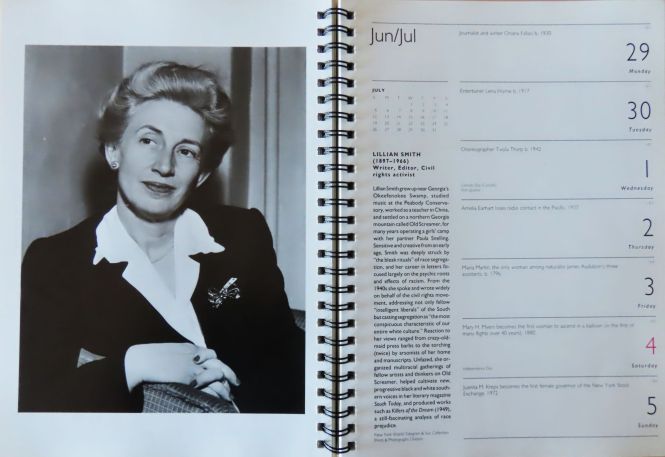
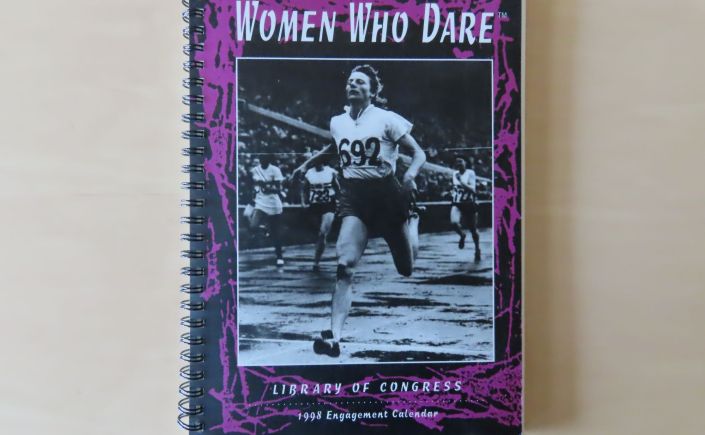
Case in point: The 1998 engagement calendar I have displayed on my desk in 2026, Women Who Dare, published by the Library of Congress. When I turned the page to Lillian Smith in late June, I had no memory of ever having heard of this intriguing individual. In case you have trouble reading the small print in the photo above, I have copied the lines:
Lillian Smith [1897-1966] grew up near Georgia’s Okefenokee Swamp, studied music at the Peabody Conservatory, worked as a teacher in China, and settled on a northern Georgia Mountain called Old Screamer, for many years operating a girls’ camp with her partner Paula Snelling. Sensitive and creative from an early age, Smith was deeply struck by “the bleak rituals” of race segregation, and her career in letters focused largely on the psychic roots and effects of racism. From the 1940s, she spoke and wrote widely on behalf of the civil rights movement, addressing not only fellow “intellectual liberals” of the South but casting segregation as “the most conspicuous characteristic of our entire white culture.” Reaction to her views ranged from crazy-old-maid press barbs to the torching (twice) by arsonists of her home and manuscripts. Unfazed, she organized multiracial gatherings of fellow artists and thinkers on Old Screamer, helped cultivate new, progressive black and white southern voices in her literary magazine South Today, and produced works such as Killers of the Dream (1949), a still-fascinating analysis of race prejudice.
Wow! This summary further piqued my interest and led me straight to my online search engine, and to more information about this woman’s remarkable life. I also came across a YouTube video titled Lillian Smith: Breaking the Silence. I spent the next 54 minutes learning more about her biography, her thinking and writing, and her courageous stance when it came to speaking out against racism and segregation in America. I highly recommend you also take the time to watch this film and think you won’t regret it.
The video includes an interview with the author that was broadcast on NBC’s Today Show in 1957 (it starts at 34 minutes and 13 seconds), with the following statement by her:
I think we have to a great extent lost our basic freedom to speak out what we think and what we believe, or to teach it. And I think that we have lost an even more important freedom and that is the freedom to do right, to listen to our own private conscience, instead of listening to the conscience of the demagogue, or the conscience of the mob, or the conscience of the hysterical cause.
Do you also get a sense of déjà-vu?
I might as well have published this post under the heading, Plus ça change, plus c’est la même chose! Like Katharine Lee Bates and like John Quincy Adams, Lillian Smith stood up and spoke out for what she believed in, looking critically at her country and finding it wanting, before asking it to live up to its ideals.
I have nothing but respect and admiration for her and am heartened by individuals like her who try to make this world a better place for everybody—they sustain my faith in humanity.
Lillian left this world on September 28, 1966, 80 years ago. What would she have to say about her country today?


Hello Tanja,
It’s interesting…I hold on to older calendars and re-use them too for the same reason😊 Thank you for introducing this documentary. I have saved it and will certainly watch it soon. I hope you are staying well.
LikeLiked by 1 person
What an inspiring lady. Like Takami, I have noted the YouTube piece, and will be sure to watch it soon. Yes, Lillian would have a lot to say about recent developments in the US…and in the UK too. We desperately need more people like her today.
LikeLike
Sehr interessant Tanja.
Und heute ist ihr Todestag.
Leider scheint der Homo sapiens nicht in der Lage zu sein dazuzulernen.
Ich wünsche dir einen guten Tag und schicke liebe Grüße
Brigitte
LikeLike
Greetings to you,
Thank you for sharing about the life of such an amazing person!
Like you, I do not recall ever hearing about Lillian Smith prior to this blog.
I also admire people who dedicate their lives trying to help make our world a better place as a whole.
By the way, I loved hearing of you neat routine to save and recycle calanders over the years! I thought that was very clever!
Thank you again for introducing me to Lillian Smith!
Blessings to you,
Gavin B.
LikeLike
Thanks for sharing the work of this forward thinker and activist. I hadn’t heard of her either!
LikeLike