
Out-of-town visitors to Colorado Springs often think of the present-day Hollywood actress when Helen Hunt’s name comes up during my tours as a volunteer docent at the Pioneers Museum. Both share a name and a relationship to California, but Helen Hunt the First (1830-1885) was a trailblazing woman and writer during our town’s infancy, in the latter half of the 19th century. Her initial impressions of Colorado Springs, however, were inauspicious:
I shall never forget my sudden sense of hopeless disappointment at the moment when I first looked on the town. There stretched before me, to the east, a bleak, bare, unrelieved desolate plain. There rose behind me, to the west, a dark range of mountains, snow-topped, rocky-walled, stern, cruel, relentless. Between lay the town-small, straight, new, treeless. One might die of such a place alone.
No chamber of commerce would advertise these words, but Colorado Springs did, eventually, pride itself of the person who expressed them and named the popular waterfalls in North Cheyenne Cañon for her.
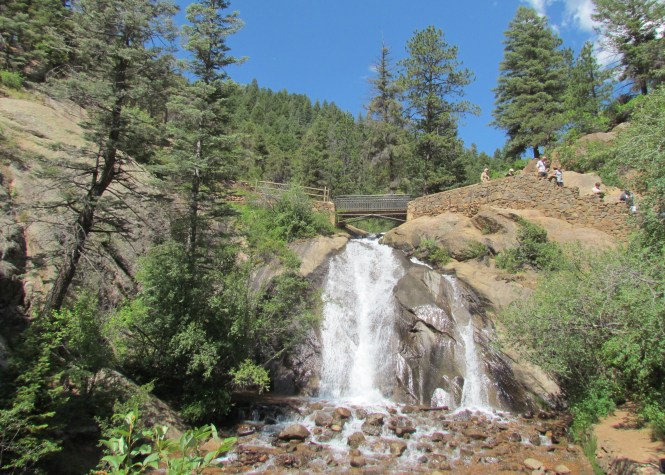
Helen Hunt Falls in North Cheyenne Cañon
Helen Hunt, née Fiske, was 43 years old in November 1873 when she suffered these somber sensations after a cross-country train journey across the flat, monochromatic Great Plains from her home in Massachusetts to Colorado. Knowing about her past life, they are understandable. Motherless since age 13, fatherless since 16, she had lost her 11-month-old son Murray at 23, her 42-year-old husband Edward B. Hunt when she was 32, and her 9-year-old son Warren at 34. Ill at heart and in body, she came here at the behest of her physician, who recommended a change of scenery for a chronic respiratory condition. Before the antibiotic era, Colorado, by virtue of its healthy climate, was among the premiere destinations for health seekers suffering from consumption. During a period of frequent misdiagnosis, Helen might have been afflicted by tuberculosis, but officially it was asthma.
Fortunately for the burgeoning community at the foot of Pikes Peak, founded only two years prior to her arrival, the dry air of the mountains did, indeed, benefit her health while their beauty lifted her spirits. Helen decided to stay, after a complete reversal of her earlier attitude. In an essay about her new home in the New York Independent in August 1874, less than a year after her arrival, she reflected, “To-day I say, one could almost live on such a place alone.” “Almost” because she continued to love and pursue travel.
While mourning in Massachusetts, Helen Hunt had started to compose and publish poetry. Once she voyaged abroad, travelogues ensued. Her circle of friends in New England included Ralph Waldo Emerson, Harriet Beecher Stowe, and Emily Dickinson. Helen encouraged Emily to publish her poems, but she only allowed a few to appear anonymously during her lifetime, with the bulk of her prolific rhymes being published posthumously. Once settled in Colorado, Helen added novelist to her résumé. She belonged to an elite group of women authors able to make a living from their craft.
Colorado Springs, designed on a drawing board and in an early state of growth, did not yet offer many accommodations. Helen resided at the Colorado Springs Hotel, the settlement’s first, where she met fellow boarder William Sharpless Jackson. He was secretary and treasurer of the Denver and Rio Grande Railroad which, like Colorado Springs, had been founded by General William Jackson Palmer. Helen and Mr. Jackson’s friendship led to marriage in 1875.
Four years later, a lecture by Ponca Chief Standing Bear altered the course of Helen’s few remaining years. She researched the mistreatment of Native Americans and became an outraged and outspoken activist on their behalf. In 1881, she distributed her critical treatise A Century of Dishonor to members of Congress. Though it remained largely unnoticed, it led to an assignment by Century Magazine to explore the situation of Native Americans living at former Spanish missions in Southern California. She subsequently managed to have herself appointed a special agent by the Commissioner for Indian Affairs and described the pitiable living conditions and prospects of Indigenous individuals. Her experiences also moved her to fictionalize their predicament. In a May 2, 1883, letter to the editor of the Atlantic Monthly she articulated her ambitions thus, “If I could write a story that would do for the Indians a thousandth part what Uncle Tom’s Cabin did for the Negro, I would be thankful for the rest of my life.”
In her novel Ramona, feverishly written in four months, and published in 1884, she conveyed her indignation. A tragedy about the ill-fated love between a Native American man and a Native-Scottish woman, raised as an orphan by a family of Spanish Mexican heritage, it delves into the racial prejudices and abuses suffered by Native people being forced to live at Catholic missions in the former Mexican territory of California which was ceded to the United States after the Mexican-American War (1846-1848).
While it has been difficult to quantify the extent of Helen Hunt’s influence on beneficial policy reforms for Native tribes, her novel Ramona became a literary bestseller. It has never been out of print since first being published in 1884, has been adapted for multiple film versions and, since 1923, has been performed annually as a drama at the Ramona Pageant in Hemet, California.
Sadly, Helen’s death soon followed the birth of her masterpiece. I sincerely hope that the sale of more than 15,000 copies in the 10 months between its publication and her passing was gratifying to her. True to her convictions till the end, from her deathbed in California she beseeched President Grover Cleveland to correct the wrongs inflicted on America’s Native peoples. On August 2, 1885, she succumbed to presumptive stomach cancer at only 54, with William by her side.
Helen loved Cheyenne Mountain in Colorado Springs so much that her husband had remodeled their house to enable her to see it from her chambers. Now he honored her wish and buried her in the mountain’s shadow, at Inspiration Point near Seven Falls, where her body rested under a growing mound of rocks, lovingly placed by the hands of her many fans.
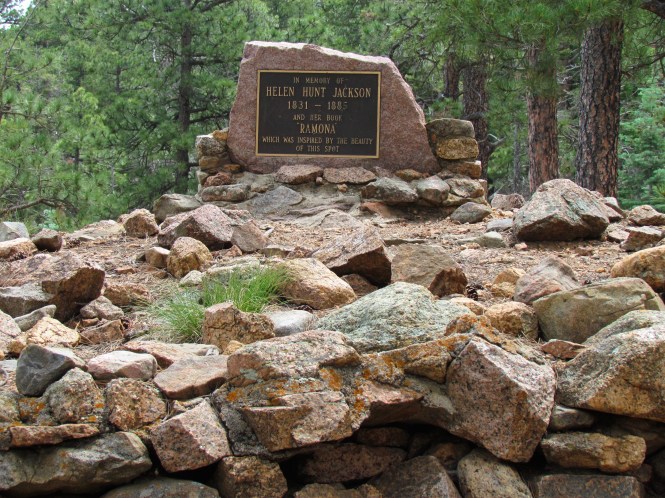
Helen Hunt’s former resting place near Inspiration Point (with the wrong year of birth)

View of modern-day Colorado Springs from Helen Hunt’s former resting place near Inspiration Point
Eventually, she was relocated to the Jackson family plot at Evergreen Cemetery. It is consoling for her acolytes to know that her grave is the one closest to, and with a direct view of the mountain she so cherished.

Helen Hunt’s resting place at Evergreen Cemetery, with a view of Cheyenne Mountain
When the city acquired the Jackson property in 1961 and the house was slated for demolition, the family donated portions of her domicile to the Colorado Springs Pioneers Museum, which showcases four of Helen’s original rooms and furnishings in a permanent exhibition.
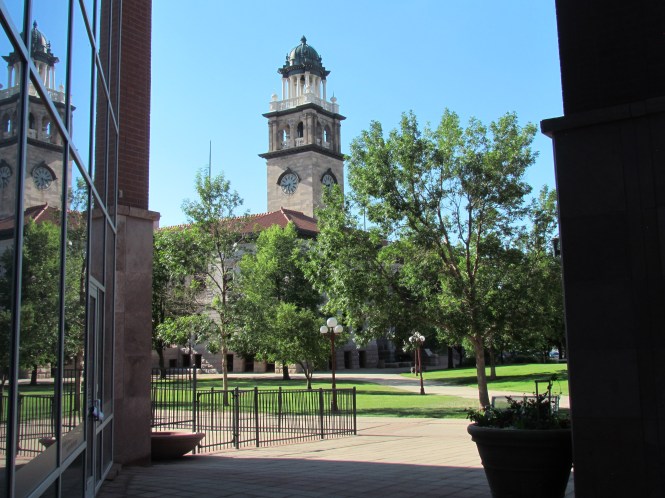
Colorado Springs Pioneers Museum
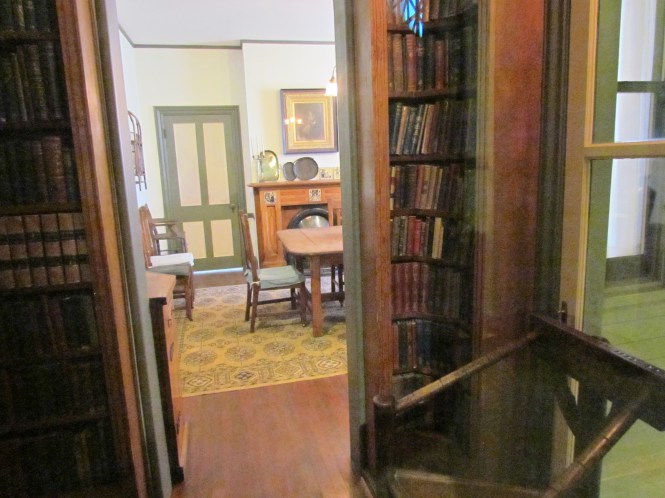
Portions of Helen Hunt’s dining room and library in the preserved rooms at the museum
Helen Hunt Jackson occupies a special place among the early citizens of Colorado Springs. Her indomitable spirit allowed her to overcome one blow of fate after another, and her activism for America’s Native tribes was unusual for a woman of her era and social standing. In our local historic universe, she shines as one of the brightest stars.
Click here for the German version/klicken Sie bitte hier für die deutsche Version:
https://tanjaschimmel.wordpress.com/2017/07/13/die-ursprungliche-helen-hunt/
PS: Helen Hunt’s portrait at the top of this post came from a photograph I took of a postcard issued by the Pikes Peak Library District. Photographer and date are unknown.


[…] Source: The Original Helen Hunt […]
LikeLike
Awesome interesting post. Thank You.
LikeLiked by 1 person
Thank you for reading, commenting, and for following my blog. I appreciate it.
Best,
Tanja
LikeLike
Thanks for calling me over to this, which coincidentally appeared just 11 days after my post. I’d read the Wikipedia article last year but your account reminded me of it and added details. I just checked and found that the Austin Public Library has a copy of Ramona, which I’ve ordered. Have you read it?
LikeLiked by 1 person
Thank your for taking the time to read my post, Steve.
I read Ramona a few years ago. It is, of course, not a happy tale, but once I got through the first couple of pages and allowed myself to slow down, I really liked the writing. If you do not mind a slower pace and being transported into a world that seems very distant from ours, I think you will enjoy it.
Let me know!
Best,
Tanja
LikeLike
I’m a slow reader so a slow pace is fine with me. I’m a third of the way through the novel now. I know things won’t turn out well, just as many don’t in real life.
LikeLiked by 1 person
Thank you for the update, Steve. Despite the tragic undercurrent, I still enjoyed the novel. I hope you do, too.
Best,
Tanja
LikeLike
Here’s the song: [https://www.youtube.com/watch?v=dlQw4xENV0k]
And here’s information about it:
https://en.wikipedia.org/wiki/Ramona_(song)
LikeLiked by 1 person
Thanks, Steve. A few years ago, our local history museum showed the silent movie version of Ramona with Dolores del Rio, with live accompaniment. It was an amazing experience, my first of that kind.
LikeLike
That must have been a great experience. I looked online a little while but didn’t find the 1928 film for sale anywhere. I may look again another time.
LikeLiked by 1 person
I thoroughly enjoyed it.
LikeLike
[…] and American Indian activist, Helen Hunt Jackson, whose life and achievements I have described in a previous post. Visitors tend to be fascinated when they learn that the structure visible in the background […]
LikeLike
[…] Among the region’s earliest health seekers, Helen Hunt came to Colorado Springs for its dry and sunny climate in 1873. A famous poet who had suffered a series of heartbreaking losses, she made Colorado Springs her home and married Mr. Sharpless Jackson. She became best-known for her scathing criticism of the genocide committed by the United States against its Indigenous populations and for her novel “Ramona.” I have delved into her remarkable life in a previous post: https://tanjabrittonwriter.com/2017/07/13/the-original-helen-hunt/. […]
LikeLike
Another remarkable 19th century American lady. I’d heard the name before, but didn’t know anything about her. I do now, thank you!
Thinking about it, when I did my university course on US history, I don’t think women were mentioned at all. It was like women didn’t even exist in America! That’s truly shameful, though perhaps not surprising given the way things were in the 1970s. I think my alma mater is now rather more enlightened…I certainly hope so!
LikeLiked by 1 person
Helen is definitely one of my favorite leading ladies in Colorado Springs history. I’m glad I could introduce her to you.
And I’m grateful that we are finally starting to acknowledge the amazing things women have done throughout the ages.
LikeLiked by 1 person
[…] Lieutenant Cramer, other Coloradans also spoke out against the offenders. Colorado Springs writer Helen Hunt Jackson, profoundly affected by a speech given by Ponca Chief Standing Bear, had become what we now call an […]
LikeLike